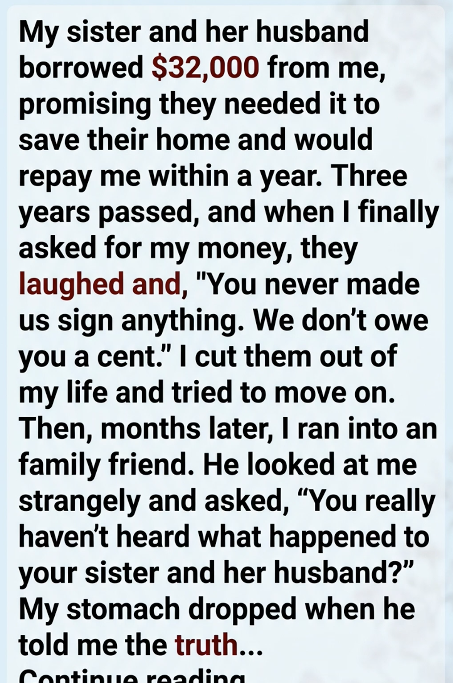
My sister and her husband borrowed **$32,000** from me.
They told me they were desperate.
Their home was about to be foreclosed.
They just needed enough money to catch up on the mortgage and keep their family from losing everything.
My sister cried when she asked.
“Please.”
“We’ll pay every dollar back within a year.”
I trusted her.
She was my sister.
So I transferred the money.
I didn’t make them sign anything.
I didn’t want to treat family like a business transaction.
That decision eventually came back to haunt me.
—
A year passed.
Then another.
Then another.
No repayment.
Every time I asked, there was another excuse.
“Things are tight.”
“The mortgage company is still sorting something out.”
“Next month.”
Eventually, after three years, I stopped being patient.
I called my sister.
“I need the money back.”
She laughed.
Then her husband joined the conversation.
“You never made us sign anything.”
I stared at my phone.
“What?”
He laughed again.
“We don’t owe you a cent.”
My sister said:
“You gave us that money.”
“Family helps family.”
I couldn’t believe what I was hearing.
“You promised to repay me.”
“Promises aren’t contracts,” her husband said.
—
That was the last conversation I ever had with them.
I stopped calling.
Stopped visiting.
Blocked their numbers.
I lost $32,000.
But somehow, losing my sister hurt more.
For months, I tried to move on.
I told myself the money was gone.
I told myself I’d learned a lesson.
Never lend family money without putting everything in writing.
Then one afternoon, I ran into an old family friend.
His name was Frank.
We hadn’t spoken in years.
We chatted for a few minutes.
Then his expression suddenly changed.
“Wait.”
“What?”
He stared at me.
“You really haven’t heard what happened to your sister and her husband?”
My stomach dropped.
“No.”
He looked shocked.
“Nobody told you?”
“Told me what?”
He lowered his voice.
**”They lost the house anyway.”**
—
I stared at him.
“What?”
“They didn’t use your money to save it.”
My heart began pounding.
“What did they do with it?”
Frank hesitated.
“Your sister’s husband was gambling.”
I felt sick.
“How do you know?”
“Because that’s what finally caused everything to collapse.”
He explained that the mortgage had never been the real problem.
They had been hiding enormous gambling debts.
The $32,000 I’d given them had been transferred into several betting accounts within weeks.
They never intended to use it to save the house.
They were trying to buy time.
—
I couldn’t speak.
Frank continued.
“After you stopped helping them, the bank foreclosed.”
“The house was sold.”
“And then things got much worse.”
I asked:
“How much did they owe?”
He shook his head.
“Far more than you knew.”
Then he gave me another detail.
They had been borrowing money from several relatives.
Not just me.
I wasn’t the only person they’d lied to.
—
I went home and searched through old messages.
Suddenly, certain conversations made sense.
My sister had asked about my savings.
Asked whether I had retirement money.
Asked whether I’d ever considered taking out a home-equity loan.
At the time, I thought she was worried about my future.
Now I realized she had been trying to figure out how much more she could get from me.
I felt betrayed all over again.
—
Then Frank told me something even stranger.
“There’s one reason I thought you needed to know.”
“What?”
“Your sister has been telling people that you stole money from her.”
I stared at him.
“What?”
“She says you promised to give her more and then backed out.”
I almost laughed.
“They took $32,000 from me.”
“I know.”
“Why would she say I stole from her?”
Frank sighed.
“Because their creditors started asking questions.”
“They needed someone else to blame.”
—
A few weeks later, I received a letter.
It wasn’t from my sister.
It was from an attorney.
The letter explained that my sister and her husband had entered bankruptcy proceedings.
Among the financial records was a list of personal loans and transfers.
My **$32,000** was clearly documented as a transfer from me to them.
But the record beside it was even more important.
It showed where the money went afterward.
Straight into gambling accounts.
The attorney said the bankruptcy trustee was reviewing the transfers.
I gave them copies of my bank records.
—
Then something unexpected happened.
The trustee contacted me.
He said there were grounds to believe my sister and her husband had intentionally misrepresented their financial condition when borrowing money from multiple family members.
The loans weren’t simply informal family help.
They were part of a larger pattern.
And because they had lied about how the funds would be used, the court was examining whether certain debts and transfers could be challenged.
—
Months later, my sister called me from an unknown number.
I almost didn’t answer.
When I did, she started crying.
“I’m sorry.”
I said nothing.
“I should never have done this.”
“No.”
“We were desperate.”
“You weren’t desperate.”
“You were gambling.”
She went quiet.
Then whispered:
“Yes.”
—
I asked the question that had bothered me for years.
“Did you ever intend to pay me back?”
She started crying harder.
“At first.”
“What changed?”
“My husband said we’d win the money back.”
I closed my eyes.
“So you gambled with my money.”
“Yes.”
“You lied to me.”
“Yes.”
“And then you told me I was the one who owed you?”
She couldn’t answer.
—
I told her:
“I forgive you for being my sister.”
“But I don’t trust you with my life.”
She started crying.
I didn’t feel victorious.
I didn’t feel satisfied.
I just felt tired.
Three years of waiting.
Three years of excuses.
And then the truth finally arrived from someone who wasn’t even part of the family.
—
The house was eventually sold.
My sister and her husband separated.
He entered a treatment program for his gambling problem.
My sister found work and moved into a small apartment.
The legal process recovered a portion of what they’d taken from different people, though not everything.
I recovered some of my $32,000.
More importantly, I recovered the truth.
—
My sister later sent me one final message.
She wrote:
*”You were the only person who trusted us when everyone else thought we were lying.”*
*”And we rewarded that trust by lying to you too.”*
I read it once.
Then put my phone down.
There wasn’t anything left to say.
—
I still wish I’d made them sign an agreement.
I still wish I’d asked more questions.
But I’ve stopped blaming myself for believing my sister.
Trust wasn’t my mistake.
Their decision to abuse that trust was theirs.
I thought I had lost $32,000.
What I actually lost was the version of my sister I believed existed.
And months after cutting her out of my life, when an old family friend looked at me and asked:
**”You really haven’t heard what happened to your sister and her husband?”**
I discovered the truth.
They hadn’t simply failed to repay me.
They had used the money to gamble.
They had lied to multiple family members.
They had lost the house anyway.
And when everything collapsed, they tried to make me the villain.
The cruelest part wasn’t that they couldn’t repay the $32,000.
It was that they knew exactly what they were doing when they took it.
And the sentence that finally gave me closure came from my sister herself:
**”You didn’t lose $32,000 when you trusted us.”**
**”We lost something worth far more when we decided your trust was something we could spend.”**