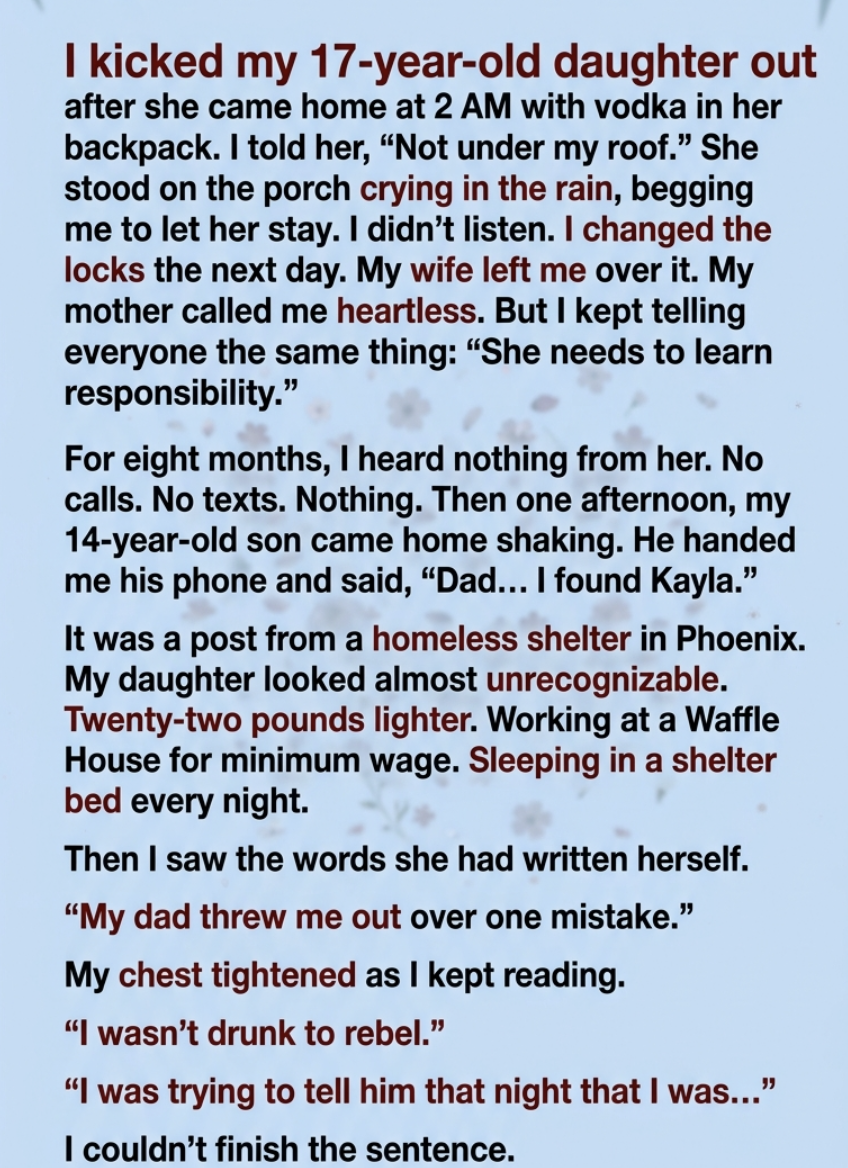
I kicked my seventeen-year-old daughter out after she came home at two in the morning with a bottle of vodka in her backpack.
I didn’t ask questions.
Didn’t listen to explanations.
Didn’t care about excuses.
I was furious.
“Not under my roof.”
Those were the words I used.
She stood on the porch crying in the rain.
Begging.
Pleading.
Promising.
I shut the door.
The next morning, I changed the locks.
My wife left me three days later.
Called me cruel.
My mother called me heartless.
My son stopped talking to me unless he had to.
But I kept repeating the same sentence.
“She needs to learn responsibility.”
For eight months, I heard nothing from my daughter.
No calls.
No texts.
No birthday card.
Nothing.
Part of me convinced myself she was fine.
Another part refused to think about it.
Then one afternoon, my fourteen-year-old son came home shaking.
He handed me his phone.
“Dad… I found Kayla.”
My stomach dropped.
On the screen was a social media post from a homeless shelter in Phoenix.
There she was.
My daughter.
Twenty-two pounds lighter.
Dark circles under her eyes.
Wearing a Waffle House uniform.
The shelter was highlighting success stories.
People trying to rebuild their lives.
Then I saw her words.
“My dad threw me out over one mistake.”
I felt sick.
I kept reading.
“I wasn’t drunk to rebel.”
My hands trembled.
“I was trying to tell him that night that I was pregnant.”
The phone slipped from my hand.
The room spun.
Pregnant.
I sat down hard.
Unable to breathe.
My son was crying.
“Dad… she tried to tell you.”
The memories came flooding back.
That night.
The way she’d kept saying:
“Please just listen.”
The way she’d followed me through the house.
The way she’d cried harder every time I cut her off.
I never gave her the chance.
Not once.
I called the shelter immediately.
No answer.
Then I called again.
And again.
Finally a woman answered.
When I explained who I was, there was a long silence.
Then she said something I’ll never forget.
“Your daughter talks about you every day.”
That hurt more than anger ever could.
“Can I speak with her?”
Another silence.
Then:
“She’s at work.”
I drove to Phoenix the next morning.
Nine hours.
No stops except gas.
The entire drive I rehearsed apologies.
None of them sounded big enough.
When I arrived at the Waffle House, I almost didn’t recognize her.
She looked older.
Tired.
Stronger.
She was carrying three plates when she looked up.
The moment she saw me, she froze.
Neither of us moved.
Finally, she whispered:
“Dad?”
I started crying immediately.
Right there in the middle of the restaurant.
“I am so sorry.”
She stared at me.
Expressionless.
Then she quietly told a coworker she needed a break.
We sat outside.
For nearly an hour.
Mostly in silence.
Then she told me everything.
The vodka wasn’t hers.
It belonged to the father of the baby.
He’d given it to her that night after telling her he wanted nothing to do with the pregnancy.
She’d been terrified.
Confused.
Seventeen.
And desperately trying to tell me.
Instead, I’d thrown her away before hearing a single word.
Then came the question I dreaded.
“What happened to the baby?”
Tears filled her eyes.
She looked away.
And shook her head.
She’d miscarried two months after leaving home.
Alone.
In a free clinic.
With nobody beside her.
Nobody.
Not her mother.
Not me.
Nobody.
I don’t think I’ve ever hated myself more than I did in that moment.
Then she told me something that shattered me completely.
“When it happened, I almost called you.”
My chest tightened.
“But I knew you wouldn’t answer.”
There was no defense.
No explanation.
No excuse.
Because she was right.
Over the next several months, I stayed in Phoenix.
Not because she asked me to.
Because I needed to earn the right to be her father again.
I helped her find an apartment.
Finish school.
Apply for college.
Some days she spoke to me.
Some days she didn’t.
And I accepted it.
Trust returns slowly.
Especially after betrayal.
One evening, nearly a year later, she invited me to dinner.
Just the two of us.
Halfway through the meal, she reached into her purse.
Pulled out a folded piece of paper.
It was the ultrasound photo.
The one she’d been carrying the night I threw her out.
The one she had been trying to show me.
I stared at it through tears.
Then she placed her hand over mine.
And said:
“You can’t change what happened.”
I nodded.
Unable to speak.
Then she smiled softly.
“But you showed up.”
Those three words saved me.
Not because I deserved forgiveness.
Because she chose to give it anyway.
Today Kayla is twenty-four.
She’s a social worker.
She helps homeless teenagers.
Kids who have nowhere else to go.
Kids who remind her of herself.
A photograph sits on her desk.
It’s not of her graduation.
Or her first apartment.
It’s that old ultrasound picture.
Framed.
A reminder.
Not of what she lost.
But of what she survived.
As for me, I keep a copy too.
Because every morning it reminds me of a lesson I learned far too late.
Sometimes the biggest mistake a parent can make isn’t being too soft.
It’s deciding they’ve already heard the whole story before listening to a single word.