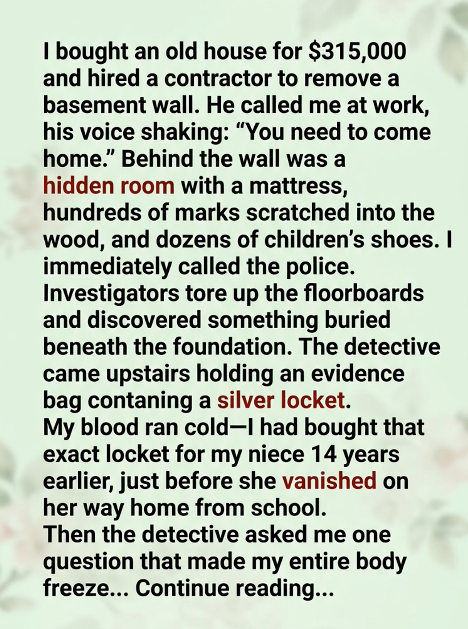
I bought an old house for $315,000.
The place needed work, especially the basement.
The previous owners had covered one wall with thick paneling, and the inspection report noted nothing unusual.
So I hired a contractor to remove it.
Two days later, while I was at work, my phone rang.
It was the contractor.
His voice was shaking.
“You need to come home.”
I asked what happened.
He wouldn’t explain.
“Just come.”
I drove home immediately.
When I reached the house, several workers were standing outside.
Nobody was talking.
My contractor led me downstairs.
The wall was gone.
Behind it was a narrow doorway.
A hidden room.
I stepped inside.
There was a mattress on the floor.
A rusted metal bucket.
Hundreds of small marks scratched into the wooden wall.
And dozens of children’s shoes arranged along one side.
My stomach turned.
I immediately called the police.
Within an hour, the basement was filled with investigators.
They photographed everything.
Measured the room.
Collected fibers and fingerprints.
Then one detective noticed that part of the floor looked different.
They removed the boards.
Then more.
Eventually, they began digging beneath the foundation.
I stood upstairs, trying not to think about what they might find.
Then the detective came toward me.
He was holding an evidence bag.
Inside was a silver locket.
My blood ran cold.
I knew that locket.
I’d bought it myself.
Fourteen years earlier.
I’d given it to my niece, Emily, for her birthday.
She wore it almost every day.
Three months later, she disappeared on her way home from school.
She was never found.
I stared at the evidence bag.
“That’s hers.”
The detective looked at me.
“Are you certain?”
I nodded.
“I bought it for her.”
He became very serious.
Then asked me one question that made my entire body freeze:
“Did your niece ever tell you who she was afraid of?”
I couldn’t answer.
Emily had been 14 when she disappeared.
She was bright.
Quiet.
And always kept her emotions to herself.
After she vanished, we searched everywhere.
Her backpack was found near a bus stop.
Her phone was discovered several days later.
But there had never been a body.
No confirmed suspect.
No explanation.
I looked at the detective.
“Why are you asking me that?”
He showed me a photograph.
It was a close-up of one of the scratches on the wall.
It wasn’t a random mark.
It was a name.
EMILY.
Beneath it were dozens of vertical lines.
Fourteen groups.
I counted them.
My hands started shaking.
The detective explained that the marks appeared to record dates or days.
The hidden room hadn’t been recently built.
Forensic testing suggested it had existed for decades.
The children’s shoes were from different years.
Different sizes.
Different brands.
The investigators believed multiple children had been inside.
Then they found something else.
A school notebook.
Most of the pages were missing.
But one page remained.
A child’s handwriting filled it.
At the bottom was a sentence:
“She said nobody would come looking.”
I felt sick.
“Who is she?”
The detective didn’t answer.
He asked:
“Did Emily have an older friend or relative who owned this property?”
I shook my head.
“Not that I know of.”
The investigators searched the property history.
The house had changed owners several times.
But one name kept appearing in old records.
A man named Gerald Price.
He had owned the house years before.
I recognized the name.
He had been a volunteer at the community center near the school Emily attended.
I’d seen him before.
Everyone knew him as a quiet, helpful older man.
He had helped coach children’s activities.
He had even attended the search effort after Emily disappeared.
I suddenly felt cold.
The detective showed me another piece of evidence.
A photograph taken in the house decades earlier.
Gerald was standing near the basement door.
In the background was a teenage girl.
I stared at the photograph.
The girl was Emily.
My heart stopped.
“That’s her.”
The detective nodded.
“We believe she had been inside this house before she disappeared.”
I couldn’t speak.
Then he showed me something else.
The silver locket wasn’t found randomly.
It had been buried beneath the concrete floor.
It was wrapped in a piece of blue fabric.
I recognized the fabric too.
It came from the sweater Emily had been wearing the day she disappeared.
I asked:
“Is she dead?”
The detective didn’t answer.
Instead, he asked:
“Did Emily ever mention a place called the old orchard?”
I shook my head.
Then remembered something.
A few weeks before she disappeared, Emily had asked me:
“Aunt Claire, do you believe people can hide somewhere and nobody find them?”
I’d laughed.
I thought she was talking about a game.
Now I remembered the exact words.
She’d looked terrified.
Investigators searched the old orchard.
They found another structure.
A small abandoned shed.
Inside were more photographs.
Several showed children.
One included Emily.
She was sitting on the same mattress that had been found in my basement.
I nearly collapsed.
But there was something stranger.
The photograph had been taken after the date Emily was reported missing.
The detective stared at it.
“We need to verify the timestamp.”
My heart was pounding.
If the photograph was authentic, Emily had been alive after the disappearance.
The investigation expanded rapidly.
Police searched Gerald Price’s former properties.
They found boxes containing old identification documents, photographs, and handwritten notes.
The evidence suggested he’d been involved in a long-running network that targeted vulnerable children.
But there was still no proof that Emily had died.
Instead, investigators found evidence that she may have been moved from one location to another.
My niece might have survived.
For fourteen years, we had been searching for a grave.
We should have been searching for a person.
Then came the breakthrough.
A woman living in another state contacted investigators after seeing the news.
She had been placed with a foster family as a child.
She recognized the photograph of the basement.
She remembered the room.
And she remembered a teenage girl named Emily.
She told detectives Emily had helped younger children stay calm.
She said Emily constantly told them:
“Someone will come for us.”
I started crying.
That sounded exactly like her.
The woman gave investigators one final clue.
She remembered that Emily had a silver locket.
Inside it, apparently, was a tiny photograph.
I told the detective that was true.
But he looked confused.
“Did you ever see what was inside?”
I shook my head.
“No.”
The detective carefully examined the locket.
Then opened it.
Inside was a tiny photograph.
Not of Emily.
It was a photograph of me.
My blood ran cold.
On the back was a handwritten message:
“If anything happens to me, find Aunt Claire.”
I couldn’t breathe.
Emily had planned for someone to find it.
She had somehow believed that even if she disappeared, the locket could eventually lead someone to me.
The detective asked:
“Did you know she was trying to tell you something?”
I shook my head.
“No.”
Then I started crying.
“I thought she was just a child.”
The detective gently answered:
“She was.”
“She shouldn’t have had to know how to protect herself.”
The investigation eventually identified several people connected to the properties.
Some had already died.
Others were arrested.
The evidence from the hidden room helped connect multiple missing-person cases.
The house I’d bought for $315,000 became a critical crime scene.
The concrete floor had concealed evidence for years.
And the silver locket became the clue that connected everything to Emily.
But there was still one question.
Where was she?
Months later, detectives traced a woman living under another name.
Her age matched Emily’s.
The records were incomplete.
DNA testing was arranged.
The result was conclusive.
She was my niece.
Alive.
She had been living under an assumed identity for years after escaping from the people who had held her.
I couldn’t believe it.
Fourteen years after she disappeared, Emily was finally coming home.
When I saw her, I almost didn’t recognize her.
She was an adult now.
Thirty.
Older than the girl I’d last hugged.
But her eyes were the same.
She looked at me.
Then started crying.
I said:
“I found your locket.”
She smiled through her tears.
“I knew you would.”
I hugged her.
And for the first time in fourteen years, I finally held my niece again.
Later, she told me why she’d hidden the photograph inside the locket.
She knew she might not escape.
She wanted someone to remember that she had a family.
She wanted me to be found.
She had scratched names into the wall because she didn’t want the children inside to disappear without leaving evidence.
The marks weren’t a count of days.
They were records.
Names.
Dates.
A desperate attempt to leave a trail.
I returned to the house after the investigation ended.
The basement had been sealed.
The hidden room was empty.
The mattress was gone.
The children’s shoes were taken into evidence.
But one thing remained.
A faint mark on the wooden wall.
Emily’s name.
I touched it.
Fourteen years ago, I thought I’d lost her forever.
Now I knew she had spent those years trying to survive.
And somehow, she had never stopped believing someone would come.
I still think about the day my contractor called me.
“You need to come home.”
I arrived expecting a renovation problem.
Instead, I found a hidden room.
A mattress.
Children’s shoes.
Hundreds of scratches.
And beneath the foundation, a silver locket I’d given my niece fourteen years earlier.
Then the detective asked me:
“Did your niece ever tell you who she was afraid of?”
At the time, I didn’t understand why he asked.
Now I know.
Emily had been trying to warn us long before she disappeared.
We simply didn’t understand the warning.
And the locket she’d worn as a teenager became the one piece of evidence that finally brought her home.
She’d hidden my photograph inside it.
Because even when she had almost nothing left…
she wanted one thing to survive with her: the knowledge that someone was still looking for her.