I had been dating a wonderful man for nearly three years.
His name was Daniel.
He was kind.
Successful.
Patient.
And, as far as I knew, completely honest.
A year into our relationship, he told me his previous marriage had ended badly.
“Divorced years ago,” he said.
I didn’t ask many questions.
By then, I trusted him.
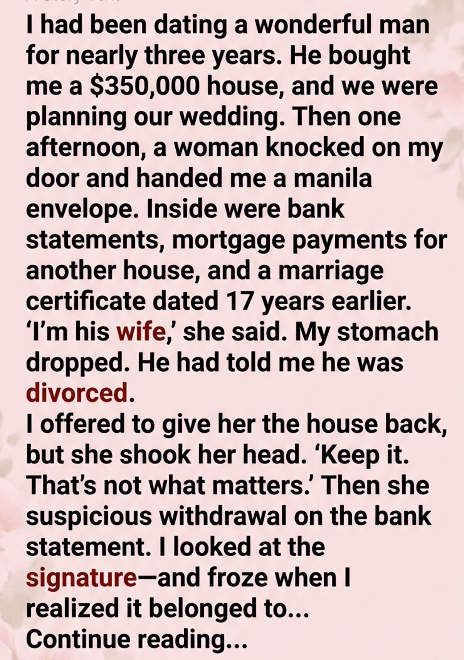
Eventually, he bought me a beautiful $350,000 house.
He told me it was part of our future together.
We were planning our wedding.
I thought I’d finally found the person I’d spend the rest of my life with.
Then one afternoon, a woman knocked on my door.
She was holding a manila envelope.
“Are you Daniel’s fiancée?”
I froze.
“Yes.”
She took a breath.
“I’m sorry.”
Then she handed me the envelope.
Inside were bank statements.
Mortgage payments for another house.
And a marriage certificate dated 17 years earlier.
My stomach dropped.
I looked at her.
“Who are you?”
She answered quietly:
“I’m his wife.”
I could barely breathe.
“His wife?”
She nodded.
“He told me he was divorced.”
“He isn’t.”
I looked through the papers.
There were mortgage payments.
Joint accounts.
Insurance documents.
And financial records showing that Daniel had been maintaining another household.
For years.
I felt sick.
“How long have you known about me?”
She shook her head.
“I didn’t know until recently.”
“Then why are you here?”
She looked at the house.
“He bought this for you?”
I nodded.
She sighed.
“Keep it.”
I stared at her.
“What?”
“Keep the house.”
I shook my head.
“I’ll give it back.”
She stepped closer.
“That’s not what matters.”
Then she pointed to one line on a bank statement.
“Look at that withdrawal.”
I did.
My heart stopped.
Because the signature belonged to someone I knew.
Someone I had trusted completely.
It was my…
father.
I couldn’t speak.
My father had been dead for six years.
I stared at the signature.
It was unmistakable.
His unusual slanted handwriting.
The loop in the final letter.
The tiny mark he always made beneath his name.
I looked at Daniel’s wife.
“Why does my father’s signature appear on this account?”
She shook her head.
“That’s exactly what I came here to ask you.”
I called my father’s old attorney.
He agreed to review the document.
Within minutes, he told me something that made my blood run cold.
My father had never been a joint account holder on any account belonging to Daniel.
But the signature was not merely similar.
It matched the signature on an old power-of-attorney document.
I stared at him.
“What does that mean?”
“It means someone may have copied your father’s signature.”
“Why?”
He asked:
“Did your father know Daniel?”
I shook my head.
“Not that I remember.”
Then I remembered something.
About ten years earlier, Dad had warned me about a man he’d met through a business transaction.
He never gave me the man’s name.
He only said:
“Some people don’t steal money first. They steal trust.”
I had forgotten.
The attorney requested the rest of the financial records.
We found more suspicious withdrawals.
Several were made using variations of my father’s signature.
Some transfers went into accounts connected to Daniel.
Others went toward the mortgage on the house where Daniel’s wife lived.
I looked at her.
“Your mortgage was being paid with money from my family?”
She nodded.
“I had no idea.”
Then she said:
“Neither did Daniel’s wife know.”
I stared at her.
“Wait.”
“You said you’re his wife.”
She nodded.
“But there are two houses.”
“Two households.”
“How?”
She gave me a sad smile.
“Because Daniel had been living two lives.”
The truth began unraveling quickly.
Daniel had not simply lied about being divorced.
He had maintained a second household under another identity.
He had created multiple financial accounts.
And somewhere along the way, he had obtained information about my family’s finances.
My father had apparently done business with one of Daniel’s companies years earlier.
That was likely how Daniel learned about him.
Then he’d used old records to reproduce my father’s signature.
I confronted Daniel.
He arrived at the house that evening.
At first, he denied everything.
“She’s lying.”
I placed the marriage certificate on the table.
“Are you married?”
He went silent.
“Yes.”
“You lied to me.”
“I was going to tell you.”
“When?”
“After the wedding.”
I laughed bitterly.
“You were going to marry me before telling me you already had a wife?”
He looked down.
Then I placed the bank statements in front of him.
“Why is my father’s signature on these?”
His face changed.
I knew immediately.
He had been caught.
He finally admitted he’d used my father’s identity on several financial documents.
But he insisted he hadn’t stolen directly from my father.
He claimed the accounts had been part of a business arrangement.
I didn’t believe him.
Neither did the attorneys.
The signature had been forged.
The transactions were unauthorized.
And the money eventually flowed into accounts controlled by him.
Then Daniel’s wife revealed something I’d never expected.
She had been investigating him for months.
She had discovered the second house.
Then another account.
Then the marriage certificate.
But there was one thing she couldn’t explain:
Why had Daniel bought me a $350,000 house?
She believed at first that it was simply another gift to keep me from asking questions.
Then she discovered the mortgage documents.
The down payment had come from a company account connected to one of the suspicious transfers.
My house hadn’t been a romantic gift.
It had been purchased with money he couldn’t clearly explain.
I felt numb.
The house I had thought represented our future now represented something else.
Evidence.
I told the attorney I wanted nothing to do with it.
But he stopped me.
“Don’t give it back.”
“Why?”
“Because if the purchase was made with fraudulent funds, transferring the property could complicate the investigation.”
So I stayed.
Not because I wanted Daniel’s house.
Because the house was now part of the evidence.
The investigation uncovered a much larger scheme.
Daniel had been moving money between businesses and personal accounts for years.
Some transactions involved forged signatures.
Others involved misleading financial disclosures.
His first wife had unknowingly been tied to some of the debts.
I had unknowingly been brought into the scheme through the house.
And my father’s identity had apparently been used because Daniel believed those old records would never be questioned.
He was wrong.
The most painful discovery came later.
My father had actually suspected something years ago.
He had written a note in an old business file.
It said:
“Do not trust Daniel with anything involving our family.”
I stared at the note.
Dad had known.
But he’d never told me why.
Perhaps he had tried.
Perhaps he had planned to explain.
He died before he could.
Daniel was eventually charged in connection with the financial crimes.
The two women in his life were left to untangle the damage he’d caused.
His wife and I met several times during the investigation.
We weren’t friends.
Not exactly.
But we understood something about each other that nobody else could.
We had both trusted the same man.
And both been deceived.
One day, she asked me:
“Are you going to keep the house?”
I shook my head.
“No.”
“Why?”
“Because it was never really a gift.”
She nodded.
“What will you do with it?”
“Whatever the court says.”
She smiled sadly.
“Good.”
Then she said:
“At least neither of us let him keep the last word.”
Eventually, the property was sold as part of the legal resolution.
Some recovered funds were distributed according to the court’s decisions.
I didn’t become wealthy.
I didn’t want to.
I simply wanted my life back.
I changed my locks.
My accounts.
My routines.
And, most importantly, my understanding of what trust means.
The woman who came to my door had first offered me an explanation.
Then she showed me the document that changed everything.
A suspicious bank withdrawal.
A copied signature.
My father’s name.
The father who had been dead for six years.
That discovery exposed a much larger truth.
Daniel hadn’t merely lied about being divorced.
He had been using identities and financial records to construct a life where nobody could easily see the whole picture.
I still think about the day she handed me that manila envelope.
She told me:
“Keep the house. That’s not what matters.”
At first, I didn’t understand.
Now I do.
The house was just the visible piece.
The real betrayal was much deeper.
He had lied about his marriage.
He had deceived both of us.
He had used financial records he had no right to use.
And worst of all, he had dragged my dead father’s name into the deception.
That was the moment I stopped grieving the future I thought I’d have with Daniel.
Because there was never a future with the man I believed I knew.
There was only a carefully constructed story.
And one forged signature finally tore it apart.
The woman who stood on my porch had come to expose my fiancé.
Instead, she helped me uncover the truth about my family too.
And when I finally understood why she’d said,
“Keep the house. That’s not what matters,”
I realized she was right.
The $350,000 house could be sold.
The money could be replaced.
But trust?
Once someone forges the name of your dead father to build a life with you…
that’s something no amount of money can ever restore.