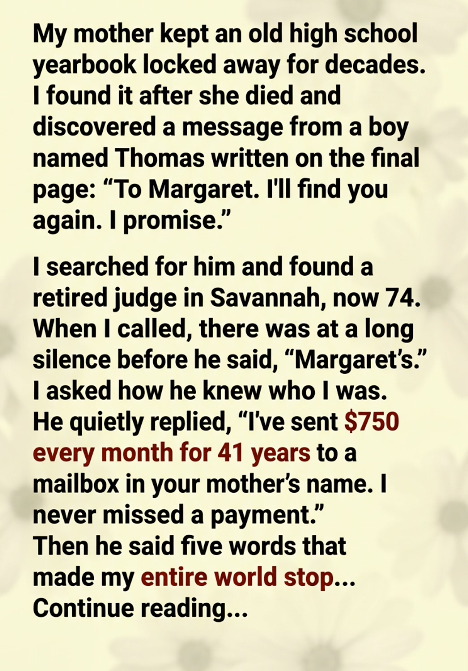
My mother kept an old high school yearbook locked away for decades.
I found it after she died.
It was tucked inside a wooden trunk beneath stacks of old photographs and letters.
I almost put it away without opening it.
Then I noticed something handwritten on the final page.
It was from a boy named Thomas.
The message said:
“To Margaret. I’ll find you again. I promise.”
I stared at those words for a long time.
My mother’s name was Margaret.
But I’d never heard her mention Thomas.
Not once.
So I searched for him.
After weeks of digging through old school records and newspaper archives, I finally found a Thomas who seemed to match.
He was now a 74-year-old retired judge living in Savannah.
I stared at his phone number for several minutes before calling.
He answered on the fourth ring.
“Hello?”
I said:
“Is this Thomas?”
“Yes.”
“My name is…”
I gave him my name.
There was a long silence.
Then he quietly said:
“Margaret’s daughter.”
My heart stopped.
I hadn’t told him my mother’s name.
“How did you know who I was?”
He took a slow breath.
Then answered:
“I’ve sent $750 every month for 41 years to a mailbox in your mother’s name.”
I couldn’t speak.
“I never missed a payment.”
My hands began shaking.
“Why?”
He was silent again.
Then he said five words that made my entire world stop:
“Your mother wasn’t raising you alone.”
I froze.
“What do you mean?”
He whispered:
“I am your father.”
I couldn’t breathe.
“No.”
“Yes.”
“My father died when I was six.”
Thomas sighed.
“The man you called your father was the man who raised you.”
“But I’m not his biological father.”
I sat down.
Everything I’d ever believed about my childhood suddenly felt uncertain.
Thomas continued:
“Your mother and I were teenagers.”
“We were in love.”
“She became pregnant.”
“We were going to get married.”
“Then my father found out.”
He had come from a wealthy and influential family.
His father wanted him to attend college, become a lawyer, and build a respectable life.
Margaret’s family was struggling.
His father considered the relationship unacceptable.
So he intervened.
Thomas was sent away before I was born.
Margaret was pressured to marry the man I knew as my father.
Thomas was told that the pregnancy had been handled.
He believed I had been given up for adoption.
For years, he searched.
Eventually, he found Margaret.
But by then, she was already married.
She had a family.
And she begged him not to interfere.
“Why?”
“She was afraid.”
“Of what?”
“Of losing you.”
I asked:
“Then why did you send money?”
He explained that Margaret eventually agreed to let him help financially, but only under one condition.
He could never contact me directly.
He could never tell me who he was.
He could only send money through a private mailbox.
Every month.
For 41 years.
I stared at the phone.
“How much?”
“$750.”
“Every month?”
“Every month.”
“Why?”
He answered:
“Because I missed everything else.”
He had kept every payment receipt.
Every returned envelope.
Every letter he wrote but never mailed.
And every birthday card he’d prepared for me.
He had even kept photographs of me growing up.
I asked:
“Where did you get those?”
“Your mother.”
“She sent them?”
“Some.”
“Others came from people who knew your family.”
My stomach tightened.
“Did you see me?”
“Sometimes.”
“Where?”
“From a distance.”
He told me he had attended my high school graduation.
He had watched from the back of the auditorium.
He had been at the courthouse when I got my first professional license.
He had even seen me marry.
I began crying.
“You were there?”
“Yes.”
“Why didn’t you come to me?”
“Because I promised your mother.”
I was furious.
“For 41 years?”
He said quietly:
“Promises can become prisons.”
I asked about the yearbook.
“Why did you write that?”
He laughed softly.
“Because I knew I was leaving.”
He had written:
“I’ll find you again. I promise.”
He had believed he’d return within a year.
But his father threatened to cut him off financially.
Then Margaret married.
Then I was born.
By the time Thomas had enough freedom to search openly, he had convinced himself that contacting us would only destroy the life Margaret had built.
So instead, he sent money.
Then I asked the question that had haunted me my whole life.
“Did my mother love you?”
There was a long silence.
Then:
“Yes.”
“Did she love the man who raised me?”
Another silence.
“Yes.”
I didn’t understand.
Thomas explained:
“Love isn’t always one person.”
“Sometimes it’s a life.”
“Sometimes it’s a promise.”
“Sometimes it’s both.”
Then he told me something I’d never known about my childhood.
The man I called Dad had known Thomas existed.
He knew I was probably Thomas’s biological daughter.
But he had chosen to raise me anyway.
Thomas said:
“Your father was a good man.”
I corrected him.
“You mean the man who raised me.”
He replied:
“No.”
“I mean your father.”
I started crying.
Apparently, when I was six, the man who raised me had suffered a serious illness.
Before he died, he asked Margaret to make sure I never learned the truth until I was old enough to understand it.
He didn’t want me growing up believing I’d been unwanted.
He wanted me to remember him as my father.
Thomas respected that wish.
For decades.
I found another envelope inside my mother’s yearbook.
It had been hidden behind the inside cover.
My name was written on it.
The letter was from Margaret.
She had written it only months before she died.
The first line said:
“You deserve to know why Thomas has never been part of your life.”
I could barely read through my tears.
She explained everything.
The pregnancy.
The pressure from Thomas’s family.
The marriage.
The secret payments.
The promises.
And the one decision she’d never regretted.
She had chosen the man who could give me a stable childhood.
But then she wrote something that changed how I saw everything.
“I never kept Thomas away because he didn’t love you.”
“I kept him away because he loved you enough to obey my choice.”
I stopped reading.
Then:
“He has paid for your life quietly for 41 years.”
“Not because I demanded it.”
“Because he wanted one small way to remain your father.”
I called Thomas again.
I asked:
“Did Mom know I would eventually find you?”
He answered:
“She hoped you would.”
“When?”
“After she was gone.”
“Why?”
“Because she knew you’d never forgive her while she was alive.”
I started crying.
“She was right.”
He sighed.
“She was always right about you.”
A few weeks later, I flew to Savannah.
Thomas was waiting outside a small courthouse.
He wasn’t dressed like a judge anymore.
Just an elderly man in a blue sweater.
He looked at me.
I looked at him.
And immediately saw the family resemblance.
Same eyes.
Same widow’s peak.
Same crooked smile.
He smiled.
“I thought you’d be taller.”
I laughed through my tears.
“You’re shorter than I expected.”
He laughed.
And somehow, that broke the tension.
We spent three days together.
He showed me the letters.
The payment receipts.
The photographs.
And the old yearbook.
He had a copy of the message he’d written.
I asked:
“Did you really think you’d find her again?”
He shook his head.
“No.”
“I hoped.”
“That’s different.”
Before I left, he gave me a small envelope.
Inside was a bank statement.
The account had been used exclusively for the monthly payments.
The balance was still substantial.
He hadn’t touched it.
I stared at him.
“What is this?”
He smiled.
“What’s left.”
“Why?”
“Because I promised your mother I’d take care of you.”
I shook my head.
“You already did.”
He looked at me.
“Then let me finish.”
I didn’t take the money immediately.
Instead, we created a trust for my children.
Thomas insisted.
He wanted the next generation to benefit from the promise he’d made decades earlier.
Not because they were entitled to it.
Because he wanted his grandchildren to know that he had never forgotten their family.
I still keep the yearbook.
The final page has Thomas’s handwriting.
“To Margaret. I’ll find you again. I promise.”
For 41 years, I thought those words were simply a teenage promise that had been forgotten.
They weren’t.
He had spent 41 years keeping it.
He didn’t find Margaret again in the way he’d imagined.
But he found her daughter.
And when I called him and he said:
“Margaret’s daughter.”
I finally understood that he had known who I was long before I knew who he was.
The $750 payments weren’t charity.
They were his quiet way of staying connected to a daughter he wasn’t allowed to raise.
And the five words that stopped my heart weren’t simply a revelation.
They were the answer to a question I’d carried all my life:
“I am your father. I never left.”