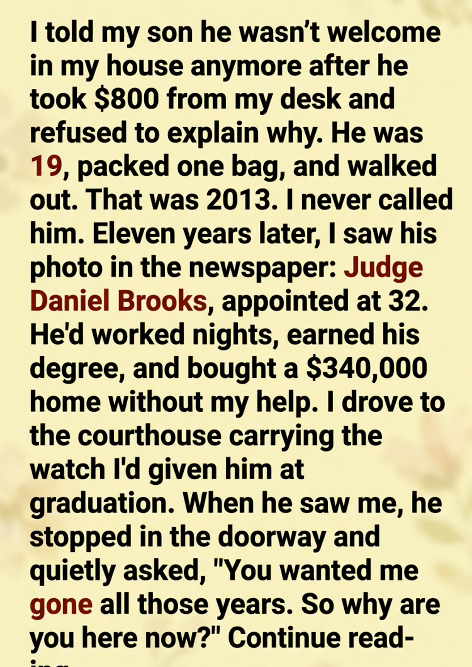
I told my son he wasn’t welcome in my house anymore after he took $800 from my desk and refused to explain why.
He was 19.
Old enough to know stealing was wrong.
Old enough to tell me the truth.
At least, that’s what I thought.
I had discovered the missing money that morning.
I checked my desk drawer twice.
Then I asked Daniel.
“Did you take it?”
He looked at the floor.
“I needed it.”
“Needed it for what?”
He wouldn’t answer.
I was furious.
“You stole from me.”
“I didn’t steal.”
“Then what do you call it?”
He stayed silent.
Something inside me snapped.
I pointed toward the hallway.
“Pack your things.”
He looked up.
“What?”
“You heard me.”
“You’re throwing me out?”
“You made your choice.”
He stood there for several seconds.
Then quietly said:
“Okay.”
He packed one bag.
No argument.
No tears.
Before walking out, he looked back at me.
I expected him to say something.
He didn’t.
The door closed.
That was 2013.
I never called him.
At first, I told myself I was teaching him responsibility.
He needed to learn that actions had consequences.
I assumed he’d call after a few days.
Then a few weeks.
Maybe when he’d cooled down.
He never did.
My pride wouldn’t let me call first.
So months became years.
I occasionally wondered where he was.
But I never asked anyone.
Then, eleven years later, I saw a photograph in the newspaper.
I was drinking coffee when the headline caught my eye:
“Judge Daniel Brooks Appointed at 32.”
I nearly dropped my cup.
I stared at the photograph.
It was my son.
Older.
More serious.
But unmistakably Daniel.
The article said he’d worked nights while earning his degree.
He’d graduated at the top of his class.
Passed the bar.
Worked as a prosecutor.
Then, at 32, had been appointed a judge.
It mentioned that he’d recently purchased a $340,000 home.
No inheritance.
No family assistance.
He had built everything himself.
I read the article three times.
Then I noticed one sentence that made my stomach tighten.
“Judge Brooks credits a difficult period in his youth with teaching him the importance of understanding why people make desperate choices.”
I knew exactly what period he meant.
I couldn’t stop thinking about the $800.
For eleven years, I’d believed Daniel had stolen from me because he was irresponsible.
That he’d walked away because he was stubborn.
Now I wondered whether I’d been wrong.
I searched through an old box in my closet.
Inside were Daniel’s childhood photographs.
His school certificates.
The watch I’d given him when he graduated high school.
A simple silver watch.
I’d saved for months to buy it.
I held it in my hand.
Then made a decision.
I was going to see my son.
The courthouse was more intimidating than I’d expected.
People moved quickly through the marble halls.
Lawyers carried folders.
Security officers stood near the entrance.
I asked where Judge Brooks’s courtroom was.
When I reached the door, I stopped.
I wasn’t sure I could do it.
I’d spent eleven years telling myself I didn’t need him.
But there I was, holding the watch I’d given him years ago.
The hearing ended.
People began leaving.
Then the courtroom door opened.
Daniel stepped out.
He was wearing black robes.
For a second, I saw the teenager who had walked out of my house carrying one bag.
Then he looked directly at me.
He stopped.
His face went completely still.
I whispered:
“Daniel.”
He didn’t answer.
He looked at the watch in my hand.
Then at me.
Finally, he quietly asked:
“You wanted me gone all those years. So why are you here now?”
I couldn’t answer immediately.
“I’m sorry.”
His expression didn’t change.
“For what?”
“For throwing you out.”
He looked away.
“That’s not what I’m asking.”
He took a breath.
“Why now?”
I swallowed.
“Because I saw your photograph in the newspaper.”
He almost smiled.
“So that’s what it took.”
I shook my head.
“No.”
“It made me realize how much I’d missed.”
He looked at me.
“You missed me?”
“Every day.”
“Then why didn’t you call?”
I had no answer that didn’t sound pathetic.
“Because I was ashamed.”
He stared at me.
Then said:
“I waited six months.”
I froze.
“What?”
“After you threw me out.”
“I lived in a room above a restaurant.”
“I worked nights.”
“I kept thinking you’d call.”
He looked down.
“You never did.”
I started crying.
“I thought you hated me.”
He shook his head.
“I didn’t.”
“Then why didn’t you call?”
“Because you told me I wasn’t welcome.”
I looked at him.
“Tell me about the $800.”
His face changed.
For eleven years, I’d wanted that answer.
Now I was afraid to hear it.
He sighed.
“I didn’t take it for myself.”
“Then why?”
He looked at the courthouse hallway.
“Mom was sick.”
I froze.
“My mother?”
He nodded.
“Her insurance had been canceled.”
“I found out she needed medication.”
“I’d promised her I’d help.”
“But I didn’t have enough money.”
“Your mother didn’t want you to know.”
My stomach dropped.
I stared at him.
“You mean Grandma?”
He nodded.
“My mother was too embarrassed to ask you.”
“She asked me.”
“You didn’t tell me.”
“I thought you’d say no.”
I shook my head.
“Daniel, I would have helped.”
He looked at me.
“Maybe.”
“But I didn’t know that then.”
He paused.
“I was scared.”
“So I took the money.”
“I planned to put it back.”
I remembered that day.
The silence.
His refusal to explain.
I had interpreted it as defiance.
He had interpreted my anger as rejection.
Both of us had been wrong.
Then he said something that hurt even more.
“The next day, I came back to explain.”
I looked at him.
“You did?”
He nodded.
“You weren’t home.”
“Your mother told me not to come back.”
I stared at him.
“She did what?”
“She said you were furious.”
“She told me you’d decided I was no longer your son.”
My heart broke.
“She never told me you came back.”
Daniel explained that he had gone to work that afternoon and slept in his car that night.
The next day, he found a room.
He never came back.
Not because he didn’t want to.
Because he believed I’d rejected him completely.
I had spent eleven years thinking he was too proud to apologize.
He had spent eleven years thinking I didn’t want him.
A misunderstanding had turned into a lifetime of silence.
I looked at the watch.
“Do you still have the one I gave you?”
He smiled faintly.
“Yes.”
“It’s at home.”
“You kept it?”
“Every day.”
I started crying.
“I thought you’d thrown it away.”
He shook his head.
“That was the only thing I took with me.”
I asked about his life.
He told me about working nights.
He washed dishes.
Loaded trucks.
Cleaned offices.
Eventually, he went to community college during the day.
Then law school.
He had almost quit several times.
But one professor encouraged him.
Another helped him apply for scholarships.
He eventually graduated.
Passed the bar.
Became a prosecutor.
Then a judge.
He’d purchased the house after years of saving.
Everything I’d seen in the newspaper was real.
He had built it all himself.
I asked:
“Did you ever want me to know?”
“Of course.”
“Then why?”
He smiled sadly.
“Because every year that passed made calling harder.”
I nodded.
“I understand.”
“Do you?”
“Yes.”
“Because I did the same thing.”
He looked at me.
“I kept telling myself I would call tomorrow.”
“Then tomorrow became eleven years.”
I gave him the watch.
“I brought this because I thought you deserved to have something back that I should never have taken from you.”
He stared at it.
“This was yours.”
“No.”
“It was always yours.”
He looked at the watch.
Then asked:
“Why bring it now?”
“Because I wanted you to know I never stopped being proud of you.”
His eyes filled with tears.
Then he asked:
“Do you want to know what the $800 really taught me?”
I nodded.
“It taught me never to judge someone before hearing their story.”
He looked at me.
“That’s why I became a judge.”
I started crying.
He continued:
“I don’t want anyone sitting in front of me to feel the way I felt that night.”
“Like one mistake means you’re no longer worth loving.”
I reached for his hand.
He let me hold it.
For a few seconds, neither of us spoke.
Then I whispered:
“I’m sorry I made you believe that.”
He nodded.
“I’m sorry I took the money.”
I looked at him.
“We both made mistakes.”
He smiled.
“Yeah.”
“But I think you were the one who learned from yours.”
He invited me to his house the following weekend.
It was beautiful.
Not enormous.
Just comfortable.
A small garden.
Bookshelves.
Photographs.
On the living-room wall was a framed picture of him graduating from law school.
I looked closer.
There was one person standing beside him.
His grandmother.
I touched the frame.
“She lived to see this?”
He smiled.
“She did.”
“She always asked about you.”
My heart tightened.
“Does she still?”
He shook his head.
“She died five years ago.”
I closed my eyes.
“Did she know I never called?”
He nodded.
“She regretted that.”
Then Daniel walked to another room.
He returned holding an old metal box.
Inside were letters.
Dozens of them.
I recognized my own handwriting.
Birthday cards I’d written but never sent.
He had somehow found copies through relatives.
There were also letters he’d written to me.
He had never mailed them.
One was dated six years after he left.
It said:
“I don’t know whether Mom told you, but I never stopped hoping you’d call.”
I covered my face.
We spent the entire afternoon reading them.
Eleven years of words that had never been spoken.
Anger.
Regret.
Memories.
Apologies.
Love.
By sunset, we’d cried enough to feel exhausted.
But for the first time, the silence between us wasn’t painful.
It was gone.
I asked him:
“Can I see you again?”
He smiled.
“You’re asking permission?”
I laughed through my tears.
“I suppose I am.”
He stood.
“Come Sunday.”
“Every Sunday?”
He nodded.
“You owe me eleven years.”
I smiled.
“I’ll start paying.”
He laughed.
“Mom?”
“Yes?”
“Bring the watch.”
I looked down at it.
“You want it?”
He shook his head.
“I just want you to wear it.”
I’ve been visiting Daniel every Sunday since then.
We can’t recover eleven years.
We can’t erase the night I told him to leave.
We can’t change what happened.
But we can stop losing time.
Sometimes we talk about the past.
Sometimes we don’t.
Sometimes we sit quietly.
Sometimes he shows me new cases he’s working on.
And once in a while, he still makes fun of me for thinking the $800 was worth losing my son over.
He’s right.
It wasn’t.
I still remember the headline that brought me back to him.
Judge Daniel Brooks, appointed at 32.
I thought I was seeing a stranger.
Instead, I was looking at the boy I’d thrown out of my house eleven years earlier.
I went to the courthouse carrying the watch I’d given him.
When he saw me, he asked:
“You wanted me gone all those years. So why are you here now?”
The answer was simple.
Because I finally understood that I had confused punishment with parenting.
I thought throwing him out would teach him responsibility.
Instead, it taught both of us how quickly pride can turn a single mistake into eleven years of silence.
The $800 was gone within days.
But the years we lost were worth infinitely more.
Daniel became a judge.
And perhaps the greatest lesson he carried into that courtroom wasn’t something he learned in law school.
It came from being a frightened 19-year-old boy standing outside his own home with one bag.
He learned that people deserve to be heard before they’re judged.
And I learned something even more painful:
A parent can win an argument, enforce a rule, and still lose the child standing in front of them.
I thought I was protecting my home when I told my son to leave.
Instead, I was the one who needed to learn what home really meant.
And eleven years later, when my son finally looked at me again, I realized I had spent all those years waiting for him to come back.
He had been waiting too.
We had both been standing at the same door, each believing the other had locked it.