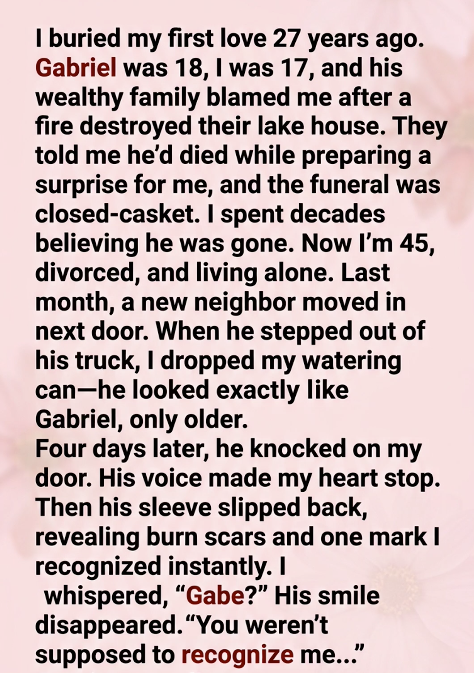
I buried my first love 27 years ago.
At the time, Gabriel was 18.
I was 17.
We were young, foolish, and completely convinced we’d be together forever.
Gabriel came from a wealthy family.
I didn’t.
His parents never approved of me.
They thought I was too ordinary for their son.
Gabriel didn’t care.
He used to tell me:
“Money doesn’t decide who I love.”
Then one summer night, everything changed.
Gabriel told me he was preparing a surprise for me at his family’s lake house.
He wouldn’t tell me what it was.
“Tomorrow,” he promised.
“You’ll see.”
But that night, the lake house caught fire.
By the time firefighters arrived, most of the building had burned.
Gabriel’s family told me he had died inside.
I remember standing outside the burned house.
His father looked at me with cold eyes.
“This happened because of you.”
I didn’t understand.
He said Gabriel had been preparing the surprise for me.
He said my son—our son—
No.
I wasn’t pregnant.
I was seventeen.
I was confused.
Terrified.
And completely shattered.
The funeral was closed-casket.
His family wouldn’t let me see him.
They told me the fire had made identification difficult.
I remember standing at the cemetery while rain soaked through my dress.
I kept thinking:
This isn’t real.
Gabriel promised he’d see me tomorrow.
Tomorrow never came.
His family blamed me.
Then they disappeared from my life.
I spent decades believing I had lost him.
I eventually married someone else.
Had a career.
Built a normal life.
But I never forgot Gabriel.
Now I was 45.
Divorced.
Living alone.
The lake town had become quieter.
One afternoon, I was watering the flowers in my front yard when a moving truck pulled up next door.
A man stepped out.
I dropped the watering can.
He was older.
His hair was dark with streaks of gray.
His face had changed.
But his eyes hadn’t.
My heart stopped.
He looked exactly like Gabriel.
Older.
Scarred.
But unmistakable.
I stood there staring.
He noticed me.
For one second, his expression changed.
Then he looked away.
I told myself it was impossible.
Gabriel was dead.
I had buried him.
For the next four days, I barely slept.
The new neighbor kept to himself.
No visitors.
No parties.
No conversations.
But every time I saw him, something inside me screamed that I knew him.
On the fourth evening, there was a knock at my door.
I opened it.
The man stood there.
“Hi.”
His voice.
I nearly stopped breathing.
That voice.
I hadn’t heard it in 27 years.
He smiled nervously.
“I wanted to introduce myself.”
I couldn’t speak.
Then his sleeve slipped back.
A series of old burn scars ran along his wrist and forearm.
But that wasn’t what made my heart stop.
There, just above his wrist, was a tiny crescent-shaped birthmark.
The same mark Gabriel had.
I whispered:
“Gabe?”
His smile disappeared.
He looked at me with tears in his eyes.
Then quietly said:
“You weren’t supposed to recognize me.”
I stepped backward.
“What happened to you?”
He looked toward the road.
“Can I come inside?”
I nodded.
He entered.
For several seconds, neither of us spoke.
Then he sat down at my kitchen table.
“I’ve been waiting 27 years to see you again.”
My hands started shaking.
“You’re alive.”
“Yes.”
“But your family said you died.”
“They wanted you to believe that.”
I stared at him.
“Why?”
He took a deep breath.
“Because they needed me to disappear.”
Gabriel explained that the fire hadn’t killed him.
He’d been inside the lake house when it started.
Someone had locked the back door.
He couldn’t get out.
He escaped through a window and suffered severe burns.
A family employee found him unconscious near the lake.
But before he could reach the hospital, his father arrived.
His family was involved in a major financial scandal.
Money had been stolen from several business accounts.
Gabriel had discovered it.
And he had planned to tell authorities.
His father knew.
The fire wasn’t an accident.
It had been deliberately started to destroy financial records stored inside the lake house.
Gabriel’s father had ordered him to stay silent.
When Gabriel refused, his father threatened him.
Then came the worst part.
Gabriel’s father told everyone that Gabriel had died.
A closed-casket funeral made the lie easier to maintain.
Gabriel was sent away under another name while his injuries healed.
“I tried to contact you,” he said.
“How?”
“Letters.”
“Phone calls.”
“Through people I trusted.”
I shook my head.
“I never got anything.”
“I know.”
Then Gabriel told me why.
His father had intercepted the messages.
He had threatened me and my family.
He told Gabriel that if he contacted me again, I would be in danger.
Gabriel was only 18.
He was injured.
Terrified.
And completely dependent on people who controlled his medical care and finances.
So he disappeared.
Not because he wanted to leave me.
Because he believed staying away was the only way to keep me alive.
I couldn’t stop crying.
“Why did you never come back?”
He looked down.
“I tried.”
“When?”
“Twice.”
“The first time, your father had people watching you.”
“The second time, you were married.”
I froze.
“You knew?”
He nodded.
“I saw you.”
“With your husband.”
“I thought you’d moved on.”
I wiped my tears.
“I never moved on from you.”
He looked at me.
“I never did either.”
Then I noticed something.
“You moved here deliberately.”
He smiled sadly.
“Yes.”
“Why?”
“Because I finally knew it was safe.”
His father’s business empire had collapsed years earlier.
The people involved in the financial scheme had been prosecuted.
The family had lost most of its wealth.
Gabriel had spent years rebuilding his life under his own name.
Now, for the first time, he could return.
I asked:
“Why didn’t you tell me immediately?”
He hesitated.
“Because I was afraid you wouldn’t forgive me.”
I stared at him.
“You were the one I thought had died.”
“I thought you hated me.”
“I never hated you.”
He looked down.
“I hoped.”
“What?”
“That you’d still remember.”
I smiled through tears.
“I remembered everything.”
He reached into his pocket.
Then pulled out something wrapped in cloth.
He placed it on the table.
I opened it.
Inside was an old photograph.
Gabriel and me at 17.
We were sitting beside the lake.
On the back he’d written:
“For tomorrow.”
I stared at it.
“This was the surprise?”
He nodded.
“I was going to propose.”
My heart broke.
“We were 17.”
“I know.”
He smiled.
“I was an idiot.”
I laughed.
“Yes.”
Then he told me the rest.
He had planned to give me a small silver ring.
Not an engagement ring.
Something simpler.
A promise.
He wanted to tell me that someday, when we were older, he would marry me.
The fire destroyed almost everything in the lake house.
But the ring survived.
He reached into another pocket.
Then placed it in my hand.
I couldn’t breathe.
It was blackened around the edges.
But still recognizable.
The inside was engraved with two initials.
G + M.
I began crying.
“Why bring it now?”
He smiled.
“Because I’ve spent 27 years carrying it.”
I looked at him.
“You never stopped thinking about me.”
“Not for a day.”
I shook my head.
“Neither did I.”
Over the next few weeks, Gabriel told me everything.
The years in hiding.
The surgeries.
The scars.
The false identity.
The legal battle.
The eventual collapse of his father’s empire.
And the guilt he’d carried over leaving me.
I told him about my life.
My marriage.
My divorce.
My children.
The things I had accomplished.
The things I had lost.
We discovered that even though we’d lived separate lives, we still remembered the same little things.
The songs.
The jokes.
The places.
The promises we’d made as teenagers.
Eventually, I asked him:
“Do you blame me for anything?”
He looked surprised.
“Never.”
“Your family blamed me.”
“They were wrong.”
“I believed them.”
“So did I, for a while.”
He reached across the table.
“Then we were both lied to.”
I held his hand.
For the first time in 27 years.
Eventually, the truth about the fire became public.
The investigation confirmed what Gabriel had told me.
His father’s financial fraud had been real.
The lake house fire had destroyed critical evidence.
The family had concealed Gabriel’s survival.
There were legal consequences.
But by then, none of that mattered as much as it once had.
The people responsible had lost their power.
And the two teenagers they had separated were finally free.
One evening, Gabriel asked me to walk with him down to the lake.
We stood where the old house had once stood.
Only part of the foundation remained.
He looked across the water.
“This is where everything ended.”
I shook my head.
“No.”
He turned toward me.
“It was where everything stopped.”
I smiled.
“That’s different.”
He took my hand.
“I thought I’d never see you again.”
I looked at him.
“I thought I buried you.”
He smiled sadly.
“Maybe we both spent 27 years grieving someone who was still alive.”
I laughed through my tears.
“That’s a terrible story.”
“Yes.”
“But we’re still here.”
“Yes.”
Months later, we started spending more time together.
There was no dramatic rush.
We were no longer teenagers.
We had lived entire lives apart.
We took our time.
We learned each other again.
Not as 17-year-olds.
As the people we’d become.
And surprisingly, it felt natural.
One evening, Gabriel placed something on my kitchen table.
The old ring.
He looked nervous.
“Remember this?”
I smiled.
“How could I forget?”
He turned it over.
“I never got to finish what I came to tell you that night.”
“What?”
He took my hand.
“I was going to ask you to wait for me.”
I laughed.
“Twenty-seven years is a long wait.”
He smiled.
“I know.”
Then he said:
“I’m not asking you to wait anymore.”
“I’m asking whether there’s still room for me beside you.”
I looked at the man in front of me.
The boy I’d loved.
The stranger I’d mourned.
The man who had survived something terrible and carried my memory through decades.
There was no way to recover what we’d lost.
But there was still time to create something new.
I smiled.
“There is.”
I still think about the night I first saw him stepping out of that truck.
I dropped my watering can because for one impossible second, I thought I’d seen a ghost.
Four days later, he stood at my door.
His sleeve slipped back.
I saw the scars.
Then the birthmark.
And I whispered:
“Gabe?”
His smile disappeared.
He looked at me and said:
“You weren’t supposed to recognize me.”
For 27 years, I had believed Gabriel died in that fire.
He hadn’t.
He had survived the flames, survived the lies, and survived a family determined to erase him.
The boy I buried had grown into a man carrying an old photograph and a damaged ring.
And when he finally came back, he didn’t ask me to forget the years we’d lost.
He simply asked whether there was still room for him.
There was.
Because sometimes love doesn’t disappear when people are separated.
Sometimes it waits.
Quietly.
For decades.
And sometimes, when you least expect it, the person you thought you buried turns up next door…
older, scarred, alive—and still carrying the promise he made when he was 18.