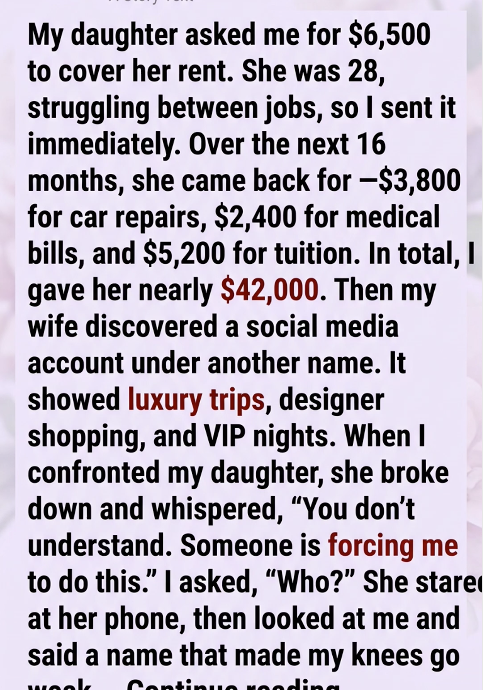
My daughter asked me for $6,500 to cover her rent.
She was 28, between jobs, and sounded desperate.
“Please, Dad. I just need enough to get through this month.”
I didn’t hesitate.
I transferred the money that afternoon.
She thanked me repeatedly.
“I’ll pay you back when I’m working again.”
I told her not to worry about it.
She was my daughter.
Parents help their children when they’re struggling.
At least, that’s what I believed.
Then it happened again.
Three months later, she needed $3,800 for car repairs.
I sent it.
A few weeks after that, she called crying.
“There’s a medical bill I can’t cover.”
That cost another $2,400.
Then came tuition.
$5,200.
Then groceries.
A security deposit.
An insurance payment.
Another rent payment.
Another emergency.
Over the next 16 months, I gave my daughter nearly $42,000.
Every time, there was a reason.
Every time, I believed her.
I never kept track of the total until my wife finally did.
One evening, she sat beside me at the kitchen table.
“Do you know how much we’ve given her?”
I shook my head.
She showed me the spreadsheet.
I stared at the number.
$41,700.
I swallowed.
“She needs help.”
My wife nodded.
“I know.”
Then she turned her phone toward me.
“And that’s why I think you need to see this.”
She had found a social-media account under a different name.
There were dozens of photographs.
Luxury hotels.
First-class flights.
Designer handbags.
Expensive restaurants.
VIP events.
A beach resort.
A sports car.
In one photograph, my daughter was holding a champagne glass beside a man I’d never seen before.
I felt sick.
“That’s not possible.”
My wife said nothing.
I kept scrolling.
The posts covered nearly the entire 16 months we’d been giving her money.
Some photographs were dated within days of the transfers I’d made.
I stared at one.
The caption read:
“Best weekend ever.”
The photograph showed her at a luxury resort.
I had sent her $6,500 for rent that same week.
I called her.
She answered immediately.
“Dad?”
“We need to talk.”
Her voice changed.
“About what?”
“I saw your account.”
Silence.
“What account?”
“Don’t.”
I told her everything I’d seen.
The trips.
The shopping.
The hotels.
The money.
She started crying.
“Dad, please.”
“Where did the money go?”
“I can’t explain.”
“You owe us an explanation.”
“I know.”
“You told me you couldn’t pay rent.”
“I know.”
“You told me you needed medical care.”
“I know.”
“Then why were you buying designer bags?”
She was silent.
Then whispered:
“You don’t understand.”
I was furious.
“What don’t I understand?”
She began sobbing.
“I’m being forced to do this.”
I stopped.
“Forced by who?”
She didn’t answer.
“Who?”
She stared at her phone.
Her hands were shaking.
Then she looked directly at me and said a name.
My knees nearly went weak.
It was my brother, Michael.
Her uncle.
I couldn’t speak.
Michael had been my closest brother for decades.
He was the person who’d stood beside me when our parents died.
The person I’d trusted with family finances.
The person my daughter had always called Uncle Mike.
I stared at her.
“Michael?”
She nodded.
“He’s making you spend the money?”
She shook her head.
“He’s making me give it to him.”
I sat down.
“What does he have on you?”
She took a shaky breath.
“Everything.”
“Everything what?”
“Videos.”
“Photographs.”
“Messages.”
“Things I did.”
“Things I didn’t do.”
I didn’t understand.
She opened her phone.
Then showed me a series of messages.
Michael had been threatening her.
He knew she’d once been involved with someone who was under investigation for fraud.
She’d never been charged.
But she’d been present when some illegal transactions took place.
Michael had discovered the connection.
Then threatened to expose her unless she followed his instructions.
I stared at the messages.
Send me $2,000 tonight.
Tell your father it’s for tuition.
Buy the bag and send me the receipt.
Post the vacation photograph tomorrow.
Don’t tell anyone.
There were dozens.
My stomach turned.
I looked at my daughter.
“Why did you make us pay?”
She cried.
“Because he told me if I didn’t have the money, he’d send everything to the police.”
I was still angry.
But now I was angry at two people.
At my daughter for lying.
And at my brother for exploiting her.
I asked:
“How long?”
“About 18 months.”
“Why didn’t you tell me?”
“Because he said he’d hurt you.”
I froze.
“Did he threaten me?”
She nodded.
“He said if I told you, you’d lose your business.”
I stared at her.
“What did he mean?”
She showed me another message.
Michael had apparently obtained confidential financial information about my business.
He had been threatening to create the appearance that I was involved in his own financial misconduct.
He didn’t just have leverage over my daughter.
He had been building leverage over me too.
I called my attorney.
Then we contacted law enforcement.
We preserved every message.
Every photograph.
Every bank transfer.
Every social-media post.
Every recording.
My daughter agreed to cooperate.
The investigators quickly discovered that Michael had been using several relatives and acquaintances in similar schemes.
He would find someone’s vulnerability.
Then use threats to force them to obtain money.
My daughter wasn’t his only target.
She was simply the person closest to the money.
I asked my daughter about the luxury trips.
She explained that many of them had been staged.
Michael instructed her to post the photographs because he wanted her to appear wealthy.
He used the social-media account to make it look as though she was spending the money herself.
In reality, most of the money went to accounts he controlled.
The designer shopping wasn’t entirely fake either.
He had her purchase certain items, keep the receipts, and hand them over.
Then he would resell them or use them as collateral.
The entire lifestyle had been part of the deception.
But there was one thing I still couldn’t understand.
“Why did you keep asking for more?”
She started crying.
“Because every time I thought I was almost done, he demanded more.”
“The $6,500?”
“He took almost all of it.”
“The $3,800?”
“Almost all.”
“The tuition?”
“Most of it.”
I stared at her.
“Why didn’t you just let him expose you?”
She whispered:
“Because I was terrified.”
I couldn’t blame her for being afraid.
But I told her something difficult.
“You still lied to us.”
She nodded.
“I know.”
“You made us think you were irresponsible.”
“I know.”
“You let us believe you were wasting our help.”
“I’m sorry.”
I took a breath.
“You should have trusted me enough to let me help you.”
She cried.
“I know.”
“I just didn’t know how to escape.”
The investigation uncovered something even worse.
Michael had deliberately encouraged my daughter to ask us for money.
He knew we’d help.
He had studied our family.
He knew which explanation would work for which person.
Rent.
Medical bills.
Tuition.
He had essentially written her scripts.
And every time she hesitated, he reminded her what he could do to her.
Eventually, investigators obtained enough evidence to confront him.
Michael denied everything.
Then the messages were presented.
The bank records.
The social-media posts.
The threats.
The account transfers.
His story collapsed.
He had been manipulating people for years.
My daughter eventually agreed to testify.
It was one of the hardest things she’d ever done.
Months later, my daughter sat at our kitchen table again.
This time, there was no request for money.
No emergency.
No story.
She simply said:
“I want you to know something.”
I waited.
“I should have told you the first day he threatened me.”
I shook my head.
“You were scared.”
“But I hurt you.”
“Yes.”
She nodded.
“I know.”
Then I said:
“Being scared explains what you did.”
“It doesn’t erase it.”
She looked at me.
“I understand.”
We created new financial boundaries.
She opened accounts I could no longer access.
I stopped giving her unrestricted money.
When she needed help, we paid legitimate expenses directly.
Rent went to the landlord.
Medical bills went to the provider.
Tuition went to the school.
Not because I didn’t trust her at all.
Because trust needed to be rebuilt through actions.
The social-media account eventually disappeared.
The luxury photographs were gone.
The designer bags were gone.
The resorts were gone.
What remained was a 28-year-old woman trying to rebuild her life after making some terrible choices under terrible pressure.
And slowly, she did.
She found a stable job.
Started therapy.
Paid back what she could.
And began telling the truth.
Even when the truth was uncomfortable.
One evening, she showed me an old photograph.
It was one of the luxury vacation pictures.
She looked beautiful.
Happy.
I knew now she had been terrified behind that smile.
She asked:
“Do you hate me?”
I shook my head.
“No.”
“Are you disappointed?”
“Yes.”
She nodded.
“I am too.”
“But you’re still my daughter.”
She started crying.
“So you’re still my dad?”
I smiled.
“That part isn’t negotiable.”
I still remember the first time I saw that secret account.
Luxury hotels.
Designer shopping.
VIP nights.
While we’d been sending her money for rent and medical bills.
I thought we’d discovered that our daughter had deceived us because she wanted a glamorous lifestyle.
The truth was far more complicated.
She had been trapped by someone who knew exactly how to manipulate her.
But she had also made choices that hurt the people who loved her.
Both things were true.
The total came to nearly $42,000.
For a while, I was obsessed with the number.
Then I realized something.
The money was recoverable.
Maybe not all of it.
But enough.
What mattered more was stopping the person who had turned our family against itself.
And making sure my daughter understood that being threatened doesn’t mean you have to stay silent forever.
My brother eventually faced the consequences of what he’d done.
The investigation uncovered financial crimes far larger than anything we’d initially suspected.
Several victims came forward.
My daughter was one of them.
So was I.
The person I’d trusted for decades had been using our family’s fear and generosity as a source of money.
I still struggle with that.
But I no longer wonder what happened to the money.
I know.
My daughter still has the original luxury account saved.
Not because she wants to remember the vacations.
Because she wants to remember what it felt like to live inside a lie.
She told me once:
“Every photograph made me look happier.”
“I was actually more scared.”
I told her:
“Then never confuse looking successful with being safe.”
She nodded.
I gave my daughter nearly $42,000 because I believed she was struggling.
She was.
Just not in the way I thought.
My wife discovered the secret social-media account.
I confronted my daughter.
She broke down and said:
“You don’t understand. Someone is forcing me to do this.”
When I asked who, she looked at her phone and gave me a name that made my knees weak.
My own brother.
For months, he had been threatening her and funneling our money through her.
The luxury lifestyle was a disguise.
The money was being extracted from us.
And the photographs were part of the cover.
The experience changed our family permanently.
My daughter learned that silence doesn’t make a threat disappear.
I learned that love doesn’t mean blindly handing someone money whenever they’re in trouble.
And perhaps the hardest lesson of all was this:
Sometimes the person asking you for money isn’t the person who has the money problem.
Sometimes they’re simply the person standing closest to the person causing it.