The first thing I noticed was the notification.
$143,000 charged.
I stared at my phone.
For several seconds, I couldn’t process the number.
Then I saw the merchant name.
A luxury travel company.
My stomach dropped.
I hadn’t booked a vacation.
I hadn’t authorized anyone to use my card.
And then I remembered something.
My parents had asked me for my credit-card information three weeks earlier.
They claimed they needed it to verify an account because my father was having trouble with an online payment.
I had trusted them.
They were my parents.
I never imagined they would use it against me.
I immediately called the credit-card company.
The representative confirmed the transaction.
It had been processed.
Not declined.
Not pending.
Completed.
The charge covered private villas, first-class flights, yacht rentals, luxury hotels, and several other expenses.
All for my younger sister.
My sister had apparently been planning the vacation of her dreams.
And my parents had decided I was going to pay for it.
I called my mother.
She answered immediately.
I expected panic.
Instead, she laughed.
“Did you see the charge?”
My voice was shaking.
“Mom, what did you do?”
“Relax.”
“You charged $143,000 to my card.”
“I know.”
“You had no permission.”
She laughed again.
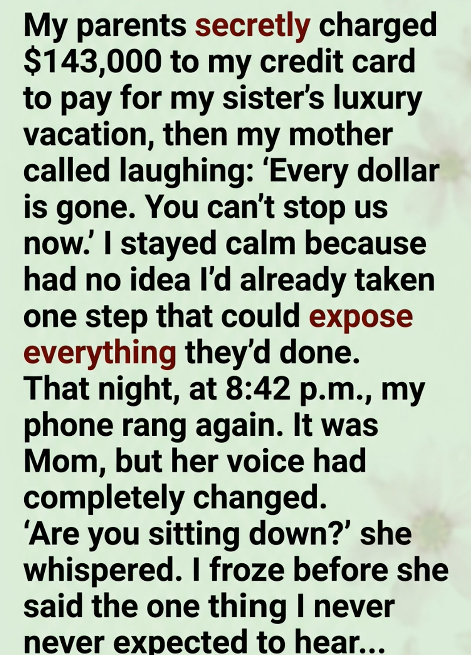
“Every dollar is gone. You can’t stop us now.”
I went completely silent.
She continued.
“You have plenty of credit. What’s the big deal?”
I could barely believe what I was hearing.
“Mom, that’s fraud.”
“Oh, please.”
She sounded almost amused.
“It’s family money.”
“No. It’s my credit card.”
“You’re making a huge issue out of nothing.”
Then she hung up.
I sat at my desk.
My hands were cold.
But I didn’t call her back.
I didn’t scream.
I didn’t threaten her.
Because my mother had no idea I’d already taken one step that could expose everything they’d done.
Months earlier, I had installed a security system on my financial accounts after noticing several smaller unauthorized transactions.
I had also enabled detailed transaction alerts.
More importantly, my bank had recorded the device information and authentication trail connected to every major transaction.
And I had saved every message my parents had ever sent me asking for financial help.
I opened my laptop.
I started taking screenshots.
The travel reservation.
The transaction.
My mother’s messages.
The date she requested my card information.
The messages where she discussed my sister’s vacation.
I saved everything.
Then I contacted the bank’s fraud department.
They immediately froze the card.
They opened an investigation.
And because the amount was so large, they escalated the case.
I also contacted an attorney.
He told me something I desperately needed to hear.
“Don’t confront them anymore.”
“Why?”
“Because if they realize you’re documenting everything, they may start deleting evidence.”
I nodded.
From that moment on, I stopped calling my parents.
I communicated only in writing.
And I saved every word.
For the next several hours, nothing happened.
Then, at exactly 8:42 p.m., my phone rang.
It was Mom.
I stared at the screen.
I almost didn’t answer.
But I did.
“Hello?”
There was silence.
Then I heard her breathing.
“Are you sitting down?”
My heart started pounding.
“What happened?”
Her voice was completely different now.
She wasn’t laughing.
She sounded terrified.
“Your sister…”
“What about her?”
“She doesn’t know.”
“Know what?”
My mother began crying.
“The card company called.”
I said nothing.
“They asked questions about the vacation.”
My stomach tightened.
“What did they ask?”
“They said the transaction was under investigation.”
I closed my eyes.
“Okay.”
Then she whispered the sentence I never expected to hear.
“They found Dad’s name on the authorization.”
I froze.
“What?”
My mother sobbed.
“Your father didn’t just use your card.”
“What are you talking about?”
“He opened something.”
“What did he open?”
“A second account.”
My heart sank.
My father had apparently created an online financial account using my information months earlier.
He had linked it to my credit card.
That account had been used to make several smaller purchases before the $143,000 vacation charge.
The large transaction was only the latest.
My attorney immediately contacted the bank.
The investigation expanded.
And then investigators found something that changed the entire case.
The account wasn’t created from my home.
It wasn’t created from my computer.
It was created from my parents’ house.
The IP records matched.
The device was registered to my father’s laptop.
Suddenly, my parents couldn’t claim that someone had stolen their information.
The evidence pointed directly to them.
But there was still another question.
Why had my mother said my sister didn’t know?
I asked her.
She hesitated.
Then she admitted the truth.
My sister had been told that the entire vacation was a gift from our parents.
She had no idea the money was coming from me.
I couldn’t decide whether I felt angry or relieved.
Angry because they had stolen from me.
Relieved because at least my sister hadn’t knowingly participated.
The following morning, federal investigators contacted me.
Because of the size of the transactions and the method used, multiple agencies were reviewing the case.
I provided everything.
Messages.
Bank statements.
Screenshots.
Call records.
Travel confirmations.
My parents’ requests for my card information.
And eventually, something even more damaging surfaced.
My mother had sent my sister a message saying:
“Don’t worry about the cost. Your brother will cover it.”
That message was dated two days before the charge.
My sister had apparently replied:
“Are you sure he said yes?”
My mother answered:
“He doesn’t need to know yet.”
That was the evidence I needed.
My parents hadn’t made a mistake.
They had planned it.
The bank reversed the unauthorized charge after completing its investigation.
The travel company canceled the remaining reservations.
The yacht booking disappeared.
The private villa was canceled.
The first-class tickets were voided.
The entire luxury vacation collapsed within forty-eight hours.
Then my parents received the news they had been trying desperately to avoid.
They were under investigation for fraud and identity theft.
My father called me.
I didn’t answer.
He left a voicemail.
“Son, please. We’re still your parents.”
I listened to it once.
Then I saved it.
My mother called next.
She cried.
She said she was sorry.
She said they had made a terrible mistake.
She said they were desperate to give my sister the life she deserved.
I finally answered.
“You didn’t give her anything.”
Silence.
“You took it from me.”
My mother started crying again.
“I thought you’d understand.”
“No.”
I paused.
“I understand exactly what you did.”
She whispered,
“We’re family.”
I replied,
“Family doesn’t steal $143,000 and then laugh about it.”
She hung up.
The legal process took months.
My parents eventually admitted to using my information without authorization.
The evidence was overwhelming.
The smaller transactions.
The account.
The device records.
The messages.
The travel bookings.
Everything connected.
My sister eventually contacted me.
She apologized.
She told me she had canceled the trip herself.
“I didn’t know,” she said.
“I believe you.”
She started crying.
“I feel terrible.”
“You should.”
There was a long silence.
Then she said,
“I thought Mom and Dad were paying for everything.”
“I know.”
That was the end of our conversation.
It took me a long time to trust anyone in my family again.
But there was one thing I learned that changed the way I handled money forever.
Being generous doesn’t mean giving people unlimited access to you.
Being family doesn’t give anyone the right to cross your boundaries.
And trusting someone doesn’t mean refusing to protect yourself.
My parents thought they had won when my mother called laughing.
“Every dollar is gone. You can’t stop us now.”
She was right about one thing.
The money had already been spent.
But she was completely wrong about the part that mattered.
I didn’t need to stop the vacation.
I needed to prove who had paid for it.
And by the time my mother called me at 8:42 p.m., the evidence was already being preserved.
The next time she called, she wasn’t laughing.
She was asking me for a lawyer’s number.
And I didn’t give her one.
Because by then, I had finally understood something I should have learned years earlier:
Sometimes protecting yourself means letting people reveal exactly who they are.