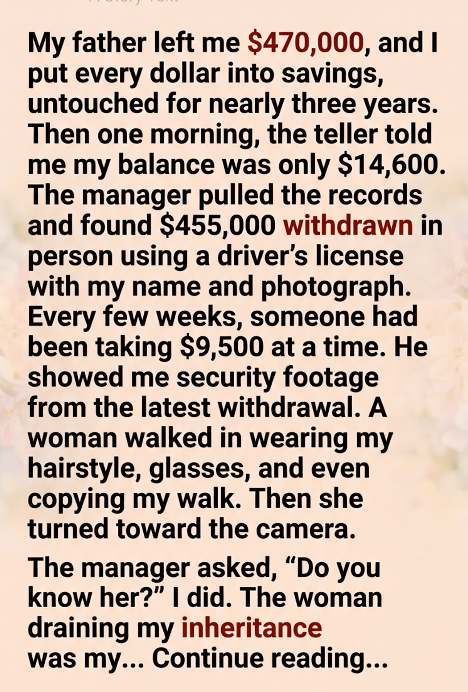
My father left me $470,000.
It wasn’t something I expected.
He had always been careful with money, but he had never talked much about his finances.
When he died, I inherited the money and decided not to touch it.
I wanted to honor him.
So I opened a separate savings account and deposited every dollar.
For nearly three years, I didn’t withdraw a cent.
I didn’t even use the interest.
I simply watched the balance grow.
It was my safety net.
The one thing my father had left me that nobody could take away.
Or so I thought.
One Tuesday morning, I went to the bank because I needed a statement.
The teller typed my information into the computer.
Then she frowned.
She checked again.
“Is there a problem?” I asked.
She looked at me.
“I’m sorry. Could you wait a moment?”
She disappeared into the back.
A few minutes later, the branch manager came out.
“Could you come into my office?”
My stomach tightened.
I followed him.
He closed the door.
“There’s something unusual about your account.”
“What kind of unusual?”
He turned his monitor toward me.
My balance was $14,600.
I stared at the screen.
“That can’t be right.”
He nodded.
“I know.”
My voice shook.
“I had $470,000.”
“You did.”
“What happened?”
He pulled up the transaction history.
There were withdrawals.
Hundreds of thousands of dollars.
Every few weeks.
Almost always the same amount.
$9,500.
My mouth went dry.
“That’s impossible.”
The manager continued scrolling.
The withdrawals had started almost a year earlier.
One after another.
$9,500.
$9,500.
$9,500.
Over and over.
Until approximately $455,000 had disappeared.
I looked at him.
“I didn’t make these withdrawals.”
“We know.”
“How?”
“Because the withdrawals were made in person.”
He showed me copies of the transaction records.
Each one had been authorized using a driver’s license bearing my name.
My photograph.
My signature.
I stared at the driver’s license image.
It was me.
Or at least it looked like me.
The manager said,
“We’ve already checked the identification.”
“What did you find?”
“The license was counterfeit.”
My hands began trembling.
“Then who was doing this?”
He hesitated.
“We have security footage.”
He opened another file.
The latest withdrawal had occurred only days earlier.
The camera showed a woman entering the bank.
She wore a dark jacket.
Glasses.
Her hair was styled exactly like mine.
She walked slowly toward the teller.
At first, I didn’t understand why the manager was showing me this.
Then I noticed something.
The way she walked.
The slight tilt of her head.
The way she held her purse.
She was copying me.
Exactly.
The woman approached the teller.
Presented the fake license.
Collected the money.
Then turned toward the security camera.
Her face came into view.
I stopped breathing.
The manager paused the video.
“Do you know her?”
I stared at the screen.
I knew her.
I knew her better than almost anyone.
The woman draining my inheritance was my younger sister, Emily.
I couldn’t speak.
Emily and I had always looked somewhat alike.
Same dark hair.
Similar height.
Similar facial features.
When we were younger, people sometimes confused us from behind.
But this wasn’t coincidence.
She had deliberately studied me.
She had copied my hairstyle.
My glasses.
My clothing.
Even my walk.
The manager looked at me.
“Are you sure?”
“Yes.”
“How?”
“She’s my sister.”
He looked stunned.
“Does she have access to your personal information?”
“Yes.”
That was when another terrible thought occurred to me.
After my father died, Emily had helped me organize his paperwork.
She had been in my apartment.
She had seen my identification.
She knew which bank I used.
She knew my account number.
And she knew exactly how much money I had inherited.
I felt sick.
I called her.
She answered immediately.
“Hey.”
“Where are you?”
A pause.
“Why?”
“Just tell me.”
She named a location.
I asked,
“Did you withdraw money from my account?”
Silence.
Then she said,
“I don’t know what you’re talking about.”
“I have video.”
Another silence.
Then she hung up.
The manager immediately contacted the bank’s fraud department.
I called the police.
Within hours, investigators were at the branch.
They reviewed every withdrawal.
The pattern was obvious.
Emily had been taking $9,500 at a time because amounts above a certain threshold triggered additional scrutiny.
She had also varied the dates.
She never came on the same day of the week.
She changed her clothing.
She sometimes wore a hat.
Sometimes glasses.
But investigators noticed something she hadn’t considered.
She always walked the same way.
And she always used the same fake identification.
The bank had saved copies.
Investigators compared the driver’s-license photographs.
They found the same facial structure beneath different disguises.
Then they searched the withdrawal records.
The total was devastating.
$455,000.
Nearly my entire inheritance.
But investigators weren’t finished.
They followed the money.
Some of it had gone toward credit-card payments.
Some had been transferred to another account.
Some had been used to purchase expensive items.
And some had been withdrawn as cash.
Then investigators discovered something that made me even angrier.
Emily hadn’t acted alone.
Someone had helped her obtain my personal information.
Someone had helped her create the counterfeit identification.
And that person turned out to be someone I had trusted.
My mother’s boyfriend.
He had previously worked in an office where he had access to identity-document templates.
He had helped Emily create the fake license.
When police confronted him, he initially denied everything.
Then they showed him the transaction records.
He confessed.
Emily eventually confessed too.
Her reason?
She had accumulated enormous debts.
She believed our father had left me “more than enough.”
She told investigators:
“She didn’t need all that money.”
I couldn’t believe it.
I had spent three years refusing to touch my father’s inheritance because I wanted to preserve it.
She had spent almost a year slowly stealing it.
And she had convinced herself that because we were sisters, she deserved some of it.
The police recovered a portion of the money.
Not all of it.
Some had already been spent.
Some was gone.
But enough was recovered to make a difference.
Emily was charged with identity theft, fraud, forgery, and theft.
The man who helped her faced charges as well.
The bank restored the remaining disputed amount after completing its investigation, and the recovered funds were eventually returned through the legal process.
But the money wasn’t what hurt most.
It was the betrayal.
I kept thinking about my father.
He had worked his entire life to leave me something.
He had trusted me to protect it.
And the person who came closest to destroying that gift was someone who shared my childhood.
My sister.
Months later, Emily asked to speak with me.
I agreed.
She looked completely different without the glasses, wig, and clothes she had used to disguise herself.
For a moment, I remembered us as children.
Then I remembered the security footage.
“You looked exactly like me,” I said.
She started crying.
“I was trying to make it look like you.”
“I know.”
“I thought nobody would notice.”
I shook my head.
“You didn’t just steal my money.”
She looked down.
“You stole something Dad left specifically for me.”
She cried harder.
I didn’t.
I had already cried enough.
Before I left, she asked,
“Can you ever forgive me?”
I thought about it.
“I don’t know.”
Then I stood up.
“But forgiveness doesn’t mean trust.”
I walked out.
I still have the bank statement from that terrible morning.
I keep it beside a photograph of my father.
Not because I want to remember the theft.
I keep it because it reminds me of something important.
My father gave me $470,000.
My sister managed to steal almost all of it.
But she couldn’t steal the lesson I learned.
Trust should never mean surrendering control.
And family should never be an excuse to ignore betrayal.
The strangest part is that the bank teller had initially told me there was nothing suspicious.
The manager only discovered the truth because he decided to look deeper.
If he hadn’t checked the security footage, my sister might have continued draining the account until nothing remained.
And if she hadn’t turned toward that camera that day, I might never have known who was pretending to be me.
The woman on the screen had my hair.
My glasses.
My clothes.
My walk.
But when she turned around, I finally saw the truth.
She looked like me.
But she wasn’t me.
And the person hiding behind my face had been my own sister.