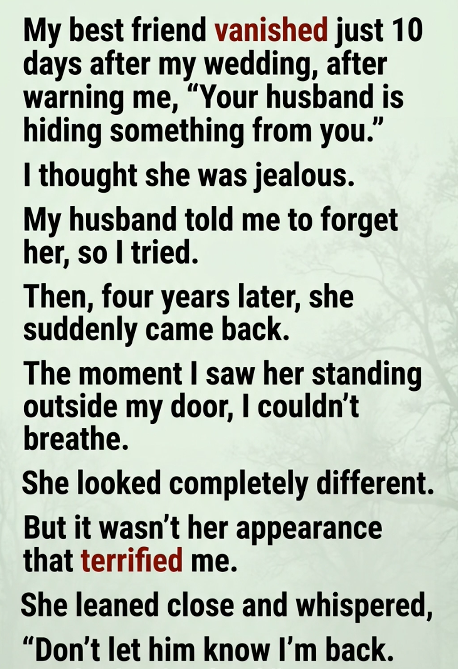
My best friend disappeared ten days after my wedding.
Four years later, she stood outside my front door.
And the first thing she said was:
“Don’t let him know I’m back. He thinks I’m dead.”
I wish I could say I immediately understood what was happening.
I didn’t.
I was too shocked to breathe.
Four years earlier, my best friend, Rachel, had stood beside me at my wedding.
She had helped me choose my dress.
She had stayed up with me the night before because I was too nervous to sleep.
She had given the speech at the reception.
And she had hugged me afterward, whispering,
“You deserve to be happy.”
Ten days later, she called me.
Her voice sounded strange.
“Are you alone?”
I laughed.
“Of course.”
“Your husband is hiding something from you.”
I stopped smiling.
“What?”
“I can’t explain over the phone.”
“Rachel, what are you talking about?”
She hesitated.
“Just promise me you’ll be careful.”
I asked her whether she had proof.
She said she did.
Then she added:
“Don’t tell him I called you.”
I was confused.
And, honestly, I was angry.
I had just married the man I loved.
I thought Rachel was jealous.
Maybe she regretted not having a relationship of her own.
Maybe she didn’t like my husband.
Maybe she simply couldn’t accept that my life had changed.
The next morning, my husband noticed I was upset.
I told him Rachel had called.
His expression immediately changed.
“What did she want?”
“She said you were hiding something.”
He laughed.
“She’s always been dramatic.”
Then he took my hand.
“Don’t let her ruin our marriage.”
I wanted to believe him.
So I did.
That afternoon, I called Rachel.
No answer.
I tried again.
Nothing.
Then her phone was disconnected.
Her apartment was empty.
Her employer said she hadn’t shown up for work.
Her family reported her missing.
Police investigated.
There were no clear leads.
No note.
No obvious reason for her to disappear.
And no evidence connecting my husband to her disappearance.
Months passed.
Then years.
Eventually, everyone stopped talking about Rachel.
I didn’t.
I thought about her every birthday.
Every Christmas.
Every anniversary.
But my husband always said the same thing.
“She’s gone. You need to move on.”
So I tried.
Four years passed.
Then, one rainy evening, someone knocked on my door.
I wasn’t expecting anyone.
I opened it.
And stopped breathing.
A woman stood outside.
She was thinner.
Her hair was shorter.
There was a scar near her eyebrow.
She looked older.
But I knew her eyes.
“Rachel?”
She nodded.
I couldn’t move.
She stepped inside quickly.
“Close the door.”
I did.
Then she grabbed my arm.
“Don’t let him know I’m back.”
“Who?”
She stared at me.
“Your husband.”
My heart began pounding.
“He thinks I’m dead.”
I stared at her.
“What happened to you?”
She looked toward the windows.
“I can’t stay long.”
“You’ve been missing for four years!”
“I know.”
“Everyone thought you were dead.”
“I know.”
“Rachel, what happened?”
She swallowed.
“Your husband found out I knew.”
I felt sick.
“Knew what?”
She looked directly at me.
“The truth.”
I shook my head.
“No.”
“He was involved in something before you met him.”
“What?”
“Money.”
She explained that several years earlier, she had worked for an accounting firm that handled financial records for one of my husband’s former business partners.
She had discovered irregular transfers.
Money was being moved through shell companies.
At first, she thought it was ordinary corporate fraud.
Then she noticed something.
One of the accounts was connected to my husband.
But the dates went back to before I had even met him.
Rachel began investigating.
That’s when she discovered something worse.
My husband wasn’t simply receiving money.
He had been helping move it.
Rachel had copied several documents.
She planned to report what she’d found.
Then she called me ten days after my wedding.
“He knew I had the documents,” she said.
I felt numb.
“What happened after you called me?”
“I was followed.”
“By whom?”
“I don’t know.”
She said she had gone to a friend’s house that night.
The next morning, someone broke into the apartment.
She realized she couldn’t trust anyone.
So she disappeared.
I stared at her.
“You could have contacted me.”
“I tried.”
“What?”
She pulled out an old phone.
“There were messages I never sent.”
She explained that she had watched my house from a distance several times.
But my husband always seemed to know when she was nearby.
She became convinced he was monitoring me.
“So you let me think you were dead?”
“I thought it was the only way to keep you alive.”
I didn’t know what to believe.
Then she pulled a flash drive from her jacket.
“This is why I’m back.”
“What is it?”
“Everything.”
She had spent four years collecting evidence.
Bank records.
Emails.
Corporate documents.
Copies of transactions.
Names.
Dates.
And recordings.
I stared at the flash drive.
“Why come back now?”
“Because I found something that changes everything.”
“What?”
She took a breath.
“Your husband wasn’t just involved in the money.”
She looked terrified.
“He was using your identity.”
My stomach dropped.
“What?”
“Several accounts were opened using your personal information.”
I suddenly remembered things.
Documents my husband had asked me to sign.
Bank forms.
Insurance paperwork.
Tax documents.
He had always said they were routine.
Rachel shook her head.
“They weren’t.”
That night, we didn’t confront him.
Instead, we contacted an attorney.
The attorney reviewed the evidence and immediately told us not to alert my husband.
Investigators were contacted.
They quietly began reviewing the records.
Then they discovered that Rachel had been right.
My identity had been used to establish multiple accounts.
My husband had also created companies in my name.
Money had passed through those companies.
And there was one transaction that terrified me.
A large insurance policy.
Taken out shortly after our wedding.
With me listed as the beneficiary.
My husband was the insured person.
The policy wasn’t illegal by itself.
But investigators discovered that he had also taken out another policy.
On me.
I stared at the document.
The date was two months before Rachel disappeared.
I felt physically sick.
“Why would he insure me?”
The investigator looked at me.
“That’s what we’re trying to determine.”
Rachel began crying.
“This is why I disappeared.”
She had discovered the insurance policy while investigating the financial records.
She believed that if my husband knew she had seen it, she would never be safe.
Investigators eventually uncovered the larger scheme.
My husband had been involved in financial fraud with several former associates.
He had used companies connected to me to move money.
He had concealed assets.
And when Rachel discovered the scheme, he had tried to make her disappear from his life permanently.
But there was still no direct evidence proving that he had physically harmed her.
Rachel had disappeared voluntarily.
That distinction mattered.
She had gone into hiding because she believed she was in danger.
She had survived.
And now she was finally willing to testify.
The police arranged a controlled meeting.
My husband came home that evening unaware of what had happened.
He walked into the kitchen.
Then he saw Rachel.
He stopped.
His face changed instantly.
For several seconds, nobody spoke.
Then he whispered:
“No.”
Rachel stood up.
“Hello.”
He looked at me.
“What is she doing here?”
I said nothing.
His eyes moved back to Rachel.
“But you’re dead.”
Rachel smiled sadly.
“That’s what you wanted everyone to believe.”
He backed away.
Then the investigators entered.
The next few hours were a blur.
My husband was arrested.
The financial investigation continued for months.
Several people were eventually charged.
The evidence Rachel had preserved became critical.
The recordings.
The documents.
The bank records.
The companies.
The insurance policies.
Everything began fitting together.
My husband eventually admitted that he had known Rachel was investigating him.
But he denied ordering anyone to hurt her.
Rachel’s disappearance had terrified him because he didn’t know what she had taken.
He had assumed she was dead after years without hearing from her.
That’s why her appearance at my house had shaken him so badly.
He hadn’t expected the woman he thought was gone forever to walk through the door carrying evidence that could destroy everything.
Our marriage ended.
The house was sold.
The financial accounts were untangled.
It took years to recover from the betrayal.
But Rachel stayed.
One afternoon, months after the arrest, we sat together drinking coffee.
I looked at her.
“I owe you an apology.”
“For what?”
“I thought you were jealous.”
She shook her head.
“You had every reason to believe me.”
“No.”
I looked down.
“I chose to believe him.”
She reached across the table.
“You were in love.”
I started crying.
She squeezed my hand.
“That doesn’t make you stupid.”
Years later, I still think about that phone call.
The one she made ten days after my wedding.
The warning I dismissed because I thought she was jealous.
If I had listened then, perhaps everything would have been different.
But Rachel eventually came back.
And when she did, she brought the truth with her.
She didn’t return looking for revenge.
She returned because she believed I deserved to know what my husband had been hiding.
And sometimes I wonder what would have happened if she had never knocked on my door that rainy night.
If she had stayed hidden.
If she had decided I was better off not knowing.
I might still be married to a man I never truly knew.
Instead, four years after her disappearance, my best friend stood in my doorway and said the words I’ll never forget:
“Don’t let him know I’m back. He thinks I’m dead.”
She wasn’t.
And neither was the truth.
It had simply been waiting for someone brave enough to bring it home.