When our daughter was born, everyone told me I was supposed to feel an overwhelming rush of happiness.
Instead, I felt confused.
Something about the timing didn’t make sense.
I had been away for work during part of the period when my wife said she became pregnant.
I didn’t accuse her of cheating.
Not at first.
I simply couldn’t make the dates fit.
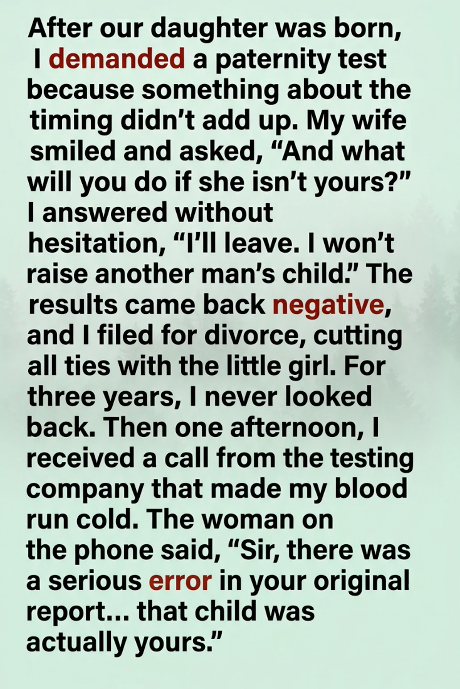
So, after our daughter was born, I asked for a paternity test.
My wife looked at me for a long moment.
Then she smiled sadly.
“And what will you do if she isn’t yours?”
I answered without hesitation.
“I’ll leave.”
She looked down at the baby.
I continued.
“I won’t raise another man’s child.”
Those words would haunt me for the rest of my life.
The test came back.
Negative.
I wasn’t the biological father.
I remember staring at the report for several minutes.
My wife didn’t argue.
She simply said,
“I told you there was nothing you understood about the timing.”
I didn’t care.
I filed for divorce.
I moved out.
I stopped answering her calls.
And, worst of all, I cut ties with the little girl.
I convinced myself I was doing the honorable thing.
She wasn’t my child.
I wasn’t going to pretend she was.
For the next three years, I never looked back.
I built a new life.
I changed jobs.
I moved to another city.
I dated occasionally.
I avoided serious relationships.
Whenever someone asked whether I had children, I said no.
It was easier that way.
I didn’t know her.
I didn’t know what she liked.
I didn’t know her first word.
I didn’t know what she looked like as a toddler.
I didn’t know whether she liked cartoons or books.
I told myself that none of it mattered.
She wasn’t mine.
Then, one afternoon, my phone rang.
The number was unfamiliar.
I answered.
“Hello?”
A woman’s voice said,
“Is this Mr. Carter?”
“Yes.”
“My name is Karen. I’m calling from the laboratory that processed your paternity test three years ago.”
My stomach tightened.
“Why?”
There was a pause.
Then she said,
“Sir, there was a serious error in your original report.”
I sat down.
“What kind of error?”
Her voice became quieter.
“The result you received was incorrect.”
I couldn’t speak.
She continued.
“We conducted an internal audit after discovering an issue with several archived samples.”
My heart began pounding.
“Are you saying…”
“Yes.”
She took a breath.
“That child was actually yours.”
Everything around me seemed to disappear.
I gripped the phone.
“No.”
“I’m very sorry.”
“No. You said the original result was negative.”
“It was.”
“Then how can you say she’s mine?”
“The samples were mislabeled during processing.”
I closed my eyes.
Three years.
Three years of believing I wasn’t her father.
Three years of staying away.
Three years of telling myself I had no daughter.
“Are you certain?”
“Yes.”
“Do you have proof?”
“We repeated the test using independently verified samples.”
She gave me the new probability.
It was effectively conclusive.
The little girl was my biological daughter.
I couldn’t breathe.
“What is her name?”
The woman hesitated.
“Your former wife listed her as Emily.”
I whispered the name.
Emily.
I had never said it before.
But somehow, it felt familiar.
I ended the call.
Then I sat in my apartment for almost an hour.
I didn’t cry.
I couldn’t.
My mind kept returning to one sentence.
I won’t raise another man’s child.
I had said it so confidently.
As if biology were the only thing that mattered.
Now I knew the child was mine.
And I’d abandoned her.
I immediately called my ex-wife.
Her number had changed.
I contacted her lawyer.
Eventually, I got a message.
She doesn’t want to speak to you.
I understood.
I deserved that.
But I needed to know where Emily was.
My lawyer helped me establish my legal rights.
The process took weeks.
Then I finally received a photograph.
Emily was three years old.
She had curly brown hair.
A small gap between her front teeth.
And the same dimple my mother had.
I stared at the photograph until my eyes hurt.
I had missed all of it.
Her first birthday.
Her first steps.
Her first words.
Christmas mornings.
Doctor appointments.
Every ordinary moment a father is supposed to experience.
I asked to meet her.
My ex-wife refused.
She told my lawyer,
“He doesn’t get to disappear for three years and suddenly decide he’s her father.”
I couldn’t argue.
She was right.
So I waited.
I went through the proper legal process.
I didn’t demand that Emily call me Dad.
I didn’t expect forgiveness.
I simply asked for a chance to meet her.
Eventually, my ex-wife agreed to a supervised meeting.
I arrived early.
I sat in a small room filled with children’s toys.
Then the door opened.
A little girl walked in holding her mother’s hand.
She looked at me.
I stood.
Neither of us spoke.
My ex-wife said,
“Emily, this is your father.”
Emily looked confused.
“Daddy?”
I couldn’t answer.
My throat closed.
She looked at me for several seconds.
Then she asked,
“Are you the daddy who didn’t want me?”
The question destroyed me.
I knelt down.
“I was wrong.”
She stared at me.
“Why?”
“Because I believed something that wasn’t true.”
“Mommy said you didn’t love me.”
I looked at my ex-wife.
She didn’t say anything.
I turned back to Emily.
“I didn’t know you were mine.”
“But you left.”
“Yes.”
“Why?”
I swallowed.
“Because I thought I wasn’t your dad.”
She frowned.
“But you are.”
“Yes.”
She thought about that.
Then she asked,
“Are you going to leave again?”
I started crying.
“No.”
She didn’t immediately trust me.
I didn’t expect her to.
I knew trust couldn’t be demanded.
It had to be earned.
So I started with small things.
I sent birthday cards.
I attended supervised visits.
I learned her favorite foods.
I learned that she hated loud noises.
She loved animals.
She was obsessed with dinosaurs.
She always wanted the blue cup.
She slept with a stuffed rabbit.
Little by little, I became part of her life.
Not because I had suddenly become worthy.
Because I kept showing up.
My ex-wife remained cautious.
I couldn’t blame her.
She had spent three years raising Emily without me.
She had watched our daughter ask questions she couldn’t answer.
She had seen Emily wait for a father who wasn’t coming.
And she had no reason to believe I would stay.
One afternoon, during a visit, Emily was coloring at the table.
She looked up.
“Dad?”
I froze.
It was the first time she’d called me that.
“Yeah?”
“Are you coming next Saturday?”
“Yes.”
“Promise?”
I smiled.
“Promise.”
She went back to coloring.
I turned away so she wouldn’t see me cry.
Months passed.
Our relationship grew.
Eventually, Emily started spending weekends with me.
We went to the zoo.
We built terrible gingerbread houses.
We watched cartoons.
I taught her how to ride a bicycle.
The first time she fell, she cried.
Then she got back up.
“Again,” she said.
I laughed.
“Again.”
One evening, while we were eating dinner, she asked:
“Why did the test say I wasn’t your daughter?”
I had dreaded that question.
I put down my fork.
“Because the people who tested it made a mistake.”
“Were you mad?”
“Yes.”
“At me?”
“No.”
“Then who?”
“The situation.”
She nodded.
Then she asked,
“Did you want me after you found out?”
I looked at her.
“More than anything.”
She smiled.
“Good.”
Then she went back to eating.
Children can sometimes forgive things adults spend years trying to understand.
But I couldn’t forgive myself so easily.
I eventually learned the full details of the laboratory error.
Two samples had been switched during processing.
The mistake wasn’t discovered until an internal quality-control review flagged an inconsistency in archived records.
The company accepted responsibility.
They reimbursed my legal expenses and the costs of the new testing.
But no amount of money could restore the three years I had lost.
I told them that.
“This wasn’t a paperwork error,” I said.
“You changed a child’s life.”
The company eventually changed its procedures.
More independent verification was required.
Additional safeguards were introduced.
But I still think about the human cost.
Because numbers on a report can look objective.
A word like “negative” can feel final.
But behind that word was a little girl who had spent three years believing her father didn’t want her.
Years later, Emily asked me something else.
We were sitting together on the porch.
“Dad?”
“Yes?”
“If the test had been right, would you still have left?”
I was silent for a moment.
Then I answered honestly.
“Yes.”
She looked down.
“Okay.”
I took her hand.
“But I wish I had understood something then.”
“What?”
“Being your father wasn’t only about whether we shared DNA.”
She looked at me.
“It was about whether I chose you.”
She smiled.
“You choose me now.”
“Yes.”
“Every day?”
“Every day.”
She leaned against me.
And I realized that was the promise I should have made three years earlier.
Not:
“I’ll stay if the test says you’re mine.”
But:
“Whatever happens, you’re a child who deserves love.”
I can’t change what I did.
I can’t get back her first birthday.
I can’t recover the photographs I wasn’t in.
I can’t hear the first word she said.
I can’t erase the years she spent wondering why her father didn’t want her.
But I can be there now.
And I can make sure she never has to wonder again.
The laboratory’s mistake changed my life.
But the biggest mistake was mine.
I had treated a piece of paper as if it could decide whether I was a father.
It couldn’t.
The report was wrong.
But I had been given something far more important than a corrected result.
I had been given another chance.
And this time, I wasn’t going to waste it.
Today, Emily is older.
She still has the stuffed rabbit.
She still likes the blue cup.
And sometimes, when she gets upset with me, she reminds me:
“You weren’t there before.”
I never argue.
She’s right.
I simply tell her:
“I can’t change before.”
Then I hug her.
“But I’m here now.”
And every time she hugs me back, I remember the phone call that changed everything.
The woman on the other end had said:
“Sir, there was a serious error in your original report.”
She thought she was correcting a laboratory result.
She was actually giving me the chance to correct the biggest mistake of my life.
Because the test had told me she wasn’t my daughter.
The truth was much bigger than that.
She was my daughter all along.
And I was the one who needed to learn what being her father really meant.