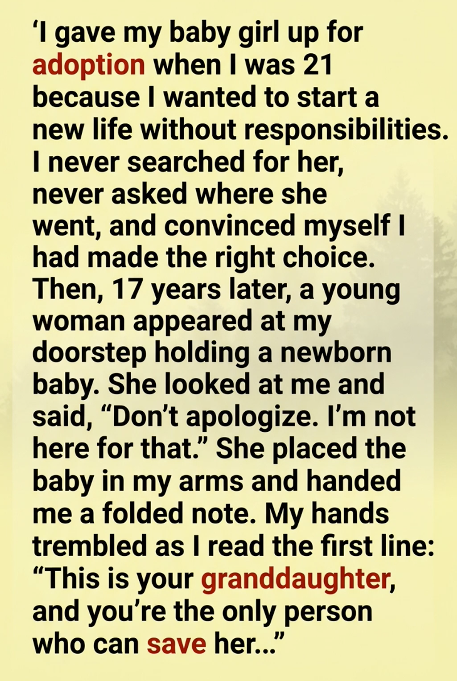
I was twenty-one when I gave my baby girl up for adoption.
I told myself I was doing the responsible thing.
The truth was harder to admit.
I wanted my freedom.
I wanted to start over.
I wanted to go to college, build a career, travel, date, and live a life without diapers, doctor appointments, and the endless responsibility of raising a child.
When my daughter was born, I held her for only a few minutes.
She was tiny.
Quiet.
Her fingers wrapped around mine.
The nurse asked if I wanted to name her.
I did.
I called her Emma.
Then I signed the adoption papers.
I never searched for her.
I never asked where she went.
I never tried to contact the agency.
Whenever guilt appeared, I pushed it away.
I told myself she had a better life without me.
And eventually, I convinced myself I had made the right choice.
I built the life I’d wanted.
I went to college.
I found a good job.
I bought a small house.
I married.
I divorced.
I made friends.
I traveled.
I celebrated birthdays without thinking about the one I had missed.
For seventeen years, I rarely allowed myself to wonder about Emma.
Then one rainy evening, someone knocked on my door.
I opened it.
A young woman stood outside.
She couldn’t have been more than seventeen or eighteen.
She looked exhausted.
Her hair was soaked.
She was holding a newborn baby wrapped in a pale blanket.
I stared at her.
“Can I help you?”
She looked directly at me.
Then she said,
“Don’t apologize.”
I frowned.
“What?”
“I’m not here for that.”
She stepped forward.
Then she placed the newborn in my arms.
My entire body went numb.
I looked down at the baby.
She was asleep.
Tiny.
Perfect.
The young woman pulled a folded piece of paper from her pocket.
“Read this.”
My hands trembled as I opened it.
The first line made my heart stop.
This is your granddaughter, and you’re the only person who can save her.
I looked at the young woman.
“Who are you?”
She swallowed.
“I’m Emma.”
I nearly dropped the note.
My daughter.
The baby in my arms was my granddaughter.
I looked at her face.
For seventeen years, I’d wondered what my daughter might look like.
I had never imagined I’d meet her like this.
“What happened?”
Emma stepped inside.
She was shivering.
I closed the door.
She sat at the kitchen table.
I put the baby in a bassinet I’d kept from when my niece was born.
Then I sat across from her.
“Tell me everything.”
Emma looked at the floor.
“I found out about you six months ago.”
“How?”
“My adoptive parents told me.”
I felt my stomach tighten.
“Are they okay?”
“They’re wonderful.”
She hesitated.
“But they aren’t my biological parents.”
I nodded.
“Did you look for me?”
“Yes.”
“Why?”
“Because I wanted to know where I came from.”
I couldn’t meet her eyes.
“And you found me.”
“Yes.”
“Why now?”
She looked toward the baby.
“Because I didn’t know who else to trust.”
Then she handed me another document.
It was a medical report.
I read it.
The baby had been diagnosed with a rare heart condition.
“She needs surgery,” Emma whispered.
I looked at her.
“How much?”
“More than I can afford.”
“Where is the baby’s father?”
“He’s gone.”
“Your adoptive parents?”
“They’re helping, but…”
She stopped.
“But what?”
“They’re already paying for my medical care.”
I looked at the baby.
“What does the note mean by I’m the only person who can save her?”
Emma took a deep breath.
“Because the doctor said she needs a specific type of transplant.”
My heart sank.
“Transplant?”
“Yes.”
“From whom?”
“A biological relative.”
I stared at her.
“Me?”
She nodded.
“The doctors said you might be a compatible donor.”
I couldn’t speak.
The same child I had abandoned seventeen years earlier had come back carrying a baby who might die without me.
I wanted to believe it was fate.
But I also knew that biology doesn’t guarantee compatibility.
We needed testing.
Immediately.
The next morning, we went to the hospital.
Emma sat beside me in the waiting room.
Neither of us knew what to say.
Finally, she whispered,
“Do you hate me?”
I looked at her.
“No.”
“You barely know me.”
“I know.”
She looked down.
“I hated you.”
I nodded.
“You had every right.”
She looked surprised.
“You’re not angry?”
“I don’t think I get to be.”
She started crying.
“I spent years wondering why you didn’t want me.”
I swallowed hard.
“I was selfish.”
She looked at me.
“I wanted a different life.”
“Without me?”
“Yes.”
She wiped her eyes.
“I always wondered what was wrong with me.”
I felt something inside me break.
“There was nothing wrong with you.”
“Then why?”
“Because I was twenty-one and afraid.”
She stared at me.
“I thought I was choosing freedom.”
“And now?”
I looked toward the nursery.
“Now I realize I didn’t understand what I was giving away.”
The doctors ran the tests.
The results came back two days later.
I was a partial match.
Not perfect.
But enough to make further treatment possible.
The doctor explained the risks.
The procedure would be difficult.
There were no guarantees.
I didn’t hesitate.
“I’ll do it.”
Emma stared at me.
“You don’t have to.”
“I know.”
“Then why?”
I looked at her.
“Because she’s my granddaughter.”
Emma began crying.
“And because,” I added quietly, “I owe you more than an apology.”
The transplant wasn’t immediate.
The baby needed to be stabilized first.
During those weeks, Emma and I spent more time together than we had ever imagined.
I learned about her life.
She loved photography.
She played piano.
She hated coffee.
She loved thunderstorms.
She had a habit of tapping her fingers when she was nervous.
I learned that her adoptive parents had loved her deeply.
They weren’t villains.
They had raised her.
They had protected her.
And when she discovered the truth about me, they hadn’t tried to stop her from searching.
That mattered.
One evening, Emma asked me,
“Did you ever think about me?”
I told her the truth.
“Yes.”
“How often?”
I looked at her.
“More than I admitted.”
“Then why didn’t you look for me?”
I took a breath.
“Because I was afraid that if I looked, I’d have to face what I’d done.”
She nodded.
“That makes sense.”
I didn’t expect forgiveness.
But hearing those words still hurt.
Then she said,
“I don’t forgive you yet.”
I nodded.
“That’s okay.”
“But I want to know you.”
I smiled.
“That would be enough.”
The baby’s condition worsened.
The doctors scheduled the procedure.
The night before surgery, Emma sat beside me in the hospital.
She held my hand.
“I keep thinking about that first line.”
“What line?”
She smiled sadly.
“This is your granddaughter, and you’re the only person who can save her.”
“I’ve thought about it too.”
“I wasn’t trying to manipulate you.”
“I know.”
“I was terrified.”
“I know.”
She looked at me.
“Do you think you would have come if I hadn’t brought her?”
I knew exactly what she was asking.
I answered honestly.
“I don’t know.”
She nodded.
“That hurts.”
“It should.”
She squeezed my hand.
“But I came now.”
She looked at me.
“And I’m not leaving again.”
The surgery lasted several hours.
I waited outside.
Every minute felt like an hour.
Eventually, the surgeon came out.
He smiled.
“The procedure went well.”
I nearly collapsed with relief.
The baby was transferred to intensive care.
She slowly improved.
Weeks later, she was strong enough to go home.
Emma chose a name.
Lily.
I asked why.
She smiled.
“Because lilies grow even after winter.”
I cried when she told me.
Not because I believed I had earned forgiveness.
Because I realized my granddaughter had survived.
And my daughter was still giving me a chance to know her.
Months passed.
Lily grew stronger.
Emma returned to college.
She continued studying photography.
She began visiting me regularly.
Sometimes we talked about the past.
Sometimes we didn’t.
There were difficult days.
There were days when Emma became angry.
There were days when I wondered whether I’d ever truly become her mother in anything other than biology.
But I kept showing up.
I attended her photography exhibitions.
I helped with Lily.
I celebrated Emma’s birthday.
I learned her favorite songs.
I listened when she needed to talk.
I never demanded forgiveness.
One afternoon, nearly a year after she first appeared at my door, Emma came to my house carrying Lily.
Lily was walking now.
She toddled across the living room and grabbed my finger.
Emma smiled.
“She’s stubborn.”
I laughed.
“Where do you think she got that?”
Emma rolled her eyes.
Then she sat beside me.
“I want to tell you something.”
“What?”
“I forgive you.”
I looked at her.
“You don’t have to.”
“I know.”
She smiled.
“But I do.”
I started crying.
She hugged me.
For the first time, I held my daughter without wondering whether she would disappear.
She didn’t.
She stayed.
Years later, I still think about the woman I was at twenty-one.
I don’t hate her.
She was young.
She was frightened.
She made a decision she believed would give her a better life.
But she was wrong about one thing.
She thought responsibility was the thing she was giving up.
She didn’t understand that she was giving up a relationship.
A person.
A future she couldn’t imagine yet.
I can’t change the seventeen years I missed.
I can’t give Emma back her childhood.
I can’t erase every birthday she celebrated without me.
But I can make sure she never again wonders whether I want her in my life.
And Lily will grow up knowing exactly who I am.
Her grandmother.
The woman who once walked away.
The woman who was given a second chance.
The woman who will never walk away again.
Sometimes I look at the old adoption papers.
I keep them in a box.
For years, they represented the biggest decision of my life.
Now they represent something else.
Proof that one terrible choice doesn’t have to become the final chapter of your story.
Seventeen years after I gave my daughter away, she came back to my doorstep carrying her own daughter.
She didn’t ask me for money.
She didn’t ask me for an apology.
She didn’t even ask me to become her mother again.
She simply said:
“Don’t apologize. I’m not here for that.”
Then she placed a tiny baby in my arms.
And handed me a note that began:
“This is your granddaughter, and you’re the only person who can save her.”
That night, I thought I was being asked to save a baby.
I didn’t realize I was being given the chance to save something else, too.
The relationship with the daughter I had spent seventeen years convincing myself I could live without.
And this time, I chose her.