When my father died, I already knew there would be an argument over the inheritance.
What I didn’t expect was how quickly my half-sister would make it clear that she believed she deserved everything.
My father had been married twice.
My mother died when I was young.
Years later, he married my stepmother, and they had my half-sister, Claire.
Claire was always treated differently.
She was the favorite.
I don’t say that because I’m bitter.
It’s simply the truth.
Dad paid for her college.
He helped her buy her first house.
When she had children, he was there for everything.
I never asked him for much.
I worked.
I paid my own bills.
I built my own life.
But I still loved him.
And despite our differences, I believed he loved me too.
When he became sick, I spent as much time with him as I could.
Claire visited too, but she was often busy with her children.
Dad never complained.
He always defended her.
“She has a lot on her plate,” he’d say.
I understood.
Or at least I tried to.
Then he died.
The funeral was difficult.
Afterward, the lawyer gathered us together to read the will.
Claire sat beside her husband.
I sat alone.
The lawyer opened the document.
Dad had left the house to Claire.
The savings.
The investment accounts.
His car.
His collection of watches.
His jewelry.
His valuable tools.
Even several pieces of artwork.
Claire’s mouth slowly curled into a smile.
Then the lawyer said,
“There is one additional item.”
He looked at me.
“An old cactus plant.”
Claire laughed.
I stared at the lawyer.
“A cactus?”
“Yes.”
“It belongs to you,” he said.
Claire burst out laughing.
“I have children,” she said.
“Dad knew who deserved his legacy.”
Then she looked at me.
“At least the plant can keep you company.”
Everyone went quiet.
I didn’t argue.
I didn’t ask Dad why.
I simply stood up.
“Fine.”
I took the cactus home.
It was an old plant.
Probably decades old.
It sat in a cracked clay pot.
The cactus itself was surprisingly healthy.
Dad had kept it beside the kitchen window for as long as I could remember.
When I was little, he used to tell me,
“Some things survive because they’re stronger than they look.”
I never understood what he meant.
Now I wondered.
Four days after the funeral, Claire called me.
“I want the cactus.”
I laughed.
“What?”
“The cactus.”
“Why?”
“Because Dad wanted me to have it.”
“You told me it was worthless.”
She went silent.
Then she said,
“Please give it to me.”
“No.”
“You don’t understand.”
“I understand perfectly.”
“Please.”
“I said no.”
She became angry.
“You’re being ridiculous.”
I hung up.
For the next few days, she called repeatedly.
I refused every time.
It made no sense.
She had inherited a house worth hundreds of thousands of dollars.
She had received Dad’s savings.
His investments.
His valuables.
Why did she suddenly care about an old cactus?
I decided to keep it.
Not because I thought it was valuable.
Because it was the last thing Dad had intentionally left me.
Seven weeks passed.
One Saturday morning, I decided to repot it.
The old pot was cracked.
The soil was dry.
I carefully lifted the cactus out.
As I brushed away the dirt, my fingers touched something hard.
I froze.
I dug around it.
It was a small metal container.
My heart began pounding.
I pulled it out.
Inside was a sealed envelope.
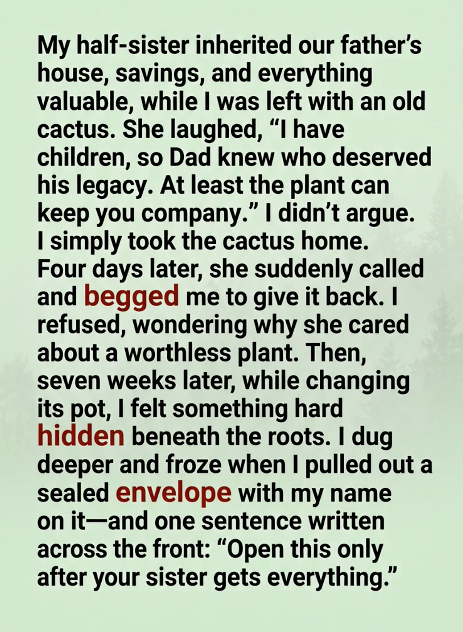
My name was written across the front.
Underneath were the words:
OPEN THIS ONLY AFTER YOUR SISTER GETS EVERYTHING.
I sat on the floor.
I couldn’t move.
Claire had inherited everything.
Exactly as the letter instructed.
I opened it.
The first line said:
My dear daughter, if you’re reading this, Claire has already received everything I promised her.
I started crying.
Dad continued.
I know you will think I’ve forgotten you. I haven’t.
I read slowly.
Every word felt like his voice.
He explained that he had deliberately written the will that way.
Claire was convinced she would inherit everything.
But Dad knew her well.
He knew she would immediately take whatever had obvious financial value.
The cactus was different.
He knew Claire would mock it.
He knew she wouldn’t want it.
Until she realized there might be something hidden inside.
Then I reached the next paragraph.
The cactus isn’t valuable. What’s beneath it is.
My hands began shaking.
The metal container had a key inside.
The letter told me where to use it.
A safety-deposit box at a bank.
The number was written underneath.
I drove there that afternoon.
The box contained several documents.
The first was a copy of my father’s original financial records.
The second was a list of assets.
The third made my heart stop.
It showed that my father had secretly created an investment account in my name.
It contained a substantial amount of money.
The account had been growing for more than twenty years.
But that wasn’t all.
There were property documents.
A small commercial building.
A piece of land.
Several investment certificates.
And one handwritten note.
These are yours.
I stared at it.
Dad had not forgotten me.
He had protected my inheritance from someone who would have taken it.
But why had he hidden it?
The answer came in another letter.
Dad explained that years earlier, Claire had discovered he intended to divide his estate equally between us.
She had become furious.
She told him that she had children and deserved more.
She threatened to stop speaking to him if he didn’t change the will.
Dad had been devastated.
But instead of fighting with her, he created a plan.
He would leave Claire the visible assets.
The house.
The accounts she knew about.
The valuables.
And he would leave me something Claire wouldn’t understand.
The cactus.
Because inside its old pot was the key to everything else.
I started crying.
Not because of the money.
Because Dad had known exactly how Claire would treat me.
And he had found a way to protect me without publicly humiliating her.
Then I found another document.
A letter addressed to Claire.
It said:
You will probably believe your sister received nothing. That is intentional.
Dad explained that he wanted Claire to understand the consequences of judging someone’s worth by what they inherited.
But there was a condition.
If Claire came to me asking for the cactus, I was supposed to give her one final envelope.
I hadn’t found that envelope yet.
I returned home and searched the metal container.
There was a second key.
It opened a small compartment in the cactus pot itself.
Inside was another envelope.
This one was addressed to Claire.
I didn’t open it.
Instead, I called her.
“Come over.”
She arrived within an hour.
The moment she saw the cactus, her face changed.
“You found it.”
I stared at her.
“You knew?”
She lowered her eyes.
“I knew Dad had hidden something.”
“How?”
“He told me once that the cactus mattered.”
“Then why did you laugh?”
She didn’t answer.
I continued.
“Why did you want it?”
“Because I thought he might have hidden money inside.”
There it was.
The truth.
She hadn’t wanted the cactus because she loved Dad.
She wanted it because she thought it contained something valuable.
I handed her the envelope.
“This is from Dad.”
She stared at it.
Then opened it.
Her eyes moved across the page.
Slowly, she began crying.
I watched her read.
When she finished, she whispered,
“He knew.”
“Yes.”
“He knew I would do this.”
“Yes.”
She sat down.
For the first time since the funeral, she looked less like my father’s favored daughter and more like the little girl I remembered.
“I was horrible to you.”
“Yes.”
“I thought Dad loved me more.”
“He didn’t.”
She looked at me.
“What?”
“He loved us differently.”
She began crying harder.
I sat across from her.
“Dad knew you would fight over money.”
She wiped her face.
“I did.”
“And he knew I’d never fight you for it.”
She nodded.
“He was right.”
There was a long silence.
Then she asked,
“How much did he leave you?”
I smiled.
“Enough.”
She looked embarrassed.
“More than the house?”
“Yes.”
“More than the savings?”
“Yes.”
She lowered her head.
“I feel terrible.”
“You should.”
She looked at me.
“But I don’t hate you.”
She started crying again.
“I don’t deserve that.”
“Maybe not.”
I paused.
“But you’re still my sister.”
The money Dad left me changed my life.
I paid off my mortgage.
I invested the rest.
But I didn’t spend it recklessly.
I kept the cactus.
I moved it into a beautiful ceramic pot.
And I placed it beside a framed photograph of my father.
Claire eventually apologized properly.
Not for losing money.
Not because she had been caught.
Because she finally understood what she had done.
She admitted that she had spent years believing Dad’s love was something she had to compete for.
She had measured everything.
Who got more.
Who got less.
Who was more important.
And in doing so, she had become exactly the kind of person Dad had feared she would become.
We didn’t instantly become close.
Trust doesn’t return because someone says sorry.
But we slowly rebuilt our relationship.
Sometimes she came over with her children.
They loved the cactus.
One day, her youngest asked,
“Why is that plant so special?”
Claire looked at me.
I smiled.
“Because Grandpa left it to me.”
The little boy frowned.
“Why?”
Claire answered quietly.
“Because sometimes the thing that looks worthless is the thing that’s worth the most.”
I looked at her.
She smiled.
For the first time, I believed she understood.
Years later, the cactus is still alive.
It’s bigger now.
Healthier.
Every time I water it, I think about my father.
He could have left me a house.
He could have left me a fortune.
Instead, he left me something that taught me a lesson.
People often judge inheritance by what they can see.
A house.
A bank account.
Jewelry.
Cars.
Land.
But my father knew something my sister didn’t understand.
The most valuable things aren’t always the things that look valuable.
He knew Claire would grab everything she could see.
He knew I would take the cactus without asking questions.
And he knew that eventually, I’d discover the truth.
Seven weeks after the funeral, I found that sealed envelope beneath the roots.
The first sentence was simple:
“Open this only after your sister gets everything.”
For years, I had wondered whether my father loved my sister more than me.
Now I know the truth.
He didn’t give her everything because she deserved more.
He gave her everything she thought she wanted.
And he gave me something far more important.
He left me the truth—and enough love to make sure I would find it.