Two years ago, my sister called me crying.
I almost didn’t recognize her voice.
My sister, Rachel, had always been the proud one.
She hated asking for help.
She was the person who insisted she could handle everything herself.
But that night, she was terrified.
“Please,” she said.
“What happened?”
“We’re going to lose the house.”
I sat up.
“What?”
Rachel’s husband, Mark, had lost his business months earlier.
They had fallen behind on their mortgage.
Late notices had turned into legal notices.
Now the bank was preparing to repossess the house.
Rachel told me they had one chance.
They needed $420,000 immediately.
I nearly dropped the phone.
“Rachel, that’s not a small amount.”
“I know.”
“Where are you going to get it?”
“We can’t.”
There was silence.
Then she whispered,
“You’re the only person we can ask.”
I had savings.
I’d invested carefully for years.
I had never spent much.
I didn’t have children.
I lived simply.
So I had enough.
But $420,000 was still a huge amount.
“What’s your plan to repay me?”
“We’ll sell the business.”
Mark had another company he was trying to restart.
“We’ll pay you back as soon as we’re stable.”
I asked,
“Can you put that in writing?”
Rachel became quiet.
Then she said,
“You don’t trust us?”
I sighed.
“That’s not what I mean.”
“We’re family.”
Her husband got on the phone.
“Give us a chance. We’ll never forget this.”
I should have insisted on a contract.
I should have hired a lawyer.
I should have protected myself.
Instead, I transferred the money.
Every dollar.
The bank confirmed the transfer.
Their mortgage was paid.
The foreclosure process stopped.
Rachel called me crying.
“You saved our family.”
I told her,
“Just pay me back when you can.”
She promised.
Mark promised.
My mother even told me,
“You’ll never regret helping your sister.”
For the first year, I didn’t.
Rachel and Mark seemed grateful.
They invited me to dinner.
They sent me birthday gifts.
They thanked me constantly.
Then things changed.
Mark’s business recovered.
They bought a new car.
Then another.
They renovated the kitchen.
They took a vacation.
I didn’t complain.
I figured they were rebuilding.
But after two years, I needed my money back.
My investments had matured.
I had plans of my own.
So I called Rachel.
“Can we talk about the $420,000?”
She became strangely quiet.
“What about it?”
“I need to start getting it back.”
“Getting what back?”
I thought I’d misheard her.
“The money I loaned you.”
She laughed.
Not nervously.
Not awkwardly.
She actually laughed.
“Loaned?”
“Yes.”
“Who says it was a loan?”
I felt cold.
“You do.”
“When?”
“You and Mark both told me you’d repay me.”
“We never signed anything.”
I stared at the wall.
“You’re serious?”
Rachel sighed.
“You gave us the money.”
“I gave it to you to save the house.”
“Yes.”
“You promised to repay me.”
“Promises aren’t contracts.”
I couldn’t believe what I was hearing.
I called Mark.
He gave me the same answer.
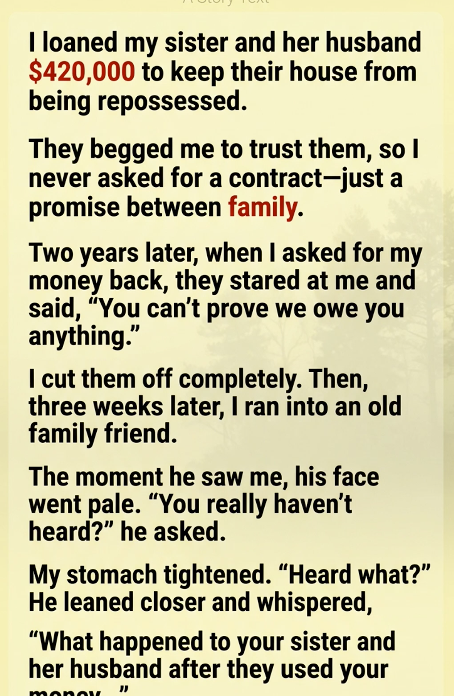
“You can’t prove we owe you anything.”
I said,
“I have the bank transfer.”
“That proves you transferred money.”
“It went directly to your mortgage.”
“That doesn’t prove it was a loan.”
My hands were shaking.
“You’re really doing this?”
Mark said,
“You gave it to us.”
Then he hung up.
I sat alone in my apartment.
For hours.
I couldn’t understand how the people I had trusted with $420,000 could look me in the eye and deny everything.
I contacted my mother.
She didn’t want to get involved.
She said,
“You should work it out between yourselves.”
I realized then that I was completely alone.
So I cut them off.
I blocked Rachel.
I blocked Mark.
I stopped attending family gatherings.
I stopped answering my mother’s calls.
If my own family wanted to pretend the money had never been a loan, I decided I would pretend they no longer existed.
Three weeks later, I ran into an old family friend.
His name was David.
He had known our family for decades.
We ran into each other at a coffee shop.
He smiled when he saw me.
Then his expression changed.
He looked almost frightened.
“You really haven’t heard?”
I frowned.
“Heard what?”
He leaned closer.
“What happened to your sister and her husband after they used your money…”
My stomach tightened.
“What happened?”
David looked around.
“Are you sure you don’t know?”
“Know what?”
He lowered his voice.
“They lost the house.”
I stared at him.
“What?”
“They’re not living there anymore.”
“That doesn’t make sense. I paid off their mortgage.”
David shook his head.
“You paid the mortgage.”
He paused.
“But they didn’t own the house outright.”
“What do you mean?”
He explained that after I gave Rachel the money, she and Mark had taken out another loan against the property.
I couldn’t believe it.
“They borrowed more money?”
“Yes.”
“How much?”
David gave me a number.
My stomach dropped.
They had taken out hundreds of thousands more.
And then they’d invested the money in Mark’s business.
The business failed again.
They couldn’t repay the new loan.
The house was eventually repossessed.
But that wasn’t the worst part.
David continued.
“They also sold several things.”
“What things?”
“Your sister’s jewelry.”
“Why?”
“To pay debts.”
I sat down.
I couldn’t understand.
“If they were in trouble, why didn’t they tell me?”
David looked at me.
“Because they didn’t want you to know.”
“Why?”
He hesitated.
“Because your $420,000 wasn’t enough.”
I stared at him.
“What do you mean?”
“They had already been in much worse financial trouble than they told you.”
My blood ran cold.
Rachel hadn’t needed $420,000 to save the house.
She had needed it to delay the collapse.
I asked David how he knew.
He told me that Mark had confessed to him months earlier.
Mark’s business had been drowning in debt.
The mortgage wasn’t the only problem.
There were unpaid taxes.
Business loans.
Creditors.
Private debts.
The $420,000 had been used to pay the most urgent ones.
The mortgage was simply the most visible.
Then David said something that made me sick.
“They were planning to sell the house.”
“To repay me?”
“No.”
“To keep the profit.”
I couldn’t speak.
They had never intended to repay me.
They had seen my money as a gift.
A lifeline.
Something they could take because I was family.
But then David revealed something else.
“They’re being sued.”
“By whom?”
“Several creditors.”
The business had collapsed completely.
Mark had allegedly transferred assets into another person’s name.
Rachel had signed documents she shouldn’t have.
And now they were facing legal consequences.
I asked,
“Where are they living?”
David gave me an address.
I didn’t go.
I didn’t want to see them.
Instead, I called an attorney.
I showed him the bank transfer.
My messages with Rachel.
Emails.
Bank records.
And every piece of evidence I had.
The attorney told me something important.
Even without a signed contract, a large transfer accompanied by communications indicating it was a loan could potentially support a civil claim.
But we needed evidence.
I remembered something.
The day I transferred the money, I had sent Rachel a message.
“The $420,000 has been transferred. Please confirm when you receive the loan.”
She had replied:
“Received. We owe you our lives. We’ll pay every cent back.”
I still had the message.
Then I found another.
Six months later, Rachel had written:
“We’ll start paying you once Mark’s company is profitable again.”
My attorney smiled.
“That helps.”
We filed a lawsuit.
Rachel and Mark denied everything.
Then their own financial records were subpoenaed.
That’s when the truth came out.
They had known the house was in danger.
They had known they couldn’t afford the mortgage.
They had taken my money.
Then they had immediately transferred part of it into another account.
They had used some to pay business creditors.
Some to purchase equipment.
And some to cover personal expenses.
The house was never truly saved.
It was only temporarily rescued.
Eventually, it was sold.
And they had kept the proceeds from the sale rather than repaying me.
The evidence was overwhelming.
The court ruled in my favor.
Rachel and Mark were ordered to repay the money, along with damages and legal costs.
They didn’t have the full amount.
So the repayment became a long process.
Assets were sold.
Accounts were examined.
Property was liquidated.
The money eventually began coming back.
But something strange happened during the case.
Rachel contacted me.
She asked to meet.
I refused.
She called again.
“Please.”
I finally answered.
“What?”
“I want to apologize.”
“You lied to me.”
“I know.”
“You told me I couldn’t prove anything.”
“I was scared.”
“You weren’t scared. You were confident.”
She started crying.
“We thought we’d recover.”
“You thought you’d recover without paying me.”
Silence.
Then she admitted it.
“We thought because you had money and no children, you wouldn’t need it as much as we did.”
That sentence hurt more than anything else.
They hadn’t just stolen money.
They had assigned a value to my life.
Because I didn’t have children, they believed my future mattered less.
I told her,
“You weren’t entitled to my money because I don’t have children.”
“I know.”
“You don’t get to decide what I need.”
“I know.”
“And you don’t get to turn my generosity into a weakness.”
She cried.
I hung up.
Years later, most of the money had been recovered.
Not all at once.
Not easily.
But enough.
Rachel and Mark eventually separated.
Their marriage didn’t survive the financial disaster.
The house was gone.
The business was gone.
Their lifestyle was gone.
I never celebrated their downfall.
I didn’t want revenge.
I wanted accountability.
There is a difference.
I still remember that coffee shop.
David looking at me with that strange expression.
“You really haven’t heard?”
And then:
“What happened to your sister and her husband after they used your money…”
At the time, I thought the worst thing they’d done was refuse to repay me.
I was wrong.
The worst thing was that they had believed my kindness meant I was weak.
They believed family meant I wouldn’t protect myself.
They believed that because I had helped them once, I would keep helping forever.
They were wrong.
I learned a painful lesson.
Love doesn’t mean refusing to protect yourself.
Trust doesn’t mean avoiding paperwork.
And family doesn’t automatically mean someone deserves access to everything you’ve worked for.
If I could go back, I would still help my sister.
But I would do it differently.
I’d put everything in writing.
I’d have a lawyer review it.
I’d establish a repayment schedule.
And I’d never again allow someone to shame me for asking for basic protection.
Because when I gave Rachel and Mark $420,000, I wasn’t buying their gratitude.
I was helping people I loved.
They chose to turn that help into betrayal.
And eventually, the truth came out.
The money they claimed I couldn’t prove they owed me became the same money trail that exposed everything they’d been hiding.
The bank transfer.
The messages.
The financial records.
All of it.
And when the judge ordered them to repay me, I didn’t feel victorious.
I felt relieved.
Because I finally understood something I’d forgotten the day I transferred that money.
Being generous doesn’t mean being foolish.
And sometimes the most important boundary you can draw isn’t between strangers.
It’s between you and the people who believe loving them means you’ll never say no.