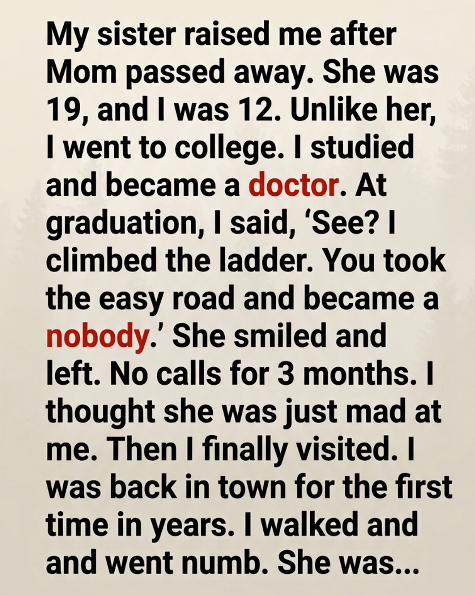
My sister raised me.
That is the sentence I should have started with.
Not “My sister didn’t go to college.”
Not “My sister stayed in our hometown.”
Not “My sister took the easy road.”
Just this:
My sister raised me.
When Mom died, I was twelve.
My sister, Anna, was nineteen.
She was barely an adult herself.
She had dreams.
She wanted to travel.
She wanted to study nursing.
She wanted to get married someday.
But she put everything aside for me.
She found a small apartment.
She worked two jobs.
She packed my lunches.
She learned how to stretch one paycheck across an entire month.
When I got sick, she stayed awake all night beside me.
When I was scared, she told me everything would be okay.
And when I asked whether she was going to college, she smiled and said,
“Maybe someday.”
I didn’t understand what “someday” meant.
I thought it meant next year.
Then the years passed.
I graduated high school.
I got a scholarship.
I went to college.
Anna stayed home.
She worked.
She paid my tuition whenever my scholarship didn’t cover everything.
She mailed me care packages.
She called every Sunday.
Sometimes I’d complain about exams.
She’d laugh and say,
“You’ll get through it.”
I eventually entered medical school.
It was difficult.
There were nights when I wanted to quit.
Anna never let me.
“You’ve come too far.”
She’d say.
“Keep going.”
So I did.
Years later, I graduated as a doctor.
My entire family attended the ceremony.
Anna sat in the front row.
She was crying.
I walked toward her afterward.
She hugged me.
“I knew you’d do it.”
I should have hugged her back.
Instead, I made the cruelest mistake of my life.
I looked at her and said,
“See? I climbed the ladder.”
She smiled.
Then I added,
“You took the easy road and became a nobody.”
Her smile disappeared.
For a second, I thought she hadn’t heard me.
She had.
She simply nodded.
“Congratulations, Doctor.”
Then she walked away.
I didn’t follow her.
I didn’t apologize.
I told myself she’d get over it.
She didn’t call the next day.
Or the next week.
Three months passed.
I thought she was angry.
I thought she’d eventually forgive me.
Then I finally returned to our hometown.
I hadn’t been back in years.
I drove past the old apartment.
Then I walked toward the neighborhood where Anna had lived.
I expected to find the same little house she’d rented after Mom died.
Instead, I saw something enormous.
A large modern building stood where the old grocery store used to be.
A sign was mounted above the entrance.
I stopped walking.
My stomach dropped.
The sign read:
ANNA HARRIS FAMILY & COMMUNITY MEDICAL CENTER
I stared at it.
My sister’s name.
On a medical center.
I walked inside.
The receptionist smiled.
“Welcome.”
I looked around.
There were children playing in a waiting area.
Nurses moving between rooms.
Doctors speaking with patients.
A pharmacy.
A dental clinic.
A counseling office.
I couldn’t understand.
“Who owns this place?”
The receptionist smiled.
“Dr. Harris.”
“Dr. Harris?”
“Yes. Anna Harris.”
My legs felt weak.
“She’s here?”
“She should be in the pediatric wing.”
I walked down the hallway.
Then I saw her.
Anna was wearing a white coat.
She was standing beside a young doctor, reviewing a patient’s chart.
She looked older.
Confident.
Completely different from the nineteen-year-old girl who had once packed my school lunches.
She turned.
Saw me.
And froze.
“Anna.”
She didn’t answer.
I walked toward her.
“What is this?”
She looked around.
“My clinic.”
“You built this?”
“Yes.”
“How?”
She smiled faintly.
“Hard work.”
I couldn’t speak.
Then I noticed a framed photograph on the wall.
It showed Anna receiving an award.
Underneath it was a plaque.
Founder and Director — Anna Harris Foundation
I stared at it.
“What foundation?”
She looked uncomfortable.
“The foundation funds medical care for families who can’t afford it.”
I looked around.
“How many patients?”
“About three hundred a month.”
“And you run all this?”
“Yes.”
“But you never went to college.”
“No.”
“How did you become…”
I couldn’t finish.
She smiled.
“You thought college was the only way to climb.”
I lowered my head.
She continued.
“After you left for college, I started a cleaning business.”
I looked at her.
“What?”
“I cleaned offices at night.”
She explained that the business grew.
She hired other people.
Then she started buying small properties.
She invested the profits.
Eventually, she sold the company.
With the money, she created the foundation.
Then she opened the clinic.
“Why medicine?”
She looked at me.
“Because of Mom.”
I froze.
“What?”
“She didn’t have good medical care before she died.”
Anna looked around.
“I promised myself that if I ever had the chance, I’d make sure other families didn’t have to choose between food and medical treatment.”
I felt something break inside me.
“You never told me.”
“You were busy becoming a doctor.”
I swallowed.
“And you were…”
“Building something.”
I looked at the clinic again.
It was beautiful.
Children were being treated.
Families were receiving free medication.
Doctors were working.
My sister had created something larger than anything I had imagined.
Then I saw another photograph.
It showed a group of children.
Underneath it was written:
Scholarship recipients — Harris Foundation
“What’s this?”
“Education scholarships.”
“How many?”
“More than two hundred.”
I stared at her.
She smiled.
“I didn’t go to college.”
“But you made sure other people could.”
She shrugged.
“I know what it feels like to have to choose.”
I couldn’t look at her.
I finally understood.
I had spent years believing I was the successful one.
I was the doctor.
She was the sister who stayed behind.
I had mistaken sacrifice for failure.
I had mistaken a different path for an easier one.
And the person I called a nobody had built a place where hundreds of people were getting second chances.
I began crying.
“Anna…”
She looked at me.
“I was horrible to you.”
“Yes.”
“I don’t know why I said that.”
“I do.”
She paused.
“You wanted to believe you had done it alone.”
I looked at her.
She wasn’t angry.
That somehow made it worse.
“You didn’t do it alone,” she continued.
“You had people helping you.”
“I know.”
“I was one of them.”
My voice broke.
“You were more than one of them.”
She smiled sadly.
“You’re my little brother.”
I started crying.
“I never should have called you a nobody.”
“No.”
“I thought I was better than you.”
“You were never better than me.”
She paused.
“You were just doing something different.”
I hugged her.
For a few seconds, neither of us moved.
Then I whispered,
“I’m sorry.”
She said,
“I know.”
But I wasn’t finished.
“I want to help.”
She pulled away.
“With what?”
“This.”
I pointed around the clinic.
“I want to work here.”
She laughed.
“You already have a job.”
“I know.”
“I don’t need another doctor.”
“Maybe not.”
I smiled.
“But your patients might.”
She looked at me for a long time.
Then she nodded.
“Okay.”
That was how we started rebuilding our relationship.
Not overnight.
Not perfectly.
But honestly.
I began volunteering at the clinic on weekends.
I saw what Anna had built.
She didn’t just provide medical care.
She paid school fees.
She helped single parents find jobs.
She provided food.
She funded emergency surgeries.
She helped elderly people get medication.
And she never advertised herself.
Most people in town simply called her “Miss Anna.”
One afternoon, I asked her how she had managed to accomplish all of it without a degree.
She laughed.
“You don’t need a diploma to care about people.”
I smiled.
“No.”
“You just need to actually do something.”
That sentence stayed with me.
Months later, the clinic held its annual fundraiser.
Hundreds of people came.
Former patients.
Doctors.
Teachers.
Families.
Children who had received scholarships.
Anna stood on the stage.
She looked uncomfortable with the attention.
Then she invited me up.
I had no idea why.
She handed me the microphone.
I looked at the crowd.
Then at my sister.
And I told them the truth.
“When I was twelve, this woman gave up her youth to raise me.”
“She could have gone to college.”
“She could have traveled.”
“She could have built a completely different life.”
“Instead, she worked so I could have mine.”
I paused.
“Years later, when I became a doctor, I made the mistake of thinking my education made me more successful than her.”
I looked at Anna.
“I called her a nobody.”
The room went silent.
“She never argued with me.”
“She simply walked away and continued building this.”
I gestured toward the clinic.
“This place is her answer.”
I turned to my sister.
“And I’m sorry.”
Anna smiled.
Then she hugged me on stage.
The audience applauded.
But I barely heard them.
Because for the first time, I wasn’t looking at my sister as the woman who sacrificed her future for mine.
I was looking at her as my equal.
Maybe even my teacher.
A year later, Anna received an honorary degree from the local university.
She laughed when she told me.
“Now I finally have a diploma.”
I smiled.
“You never needed one.”
She raised an eyebrow.
“Careful.”
I laughed.
“You’re right.”
She looked at the diploma.
“Mom would have liked this.”
I nodded.
“She’d have been proud.”
“Of you too.”
I shook my head.
“No.”
“Both of us.”
I smiled.
“Both of us.”
Today, I’m still a doctor.
Anna is still the director of the medical center.
But I no longer measure success by degrees, titles, salaries, or status.
Because my sister taught me something I should have understood when I was twelve.
There are people who climb ladders.
And there are people who build ladders for everyone else.
I spent years climbing mine.
My sister spent those same years building one.
And when I finally returned home and saw what she’d become, I realized how deeply I’d misunderstood her.
I thought she had taken the easy road.
The truth?
She took the harder road so I could take mine.
I thought I had become somebody.
But standing inside the medical center she’d built, surrounded by people whose lives she had changed, I finally understood who the real nobody had been.
It wasn’t my sister.
It was the version of me who had been too arrogant to recognize what she had done for me.
And when Anna smiled and forgave me, I realized something else.
The greatest achievement of my life wasn’t becoming a doctor.
It was finally becoming worthy of the sister who made it possible.