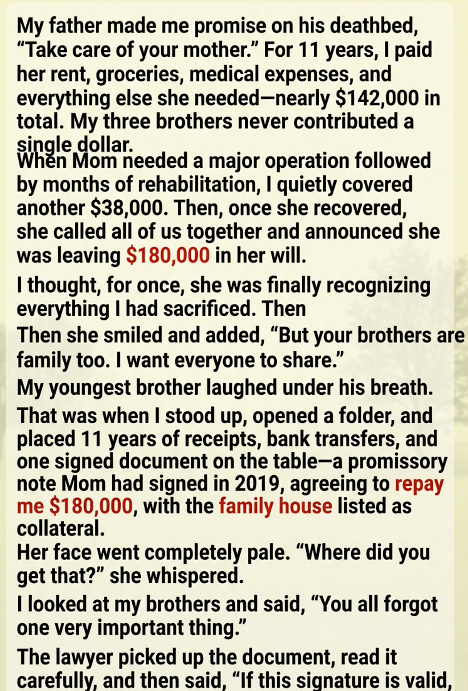
My father made me promise on his deathbed:
“Take care of your mother.”
He didn’t ask my three brothers.
He looked directly at me.
And I said yes.
I was thirty-eight years old.
My brothers were thirty-six, forty-one, and forty-three.
All of us were adults.
All of us had jobs.
All of us had families.
But somehow, after my father died, taking care of Mom became my responsibility.
At first, I didn’t mind.
She was my mother.
I loved her.
So I paid her rent.
Then groceries.
Then electricity.
Then medication.
Then medical appointments.
Then repairs around her house.
Then insurance premiums.
Then whatever else came up.
One expense became another.
One year became five.
Five years became eleven.
By the time I added everything together, I had spent nearly $142,000.
My brothers?
Not one dollar.
Not one.
Whenever I asked them to help, they always had an excuse.
“My kids need me.”
“I’m between jobs.”
“You’re closer to Mom.”
“You’re better with money.”
“She listens to you.”
Eventually, I stopped asking.
Then Mom needed a major operation.
The doctors said she would need months of rehabilitation afterward.
The estimated cost was around $38,000.
I paid it.
Every cent.
I remember sitting in the hospital parking lot afterward, looking at my bank account.
I had spent almost $180,000 on my mother over eleven years.
My retirement savings were smaller.
My house needed repairs.
I had postponed vacations.
I had turned down opportunities.
But I told myself the same thing every time:
She’s my mother.
Then she recovered.
And that’s when everything changed.
One Sunday afternoon, Mom called all four of us to her house.
She said she wanted to discuss her will.
I assumed she wanted us to know what she had planned.
My brothers arrived before me.
They were laughing in the living room when I walked in.
Mom was sitting in her favorite chair.
She looked healthier than she had in years.
“I have something important to tell you,” she said.
We sat down.
Mom folded her hands.
“I’ve decided what will happen to the house and my savings when I’m gone.”
The family house was worth roughly $360,000.
Mom had around $180,000 in liquid assets.
I immediately thought about the years I’d spent keeping her afloat.
Maybe she had finally recognized it.
Maybe she intended to repay me.
Maybe, for once, my brothers would understand.
Mom smiled.
“I’m leaving $180,000 in my will.”
My heart lifted.
Then she added:
“But your brothers are family too.”
My youngest brother laughed under his breath.
Mom continued.
“I want everyone to share equally.”
I stared at her.
Everyone.
Equal shares.
After eleven years of me paying everything.
I looked at my brothers.
None of them seemed uncomfortable.
My youngest brother actually smiled.
I felt something inside me go completely still.
Then I stood.
“Okay.”
Mom looked surprised.
“Okay?”
“Yes.”
I reached for the folder beside my chair.
I put it on the table.
Then I opened it.
“Before we discuss your will, I think everyone should see this.”
I pulled out receipts.
Bank transfers.
Medical invoices.
Rent payments.
Grocery records.
Insurance statements.
Rehabilitation bills.
Eleven years of proof.
I spread them across the table.
My oldest brother stopped smiling.
“What is all this?”
“Everything I paid for Mom.”
My middle brother leaned forward.
“How much?”
“Nearly $142,000 before her surgery.”
Then I placed another stack on the table.
“Another $38,000 after that.”
The room became silent.
I looked at Mom.
“You remember signing this?”
I pulled out one final document.
A promissory note.
Dated 2019.
Signed by Mom.
It stated that she owed me $180,000.
And the family house was listed as collateral.
Mom’s face went pale.
“Where did you get that?”
I looked at her.
“You signed it.”
My youngest brother laughed nervously.
“That’s ridiculous.”
I turned toward him.
“Read it.”
He didn’t.
Instead, he looked at Mom.
She wouldn’t look at him.
That’s when the doorbell rang.
Mom’s attorney had arrived.
His name was Jonathan Pierce.
He had been preparing Mom’s will.
He walked into the living room carrying a briefcase.
Mom immediately said:
“Jonathan, tell them that document isn’t enforceable.”
He stopped.
“What document?”
I handed it to him.
He read the first page.
Then the second.
His expression changed.
He looked at Mom.
“Did you sign this?”
She didn’t answer.
“Mrs. Harris?”
Finally she whispered:
“Yes.”
Jonathan looked at me.
“Where did you get it?”
“She gave me a copy in 2019.”
My brothers looked at one another.
The youngest said:
“That doesn’t mean anything.”
Jonathan raised his hand.
“Let me finish.”
He examined the signature.
Then the witness signatures.
Then the notarization.
His face became serious.
“If this signature is valid, the will may be the least of your problems.”
Mom’s lips parted.
“What does that mean?”
Jonathan looked at all of us.
“It means this promissory note could create a secured debt against the house.”
Nobody spoke.
He continued.
“If the debt remains unpaid, the estate could be required to satisfy it before the beneficiaries receive anything.”
My youngest brother’s face changed.
“So she gets the house?”
Jonathan shook his head.
“Not necessarily.”
Then he looked at me.
“She may be entitled to repayment of the debt first.”
My mother stared at me.
“But the money was for taking care of me.”
I nodded.
“Yes.”
“You’re my daughter.”
“I know.”
“How could you do this?”
I stared at her.
“How could I?”
She looked away.
I pointed at the documents.
“Mom, I didn’t create the debt.”
“You signed the note.”
“Because you promised to repay me.”
“I was sick.”
“You weren’t in 2019.”
She had no answer.
The promissory note had been created after the first time I realized my brothers would never help.
In 2019, Mom had needed money for home repairs and medical expenses.
I had already paid more than $90,000 at that point.
One night, I finally told her:
“Mom, I can’t keep doing this indefinitely.”
She cried.
She said she was sorry.
She said my brothers should help.
I told her I wasn’t asking her to choose between us.
I just needed some security.
So she offered to sign a promissory note.
The agreement said that if she couldn’t repay me during her lifetime, the debt would be satisfied from her estate.
The house would serve as collateral.
We had it witnessed and notarized.
I never threatened her.
I never forced her.
She signed voluntarily.
Then I continued paying her expenses.
For another six years.
I had completely forgotten about the note until she announced the $180,000 inheritance.
I hadn’t planned to use it against her.
Until she decided that everything I had sacrificed should be divided equally among people who had contributed nothing.
Jonathan looked through my receipts.
“These are remarkably thorough.”
“I kept everything.”
“Why?”
“Because I knew someday someone would ask what I’d actually done.”
My oldest brother leaned back.
“So what are you saying?”
“I’m saying Mom owes me $180,000.”
My youngest brother scoffed.
“You got to be the favorite.”
I looked at him.
“Favorite?”
He shrugged.
“She lived with you nearby. You made the choices.”
I laughed.
“She lived twenty minutes from you.”
He said nothing.
“You could have visited.”
Silence.
“You could have paid a medical bill.”
Nothing.
“You could have bought groceries.”
Nothing.
“You could have sent $100.”
Still nothing.
I looked at all three brothers.
“I didn’t ask you to spend $180,000.”
I pointed at the table.
“I asked you to care.”
Mom suddenly began crying.
“I never meant for this to happen.”
I looked at her.
“Then why did you tell me I would get repaid?”
She wiped her eyes.
“I thought you’d understand.”
“Understand what?”
She whispered:
“That they’re your brothers.”
There it was.
The sentence I had heard my entire life.
They’re your brothers.
Be patient.
They’re your brothers.
Help them.
They’re your brothers.
Forgive them.
They’re your brothers.
And apparently, even after eleven years of sacrificing for Mom, they were still entitled to an equal share simply because they were my brothers.
I sat down.
“Mom, I don’t hate them.”
My brothers looked at me.
“But I won’t pretend equality means everyone contributed equally.”
Then Jonathan said:
“There’s another issue.”
Everyone looked at him.
He pulled out Mom’s will.
“Mrs. Harris, you told me the house was free of liens.”
“It is.”
“No.”
He pointed toward my promissory note.
“If this agreement was properly executed, it may constitute a secured obligation.”
Mom stared at him.
“How much?”
“One hundred eighty thousand.”
My youngest brother stood.
“That’s everything she was going to leave us!”
Jonathan shook his head.
“Not exactly.”
He explained that the $180,000 in Mom’s bank accounts was separate from the house.
But the estate would need to account for the debt.
If Mom died with the debt unpaid, the estate could potentially use her liquid assets to satisfy it.
If the estate didn’t have enough, the house could be sold.
My youngest brother’s face went white.
“So we’d get nothing?”
Jonathan corrected him.
“That’s not for me to determine today.”
I looked at my brothers.
For eleven years, they had assumed there would always be something waiting for them.
Mom’s house.
Mom’s savings.
Mom’s jewelry.
Mom’s belongings.
They had contributed nothing.
But they had always expected to inherit everything.
Now, for the first time, they realized inheritance isn’t the same thing as entitlement.
Then Mom said:
“Wait.”
She reached into a drawer.
She pulled out another envelope.
“I need to show you something.”
She handed it to Jonathan.
He opened it.
Inside was a letter.
It was written by my father.
Dated three months before he died.
Jonathan read it silently.
Then he handed it to me.
I unfolded it.
My father’s handwriting was unmistakable.
To my children,
I know what will happen after I’m gone.
Your mother will need help.
I have asked Claire to take care of her because she is the one I trust to make sure Mom is safe.
But I don’t want her brothers to mistake her kindness for an obligation.
You all have a responsibility to your mother.
Don’t leave it to one person.
Don’t let Claire sacrifice her life while the rest of you wait for an inheritance.
If you love your mother, prove it while she’s alive.
Nothing you inherit later will make up for what you refused to do now.
I couldn’t speak.
My father had seen it coming.
Even before he died.
Mom began crying.
“I kept that letter all these years.”
I looked at her.
“Why didn’t you show us?”
She lowered her head.
“Because I was ashamed.”
“Of what?”
“Because I knew he was right.”
My oldest brother started crying.
“I should have helped.”
My middle brother nodded.
“Me too.”
The youngest said nothing.
I looked at him.
He stared at the floor.
Finally, he whispered:
“I thought Claire wanted to handle everything.”
I almost laughed.
“I begged you to help.”
“I know.”
“How many times?”
He didn’t answer.
“How many?”
“Too many.”
The room fell silent.
Then he said:
“I’m sorry.”
It was the first sincere apology I’d heard from him in years.
The legal issue took months to resolve.
Mom and I went through the documents with Jonathan.
The promissory note was valid.
The witnesses confirmed it.
The notary confirmed it.
My receipts supported the amount.
The estate lawyer agreed that the debt had to be addressed.
But something unexpected happened.
Mom asked me to sit with her privately.
“I want to change the will.”
I nodded.
“Okay.”
“I don’t want you to think I’m doing it because I’m afraid of the note.”
I didn’t answer.
She continued.
“I finally understand what I did.”
She looked at me.
“I treated your sacrifice like something you owed me.”
That sentence hurt.
But it was also the first time she had ever said it.
She continued:
“I shouldn’t have.”
I took her hand.
“I didn’t take care of you because you owed me.”
“I know.”
“I did it because I loved you.”
“I know.”
“But you shouldn’t have expected me to keep paying while everyone else received the same reward.”
She started crying.
“I know.”
Mom changed her will.
The $180,000 she had intended to divide among the four of us was used first to repay the promissory note.
The family house remained hers during her lifetime.
After her death, whatever remained would be divided equally.
But she added one condition.
Each of my brothers had to contribute to her care while she was alive.
Not to me.
To her.
Medical expenses.
Home maintenance.
Groceries.
Whatever she needed.
It wasn’t about punishment.
It was about responsibility.
My brothers agreed.
For the first time in eleven years, I wasn’t carrying everything alone.
The youngest brother changed the most.
He began visiting Mom every Saturday.
My middle brother handled her medical appointments.
My oldest brother took over home repairs.
I still helped.
But I no longer had to do everything.
One afternoon, Mom and I were sitting on her porch.
She looked at me.
“Do you regret helping me?”
I thought about the $180,000.
The missed vacations.
The nights I had spent at hospitals.
The checks.
The grocery bags.
The arguments.
The exhaustion.
“No.”
She looked surprised.
“No?”
“No.”
“Why?”
“Because I got eleven years with you.”
She smiled through tears.
“But I do regret letting everyone believe it was only my responsibility.”
She nodded.
“That’s fair.”
Then she took my hand.
“I can’t give you back those years.”
“I don’t need them back.”
“I can’t give you everything you deserve.”
I smiled.
“Mom, you don’t have to.”
“What do you want?”
I thought about it.
“I want my brothers to understand that family isn’t a word you use when there’s something to inherit.”
She nodded.
“They understand now.”
Mom lived another six years.
During those years, the four of us became closer than we’d been in decades.
Not perfect.
But closer.
My youngest brother eventually admitted that the inheritance announcement had made him ashamed.
“I was laughing because I thought I was getting something for free.”
I told him:
“That’s exactly why I put the folder on the table.”
He smiled.
“I deserved that.”
“Yes.”
We both laughed.
When Mom finally died, we were all there.
She wasn’t alone.
She held my hand.
Then she reached for my brothers.
All four of us were beside her.
After the funeral, Jonathan read the final will.
The debt had already been settled.
There was no argument.
No fight.
No one demanded more.
The remaining estate was divided equally.
And when the papers were signed, my brothers did something unexpected.
They each gave me a portion of their inheritance.
I refused.
They insisted.
“It’s not payment,” my oldest brother said.
“It’s not repayment,” said my middle brother.
My youngest looked at me.
“It’s our way of saying we finally understand.”
I shook my head.
“You don’t owe me.”
He smiled.
“Maybe not.”
Then he added:
“But you’re our sister.”
I laughed.
“Don’t start that again.”
He laughed too.
“Fair enough.”
I still have the folder.
Eleven years of receipts.
Bank transfers.
Medical bills.
The promissory note.
My father’s letter.
I don’t keep them because I’m angry.
I keep them because they remind me of something important.
Love and sacrifice are not the same as obligation.
Being the responsible child doesn’t mean you should become the only child.
And being family doesn’t give anyone the right to benefit from another person’s sacrifice while contributing nothing.
My father asked me to take care of my mother.
I did.
For eleven years.
I kept my promise.
But eventually, my brothers learned something my father had wanted them to understand all along:
A promise made by one child doesn’t release the other children from their responsibility.
The day Mom announced that she was leaving $180,000 to all of us equally, I thought I was about to lose the one thing I believed my sacrifice had earned me—recognition.
Instead, I gained something far more valuable.
My brothers finally saw the truth.
Mom finally acknowledged it.
And I finally stopped feeling guilty for asking other people to carry their share.
The money was never the real issue.
It was never about $142,000.
Or $38,000.
Or even the $180,000 promissory note.
It was about eleven years of being told:
“You’re family. You should help.”
And finally being brave enough to answer:
“Yes. I am family. So are they.”
And that was the day my brothers stopped being my mother’s sons only when inheritance was involved…
and started being her sons while she was still alive.