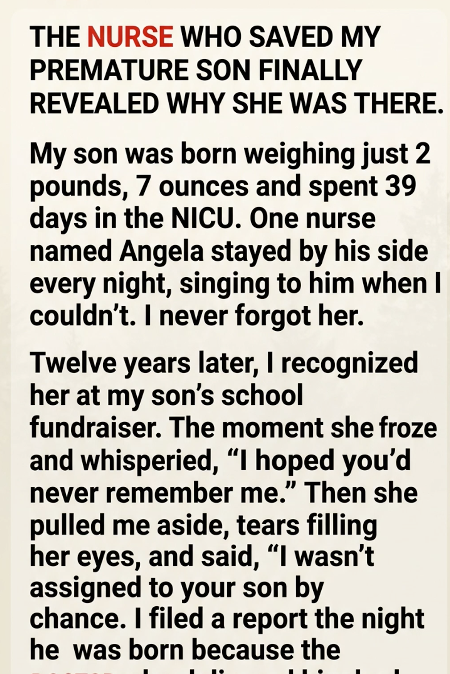
My son was born weighing just 2 pounds, 7 ounces.
For thirty-nine days, I lived in a plastic chair beside an incubator, watching a tiny chest rise and fall beneath a tangle of wires.
His name was Noah.
And the woman who helped keep him alive was a night-shift nurse named Angela.
She sang to him when I was too exhausted to speak.
She touched his tiny hand through the incubator opening when I was afraid to.
She whispered, “Come on, little fighter,” whenever his oxygen numbers dropped.
I never forgot her.
So twelve years later, when I recognized Angela standing across the room at my son’s school fundraiser, I immediately smiled.
“Angela?”
She turned.
The color drained from her face.
For a second, she simply stared at me.
Then she whispered something I almost couldn’t hear.
“I hoped you’d never remember me.”
I laughed nervously.
“Of course I remember you. You saved my son’s life.”
Her eyes filled with tears.
She looked around the crowded gymnasium before taking my arm.
“Please,” she said quietly. “We need to talk somewhere private.”
We stepped into an empty hallway.
Angela closed the door behind us.
Then she took a shaky breath.
“I wasn’t assigned to your son by chance.”
I stared at her.
“What do you mean?”
She wiped her eyes.
“I filed a report the night he was born.”
My heart began pounding.
“What kind of report?”
She looked directly at me.
“The doctor who delivered your son had already been investigated twice for changing medical records.”
I felt the hallway tilt beneath me.
“What?”
Angela continued.
“Your son wasn’t supposed to survive that night.”
I couldn’t speak.
She reached into her purse and pulled out a small, worn envelope.
“I kept this for twelve years.”
She handed it to me.
My hands were trembling.
“What is it?”
“Copies of the records I was afraid the hospital would destroy.”
I looked down at the envelope.
And suddenly, the memory of Noah’s birth came rushing back.
The flashing lights.
The emergency delivery.
The doctors shouting.
The nurse telling me not to panic.
The words:
“He’s extremely premature.”
At the time, I’d thought the worst thing that could happen was losing my baby.
I had never imagined someone might have made a decision that put him in danger.
Angela’s voice broke through my thoughts.
“Your son’s birth was the beginning of something much bigger.”
Twelve years earlier, I had been thirty-one years old and pregnant with my first child.
The pregnancy had been difficult, but nothing prepared me for the night my water broke.
I was only thirty-one weeks along.
My husband, Mark, drove me to the hospital while I cried the entire way.
I remember gripping his hand.
“It’s too early.”
“I know.”
“Something’s wrong.”
“We’re going to get through this.”
But neither of us knew what was waiting for us.
Noah was delivered less than an hour after we arrived.
He weighed two pounds, seven ounces.
I saw him for perhaps three seconds.
He was impossibly small.
His arms were thinner than my wrist.
His eyes were closed.
A team of doctors immediately surrounded him.
Someone said, “We need respiratory support.”
Someone else said, “Get him to NICU.”
Then he disappeared.
For the next thirty-nine days, the NICU became my entire world.
I slept in chairs.
I forgot to eat.
I learned the meanings of numbers I had never cared about before.
Oxygen saturation.
Respiratory rate.
Heart rate.
Blood pressure.
Every beep terrified me.
And every night, when the hospital became quiet, Angela appeared.
She wasn’t Noah’s primary nurse.
At least, that’s what I believed.
She worked nights and often had several babies under her care.
Yet somehow, she always found time to check on him.
One night, I woke from a chair and saw her standing beside his incubator.
She was singing softly.
I couldn’t understand the words.
I whispered, “What are you singing?”
She smiled.
“An old song my mother used to sing.”
“Why?”
Angela looked at Noah.
“Because sometimes babies need to hear a voice that isn’t afraid.”
That sentence stayed with me.
On the thirty-ninth day, Noah finally came home.
I hugged Angela before we left.
“You’re part of his story,” I told her.
She smiled.
“I think he’ll be okay.”
Then she looked at me strangely.
As if she wanted to say something else.
But she didn’t.
I assumed we’d never see each other again.
I was wrong.
Now, twelve years later, I was standing in a school hallway while Angela handed me a twelve-year-old secret.
“What happened that night?” I asked.
Angela sat down.
“The doctor who delivered Noah was Dr. Robert Keller.”
I remembered the name.
“Yes.”
“He wasn’t supposed to be working that night.”
I frowned.
“What?”
“He had been temporarily removed from high-risk deliveries after a complaint.”
My stomach tightened.
“Then why was he there?”
Angela shook her head.
“That was the question I couldn’t answer.”
She opened the envelope.
Inside were photocopies of medical records.
Some were faded.
Some had handwritten notes.
One page had several sections blacked out.
“This is Noah’s original delivery record,” she said.
“What does it show?”
Angela pointed.
“The first record says Noah was delivered at 2:14 a.m.”
I nodded.
“That sounds right.”
“But the official record was changed to 2:27.”
“Why?”
“Because there was a thirteen-minute gap.”
“What happened during those thirteen minutes?”
Angela looked at me.
“That’s what I reported.”
She explained that Noah had been delivered in serious distress.
The medical team should have immediately begun a specific sequence of emergency interventions.
Instead, according to Angela, Dr. Keller delayed one of the critical steps.
Not for seconds.
For several minutes.
And during those minutes, Noah’s oxygen levels dangerously dropped.
Angela had been assigned to another infant nearby.
She noticed the monitors.
Something didn’t look right.
She stepped over to Noah’s station.
And she realized the documentation didn’t match what she was seeing.
“The doctor told me everything was under control,” she said.
“But it wasn’t.”
“No.”
“What did you do?”
“I called the NICU attending.”
“And?”
“He came immediately.”
According to Angela, another doctor took over.
Noah stabilized.
But Angela noticed something else.
The original treatment time had been written down.
Then crossed out.
A new time had been entered.
Angela confronted Dr. Keller.
He told her she had misunderstood.
She didn’t believe him.
So she filed an internal incident report.
“Did anyone investigate?”
“Yes.”
“And?”
She gave a bitter smile.
“They said there wasn’t enough evidence.”
I stared at the papers.
“Then why did you stay with Noah?”
Angela looked at me.
“Because after I filed the report, I was afraid someone would retaliate.”
“Against you?”
“Maybe.”
“Against Noah?”
She nodded.
“I didn’t know.”
For twelve years, I had believed Angela stayed with my son because she was simply an extraordinary nurse.
Now I realized there was another reason.
She was watching.
She was making sure nobody changed anything else.
“She knew I was keeping copies,” Angela said.
“Who?”
“The hospital administrator.”
I looked up.
“Why would the administrator care about one premature baby?”
Angela hesitated.
“Because Noah wasn’t the only one.”
She opened another folder.
Inside were copies of reports involving other premature infants.
Different families.
Different dates.
But the same doctor.
The same unusual record changes.
The same unexplained treatment delays.
And in several cases, medical procedures had been billed differently from what the original notes described.
My hands went cold.
“This wasn’t just a doctor making mistakes.”
Angela shook her head.
“No.”
“What was it?”
“I think there was a system.”
Over the next several weeks, I began investigating.
Not because I wanted revenge.
Because I needed to know what had happened to my son.
Angela connected me with another former nurse.
Then another.
Eventually, we learned that several employees had raised concerns over a period of years.
Some had left the hospital.
Some had been transferred.
Some had simply stopped talking.
The pattern was disturbing.
Certain high-risk cases had been documented incorrectly.
Some procedures had been recorded as having occurred earlier than they actually did.
Insurance claims didn’t always match nursing notes.
And in several cases, families had been told their babies had suffered complications that may have been preventable.
Then we found something worse.
A former hospital billing specialist had kept copies of internal emails.
Those emails suggested administrators had pressured staff to make records “consistent” before submitting claims.
The language was deliberately vague.
But the meaning was clear.
Records were being changed.
Angela’s original report was one of the few documents that had survived.
And it contained a sentence that stopped me cold.
“Infant Noah Brooks experienced an unexplained delay in emergency intervention. I believe the medical record was altered afterward.”
I read that sentence over and over.
My son had almost died.
And someone had tried to rewrite the story afterward.
The investigation eventually became official.
A state medical board reviewed the records.
Then federal investigators became involved because the allegations included potential insurance fraud.
Dr. Keller denied everything.
He said Angela was mistaken.
He said the records had been corrected because of “clerical inconsistencies.”
He said Noah’s condition had been extremely unstable and that nothing improper had happened.
But then investigators found the original electronic timestamps.
They showed exactly when certain orders had been entered.
They found deleted messages.
They found billing discrepancies.
And they discovered that several patients had been affected.
Dr. Keller eventually lost his medical license.
Several administrators resigned.
The hospital paid settlements to multiple families.
But there was something I couldn’t understand.
Why had Angela risked everything for my son?
One evening, I asked her.
We were sitting at my kitchen table.
“You could have lost your job.”
She nodded.
“I almost did.”
“You could have walked away.”
“I almost did that too.”
“Then why didn’t you?”
Angela looked down at her hands.
“Because I had a baby once.”
I waited.
“My son was born premature.”
My heart sank.
“What happened?”
“He died.”
She took a slow breath.
“He was twenty-eight weeks.”
I didn’t know what to say.
“I was twenty-six,” she continued. “I was terrified. I trusted the doctors completely.”
She stared out the window.
“One doctor made a mistake.”
Her voice trembled.
“My son didn’t survive.”
I reached across the table.
Angela continued.
“I became a nurse because I couldn’t accept what happened.”
She wiped her eyes.
“I promised myself that if I ever saw another mother sitting beside an incubator, terrified and helpless, I would pay attention.”
She looked at me.
“So when Noah was born, I recognized the signs.”
“You knew something was wrong.”
“Yes.”
“And that’s why you stayed.”
She nodded.
“But that’s not the whole reason.”
I frowned.
“What else?”
Angela smiled sadly.
“Because you were asleep.”
I looked confused.
“You were exhausted. You hadn’t slept properly in days. One night you finally fell asleep in that chair.”
She laughed softly.
“You were holding Noah’s blanket.”
I remembered.
Vaguely.
“I stood beside him for almost an hour.”
“Why?”
“Because I wanted to make sure his numbers stayed stable.”
She paused.
“And because I wanted one mother in that room to wake up with good news.”
The investigation lasted almost a year.
During that time, Noah knew almost nothing about what had happened.
He was twelve.
To him, the NICU was just a story his parents told.
He knew he’d been tiny.
He knew he’d been sick.
He knew a nurse named Angela had taken care of him.
But he didn’t know how close he’d come to dying.
I didn’t want to frighten him.
Eventually, however, the truth became part of our family history.
One Saturday morning, I told him Angela was coming over.
When she arrived, Noah opened the door.
He stared at her.
Then his face lit up.
“Angela?”
She laughed.
“You remember me?”
“Mom showed me pictures.”
He hugged her.
She froze.
Then she hugged him back.
She cried into his shoulder.
“You got so big.”
Noah smiled.
“I was always going to.”
Angela laughed through her tears.
“I know.”
He invited her inside.
We sat around the kitchen table.
Noah looked at her.
“Did you really sing to me?”
“Yes.”
“Why?”
Angela glanced at me.
“Because you were a fighter.”
Noah smiled.
Then he asked the question neither of us expected.
“Did you save my life?”
Angela looked at him.
“I helped.”
“No.”
He shook his head.
“Mom says you saved me.”
Angela’s eyes filled with tears.
She looked at me.
I nodded.
Finally she answered.
“I think you saved yourself.”
Noah smiled.
“That’s a pretty good answer.”
Years passed.
Noah grew into a healthy teenager.
Then a young man.
He became interested in medicine.
When he was eighteen, he told us he wanted to become a doctor.
I laughed.
Angela cried.
He eventually became a pediatrician.
And when he entered medical school, he kept one thing in his room.
A faded photograph from the NICU.
It showed him inside the incubator.
On the back, Angela had written:
“For the little fighter who taught me never to stop asking questions.”
Noah carried it with him through medical school.
Years later, he gave a copy of that photograph to Angela.
On the back, he wrote:
“For the nurse who taught me that caring means paying attention.”
Angela framed it.
It hung beside a photograph of her own son.
The two boys who never met.
One who died too soon.
One who survived.
And somehow, their stories became connected.
I used to think the most important moment of Noah’s life was the day he came home from the hospital.
I was wrong.
It was the night a nurse noticed something didn’t make sense.
She could have looked away.
She could have trusted the chart.
She could have told herself it wasn’t her responsibility.
Instead, she asked a question.
Then another.
And when nobody gave her a satisfactory answer, she documented what she saw.
She protected a tiny baby who couldn’t speak for himself.
Twelve years later, she finally told me why.
Not because she wanted praise.
Not because she wanted money.
Not because she wanted to be called a hero.
She did it because years earlier, someone had failed to protect her own baby.
And she refused to let history repeat itself.
At Noah’s medical school graduation, Angela sat in the front row.
When his name was called, he walked across the stage.
Then he turned toward the audience.
His eyes found Angela.
He smiled.
After the ceremony, he walked directly to her.
He hugged her and whispered something in her ear.
I couldn’t hear him.
Later, I asked what he had said.
He smiled.
“I told her she was right.”
“About what?”
“That babies need to hear a voice that isn’t afraid.”
I looked at Angela.
She was crying.
And I finally understood something.
Some people enter your life for only a few hours.
Some for a few years.
And some leave fingerprints on your life so deep that twelve years later, one look across a crowded room can bring everything back.
Angela had been there the night my son was born.
She had been there when I was terrified.
She had been there when nobody knew what would happen next.
And twelve years later, she was still there.
Not because she had been assigned to my son.
But because she had chosen him.
And sometimes, the people who save our lives don’t even realize how much of our future they are saving.
They simply do the right thing when it matters.
Angela did.
And because she did, my son got to grow up.
He got to laugh.
He got to fall in love.
He got to become a doctor.
He got to save other children.
And every time I watched him walk into a hospital wearing a white coat, I thought about that tiny two-pound-seven-ounce baby inside an incubator.
And the nurse who stayed beside him through the night.
The nurse who noticed something was wrong.
The nurse who refused to look away.
The nurse who saved my son.
And finally, after twelve years, told me why.