The first person to recognize me at our thirty-fifth high school reunion was the woman who had made my life miserable in school.
Her name was Vanessa.
In high school, she had been beautiful, wealthy, popular, and cruel in the effortless way some people are when they’ve never been forced to question themselves.
She was our queen bee.
I was the quiet girl who worked after school, earned good grades, and spent most of my time worrying about whether there would be enough money at home.
Thirty-five years later, Vanessa walked into the banquet hall wearing a designer dress and immediately recognized me.
I was carrying a coffee pot.
She stopped.
Then she laughed.
“Wait.”
Her friends turned.
“Is that really you?”
I smiled politely.
“Yes.”
Vanessa looked at the coffee pot.
Then at my uniform.
Then back at me.
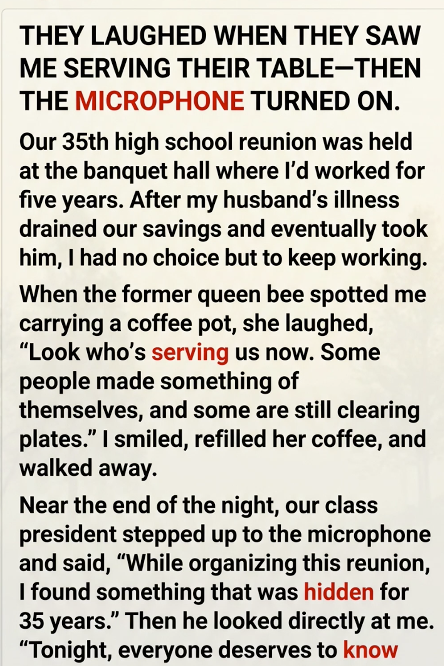
“Look who’s serving us now.”
Her friends laughed.
She leaned closer.
“Some people made something of themselves.”
She gestured toward the room.
“And some are still clearing plates.”
I didn’t respond.
I simply refilled her coffee.
“Anything else?”
Vanessa smiled.
“No, sweetheart. That’ll be all.”
I walked away.
But I could feel their eyes following me.
And what they didn’t know was that I wasn’t embarrassed.
Not anymore.
Because they didn’t know what had happened to me.
They didn’t know about my husband.
They didn’t know about the years I spent caring for him through an illness that drained our savings.
They didn’t know about the hospital rooms.
The sleepless nights.
The medical bills.
The day he finally died holding my hand.
They didn’t know that I worked at the banquet hall because I needed to survive.
And they certainly didn’t know what happened in 1989.
None of them did.
Except one person.
Our class president.
And near the end of the night, he finally decided to tell everyone.
The reunion had started at seven.
By nine, everyone was laughing.
Old photographs were projected onto a screen.
People compared careers.
Families.
Homes.
Vacations.
Vanessa talked loudly about her company.
Another classmate bragged about his house.
Someone mentioned their children attending expensive universities.
I kept working.
Pouring coffee.
Clearing plates.
Collecting glasses.
Every now and then, someone recognized me.
“Oh my gosh, Sarah?”
“Yes.”
“What happened?”
That question always sounded innocent.
It never was.
I would smile.
“Life happened.”
Then I’d move on.
But Vanessa didn’t move on.
She kept watching me.
Eventually she approached the service station.
“You know,” she said, “I almost didn’t recognize you.”
“I understand.”
“You used to be so ambitious.”
“I still am.”
She laughed.
“Really?”
I looked at her.
“Yes.”
She didn’t understand.
People often confuse ambition with money.
They think success means the car you drive.
The house you own.
The title on your business card.
They don’t understand that sometimes success means simply surviving something that should have broken you.
At ten-thirty, the dinner was finished.
The lights dimmed.
Our class president, Michael Reynolds, walked onto the stage.
Michael had been one of the quietest people in school.
He wasn’t popular.
He wasn’t athletic.
He wasn’t part of Vanessa’s crowd.
But he had always been observant.
He tapped the microphone.
“Before we end tonight, I have something to say.”
Everyone quieted.
Michael smiled.
“Thirty-five years ago, we graduated.”
Applause.
“We thought we knew everything about one another.”
More laughter.
“But we didn’t.”
He paused.
“Not even close.”
I continued stacking plates.
Then he said:
“While organizing this reunion, I found something that was hidden for thirty-five years.”
I stopped.
My hand froze around a glass.
Michael looked directly at me.
“Tonight, everyone deserves to know what really happened back in 1989.”
The room became silent.
I knew immediately.
My stomach tightened.
Because there was only one thing he could be talking about.
The scholarship.
In 1989, I had been seventeen.
My father worked nights at a factory.
My mother cleaned houses.
College seemed impossible.
Then, in the spring of our senior year, our school announced a scholarship.
The Reynolds Foundation Scholarship.
Five thousand dollars.
At the time, it might as well have been a fortune.
The application required grades, recommendations, and an essay.
I applied.
I didn’t tell anyone.
Not even my parents.
I didn’t want them to get their hopes up.
Two weeks before graduation, Michael’s father, who had established the scholarship, called the school.
He wanted to personally congratulate the winner.
The winner was me.
At least, that’s what I was told.
But I never received it.
Instead, Vanessa won.
Everyone celebrated.
She gave a speech.
She thanked her parents.
She said she planned to attend an expensive private university.
I went home that night and cried.
Not because I thought I deserved it more.
But because I had believed, for one brief moment, that my life might change.
The next morning, the school counselor called me into her office.
She told me my application had been disqualified.
The reason?
Academic dishonesty.
Someone had accused me of copying part of my scholarship essay.
I denied it.
But nobody believed me.
A week later, the rumor spread throughout school.
Sarah cheated.
Sarah stole someone else’s words.
Sarah didn’t deserve the scholarship.
Vanessa won.
And I said nothing.
Because I had no proof.
And because the person who accused me had been the most powerful student in our class.
Vanessa.
Michael’s voice brought me back.
“Thirty-five years ago, Sarah Bennett applied for the Reynolds Foundation Scholarship.”
Everyone turned toward me.
Vanessa laughed nervously.
“Michael, really?”
He didn’t smile.
“Sarah’s application was disqualified.”
The room became uncomfortable.
Michael continued.
“The official reason was plagiarism.”
I stared at him.
He held up a folder.
“But I found something in my father’s old files.”
My heart began pounding.
“He kept a copy of the original judging notes.”
He opened the folder.
“The scholarship committee unanimously ranked Sarah first.”
A murmur spread through the room.
Vanessa stood up.
“That can’t be right.”
Michael looked at her.
“It is.”
He held up another page.
“Sarah’s essay was judged the strongest by every member of the committee.”
Someone whispered,
“Then why didn’t she win?”
Michael looked down.
Then back at me.
“Because someone submitted a forged letter claiming Sarah had cheated.”
The room went silent.
Michael continued.
“The letter was anonymous.”
My hands began trembling.
“But my father kept it.”
He held it up.
“Thirty-five years later, I found the original.”
Vanessa’s face changed.
Michael looked at her.
“And the handwriting matches Vanessa’s.”
Everyone turned.
Vanessa laughed.
“No.”
Michael didn’t react.
“She wrote the accusation.”
Vanessa shook her head.
“That’s ridiculous.”
Michael reached into the folder.
“There is more.”
He produced another document.
“This is a copy of a letter written by the school counselor.”
He read:
“Vanessa admitted privately that she wanted Sarah disqualified because she believed Sarah had no right to compete.”
Someone gasped.
Vanessa’s face went white.
“That was never proven.”
“No,” Michael said.
“Because the counselor was afraid of your parents.”
Silence.
Vanessa sat down.
I couldn’t speak.
For thirty-five years, I had believed I had simply lost.
Now I knew I had been cheated.
But Michael wasn’t finished.
“There was one more thing.”
He turned toward me.
“My father tried to contact Sarah.”
I stared at him.
“What?”
“He wanted to offer her another scholarship.”
Michael’s voice softened.
“But your father refused.”
I looked confused.
“Why?”
“Because he said your family didn’t want charity.”
My eyes filled with tears.
That sounded exactly like my father.
Proud.
Stubborn.
Determined.
Michael nodded.
“So my father gave the scholarship money to another student.”
I whispered,
“Who?”
He smiled.
“Me.”
The room became silent.
“My father told me that if I ever had a chance to help someone who deserved it, I should.”
Michael looked at me.
“I never forgot that.”
Vanessa stood.
“This is absurd.”
Michael turned toward her.
“You’ve had thirty-five years to tell the truth.”
“I was seventeen.”
“So was Sarah.”
Vanessa’s voice cracked.
“I was scared.”
“Of what?”
“That she’d get everything.”
I stared at her.
“Everything?”
Vanessa looked at me.
“You were smarter than me.”
I shook my head.
“You had everything.”
She began crying.
“My parents expected me to win.”
“So you destroyed my chance.”
“I thought it would be one scholarship.”
I looked at her.
“It was my future.”
She lowered her head.
“I know.”
I thought about the life I had lived.
I never went to college.
I married my husband, David, at twenty-one.
We built a modest life.
He worked construction.
I worked wherever I could.
We had two children.
Then, when David was forty-nine, he became sick.
The illness progressed quickly.
Our savings disappeared.
We sold our second car.
Then our house.
Eventually, I became his full-time caregiver.
For three years, I watched the man I loved become weaker.
The night he died, he held my hand.
He whispered,
“Don’t stop living.”
I promised him I wouldn’t.
After he died, I needed income.
So I found a job at the banquet hall.
I’d worked there for five years.
I wasn’t ashamed.
But Vanessa didn’t know any of that.
She saw a uniform.
I saw survival.
Michael walked toward me.
Then he handed me an envelope.
“What is this?”
“Something my father left.”
I opened it.
Inside was a letter.
The handwriting was old.
Dear Sarah,
I am sorry.
You deserved that scholarship.
I could not convince the school to reverse the decision without creating a legal battle your family did not want.
But I hope you never believe that one decision determines your worth.
You were the most deserving student in that room.
I couldn’t read anymore.
Tears blurred the page.
Michael waited.
Then he said,
“My father died believing he had failed you.”
I shook my head.
“He didn’t.”
Michael smiled.
“He would be glad to hear that.”
The room had changed completely.
People weren’t laughing anymore.
The same classmates who had spent the evening talking about promotions and vacations were looking at me differently.
Not with pity.
With respect.
But I didn’t need their respect.
I’d spent thirty-five years building a life without it.
Vanessa approached me.
Her makeup was streaked with tears.
“Sarah.”
I looked at her.
“I don’t expect you to forgive me.”
“Good.”
She nodded.
“I don’t deserve it.”
“No.”
She swallowed.
“But I’m sorry.”
I studied her.
Then I said,
“I believe you.”
She looked surprised.
“But forgiveness isn’t something you get because you apologized.”
“I know.”
“It’s something I decide when I’m ready.”
She nodded.
“I understand.”
Then she walked away.
The next morning, Michael called me.
He told me something I never expected.
“My father’s foundation still exists.”
“What?”
“The board wants to establish a new scholarship.”
He paused.
“They want to name it after you.”
I laughed.
“After me?”
“Yes.”
“I don’t need a scholarship.”
“I know.”
“Then why?”
“Because my father believed scholarships aren’t supposed to reward people who already have everything.”
He continued.
“They’re supposed to change someone’s life.”
I sat silently.
Then I said,
“Use my name.”
“But there’s one condition.”
“What?”
“The first recipient should be a student who thinks college is impossible.”
Michael smiled.
“Done.”
A year later, the Sarah Bennett Opportunity Scholarship was awarded for the first time.
The recipient was a seventeen-year-old girl named Maya.
Her mother worked two jobs.
Her father was unemployed.
She had excellent grades but no money for college.
When Maya stood onstage, crying as she accepted the scholarship, I remembered myself at seventeen.
I walked up to her.
She hugged me.
“Thank you.”
I whispered,
“Don’t thank me.”
She looked confused.
“Thank the girl I used to be.”
She smiled.
Then I gave her a small envelope.
Inside was a copy of the letter Michael’s father had written me.
I told her,
“Keep going even when someone tells you that you don’t deserve the opportunity.”
Five years later, I was invited back to the reunion hall.
Not as a server.
As a guest.
The scholarship had helped dozens of students.
Michael had become its director.
Vanessa had apologized publicly for what she’d done.
We never became friends.
We didn’t need to.
Some relationships don’t need to be repaired.
They simply need to stop controlling your life.
I continued working at the banquet hall for a while.
Eventually, I retired.
My children convinced me to travel.
I visited places I’d never dreamed I’d see.
I started painting.
I planted roses.
I learned to enjoy quiet mornings.
And one day, I found myself standing in front of the mirror, realizing something.
I was happy.
Not because I had finally proven Vanessa wrong.
Not because everyone knew the truth.
Not because I had been given a scholarship thirty-five years too late.
I was happy because my husband’s final words had come true.
Don’t stop living.
People sometimes ask me whether I regret not fighting harder in 1989.
I used to say yes.
Now I don’t.
I wish I had known the truth.
I wish someone had defended me.
I wish my seventeen-year-old self had understood that one person’s cruelty wasn’t a measurement of my worth.
But I don’t regret the life I built afterward.
Because that life contained my husband.
My children.
My family.
And a love that lasted until the very end.
Vanessa took an opportunity from me.
She didn’t take my future.
I built that myself.
And when Michael turned on that microphone thirty-five years later, I thought he was giving me justice.
But he was giving me something much more valuable.
He was giving my younger self an answer.
The answer she had waited decades to hear.
You weren’t a failure.
You weren’t a cheater.
You weren’t less deserving.
Someone simply made a decision that wasn’t yours to carry.
And when the applause finally came that night, I didn’t stand up immediately.
I looked down at my hands.
Hands that had washed dishes.
Held my husband’s hand in hospitals.
Changed dressings.
Raised children.
Worked long shifts.
Carried trays.
Held scholarship letters.
Held grief.
Held hope.
Then I stood.
The applause grew louder.
I didn’t look at Vanessa.
I didn’t need to.
I looked at the microphone.
And for the first time in thirty-five years, I felt as though someone had finally turned it on for me.
Not so I could embarrass the people who had laughed.
Not so I could prove I was better than them.
But so I could finally say what I had been unable to say at seventeen:
My life was never defined by what they took from me.
It was defined by what I chose to build afterward.
And that, more than any scholarship, title, house, or bank account, was the one thing nobody could ever take away.