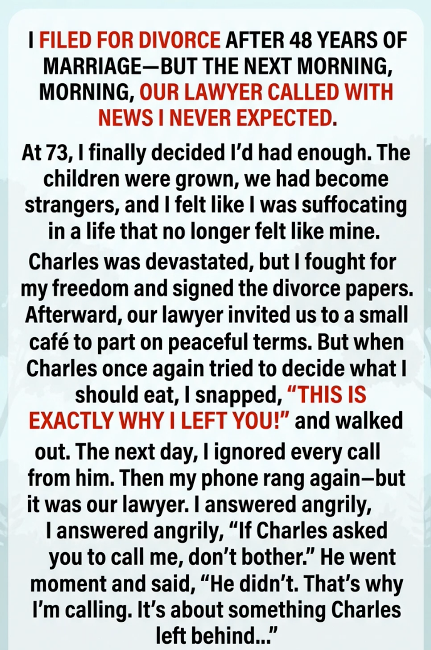
At seventy-three years old, I finally decided I had had enough.
Not of marriage itself.
Not of love.
Of disappearing.
For forty-eight years, I had been Charles’s wife.
Mother to three children.
Grandmother to six.
The person who remembered everyone’s birthdays, doctor’s appointments, favorite meals, school schedules, anniversaries, allergies, passwords, and forgotten promises.
Somewhere along the way, I had stopped being Margaret.
I had become Charles’s wife.
And I was tired.
Our children were grown.
Our house was quiet.
And Charles and I had become strangers who happened to sleep in the same bedroom.
He wasn’t a cruel man.
That almost made it harder.
He simply made every decision.
Where we went.
What we ate.
When we traveled.
What television we watched.
Which friends we saw.
Even what I wore when we went somewhere together.
Whenever I objected, he would smile and say,
“I’m just trying to make things easier.”
But easier for whom?
The final argument happened over breakfast.
I had made toast.
Charles looked at my plate.
“You shouldn’t eat that.”
I looked up.
“Why?”
“Too much butter.”
I stared at him.
“It’s toast, Charles.”
“You’ve been complaining about your weight.”
“I wasn’t complaining.”
“You said your clothes felt tight.”
“I said I wanted to buy a new dress.”
He sighed.
“You always take everything personally.”
Something inside me finally snapped.
I put down my knife.
“Do you know what I’ve realized?”
He looked confused.
“What?”
“I don’t know who I am anymore.”
He laughed softly.
“Margaret, you’re being dramatic.”
“No.”
I stood.
“I’m being honest.”
That afternoon, I called a lawyer.
The next morning, I filed for divorce.
Charles was devastated.
I expected anger.
Instead, he cried.
“After forty-eight years?”
“Yes.”
“Why now?”
“Because if I wait any longer, there won’t be enough of my life left to live.”
He stared at me.
“I love you.”
“I know.”
“Then why?”
“Because love isn’t supposed to make you feel invisible.”
He lowered his head.
For the first time in decades, he didn’t argue.
The divorce process moved faster than I expected.
Our lawyer, David Harris, was patient and professional.
We divided the assets.
The house would eventually be sold.
Our children were informed.
Some supported me.
Others didn’t understand.
Our oldest daughter said,
“Mom, why now?”
I told her,
“Because now I finally have the courage.”
On the day we signed the final documents, Charles asked if we could have coffee afterward.
“Just one peaceful goodbye,” he said.
I agreed.
We went to a small café near the courthouse.
It was quiet.
Warm.
Almost nostalgic.
We sat across from each other.
Charles smiled.
“You always liked this place.”
“I still do.”
He picked up the menu.
“What are you getting?”
“I don’t know.”
“You should get the vegetable soup.”
I looked at him.
“Why?”
“It’s healthier.”
I stared at him.
He didn’t notice.
“You could get the grilled chicken instead.”
“Charles.”
“What?”
“I’ll decide.”
He frowned.
“I was only helping.”
“No.”
I put down the menu.
“This is exactly why I left you!”
The café became silent.
Charles froze.
I stood.
“You’ve spent forty-eight years telling me what was best for me.”
He looked hurt.
“I was trying to take care of you.”
“I don’t need someone to take care of me.”
I grabbed my purse.
“I need someone who sees me.”
Then I walked out.
The next morning, I ignored every call from Charles.
My phone rang six times.
I didn’t answer.
Then it rang again.
I expected his name.
Instead, the screen said:
David Harris — Attorney.
I almost ignored that too.
But I answered.
“If Charles asked you to call me, don’t bother.”
David was silent.
Then he said,
“He didn’t.”
I stopped.
“Then why are you calling?”
“Because I’m calling about something Charles left behind.”
My heart tightened.
“What?”
“A box.”
“What kind of box?”
“I don’t know.”
“What do you mean?”
“He specifically instructed me not to open it unless the divorce was finalized.”
I sat down.
“What did he leave?”
David’s voice became quiet.
“Letters.”
My stomach dropped.
“To whom?”
“You.”
I went to the lawyer’s office that afternoon.
David placed a small wooden box on the desk.
It was old.
Scratched.
The initials M.C. were carved into the lid.
I touched them.
“Charles made this?”
“Yes.”
“What’s inside?”
“I haven’t opened it.”
“Why?”
“He gave me written instructions.”
David handed me a folded page.
I recognized Charles’s handwriting.
If Margaret ever chooses to leave me, give her this box.
Do not explain it.
Do not tell her what is inside.
Let her decide whether she wants to know.
I stared at the words.
Then opened the box.
Inside were dozens of envelopes.
Each one had a date.
All the way through 2024.
I looked at David.
“What are these?”
“I don’t know.”
I opened the first envelope.
Inside was a letter.
And the first line made my hands tremble.
Dear Margaret,
Today I saw you for the first time.
I read the letter.
It was dated three months before Charles and I met.
He had seen me in a bookstore.
He wrote about the blue dress I wore.
The way I laughed.
The book I was carrying.
He had written:
I don’t know her name yet. But I know I want to.
I looked at the next letter.
It was dated the day we met.
Then another from our first date.
Then one from the night he proposed.
I stared at him through the handwriting.
“What is this?”
David shook his head.
“You should keep reading.”
The letters continued.
One was written the night before our wedding.
Tomorrow I marry the woman I hope I never stop choosing.
Another was written after our first child was born.
Margaret is exhausted. She thinks she’s failing because she cries. She doesn’t understand that I’ve never seen anyone stronger.
Another was written after our son was born.
She held him for three hours even though she was barely able to stand. I don’t think she’ll ever know how much I admire her.
Then came letters from difficult years.
Arguments.
Financial problems.
Our children’s illnesses.
His father’s death.
My mother’s illness.
Each letter contained something I’d never heard him say aloud.
I should tell Margaret I’m proud of her.
I don’t know how to apologize.
I think she’s unhappy.
I am afraid she’s slipping away from me.
Then I found one dated twenty years earlier.
I know I’m becoming controlling.
I stopped.
He knew.
He had known.
I kept reading.
Another letter:
Today Margaret said she feels like I make every decision. She laughed afterward, but I don’t think it was a joke.
Another:
I promised myself I’d change.
Another:
I didn’t.
Then:
Why is it so easy for me to tell myself I’m protecting her when really I’m afraid of losing control?
I began crying.
Because I’d spent forty-eight years trying to explain that exact feeling.
And he had understood.
He just hadn’t changed.
There was one envelope marked:
1998 — DO NOT OPEN UNTIL SHE LEAVES ME
I stared at it for a long time.
Then I opened it.
Inside was a single page.
Margaret,
If you’re reading this, then I failed.
Not because you left.
Because I gave you reasons to.
I covered my mouth.
He continued:
I’ve spent years telling myself that I make decisions because I love you.
The truth is uglier.
I am afraid.
I’m afraid that if I don’t control everything, you’ll realize you don’t need me.
I cried harder.
You never needed me to make your choices.
You needed me to stand beside you while you made them.
The letter ended:
If you ever leave me, I hope you finally become the woman I was too afraid to let you be.
I closed my eyes.
For the first time, I understood something.
Charles had loved me.
But love hadn’t been enough.
He had loved me while controlling me.
Loved me while dismissing me.
Loved me while slowly shrinking my world.
And perhaps the saddest part was that he knew.
He knew what he was doing.
He simply didn’t know how to stop.
Then I found another envelope.
This one was dated only six months earlier.
It was the last letter.
I opened it.
Margaret,
You told me you’re unhappy.
I wanted to argue.
Instead, I listened.
And I finally understood.
You’ve spent forty-eight years becoming everything everyone needed you to be.
I helped make you disappear.
I don’t know how to fix that.
Maybe I can’t.
Maybe the most loving thing I can do now is let you go.
My hands shook.
Then I reached the final line.
I am sorry I learned how to love you properly only when you were finally brave enough to leave me.
I couldn’t read anymore.
I left the lawyer’s office carrying the box.
That evening, I called Charles.
He answered immediately.
“Margaret?”
“Why didn’t you tell me?”
Silence.
“About the letters.”
“I didn’t think you’d believe me.”
“You wrote them for forty-eight years.”
“I know.”
“Why?”
“Because I couldn’t say those things.”
I closed my eyes.
“You could have.”
“I was afraid.”
“Of what?”
“Of being vulnerable.”
I sat on my porch.
“I needed a husband, Charles.”
“I know.”
“Not a manager.”
“I know.”
“I needed someone to ask what I wanted.”
“I know.”
“You can’t keep saying you know.”
He was silent.
Then he said,
“I know.”
I almost laughed.
Even now.
But this time, there was no control in his voice.
Only sadness.
A week later, Charles asked if we could meet.
I agreed.
Not to reconcile.
Just to talk.
We met at the same café.
He smiled when he saw me.
“I won’t tell you what to order.”
I laughed.
“Good.”
We sat down.
He looked older.
Smaller.
Maybe I did too.
But something had changed.
He didn’t reach for the menu.
He didn’t tell me where to sit.
He didn’t order for me.
He simply asked,
“How are you?”
I thought about the question.
Then answered honestly.
“Free.”
He nodded.
“Good.”
“You’re not angry?”
“I was.”
“Are you now?”
“No.”
“Why?”
“Because I finally understand that your freedom isn’t the same thing as my abandonment.”
I looked at him.
That was the first time in forty-eight years I’d heard him say something like that.
We didn’t remarry.
We didn’t move back in together.
But we didn’t become enemies either.
Over the next year, we slowly learned how to talk without making decisions for one another.
Sometimes we had coffee.
Sometimes we went to our grandchildren’s events together.
Sometimes we laughed about old memories.
And sometimes we disagreed.
But now, when I said no, he respected it.
When he wanted something, I respected that too.
Our relationship became something neither of us had known how to have during our marriage.
A choice.
Six months after the divorce, I moved into a small apartment of my own.
The first morning there, I woke up and realized something extraordinary.
Nobody was telling me what to do.
I made coffee.
I wore an old robe.
I played music too loudly.
I ate cake for breakfast.
Then I laughed.
I laughed so hard I cried.
At seventy-three, I was finally learning what freedom felt like.
Not freedom from Charles.
Freedom to be Margaret.
One afternoon, I found another letter at the bottom of the wooden box.
I thought I’d read them all.
This one had no date.
It simply said:
For Margaret, when she is happy again.
I opened it.
If you’ve reached this letter, I hope you’re somewhere I can no longer control.
I smiled.
I hope you’re laughing loudly.
I hope you’re eating whatever you want.
I hope you’re traveling somewhere without asking whether I approve.
I hope you bought the dress I once told you was too expensive.
I laughed through my tears.
Then I read the final paragraph.
And if one day you think of me, I hope you don’t remember me as the man who kept you small.
Remember me as the man who loved you, even though he spent too long learning that love is not ownership.
You were never mine to control.
You were always yours.
I folded the letter.
Then placed it back in the box.
A year after our divorce, I took a trip to Italy.
Alone.
I had always wanted to go.
For forty-eight years, there had been reasons.
Too expensive.
Too far.
Too complicated.
Too much work.
Not practical.
This time, I bought the ticket.
When I stood in a little café in Florence, I ordered whatever I wanted.
Nobody corrected me.
Nobody suggested something healthier.
Nobody told me what I should do.
I sat by the window and watched people walk past.
And I realized something.
My life hadn’t ended at seventy-three.
It had finally begun.
When I came home, there was a message from Charles.
I hope you had a wonderful trip.
I replied:
I did.
He answered:
I’m glad.
That was all.
No questions.
No advice.
No expectations.
Just support.
And somehow, that simple message meant more to me than all the grand gestures he had made during forty-eight years.
Because for the first time, Charles wasn’t trying to decide what was best for me.
He was simply happy that I had found it myself.
People sometimes ask why I filed for divorce after forty-eight years.
They expect some dramatic betrayal.
An affair.
A secret family.
A hidden fortune.
There was none of that.
The truth was simpler.
I had slowly disappeared.
And one day, I realized I wanted to find myself again.
Charles loved me.
I believe that.
But he loved me imperfectly.
And sometimes love, when mixed with fear and control, can become a cage without anyone realizing when the door closed.
The divorce didn’t erase forty-eight years.
It didn’t make them meaningless.
Those years gave me children.
Grandchildren.
Memories.
Lessons.
And eventually, courage.
The next morning after I walked out of that café, our lawyer called with news I never expected.
Charles had left something behind.
Not money.
Not property.
Not some secret that could change my fortune.
He had left behind the truth.
For forty-eight years, he had known exactly what I had been trying to tell him.
I wanted to be seen.
He just didn’t know how to look without trying to control what he saw.
And perhaps that was the final gift of our marriage.
Not getting back together.
Not forgetting the pain.
But finally understanding each other.
He learned that loving me meant letting me choose.
And I learned that choosing myself wasn’t selfish.
At seventy-three, I didn’t feel like a woman whose life was ending.
I felt like a woman who had finally been handed the pen.
And for the first time in forty-eight years—
I was the one deciding what came next.