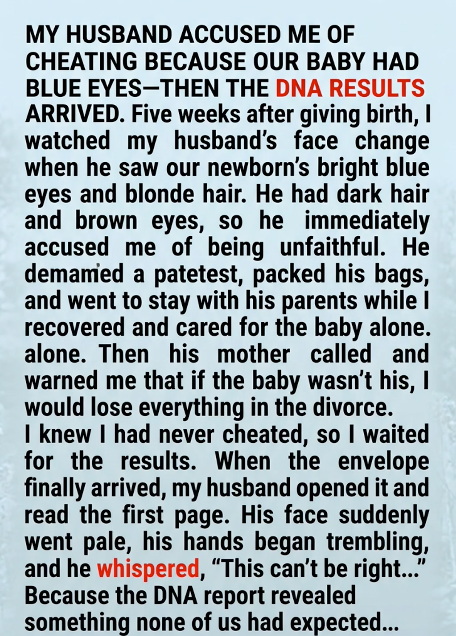
Five weeks after giving birth, I was still learning how to function on three hours of sleep.
Our daughter, Lily, had finally fallen asleep against my chest after nearly an hour of crying.
I was exhausted.
My hair was a mess. My hospital sweatshirt was covered in spit-up. I hadn’t showered since the previous evening.
But when I looked down at her tiny face, none of that mattered.
She had the brightest blue eyes I’d ever seen.
And a soft patch of blonde hair that curled around her forehead.
I kissed her cheek.
“My beautiful girl,” I whispered.
That’s when my husband walked into the room.
He stopped.
He stared at Lily.
Then he looked at me.
Something changed in his face.
At first, I thought he was surprised.
Then I saw the suspicion.
“Those aren’t your eyes,” he said.
I frowned.
“What?”
“Her eyes.”
I looked down at Lily.
“She’s a baby, Mark. Babies’ eye colors can change.”
“Blue.”
“What?”
“Her eyes are blue.”
I laughed nervously.
“Okay.”
“You have brown eyes.”
I looked at him.
“So do you.”
His jaw tightened.
“And our baby has blue eyes.”
There was something in his voice that made my stomach drop.
“Mark…”
“Who is he?”
I stared at him.
“Who is who?”
“The father.”
For a moment, I genuinely thought I had misunderstood him.
Then I realized he was serious.
I slowly stood up.
“You think I cheated on you?”
“I think I want the truth.”
“The truth is that Lily is your daughter.”
He shook his head.
“She doesn’t look like me.”
“She’s five weeks old!”
“Her hair is blonde.”
“Babies can have blonde hair.”
“Her eyes are blue.”
“And?”
“And I have brown eyes.”
I stared at the man I’d been married to for six years.
The man who had held my hand in the delivery room.
The man who had cried when our daughter was born.
The man who had whispered, “She’s perfect.”
Now he was looking at our newborn child as if she were evidence in a crime.
“Mark,” I said quietly, “I never cheated on you.”
“I need a paternity test.”
“Fine.”
His eyes narrowed.
“You’re agreeing that easily?”
“Because I have nothing to hide.”
He nodded.
Then he did something I’ll never forget.
He packed a suitcase.
“I’ll stay at my parents’ house until the results come back.”
I stared at him.
“You’re leaving me alone with a five-week-old baby?”
“I’m not abandoning you.”
“It certainly feels like it.”
“I just need space.”
He walked toward the bedroom.
I followed him.
“Mark, please.”
He didn’t turn around.
“I can’t look at her without wondering.”
Those words broke something inside me.
Not because he doubted me.
Because he doubted her.
Our little girl.
His daughter.
Or at least, that’s what I believed.
Two hours later, his car disappeared down the street.
I stood at the window holding Lily.
She opened her bright blue eyes.
I looked at her.
Then I whispered,
“Your daddy will come back.”
I had no idea how wrong—or how complicated—that promise would become.
Three days later, Mark’s mother called me.
I almost didn’t answer.
But I did.
“Hello?”
Her voice was cold.
“Have you received the test appointment?”
“Yes.”
“Good.”
I waited.
Then she said something that made my blood run cold.
“If that baby isn’t Mark’s, don’t expect to walk away with anything.”
I stared at the wall.
“What?”
“You heard me.”
“I’ve been married to your son for six years.”
“And if you’ve deceived him, the law won’t protect you from the consequences.”
I swallowed.
“I didn’t deceive anyone.”
“Then you have nothing to worry about.”
The call ended.
I stood there holding the phone.
For the first time, fear began replacing anger.
Not because I doubted myself.
But because I realized Mark’s family had already decided I was guilty.
The paternity test was done the following week.
A technician came to our house.
He swabbed Lily’s cheek.
Then mine.
Then Mark’s.
The entire process took less than ten minutes.
Mark barely looked at me.
Before leaving, the technician said the results would arrive within several weeks.
That night, I put Lily in her crib.
I sat beside her until she fell asleep.
Then I opened my laptop.
I started researching genetics.
Blue eyes.
Brown eyes.
Blonde hair.
I learned that eye color isn’t determined by one simple gene.
Neither is hair color.
Two brown-eyed parents can have a blue-eyed child.
Two dark-haired parents can have a blonde child.
Genetics can be unpredictable.
I wasn’t a scientist.
But I knew one thing.
Blue eyes weren’t proof of cheating.
Still, none of that seemed to matter to Mark.
Weeks passed.
He visited Lily twice.
The first time, he stood across the room.
“Can I hold her?” he asked.
I handed her over.
He stared down at her.
She wrapped her tiny fingers around his thumb.
For a second, his expression softened.
“She’s beautiful,” he whispered.
“She’s your daughter.”
He looked at me.
“I hope so.”
I swallowed my tears.
The second visit was even worse.
He brought his mother.
She barely acknowledged me.
She walked straight to Lily’s crib.
Then she looked at the baby and said,
“Poor thing.”
I knew exactly what she meant.
I wanted to scream.
Instead, I walked away.
Five weeks after Mark left, the envelope finally arrived.
It was a thick white envelope from the laboratory.
My hands were shaking.
I called Mark.
“The results are here.”
There was silence.
“I’ll come over.”
He arrived twenty minutes later.
His mother came with him.
I wanted her to stay outside.
She refused.
Mark sat at the kitchen table.
The envelope was between us.
He stared at it.
“You open it,” he said.
“No.”
“Why?”
“Because you demanded the test. You should read it.”
He picked up the envelope.
His fingers trembled slightly.
He opened it.
He pulled out the report.
His mother leaned over his shoulder.
He read the first page.
Then he stopped.
His face went pale.
He turned the page.
Then another.
His breathing changed.
His mother frowned.
“What does it say?”
Mark didn’t answer.
“Mark?”
He looked at me.
His lips were trembling.
“This can’t be right.”
My heart started pounding.
“What?”
He looked down at the report again.
Then he whispered,
“You’re right.”
I stood up.
“About what?”
“Lily is my daughter.”
I closed my eyes.
Relief flooded through me.
For one second, I thought the nightmare was over.
Then Mark continued.
“But…”
I opened my eyes.
“But what?”
He looked at his mother.
She was staring at the report.
Her face had gone completely white.
Mark slowly turned the paper toward me.
I read the words.
Then I stopped breathing.
The report didn’t simply confirm that Mark was Lily’s father.
It said something else.
Something none of us had expected.
The DNA profile showed that Mark was Lily’s biological father…
but the report also contained a warning.
A close genetic relationship had been detected that could not be explained by ordinary paternity.
I looked at Mark.
“What does that mean?”
He didn’t answer.
The laboratory had included a second page.
Mark pointed to a section near the bottom.
“Look.”
I read it.
The wording was technical, but the meaning was unmistakable.
Lily’s DNA contained a genetic pattern suggesting that Mark’s biological parents were not the people he had always believed were his parents.
I looked up.
“What?”
Mark’s mother suddenly stood.
“We’re leaving.”
Mark stared at her.
“Mom.”
“Now.”
“What is this?”
“I don’t know.”
“You clearly do.”
She grabbed her purse.
“I said we’re leaving.”
Mark didn’t move.
His eyes were fixed on her.
“Mom…”
His voice was different now.
“Who am I?”
She froze.
I felt a chill run through me.
“Mark,” I whispered.
He stood.
“You knew something.”
She said nothing.
“You knew.”
“I don’t know what you’re talking about.”
He held up the DNA report.
“This says something is wrong with my family history.”
She shook her head.
“It’s a mistake.”
Mark laughed bitterly.
“A mistake?”
He pointed toward Lily.
“You said she couldn’t be my daughter.”
His voice cracked.
“Now the test says she is—and somehow the same test says my own DNA doesn’t match the family I’ve known my entire life.”
His mother looked at me.
Then at him.
Finally, she whispered,
“You weren’t supposed to find out this way.”
Silence.
Mark’s face changed.
“What did you say?”
His mother sat down.
She looked suddenly much older.
“I should have told you years ago.”
Mark stared at her.
“Told me what?”
She began to cry.
And then she told us the truth.
Mark’s parents had struggled to have children.
For years, they had tried.
Doctors told them his mother might never carry a baby.
Eventually, when she was thirty-two, they were offered an opportunity through an old fertility clinic.
The clinic had operated differently from modern facilities.
Donors were used.
Records were incomplete.
Confidentiality was strict.
Mark’s mother had been desperate.
She accepted.
A year later, she gave birth to him.
She and her husband raised him as their biological son.
Mark had never questioned it.
But there was something his mother hadn’t told him.
The fertility clinic had made a terrible mistake.
Two embryos had been mislabeled.
One family received the wrong embryo.
And another family received theirs.
Mark’s mother had discovered the possibility years later.
But by then, Mark was already an adult.
She had been afraid to tell him.
So she buried it.
“What does this have to do with Lily?” Mark asked.
His mother wiped her eyes.
“Everything.”
I looked at the DNA report again.
Then it hit me.
Mark wasn’t biologically related to the parents who raised him.
But Lily was his biological daughter.
Which meant the unusual genetic pattern wasn’t evidence that I had cheated.
It was evidence of something else.
The DNA laboratory had accidentally exposed a family secret that had been buried for more than thirty years.
But there was still one question.
“Who are Mark’s biological parents?”
His mother looked down.
“We don’t know.”
Mark stared at her.
“You don’t know?”
“The clinic closed years ago.”
“Then how did they identify the genetic connection?”
The laboratory had apparently found a match through a broader genetic database.
A distant relative had submitted DNA years earlier.
That relative’s profile suggested Mark’s biological father belonged to another family.
Mark was silent.
Then he asked,
“Do I have biological parents somewhere?”
His mother nodded.
“Yes.”
“Do I have siblings?”
She didn’t answer.
That was answer enough.
The next several months changed everything.
Mark contacted the fertility clinic’s former records office.
The original files were incomplete.
But not destroyed.
A lawyer helped him request the remaining documents.
Eventually, they discovered the name of the couple connected to the embryo Mark had actually come from.
His biological father’s name was Daniel Carter.
His biological mother’s name was Rebecca Carter.
They lived only two states away.
Mark was thirty-seven years old when he met them.
I didn’t go.
That was something he needed to do alone.
He came home the next evening.
He sat on the couch.
For several minutes, he didn’t speak.
Finally, I asked,
“How did it go?”
He looked at me.
“My biological mother cried for twenty minutes.”
I sat beside him.
“What did she say?”
“She said she had always felt something was missing.”
He looked down.
“My biological father said they had a son who was supposed to be born.”
My heart tightened.
“Did they have another child?”
“Yes.”
“A daughter.”
He smiled sadly.
“She was two years older than me.”
He had a sister.
A biological family he never knew existed.
And all of it had been revealed because our baby was born with blue eyes.
But Mark wasn’t finished apologizing.
One evening, he came into the nursery.
Lily was sleeping.
He stood beside the crib.
“Can I tell you something?”
I nodded.
He looked at our daughter.
“I was wrong.”
I didn’t answer.
“I accused you because I didn’t understand genetics.”
Still nothing.
“I let my insecurity become an accusation.”
He swallowed.
“And I made you spend five weeks believing the man you loved thought you were a liar.”
I looked at him.
“You did.”
His eyes filled with tears.
“I’m sorry.”
I wanted to forgive him immediately.
Part of me did.
But another part remembered the way he had packed his bags.
The way his mother had threatened me.
The way he had looked at our daughter as if her face were proof of betrayal.
“You don’t get to undo that with one apology,” I said.
“I know.”
“You left me alone.”
“I know.”
“You believed strangers over your wife.”
“I know.”
“And you made me feel like I had to prove that Lily deserved a father.”
He lowered his head.
“I know.”
Then he looked at me.
“But I want to earn your trust again.”
That was the first thing he’d said that I believed.
Not because it fixed anything.
Because he didn’t ask me to forget.
He asked for the chance to rebuild.
Mark’s relationship with his biological family grew slowly.
He met his sister.
Then his biological parents.
He learned about their lives.
He discovered that he had inherited his blue eyes from his biological mother.
His blonde hair came from her side of the family.
Suddenly, Lily’s appearance made perfect sense.
She had inherited those traits from him.
The irony wasn’t lost on any of us.
The very features Mark had used to accuse me were actually traits he had inherited from the family he never knew.
Months later, Mark’s mother apologized to me.
Not because she wanted forgiveness.
Because she knew she had helped make everything worse.
“I was afraid of losing my son,” she said.
I looked at her.
“You almost helped your son lose his wife and daughter.”
She nodded.
“I know.”
I didn’t hug her.
Not then.
But I accepted her apology.
Some wounds need time.
As for our marriage, we didn’t pretend everything was suddenly perfect.
We went to counseling.
We talked.
A lot.
Sometimes painfully.
Mark learned that suspicion isn’t proof.
I learned that forgiveness doesn’t mean pretending something didn’t hurt.
And Lily grew.
Her blue eyes stayed.
So did her blonde hair.
At six months old, she started laughing whenever Mark made funny faces.
At nine months, she crawled toward him whenever he entered the room.
At one year, she took her first steps directly into his arms.
I watched them from across the living room.
Mark looked at me.
“She’s amazing.”
“She is.”
He smiled.
“Thank you for not giving up on me.”
I looked at our daughter.
Then at him.
“I almost did.”
He nodded.
“I know.”
“But you came back.”
“I’ll keep coming back.”
Years later, when Lily was old enough to understand the story, she asked why she had blue eyes when both her parents had brown ones.
Mark laughed.
“Because you got them from a family I didn’t know I had.”
She frowned.
“That’s confusing.”
“It is.”
I smiled.
“But it’s also kind of beautiful.”
Lily looked at me.
“Did Daddy think you were a bad mommy?”
Mark’s smile disappeared.
He looked at me.
Then at our daughter.
“I made a very stupid mistake.”
Lily crossed her arms.
“What kind?”
Mark sighed.
“I thought something beautiful couldn’t possibly belong to me because it didn’t look like me.”
Lily thought about that.
Then she walked over and hugged him.
“That’s silly, Daddy.”
Mark laughed.
“Yes, sweetheart.”
“It was very silly.”
I couldn’t help laughing too.
Because she was right.
The DNA test had answered the question my husband thought he was asking.
Yes, Lily was his.
But it answered a much bigger question too.
It revealed that Mark himself had been living inside a genetic mystery his entire life.
The baby he thought proved I had betrayed him actually proved the opposite.
Her blue eyes weren’t evidence of infidelity.
They were evidence of inheritance.
And the DNA test didn’t destroy our family.
It uncovered the truth that had been hidden inside another family for nearly four decades.
Today, Lily still has those brilliant blue eyes.
Mark still has brown eyes.
And I still remember the day he accused me of cheating.
But I also remember what happened afterward.
Because sometimes the truth doesn’t arrive gently.
Sometimes it arrives in a sealed envelope, turns someone’s entire world upside down, and forces everyone to confront the things they’ve been afraid to ask.
Mark thought the DNA test would prove I was unfaithful.
Instead, it proved he had been wrong about me…
and wrong about himself.
And in the end, the most important DNA match wasn’t the one written on the laboratory report.
It was the bond between a father and daughter who finally understood that family isn’t always about what you inherit.
Sometimes, it’s about who chooses to stay.
And this time, Mark chose to stay.