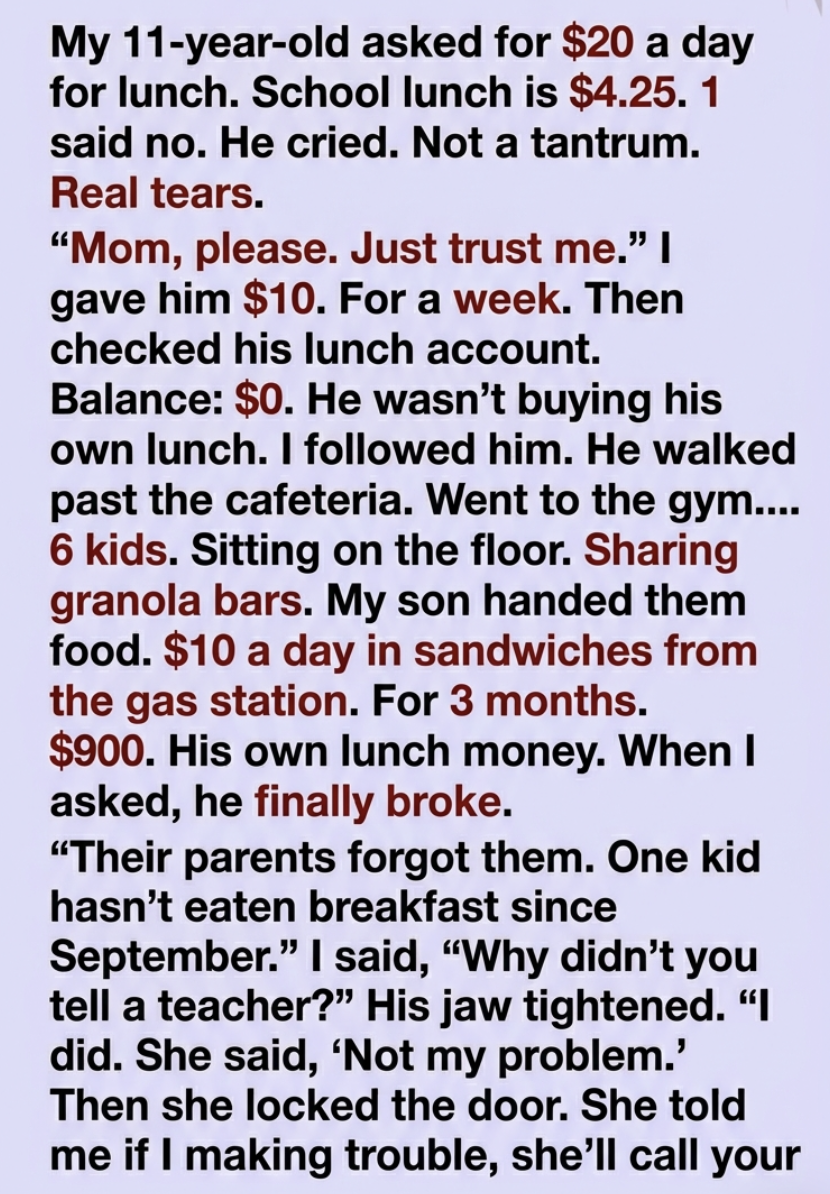
My 11-year-old asked me for twenty dollars a day for lunch.
School lunch cost four dollars and twenty-five cents.
Naturally, I said no.
He didn’t throw a tantrum.
Didn’t argue.
Didn’t complain.
He cried.
Real tears.
“Mom, please.”
His voice cracked.
“Just trust me.”
Something about the way he said it bothered me.
I compromised.
Ten dollars a day.
One week.
Then we’d talk again.
A few days later, curiosity got the better of me.
I logged into his school lunch account.
Balance used?
Zero.
Nothing.
Not a single purchase.
If he wasn’t buying lunch, where was the money going?
The next day I took an early lunch from work and drove to the school.
I parked where I could see the cafeteria entrance.
When the lunch bell rang, hundreds of kids headed inside.
My son didn’t.
He walked past the cafeteria.
Past the library.
Past the playground.
Straight to the gym.
I followed quietly.
Peeking through the small window in the door.
And what I saw broke my heart.
Six children sat cross-legged on the floor.
Sharing food.
Granola bars.
Sandwiches.
Juice boxes.
Fruit.
My son pulled grocery bags from his backpack and started handing everything out.
The kids practically attacked the food.
One little boy wrapped half a sandwich in a napkin and slipped it into his pocket.
For later.
I sat frozen.
Watching.
That evening I asked him the truth.
At first he denied everything.
Then he broke down crying.
“Their parents forgot them.”
I listened.
“One kid hasn’t eaten breakfast since September.”
The room went silent.
I wrapped my arms around him.
Trying not to cry myself.
Then I asked the obvious question.
“Why didn’t you tell a teacher?”
His entire expression changed.
His jaw tightened.
His eyes filled with anger.
“I did.”
I froze.
“What happened?”
He stared at the floor.
Then quietly said:
“She told me it wasn’t her problem.”
I felt sick.
But he wasn’t finished.
“Then she locked the gym door.”
“What?”
He nodded.
“She said if I kept making trouble, she’d call your employer and tell them you’re raising a disruptive child.”
I couldn’t believe what I was hearing.
The next morning I drove straight to the school.
I demanded a meeting with the principal.
Immediately.
At first he seemed skeptical.
Until I showed him photographs I’d taken through the gym window.
Then I showed him receipts.
Nearly nine hundred dollars worth of food purchases.
Three months.
Every day.
My eleven-year-old had spent his own lunch money feeding hungry children.
While adults did nothing.
The principal’s face turned pale.
Then he called the school counselor.
The counselor arrived.
Looked at the photographs.
And started crying.
Because she recognized every child.
Each one had already been flagged as potentially food insecure.
Reports had been filed.
Concerns documented.
But somehow nothing meaningful had happened.
Then came the twist nobody expected.
One of the children had secretly recorded the teacher’s comments on a school-issued tablet.
The recording was clear.
Very clear.
Every word.
The principal listened once.
Then immediately contacted the district office.
By the end of the week, the teacher was placed on administrative leave.
An investigation began.
But the story didn’t end there.
Because the real problem wasn’t one teacher.
The real problem was that six children were hungry.
Every day.
In a school full of adults.
The district launched an emergency review.
Food assistance programs expanded.
Breakfast became available before school.
Local businesses donated meals.
Community volunteers stepped in.
Within weeks, every child identified as needing help had access to food.
No questions asked.
No paperwork delays.
No embarrassment.
One month later, the school board invited my son to a meeting.
He hated the idea.
“I don’t want attention.”
Typical eleven-year-old.
But he went.
When he walked into the room, every board member stood.
And applauded.
My son turned bright red.
Then tried to hide behind me.
The superintendent smiled.
And said something I’ll never forget.
“Sometimes children remind adults how to be human.”
After the meeting, one of the boys from the gym walked over.
Handed my son a folded note.
Inside were six simple words.
“Thank you for feeding my sister.”
Not me.
Not the school.
Not a charity.
My son.
Years later, I still keep a copy of that note.
Because whenever someone asks me when I realized my child was becoming a good man, I think back to that gym.
To six hungry kids.
To nine hundred dollars in sandwiches.
And to an eleven-year-old boy who saw a problem and decided it belonged to him.
The truth is, heroes rarely look heroic.
Sometimes they look like skinny kids carrying too many grocery bags.
Doing the right thing when they think nobody is watching.