She had raised three children.
She had cared for my father through years of illness.
She volunteered at the local food pantry.
And even after turning seventy, she still woke up every morning before sunrise because she believed there was always something useful she could do.
So when our neighbor, Claire, asked her to babysit her six-year-old daughter, Lily, Mom agreed.
At first, it was supposed to be temporary.
“One week,” Claire said.
“Maybe two.”
Mom smiled.
“That’s fine.”
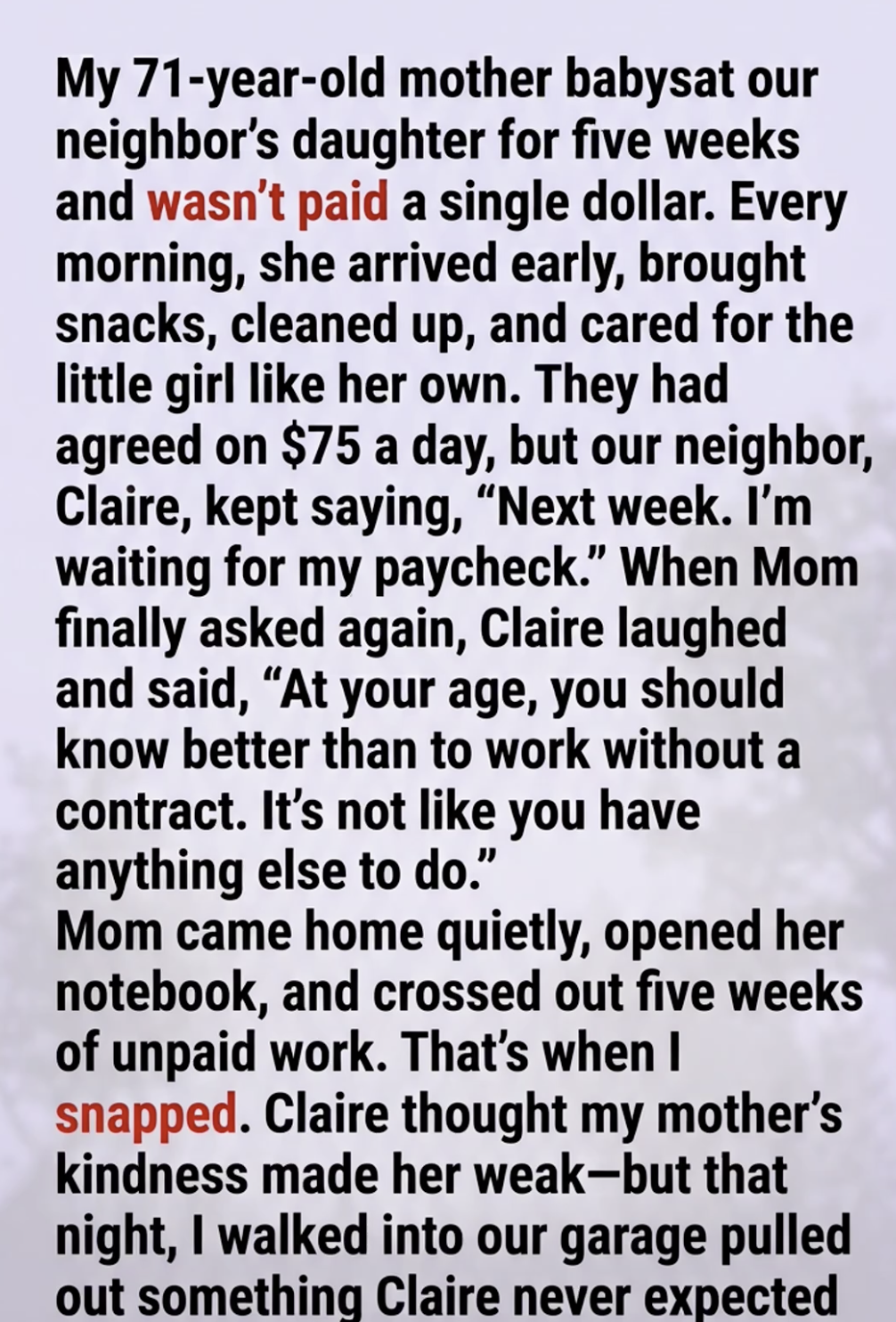
They agreed on $75 a day.
Claire shook Mom’s hand.
“Thank you. I really appreciate this.”
And Mom meant it when she said,
“Of course.”
The first week went perfectly.
Mom arrived at 7:30 every morning.
She brought Lily fruit, sandwiches, crackers, and little homemade muffins.
She helped her with homework.
She took her to the park.
She washed the dishes after lunch.
She even cleaned the toys before Claire came home.
On Friday afternoon, Claire hugged her.
“I’ll pay you Monday. My paycheck comes in then.”
Mom nodded.
“No problem.”
Monday came.
Claire didn’t pay.
“Sorry,” she said.
“My paycheck was delayed.”
Mom smiled.
“That’s okay.”
The following week passed.
Still nothing.
When Mom mentioned the money, Claire said,
“Next week. I promise.”
Mom didn’t argue.
She continued showing up every morning.
By the third week, Lily had become attached to her.
She called Mom “Grandma.”
She would run to the door every morning.
“Grandma!”
Mom would laugh.
“Good morning, sweetheart.”
They baked cookies together.
They planted flowers.
They read bedtime stories during the afternoons when Claire worked late.
But Claire still didn’t pay.
By the fourth week, Mom began writing everything down.
Not because she wanted to cause trouble.
She simply kept a little notebook where she recorded the dates and hours.
Monday.
Tuesday.
Wednesday.
Thursday.
Friday.
Five weeks.
Twenty-five days.
At $75 a day, Claire owed her $1,875.
On Friday afternoon, Mom finally asked.
“Claire, could you please settle the payment soon? I need to take care of a few bills.”
Claire rolled her eyes.
“Next week.”
Mom stood quietly.
“I’ve heard that several times.”
Claire sighed.
“I’m waiting for my paycheck.”
“You said that three weeks ago.”
Claire’s expression changed.
Then she laughed.
“You’re serious?”
Mom nodded.
Claire crossed her arms.
“At your age, you should know better than to work without a contract.”
Mom’s face went pale.
Claire continued.
“It’s not like you have anything else to do.”
I happened to be standing in the hallway when she said it.
I wanted to confront Claire immediately.
But Mom touched my arm.
“Let’s go.”
We walked home.
She didn’t say a word.
When we got inside, Mom sat at the kitchen table.
She opened her notebook.
She looked at the five weeks of dates.
Then she drew one long line through them.
I thought she was giving up.
“Mom…”
She closed the notebook.
“It’s fine.”
“No, it isn’t.”
“She needed help.”
“And she used you.”
Mom looked at me.
“I don’t want Lily punished because her mother is dishonest.”
That sentence made me even angrier.
“You don’t understand,” I said.
“She knows you’re kind, and she’s taking advantage of you.”
Mom sighed.
“Maybe.”
Then she stood up.
“I’m going to make some tea.”
That night, I couldn’t sleep.
Claire’s words kept replaying in my head.
“At your age…”
“It’s not like you have anything else to do.”
I knew my mother.
She wouldn’t fight Claire.
She wouldn’t threaten her.
She wouldn’t demand anything.
She would simply walk away.
But I couldn’t let it go.
Around midnight, I went into our garage.
I wasn’t looking for anything in particular.
I was just angry.
Then I remembered something.
A box my father had left behind.
I pulled it down from a shelf.
Inside were old documents.
Receipts.
Business records.
Property papers.
And one thick folder.
I opened it.
My heart stopped.
It contained copies of every rental agreement, employment contract, invoice, and legal document my father had kept for decades.
And at the bottom was something else.
A handwritten note.
Never assume someone is powerless because they’re quiet.
I stared at the words.
Then I remembered something my father had told me years ago.
Before retiring, he had worked in contract administration.
He had always taught us to document everything.
“Kindness is good,” he’d say.
“But never let someone confuse kindness with permission to hurt you.”
I went back inside.
Mom was asleep.
I didn’t wake her.
The next morning, I asked her a question.
“Mom, did Claire ever give you anything in writing?”
Mom thought for a moment.
“She texted me.”
“Do you still have the messages?”
She nodded.
“I think so.”
She handed me her phone.
There they were.
Claire had written:
I’ll pay you $75 per day.
Starting Monday.
Thank you for helping me.
Then another message:
Don’t worry. You’ll get everything at the end of the week.
Then another.
I owe you for this week too.
There were dozens of messages.
Claire had accidentally documented everything herself.
The dates.
The agreed rate.
The hours.
The requests.
The promises to pay.
Even her acknowledgment that Mom was working for her.
I showed Mom.
She stared at the screen.
“I didn’t realize…”
“Exactly.”
Then I pulled another document from my father’s old folder.
It was a simple payment-demand template he’d once used in his business.
I rewrote it carefully with the dates and amount.
$1,875.
Mom looked uncomfortable.
“Do we really need to do this?”
“Yes.”
“She’s our neighbor.”
“And you’re her employee.”
Mom sighed.
“I don’t want a fight.”
“You won’t get one.”
I knocked on Claire’s door that afternoon.
She opened it.
“Oh. Hi.”
I handed her the envelope.
“What is this?”
“An invoice and formal demand for the five weeks of babysitting.”
Claire laughed.
“You’re actually doing this?”
“Yes.”
“She doesn’t have a contract.”
“You’re right.”
Claire smiled.
“So you admit you can’t prove anything?”
I pulled out my phone.
“I don’t need a paper contract.”
I showed her the messages.
Her smile disappeared.
She read them.
Then looked at me.
“I was just being polite.”
“You specifically agreed to $75 a day.”
“I didn’t mean—”
“You said you’d pay at the end of each week.”
Silence.
Then Claire’s expression became angry.
“You people are unbelievable.”
“My mother worked twenty-five days.”
“She volunteered.”
“No.”
“She loves Lily.”
“That doesn’t make unpaid labor voluntary.”
Claire slammed the door.
I thought that was the end.
It wasn’t.
The next morning, Mom received a message.
Tell your son to stop harassing me.
Mom showed me.
I didn’t respond.
Instead, I contacted a local legal-aid office and asked for advice.
They explained that written messages could be important evidence and suggested that Mom send a formal written demand for payment.
So we did.
Three days later, Claire called.
“I’ll give her $500.”
“No.”
“That’s all I can afford.”
“You owe her $1,875.”
“I don’t have it.”
“That isn’t my mother’s problem.”
Claire became quiet.
Then she said,
“I can pay in installments.”
Mom was sitting beside me.
She looked at me.
I said,
“That’s her decision.”
Mom thought for a moment.
“Four payments.”
Claire agreed.
But something unexpected happened before the first payment.
Lily came to our house.
She was holding a drawing.
“Grandma?”
Mom smiled.
“Hi, sweetheart.”
Lily handed her the paper.
It showed a little girl standing beside an older woman.
Above them were the words:
My favorite person.
Mom’s eyes filled with tears.
Claire stood behind her daughter.
For the first time, she looked ashamed.
“Mom…”
Lily looked at her.
“Why don’t you let Grandma come anymore?”
Claire didn’t answer.
Mom knelt down.
“I’ll always love you, sweetheart.”
“Are you coming tomorrow?”
Mom looked at Claire.
Then she looked back at Lily.
“No, honey.”
“Why?”
“Because Grandma needs to rest.”
Lily hugged her.
Then Claire quietly said,
“I was wrong.”
Mom stood up.
“You were.”
Claire swallowed.
“I shouldn’t have said what I said.”
Mom nodded.
“You shouldn’t have.”
“I thought because you were older, you needed the money less.”
Mom’s expression hardened.
“That wasn’t your decision to make.”
Claire lowered her eyes.
“I know.”
Then she handed Mom an envelope.
Inside was the first payment.
$500.
Mom didn’t smile.
She simply said,
“Thank you.”
Claire left.
Over the next few weeks, she paid the rest.
$500.
$500.
$375.
Every payment was documented.
Every receipt was kept.
Not because Mom wanted revenge.
Because she had finally learned something important.
Being kind doesn’t mean accepting disrespect.
Several months later, Claire knocked on our door again.
She was holding a small cake.
“I wanted to apologize.”
Mom invited her inside.
Claire sat at the table.
“I’ve been thinking about what I said.”
Mom waited.
“You told me you had nothing else to do.”
Claire looked embarrassed.
“I know.”
“You were wrong.”
Claire nodded.
“My age doesn’t make my time worthless.”
“No.”
“My kindness doesn’t make my work free.”
“No.”
“And being someone’s neighbor doesn’t mean they get to take advantage of me.”
Claire looked down.
“You’re right.”
Mom accepted the apology.
But she didn’t start babysitting again.
That part was important.
She forgave Claire.
She didn’t give her another opportunity to disrespect her.
A few months later, Mom started helping at a community center.
She taught children how to bake.
She organized donated clothes.
She helped elderly neighbors with paperwork.
And whenever someone asked her why she continued helping people after what happened with Claire, she would smile and say,
“Because one dishonest person doesn’t get to turn me into a bitter one.”
One afternoon, I found her writing in the same old notebook.
I looked over her shoulder.
She had written something underneath the five crossed-out weeks.
My time has value.
Then she added:
Kindness is a gift, not an obligation.
I smiled.
She closed the notebook.
“You know,” she said, “your father would have liked that.”
I laughed.
“Dad would have written a contract for everything.”
Mom laughed too.
And for the first time, I realized something.
Claire had thought my mother’s age made her weak.
She thought her kindness meant she could push her around.
She thought an older woman who didn’t fight back had no power.
But she had misunderstood the quietest person in the room.
My mother didn’t need to scream.
She didn’t need to threaten anyone.
She simply kept the evidence.
And when the time came, she stood up for herself.
Because sometimes the strongest person isn’t the one who makes the most noise.
Sometimes it’s the person who quietly opens a notebook, turns the page, and finally decides:
Enough.