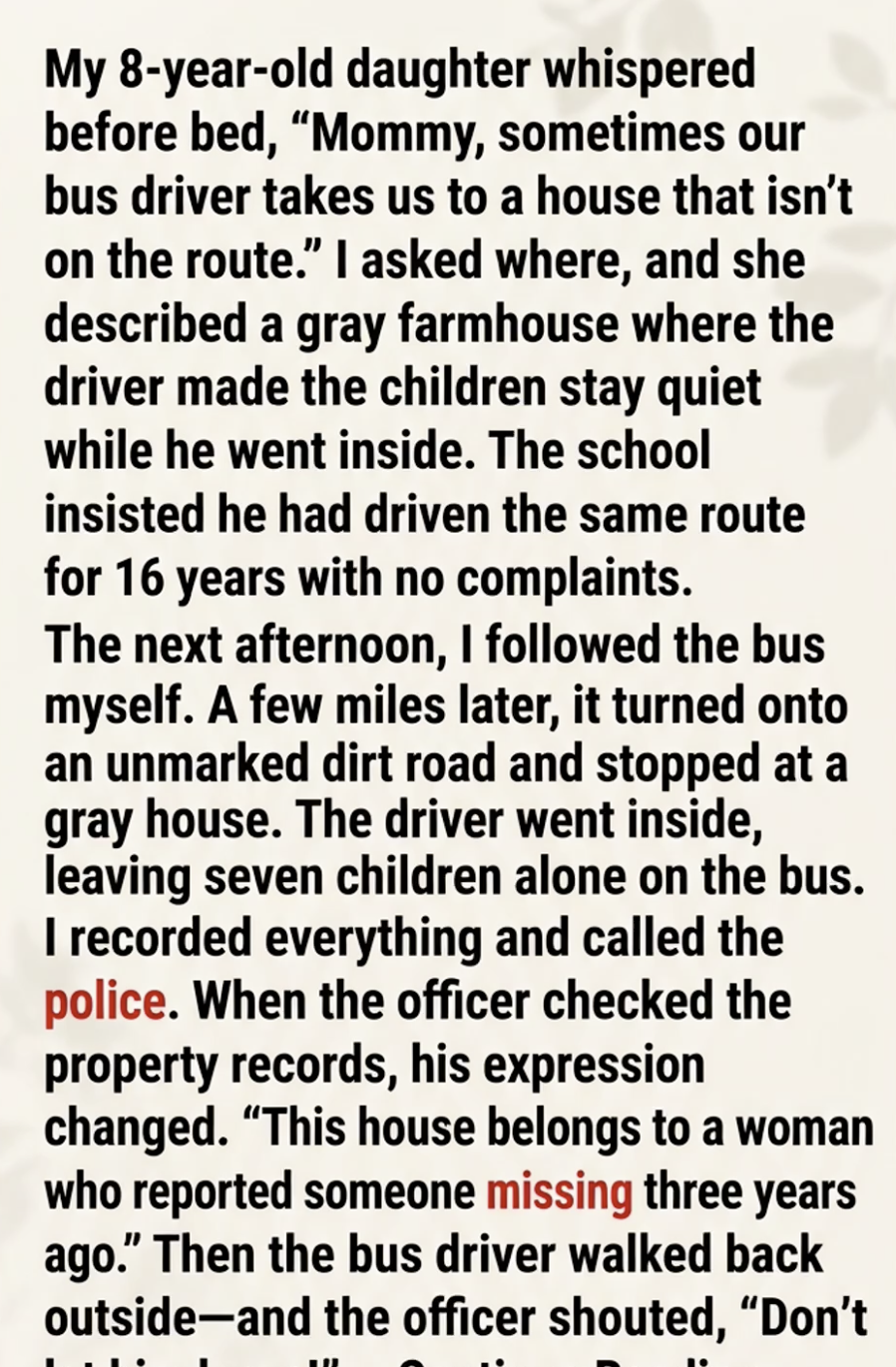
“Mommy, sometimes our bus driver takes us to a house that isn’t on the route.”
I stopped folding her pajamas.
“What house?”
She pulled the blanket up to her chin.
“A gray house.”
“Why does he go there?”
“He tells us to be quiet.”
My stomach tightened.
“What does he do?”
“He goes inside.”
“Does he take anyone with him?”
She shook her head.
“No. We stay on the bus.”
I sat beside her.
“How many times?”
She thought for a moment.
“Three.”
“Are you scared?”
“A little.”
“Did he tell you not to tell me?”
She nodded.
“He said grown-ups don’t need to know everything.”
I barely slept that night.
The next morning, I called the school.
The secretary sounded almost amused.
“Our bus driver has been driving that route for sixteen years.”
“Then you know about the gray house?”
There was a pause.
“What gray house?”
I explained what my daughter had told me.
The principal called me back an hour later.
“We spoke with Mr. Collins,” he said.
“Does he take the children somewhere off route?”
“No.”
“My daughter says he does.”
“He’s been with us for sixteen years. We’ve never had a complaint.”
“I am telling you my daughter described a specific house.”
“Children can misunderstand distances.”
“My daughter doesn’t invent things like this.”
The principal’s voice became more cautious.
“We’ll look into it.”
But I wasn’t satisfied.
The next afternoon, I waited near the school.
When the bus left, I followed it.
I kept far enough behind that my daughter wouldn’t see my car.
For the first fifteen minutes, everything looked normal.
The bus followed the usual route.
Then, suddenly, it turned.
Not onto another neighborhood street.
Onto an unmarked dirt road.
My heart started pounding.
I followed.
The road narrowed.
Trees surrounded us.
Then I saw it.
A gray farmhouse.
Exactly as my daughter had described.
The bus stopped.
The doors opened.
The driver stepped outside.
He looked around.
Then he walked toward the house.
Seven children remained inside the bus.
Alone.
I pulled over.
I started recording with my phone.
I called the police.
“There’s a school bus at an isolated property,” I told the dispatcher. “The driver left seven children alone on the bus.”
“Are the children in immediate danger?”
“I don’t know.”
“What’s the address?”
I gave her the location.
A police officer arrived about ten minutes later.
He approached my car.
“Are you the caller?”
“Yes.”
I showed him the video.
Then we watched the bus driver disappear inside the gray farmhouse.
The officer frowned.
“Stay here.”
He walked toward the property.
A few minutes later, he returned holding his phone.
His expression had changed.
“What is it?” I asked.
He looked at the farmhouse.
“This house belongs to a woman named Margaret Hale.”
“Okay.”
“She reported someone missing three years ago.”
My heart sank.
“Who?”
The officer hesitated.
“Her eight-year-old granddaughter.”
I stared at him.
“What?”
“Her granddaughter disappeared three years ago.”
“Was she ever found?”
He shook his head.
“No.”
I looked at the bus.
Seven children.
One driver.
An isolated farmhouse.
A missing child.
Everything suddenly felt much darker.
The officer called for backup.
Then the bus driver’s door opened.
Mr. Collins stepped outside.
He looked directly toward us.
For one second, his face showed surprise.
Then something happened.
He turned around.
The officer shouted,
“Don’t let him leave!”
Mr. Collins ran.
Two officers chased him across the yard.
He made it about twenty feet before they tackled him.
The children started screaming.
The officers immediately surrounded the bus.
“Everyone stay calm!”
One officer opened the door.
“Kids, you’re safe.”
My hands were shaking.
I wanted to run to my daughter, but the officers told me to wait until they had secured the scene.
Then another officer came running out of the farmhouse.
“Detective!”
He was carrying a photograph.
The first officer looked at it.
His face went pale.
“What?”
“We found a room.”
“What kind of room?”
“A child’s room.”
The officer looked toward me.
“There’s a bed. Toys. Clothes.”
My heart was pounding.
“Could it belong to the missing girl?”
“We don’t know yet.”
Then they found something worse.
A wall covered in photographs.
Not one child.
Several.
Some were old.
Some were recent.
School pictures.
Birthday photographs.
Bus photographs.
Children getting onto buses.
Children walking home.
I felt sick.
“Why would someone photograph these kids?”
Nobody answered.
Then an officer called from the farmhouse.
“We found the basement.”
The detective’s expression changed.
He ordered everyone away from the building.
A search team entered.
Minutes later, they came back carrying boxes.
Inside were notebooks.
Names.
Dates.
Bus routes.
Descriptions of children.
The detective opened one notebook.
He looked at me.
“Your daughter is in here.”
My blood ran cold.
“What does it say?”
He didn’t answer immediately.
Then he read the entry.
“Eight years old. Brown hair. Walks home with mother. Usually picked up at 3:15.”
I nearly collapsed.
“That’s my daughter.”
The detective closed the notebook.
“There’s something else.”
“What?”
“Your daughter wasn’t the only child listed.”
He showed me another page.
Seven names.
The same seven children currently sitting on the bus.
Then he turned another page.
There were names from previous years.
Dozens of them.
Children who had ridden Mr. Collins’s bus.
The detective looked toward the gray farmhouse.
“We need to know why.”
The investigation lasted through the night.
The farmhouse belonged to Margaret Hale, the woman whose granddaughter had disappeared three years earlier.
But Margaret hadn’t been living there for months.
She had been receiving medical treatment in another city.
So why was Mr. Collins using the property?
That question led investigators to an abandoned shed behind the house.
Inside, they found boxes belonging to Margaret’s missing granddaughter.
Her name was Emily.
Eight years old when she disappeared.
A small red backpack.
A purple sweater.
A stuffed rabbit.
And photographs.
But there was something investigators hadn’t expected.
A locked metal cabinet.
Inside were documents showing that Margaret had hired Mr. Collins three years earlier to help search for Emily.
Then they found his fingerprints on the original missing-person file.
The detective stared at the documents.
“He was involved from the beginning.”
But that still didn’t explain the bus.
The answer came from a notebook found in the basement.
Mr. Collins had been keeping records of children’s routines.
But next to some names were strange symbols.
The detective explained that they appeared to indicate which children had family members living alone, which children had working parents, and which children regularly walked home unattended.
Mr. Collins had been gathering information.
But for what?
Investigators questioned him.
At first, he refused to speak.
Then they showed him the photographs.
He finally broke.
But the truth wasn’t what any of us expected.
Mr. Collins had not been kidnapping the children.
He had been secretly taking them to the farmhouse because someone else had been using the property.
Margaret’s missing granddaughter had been taken three years earlier by a man who had been renting the farmhouse under a false name.
That man had died two years later.
But before he died, he left behind a collection of photographs and documents.
Mr. Collins had discovered them.
Instead of going directly to the police, he panicked.
He believed the people connected to Emily’s disappearance were still watching him.
So he began using the farmhouse as a place to secretly collect evidence.
But why bring children there?
That was where he had made his biggest mistake.
He had discovered that several children on his route had witnessed suspicious activity around the neighborhood.
Instead of reporting the information properly, he brought them to the farmhouse one at a time and questioned them.
He told them to stay quiet.
He told them not to tell their parents.
And he wrote down everything they said.
It was completely unacceptable.
But then investigators discovered something hidden beneath the basement floor.
A metal box.
Inside was Emily’s necklace.
Her school ID.
And a photograph of a man standing beside the farmhouse.
The detective recognized him immediately.
It was Margaret’s former caretaker.
A man who had disappeared shortly after Emily vanished.
Police found him living under another name in another state.
He was arrested.
And after three years, Emily’s disappearance finally had an answer.
She had been taken from the farmhouse by the caretaker after he became involved in an illegal adoption scheme.
Emily had died shortly after the abduction.
The truth was devastating.
But it finally gave her family answers.
As for Mr. Collins, he was arrested for illegally transporting children, endangering minors, and withholding evidence.
He had convinced himself that he was helping.
But he had frightened children, violated their parents’ trust, and placed them in danger.
When I finally got my daughter back, she wouldn’t let go of me.
I held her tightly.
“Why didn’t you tell me sooner?” I asked.
She cried.
“I was scared.”
“Of the driver?”
She nodded.
“He said if we told anyone, something bad would happen.”
I kissed her forehead.
“You did the right thing by telling me.”
She looked at me.
“Is he going to come back?”
“No.”
“Are we safe?”
I hugged her tighter.
“Yes.”
But the experience changed our family.
The school changed its transportation policies.
Parents were notified about every route deviation.
Bus drivers were required to document unexpected stops.
And children were taught that if an adult ever tells them to keep something secret from their parents, they should tell someone they trust immediately.
Months later, my daughter asked me something.
“Mommy?”
“Yes?”
“Do you remember the gray house?”
“Yes.”
She thought for a moment.
“I knew something was wrong.”
I smiled sadly.
“You did.”
She looked at me.
“But you believed me.”
I hugged her.
“I will always believe you.”
That was the lesson I carried with me.
The school had trusted a man because he had been driving the same bus for sixteen years.
Everyone assumed his experience meant he couldn’t be dangerous.
Everyone assumed there would have been complaints if something was wrong.
But my daughter noticed something adults ignored.
A route that didn’t make sense.
A house that shouldn’t have been there.
A driver who told children to stay quiet.
Sometimes children notice the smallest details because they haven’t yet learned to ignore the things adults consider inconvenient.
My daughter wasn’t imagining the gray house.
She was warning me.
And because she did, seven children went home safely that night.
Three years after a little girl disappeared, the truth finally came out.
But I still think about that farmhouse sometimes.
A gray house on an unmarked road.
A school bus that was never supposed to stop there.
And seven children who were lucky enough to have one of them whisper to her mother:
“Mommy, sometimes our bus driver takes us somewhere he shouldn’t.”