My son gave me the DNA kit on Mother’s Day.
It came wrapped in bright green paper with a ridiculous bow on top.
“Happy Mother’s Day, Mom,” he said, grinning. “Now we’ll finally find out if we’re actually Irish.”
I laughed.
My family had always claimed we were mostly Irish.
My father used to say we had “Irish blood, Irish tempers, and Irish luck.”
My mother would roll her eyes and tell him he had forgotten the most important part.
“Irish stubbornness.”
I was seventy-one years old, and I had never had much reason to question any of it.
My parents had been married for forty-eight years.
They had raised me in a small Ohio town.
I was their only child.
At least, that was what I had always been told.
So I sent the sample away, forgot about it, and went on with my life.
Seven weeks later, an email arrived.
Your DNA results are ready.
I almost deleted it.
Then I remembered my son.
I opened it at the kitchen table while drinking coffee.
The ancestry results were exactly what I expected.
Some Irish.
Some English.
A little German.
Nothing shocking.
I was about to close the page when I noticed a section called DNA Matches.
I clicked it.
At first, I saw distant relatives I didn’t recognize.
Third cousins.
Fourth cousins.
People with surnames I had never heard before.
Then I saw one match near the top.
I stared at the percentage.
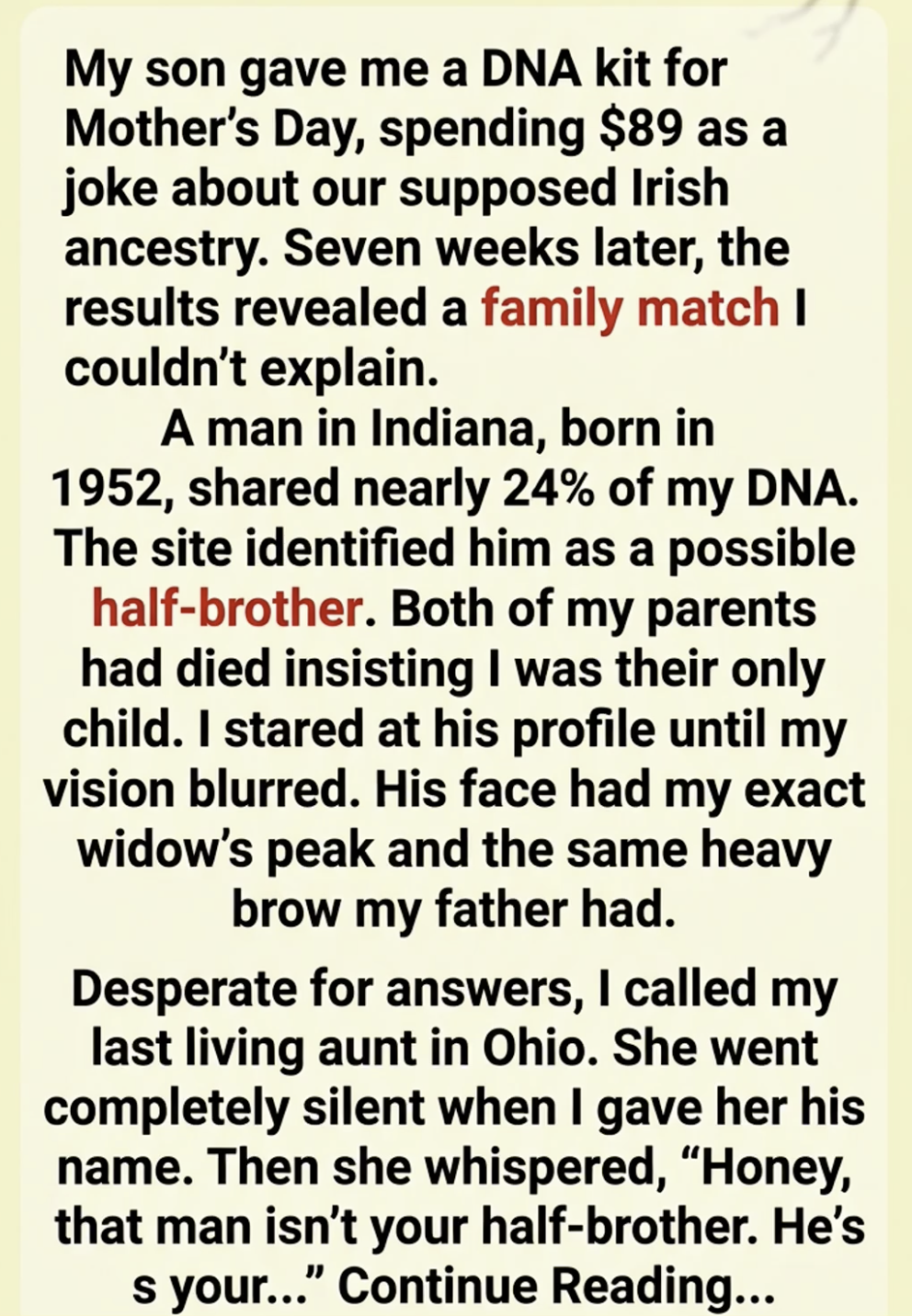
23.8% shared DNA.
That was a lot.
I clicked the profile.
The website said:
Possible relationship: Half-sibling, grandparent, aunt/uncle, or niece/nephew.
The man’s name was Richard Harlan.
Born in Indiana.
1952.
I sat back in my chair.
My hands went cold.
I looked at the screen again.
Then I laughed.
Not because anything was funny.
Because sometimes the human mind laughs when it doesn’t know what else to do.
A stranger.
A man I’d never heard of.
A man nearly twenty years older than me.
And the website was telling me he could be my half-brother.
Impossible.
Both my parents were dead.
My father had died fourteen years earlier.
My mother followed him six years after that.
Neither had ever mentioned another child.
Not once.
I had grown up hearing the same sentence whenever someone asked whether I had siblings.
“No. She’s our only one.”
My father said it.
My mother said it.
My grandparents said it.
My aunts said it.
Everybody knew.
I was an only child.
I scrolled down to Richard’s photograph.
And my stomach dropped.
He had my father’s eyebrows.
Not similar.
Not vaguely familiar.
The exact same heavy brow.
And beneath his dark hair was a widow’s peak shaped almost identically to mine.
I enlarged the photograph.
There was something else.
The shape of his nose.
The narrow bridge.
The slight bend near the tip.
My father’s nose.
I whispered, “Who are you?”
The photograph, of course, didn’t answer.
I spent the next three days obsessing over it.
I searched his name.
Richard Harlan.
Born 1952.
Indiana.
I found an old newspaper article about a local charity event with his photograph.
I found a business listing.
A marriage announcement.
A public obituary for someone with his last name.
Every tiny detail made the impossible feel more possible.
Finally, I called my son.
“Mom?”
“I think I have a brother.”
Silence.
Then he laughed.
“What?”
“I took the DNA test.”
“Yeah.”
“And it says I have a close family match.”
“How close?”
“Twenty-three point eight percent.”
The laughter stopped.
“Oh.”
“I found a man in Indiana.”
“Does he know about you?”
“I don’t know.”
My son immediately said, “Don’t contact him until we know more.”
“I wasn’t planning to.”
I paused.
“Maybe.”
“Mom.”
“I said maybe.”
He sighed.
Then I remembered something.
My Aunt Evelyn.
My mother’s younger sister.
She was ninety-two and living in Ohio.
She was the last person alive who had known my mother as a young woman.
If anyone could explain this, it was her.
I called her the next morning.
She answered on the fourth ring.
“Hello?”
“Aunt Evie, it’s me.”
“Sweetheart.”
We exchanged the usual greetings.
Then I said,
“I need to ask you something strange.”
She chuckled.
“At my age, strange is usually what makes the day interesting.”
I took a breath.
“Do you know a man named Richard Harlan?”
The silence that followed was unlike anything I’d ever heard from her.
Not confusion.
Not surprise.
Fear.
I could hear her breathing.
“Aunt Evie?”
Nothing.
Then, very quietly, she said,
“Where did you get that name?”
“My DNA results.”
Another silence.
I sat up straighter.
“What does that mean?”
Her voice dropped to a whisper.
“Honey…”
She swallowed.
“That man isn’t your half-brother.”
My heart started pounding.
“Then what is he?”
She took a long breath.
Then she said the words that changed everything.
“He’s your father.”
I couldn’t speak.
My aunt continued before I could ask.
“Your biological father.”
I stared at the kitchen wall.
“No.”
“Yes.”
“No. My father was Frank.”
“I know.”
“My father raised me.”
“I know.”
“He was married to my mother.”
“I know.”
“He was my father.”
“Yes, sweetheart.”
Her voice softened.
“That’s why I said your biological father.”
I couldn’t understand.
My father’s name was Frank Bennett.
He had taught me to ride a bicycle.
He’d sat beside my bed when I had pneumonia.
He’d walked me down the aisle when I got married.
He’d held my son the day he was born.
He was my father.
There was no room in my life for another one.
But Aunt Evelyn had already opened a door that could never be closed again.
“Tell me everything.”
She cried before she answered.
“Your mother was seventeen.”
I closed my eyes.
“Seventeen?”
“Yes.”
“And Richard?”
“Seventeen too.”
She told me that my mother, Margaret, had grown up with a family that cared deeply about appearances.
She had met Richard at a summer dance.
They fell in love quickly.
Too quickly, according to Margaret’s parents.
Then Margaret became pregnant.
She was terrified.
Her parents were furious.
Richard wanted to marry her.
But there was a problem.
His family was moving to Indiana.
His father had already accepted a job there.
Richard was seventeen.
He had no money.
No car.
No way to support a wife and baby.
Margaret’s parents decided the pregnancy had to disappear.
Not the baby.
The truth.
Margaret was sent away to stay with relatives in Pennsylvania.
She gave birth to a little girl.
Me.
“When I was born,” I whispered.
“Yes.”
“Where was Richard?”
“He came.”
My breath caught.
“He came to the hospital?”
“He tried.”
Aunt Evelyn explained that Richard’s parents had forbidden him from seeing Margaret.
But he found out where she had gone.
He showed up anyway.
He wanted to see his daughter.
My grandmother refused.
She told him Margaret had lost the baby.
“She lied?”
“Yes.”
“Why?”
“Because your grandfather believed he was protecting the family.”
I almost laughed.
Protecting the family.
That phrase had apparently destroyed generations of lives.
“So where did Frank come from?”
Aunt Evelyn hesitated.
“Your mother met him shortly afterward.”
Frank was twenty-two.
Kind.
Stable.
Already working.
He knew Margaret had been pregnant.
But he was told the child had died.
He married her two years later.
And he raised me.
I sat there, stunned.
“But did Frank know?”
My aunt didn’t answer immediately.
Then she said,
“I think he eventually suspected.”
“Did Mom tell him?”
“I don’t know.”
“Did Richard ever know I was alive?”
“Yes.”
I gripped the edge of the table.
“How?”
“He found out.”
“When?”
“Years later.”
“How many years?”
“About twenty.”
I felt dizzy.
Twenty years.
Richard had spent twenty years believing his daughter was dead.
And I had spent twenty years believing my father was Frank.
“What happened when he found out?”
“He came to Ohio.”
I could barely breathe.
“Did he see me?”
“No.”
“Why?”
“Because your mother asked him not to.”
I didn’t understand.
“Why would she do that?”
“Because by then you were grown. Married. You had a life. She was afraid telling you would destroy everything.”
I stood up.
Then sat down again.
“Did he agree?”
“He didn’t have much choice.”
My aunt’s voice cracked.
“Your mother told him that if he loved you, he’d leave you alone.”
I covered my mouth.
“That was cruel.”
“It was.”
“Did he?”
“Yes.”
I stared at the DNA profile again.
Richard Harlan.
Born 1952.
My biological father.
A man who had spent seventy years carrying a secret that wasn’t his fault.
And I had never even known he existed.
My aunt gave me one more piece of information.
“He sent your mother letters.”
“How many?”
“Dozens.”
“Where are they?”
She hesitated.
“I don’t know.”
That night, I couldn’t sleep.
I kept thinking about my father.
Frank.
The man who wasn’t my biological father but had been my father in every way that mattered.
Then I thought about Richard.
The man whose DNA had somehow found its way across decades of lies and silence.
The next morning, I messaged him through the DNA website.
I wrote only:
Hello. I believe we may have a family connection. My name is Margaret’s daughter.
I almost deleted it.
Then I pressed send.
He responded four hours later.
What is your mother’s full name?
I gave it to him.
Three minutes later, another message appeared.
Margaret Bennett?
Then:
Oh my God.
Then:
Are you alive?
I cried when I read that.
Not because I was sad.
Because I suddenly understood how much grief could fit inside three words.
Are you alive?
I answered:
Yes. I’m 71.
He didn’t respond for almost an hour.
Then:
I have waited 54 years to know the answer to that question.
We talked for six hours that night.
He told me everything he remembered.
The dance.
The pregnancy.
The hospital.
The day he was told his daughter had died.
He showed me photographs.
One was of him at seventeen.
Another was of his family standing beside a car in Indiana.
And then he sent me something that made my heart stop.
A photograph of a tiny baby bracelet.
Written across it were three words:
Baby Girl Bennett.
My name.
He had kept it for seventy-one years.
We eventually arranged a meeting.
I flew to Indiana with my son.
I was terrified.
What if it felt wrong?
What if I expected too much?
What if he expected a daughter who had somehow been frozen at seventeen?
Instead, when I walked into the restaurant, I saw an elderly man standing near the window.
He was thinner than I’d imagined.
His hair was white.
His shoulders were bent.
But his eyebrows were unmistakable.
My father’s eyebrows.
He saw me.
His face crumpled.
He didn’t say hello.
He simply whispered,
“You’re real.”
I nodded.
“So are you.”
He laughed through tears.
Then he asked the question I think he’d been carrying for more than half a century.
“Can I hug you?”
I walked into his arms.
He held me carefully.
Like I might disappear.
We stayed that way for a long time.
Eventually, we sat down.
He told me he’d spent decades wondering what kind of woman I’d become.
“I imagined you a thousand times,” he said.
“Were you disappointed?”
He looked offended.
“Disappointed?”
He shook his head.
“I was afraid I’d never get the chance to find out.”
We talked about everything.
His life.
Mine.
My son.
His children.
His grandchildren.
The careers we’d had.
The people we’d loved.
The things we had missed.
Then I asked the hardest question.
“Are you angry at my mother?”
He looked down.
“For a long time.”
“And now?”
He thought about it.
“Now I’m mostly sad.”
“Why?”
“Because she was seventeen.”
He looked out the window.
“People forget how young seventeen really is.”
That sentence stayed with me.
My mother had made a terrible decision.
But she had made it while still practically a child, surrounded by adults who were terrified of shame.
That didn’t erase what she had done.
But it helped me understand it.
Before we left, Richard gave me a small box.
Inside was a photograph of my mother as a teenager.
She was laughing.
I’d never seen that photograph before.
On the back, Richard had written:
The girl I loved before the world got complicated.
I cried all the way back to the hotel.
My son drove.
Neither of us spoke for almost an hour.
Finally he said,
“Mom?”
“Yes?”
“Does this change who Grandpa was?”
I looked out the window.
“No.”
And I meant it.
Frank was still my father.
DNA could explain where my eyes came from.
It could explain my widow’s peak.
It could explain why a stranger’s face looked familiar.
But it couldn’t explain the man who stayed up all night when I was sick.
The man who taught me to drive.
The man who paid for my first apartment.
The man who called every Sunday.
The man who cried when I graduated.
The man who held my son.
Frank had chosen me every day of his life.
Richard had lost me before he ever had the chance to know me.
Both truths could exist at once.
Months later, I found the courage to go through my mother’s old belongings.
In the back of an old cedar chest, beneath Christmas decorations and photographs, I found an envelope.
My name was written on it.
Inside was a letter.
It had never been mailed.
My mother wrote:
My darling girl,
There are things about your beginning that I was never brave enough to tell you.
I have spent my whole life believing silence could protect you.
I don’t know if it did.
I want you to know that your father loved you.
And the man whose blood you carry loved you too.
I was too afraid to let you know that both could be true.
If you ever discover the truth, I hope you will forgive me for confusing protection with honesty.
At the bottom she had written:
You were never unwanted.
You were never a mistake.
You were the best thing that ever happened to me.
I read the letter three times.
Then I placed it beside Frank’s wedding photograph.
For the first time, the pieces of my life didn’t feel like they were fighting each other.
They were simply different pieces.
A mother who made a terrible choice.
A biological father who lost a daughter before he knew her.
And a father who raised a child who wasn’t biologically his and loved her completely.
I stayed in touch with Richard.
We didn’t pretend seventy-one years could be recovered in a few months.
We couldn’t manufacture a lifetime of memories.
But we built something new.
He became the man I called on birthdays.
I became the daughter he had finally gotten to meet.
And every year on Mother’s Day, my son jokes about the $89 DNA kit.
“I still can’t believe I spent eighty-nine dollars and accidentally found Grandpa.”
I always smile.
Then I look at the old photograph of Richard at seventeen.
And the photograph of Frank holding me as a baby.
Two men.
Two kinds of fatherhood.
One life.
And one truth I never expected to learn at seventy-one:
Sometimes DNA can tell you where you came from.
But it cannot tell you who loved you.
It cannot tell you who stayed.
It cannot tell you who chose you.
And it certainly cannot tell you what makes a family.
Because blood may connect people.
But love is what turns that connection into family.
And after seventy-one years, I finally understood something my mother had been trying to say in that old letter:
I was never the secret.
The secret was the fear surrounding my birth.
And once the truth finally came out, it didn’t destroy my family.
It simply gave every missing piece a name.