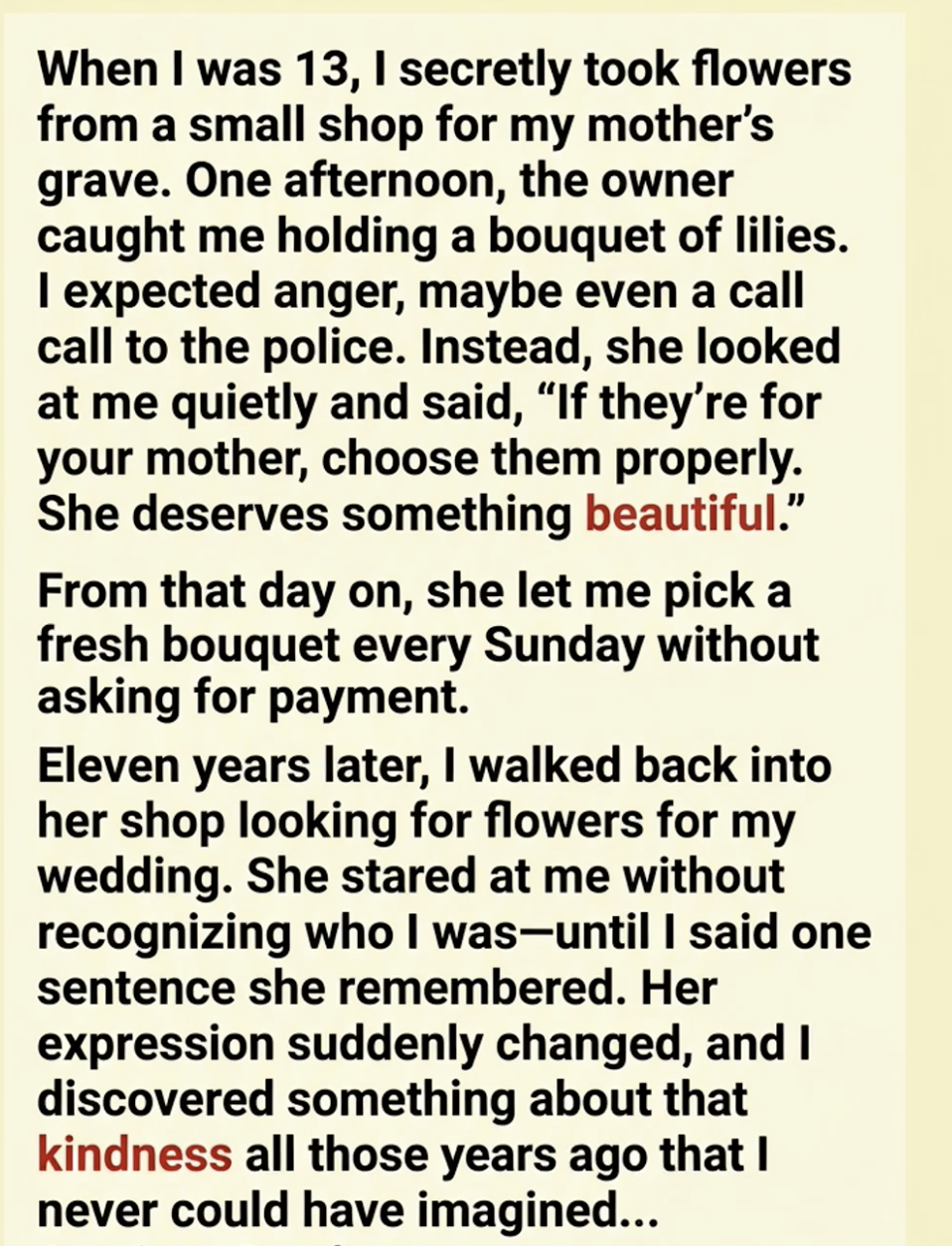
I was thirteen years old when I stole my first bouquet of flowers.
They were lilies.
White ones.
My mother had been dead for eleven months.
I still visited her grave every Sunday.
At first, my father came with me.
Then he stopped.
He said the cemetery made him too sad.
I understood.
I didn’t.
I needed to go.
I needed somewhere to talk to her.
Somewhere I could pretend she was still listening.
But flowers cost money.
And we didn’t have much.
My father worked construction when there was work.
Some weeks there was plenty.
Other weeks there wasn’t.
I knew better than to ask him for money for flowers.
So one Sunday afternoon, I walked past a small flower shop near the cemetery.
The window was filled with roses, tulips, lilies, and bright bouquets wrapped in paper.
I stood outside for almost ten minutes.
Then I went inside.
I picked up a small bouquet of lilies.
I looked around.
Nobody was watching.
I walked toward the door.
“Sweetheart?”
I froze.
An older woman stood behind the counter.
She wasn’t angry.
She wasn’t shouting.
She was simply looking at me.
I expected the worst.
“I’m sorry,” I whispered.
She walked toward me.
“What are those for?”
I looked down.
“My mother.”
Her expression changed.
“How old are you?”
“Thirteen.”
“And your mother?”
I swallowed.
“She died.”
The woman looked at the flowers.
Then at me.
“If they’re for your mother,” she said quietly, “choose them properly.”
I stared at her.
“What?”
She took the lilies from my hands.
“These are beautiful, but look.”
She walked to another bucket.
“These ones just came in.”
She selected a fresh bouquet.
Then handed it to me.
“Your mother deserves something beautiful.”
I couldn’t speak.
“How much?”
She waved her hand.
“Nothing.”
I stared at her.
“I stole these.”
“I know.”
“Are you going to call the police?”
She smiled.
“No.”
“Why?”
She looked at me for a long moment.
“Because I don’t think you’re stealing flowers.”
I frowned.
“Then what am I doing?”
She placed the bouquet in my hands.
“You’re trying to bring your mother something.”
I started crying.
She pretended not to notice.
That was the first Sunday.
The next Sunday, I came back.
She was waiting.
“You’re here early.”
I nodded.
She handed me a bouquet.
“Fresh ones.”
I reached for my pocket.
She shook her head.
“No.”
“I can pay.”
“I know.”
“But—”
“Go see your mother.”
And that became our routine.
Every Sunday.
For eleven months.
I would walk into the shop.
She’d choose something beautiful.
I’d take it to my mother’s grave.
And I never paid a cent.
Her name was Mrs. Evelyn Carter.
I eventually learned she had owned the shop for more than thirty years.
She never asked me much about my family.
She never asked why my father didn’t come.
She never asked how my mother died.
She simply gave me flowers.
Sometimes lilies.
Sometimes roses.
Sometimes daisies.
Once, in winter, she gave me a tiny bouquet of dried lavender.
“Fresh flowers are hard to keep alive this time of year,” she said.
“So?”
“So your mother deserves something that lasts.”
I smiled.
She smiled back.
I didn’t know it then, but those Sundays changed my life.
I started working harder at school.
I saved every dollar I could.
I eventually got a scholarship.
I went to college.
I moved away.
Life became busy.
But I never forgot her.
Every year on my mother’s birthday, I sent flowers to the cemetery.
And every year, I thought about Evelyn.
Then, eleven years after the day she caught me stealing, I walked back into her shop.
I was twenty-four.
And I was getting married.
I wanted flowers for my wedding.
Not expensive ones.
Just beautiful ones.
I walked through the door.
A woman stood behind the counter.
Older now.
Gray hair.
Glasses.
I recognized her immediately.
She looked at me.
Nothing.
No recognition.
Of course.
Eleven years had passed.
I smiled.
“Hi.”
“Hello.”
“I’d like to order wedding flowers.”
She smiled professionally.
“Congratulations.”
“Thank you.”
I looked around.
Everything felt smaller than I remembered.
Or maybe I was simply older.
She pulled out a notebook.
“When’s the wedding?”
“October.”
“Color scheme?”
“I don’t know yet.”
She laughed.
“That’s not very helpful.”
“I know.”
We both smiled.
Then I said,
“Can I have lilies?”
She looked up.
“Of course.”
I smiled.
“Fresh ones.”
Something about the way I said it made her pause.
She stared at me.
I could see her searching my face.
Then I said the sentence I’d heard from her eleven years earlier.
“My mother deserves something beautiful.”
Her hand froze.
The notebook fell onto the counter.
She stared at me.
“It’s you.”
I nodded.
She covered her mouth.
“Oh my God.”
She came around the counter.
We hugged.
And she started crying.
“I wondered what happened to you.”
“I went to college.”
She pulled back.
“You grew up.”
“I did.”
“Are you okay?”
I smiled.
“I’m getting married.”
She laughed through tears.
“Your mother would be proud.”
I nodded.
“She would.”
Then Evelyn said something I never expected.
“Do you know why I gave you those flowers?”
I smiled.
“Because you were kind.”
She shook her head.
“No.”
She sat down.
I sat beside her.
“When I was seventeen,” she said, “my little sister died.”
I listened.
“She loved flowers.”
Evelyn looked toward the shop window.
“Every Sunday, I used to take flowers to her grave.”
She smiled sadly.
“One Sunday, I couldn’t afford them.”
I stared at her.
“What happened?”
“I stole some.”
I blinked.
“You?”
She laughed.
“Yes.”
“I got caught.”
“Did they call the police?”
“No.”
“The shop owner let me go.”
She looked at me.
“Then she told me something I’ll never forget.”
“What?”
Evelyn’s eyes filled with tears.
“She said, ‘If they’re for someone you love, don’t take the wilted ones. Take the freshest flowers.’”
I couldn’t speak.
“That shop owner was my mother,” Evelyn said.
I stared at her.
“What?”
“My mother owned this shop before me.”
She looked around.
“This was her shop.”
I suddenly understood.
She hadn’t simply recognized a grieving child.
She had recognized herself.
She had seen the thirteen-year-old version of the girl she had once been.
“And you did the same thing for me?”
She nodded.
“Because someone did it for me.”
I looked around the shop.
All those years, I had thought Evelyn had given me flowers because she felt sorry for me.
But that wasn’t the whole truth.
She had been continuing a kindness that had started decades before I was born.
She had taken something someone had done for her in her darkest moment and passed it forward.
“Why didn’t you ever tell me?”
She smiled.
“Because then it wouldn’t have been yours.”
I didn’t understand.
She explained.
“I didn’t want you to feel like you owed me.”
I started crying.
“You changed my life.”
“No.”
She shook her head.
“You changed yours.”
I looked down.
“I was just a kid.”
“Exactly.”
She reached across the table.
“You were thirteen. You were grieving. You thought stealing flowers made you a bad person.”
I nodded.
“I remember.”
“I wanted you to learn something different.”
“What?”
“That needing something doesn’t make you bad.”
I cried harder.
She squeezed my hand.
“Sometimes people just need someone to make one small thing easier.”
That sentence stayed with me.
I ordered my wedding flowers from her.
Lilies.
White roses.
Baby’s breath.
And lavender.
On my wedding day, the flowers arrived exactly as I’d imagined.
But Evelyn had added one extra bouquet.
A small bunch of white lilies.
I looked at the card.
It said:
For your mother.
I cried before I even reached the altar.
My father saw me.
He asked,
“What’s wrong?”
I handed him the card.
He read it.
Then he looked at me.
“Who’s it from?”
“Someone who helped me when you couldn’t.”
He nodded.
He understood.
After the ceremony, I took the lilies to my mother’s grave.
My husband came with me.
We stood there together.
I placed the bouquet beside her headstone.
Then I told her everything.
About the wedding.
About Evelyn.
About the little flower shop.
About the thirteen-year-old girl who used to come every Sunday.
And I whispered,
“I wish you could have seen me.”
The wind moved through the trees.
My husband took my hand.
“I think she did.”
I smiled.
Maybe he was right.
Years later, Evelyn retired.
Before she closed the shop, she called me.
“I have something for you.”
When I arrived, she handed me an old wooden box.
Inside was a photograph.
A teenage girl stood outside the flower shop.
It was Evelyn.
And beside her was another woman.
Her mother.
On the back was written:
Kindness should never end with the person who receives it.
I looked at Evelyn.
“You kept this all these years?”
She nodded.
“Now it’s yours.”
I framed it.
It hangs in my house.
Beside it is another photograph.
Me at thirteen.
Holding my first bouquet of lilies.
I don’t remember who took that picture.
Maybe Evelyn.
Maybe her mother.
But I keep it because it reminds me of something I didn’t understand as a child.
I thought those flowers were just flowers.
They weren’t.
They were proof that someone had seen me.
Someone had noticed my grief.
Someone had decided that a scared thirteen-year-old girl deserved something beautiful even when she couldn’t afford it.
And years later, I learned that Evelyn hadn’t simply helped me.
She had continued a chain of kindness that had begun with her own mother decades earlier.
One small act.
Passed from one grieving girl to another.
And then, eventually, to me.
So I started my own tradition.
Every Sunday, I buy flowers.
Sometimes I take them to my mother’s grave.
Sometimes I give them to a stranger.
Sometimes I leave them on someone’s doorstep.
I never explain why.
I simply hand them over.
Because Evelyn taught me something that took me years to understand:
You never know how far one small act of kindness will travel.
The woman who gave flowers to a grieving seventeen-year-old girl could never have known that her kindness would eventually reach me.
And Evelyn could never have known that the flowers she gave a thirteen-year-old thief would one day decorate that girl’s wedding.
But that’s how kindness works.
It doesn’t always come back to you.
Sometimes it moves forward.
From person to person.
From one broken heart to another.
And sometimes, twenty or thirty years later, you discover that the smallest kindness you ever received quietly became one of the most important parts of your life.
I walked into that flower shop looking for wedding flowers.
I walked out carrying something much more precious.
A story.
A photograph.
A tradition.
And the knowledge that my mother wasn’t the only person who had been looking after me.
There had been a woman behind a flower counter who saw a grieving little girl and decided not to punish her for being poor.
She simply said:
“If they’re for your mother, choose them properly. She deserves something beautiful.”
And eleven years later, I finally understood.
She wasn’t just talking about flowers.
She was teaching me that even in the middle of grief, love deserves something beautiful.