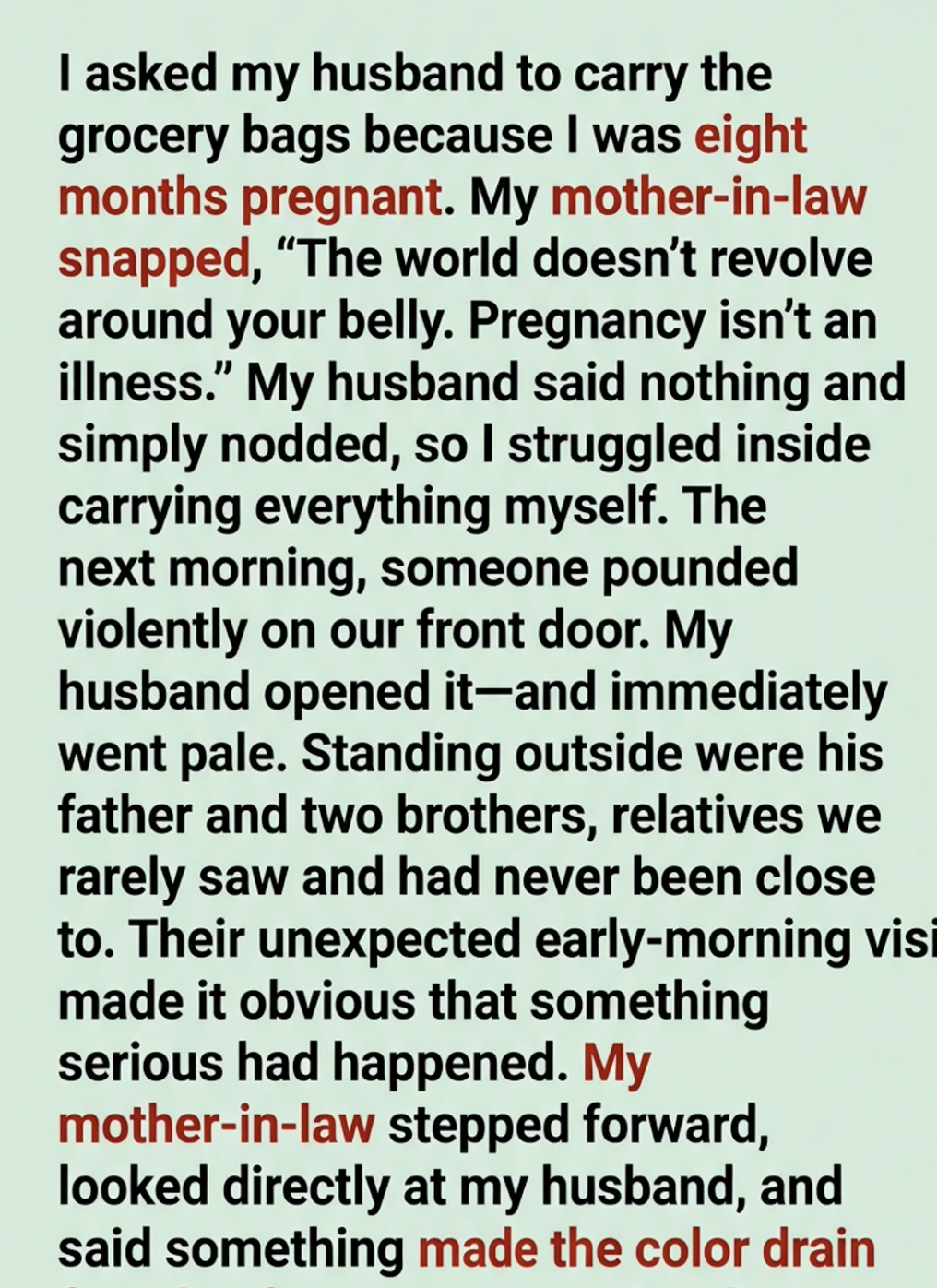
I was eight months pregnant when my husband’s mother told me something I would never forget.
It happened over something as ordinary as groceries.
My husband, Daniel, and I had stopped at the supermarket after work.
By the time we reached the car, I was exhausted.
My back hurt.
My ankles were swollen.
And our baby seemed determined to practice gymnastics against my ribs.
Daniel loaded a few bags into the trunk.
I picked up the remaining ones.
Then I realized how heavy they were.
“Daniel,” I said gently, “could you carry these?”
Before he could answer, his mother spoke.
“The world doesn’t revolve around your belly.”
I turned.
She was standing beside us.
She had come along because she wanted to stop by our house afterward.
“Pregnancy isn’t an illness,” she continued.
I looked at Daniel.
I expected him to defend me.
Instead, he simply nodded.
“Mom’s right.”
Something inside me sank.
I didn’t argue.
I carried the bags myself.
By the time we reached the house, my hands were shaking.
I put everything on the kitchen counter and quietly walked upstairs.
Daniel followed.
“Are you upset?”
I looked at him.
“I asked you to carry groceries.”
“I know.”
“I didn’t ask you to choose sides.”
He sighed.
“You know how Mom is.”
I stared at him.
“No, Daniel. I know how you are.”
He didn’t answer.
That night, I went to bed angry.
Not because of the groceries.
Because I had suddenly realized how alone I felt.
At three in the morning, I woke up with a sharp pain in my back.
I sat up and waited.
It passed.
Probably nothing.
Eight months pregnant meant every unusual sensation made me nervous.
I eventually fell asleep.
The next morning, someone began pounding on our front door.
Not knocking.
Pounding.
I woke instantly.
Daniel jumped out of bed.
“What the hell?”
The pounding came again.
Harder.
I sat up.
“Who is that?”
“I don’t know.”
Daniel hurried downstairs.
I heard the front door open.
Then silence.
A long silence.
I slowly walked toward the staircase.
Daniel stood frozen in the doorway.
His face had gone completely pale.
Standing outside were his father and his two brothers.
People we rarely saw.
People who hadn’t visited our house in years.
His father looked furious.
One brother was holding a folder.
The other had tears in his eyes.
Daniel whispered,
“Dad?”
His father stepped inside.
“We need to talk.”
Daniel looked terrified.
Then his mother came down the stairs.
She had heard everything.
“What are you doing here?”
Daniel’s father looked at her.
“Tell him.”
She crossed her arms.
“Tell him what?”
His father pointed at Daniel.
“Tell your son what you did twenty-nine years ago.”
Daniel’s face changed.
“What are you talking about?”
His mother suddenly looked nervous.
His father opened the folder.
“You told him his brother died.”
Daniel stared at him.
“What?”
I felt the air leave the room.
His mother whispered,
“Stop.”
His father continued.
“You told Daniel that his older brother, Michael, died shortly after birth.”
Daniel looked at his mother.
“You said he was dead.”
She said nothing.
His oldest brother stepped forward.
“Michael isn’t dead.”
Daniel’s mouth fell open.
“He’s alive.”
Nobody spoke.
I looked at my husband.
He was trembling.
“Where?”
His father handed him a photograph.
A young man stood beside a hospital bed.
He looked remarkably like Daniel.
The same eyes.
The same crooked smile.
On the back was a date.
Twenty-nine years earlier.
Daniel whispered,
“Why didn’t anyone tell me?”
His mother finally spoke.
“Because I had to protect you.”
“Protect me from what?”
“From him.”
His father shook his head.
“No.”
He looked at me.
“She wasn’t protecting Daniel.”
He looked back at his wife.
“She was protecting herself.”
Daniel stared at his mother.
“What happened?”
She began crying.
“Michael was born with a serious heart condition.”
Daniel’s father continued.
“The doctors said he needed surgery.”
“But it was risky,” she whispered.
“They gave us options,” his father said. “Your mother chose to give him up.”
Daniel stared at him.
“She gave my brother away?”
“She told us he wouldn’t survive.”
His younger brother stepped forward.
“But he did.”
Daniel’s mother covered her face.
“He was adopted.”
“By who?”
His father answered.
“Your mother’s older sister.”
Daniel’s eyes widened.
“She had a sister?”
“Yes.”
I felt confused.
Why had none of them ever mentioned her?
His father explained that years ago, the family had been deeply divided.
Daniel’s mother had wanted to send Michael away because she believed caring for a severely ill child would destroy the family financially.
Her sister, Elena, couldn’t have children.
She offered to take Michael.
The family agreed.
But afterward, Daniel’s mother became ashamed.
When Daniel was born two years later, she decided never to tell him.
She told everyone Michael had died.
Including Daniel.
For twenty-seven years, she maintained the lie.
Then two months earlier, Elena had died.
And Michael discovered the truth.
He learned that he had a biological family.
He learned that he had a younger brother.
And he learned that his mother had told everyone he was dead.
Daniel sat down.
“Where is he?”
His brother handed him another photograph.
Michael was standing outside a hospital.
“He’s been sick again.”
Daniel looked at the photograph.
“What kind of sick?”
His father hesitated.
“His heart condition came back.”
Daniel stood.
“We’re going.”
His mother grabbed his arm.
“No.”
Daniel pulled away.
“You don’t get to decide that anymore.”
She started crying.
“I was afraid.”
“You lied to me for twenty-seven years.”
“I thought I was saving you.”
“You took my brother from me.”
I had never seen Daniel speak to his mother that way.
Then his father looked at me.
“There is something else you need to know.”
I swallowed.
“What?”
He pointed toward my stomach.
“Michael asked about the baby.”
I froze.
“How does he know?”
“He saw a photograph of Daniel.”
“And he recognized him.”
My husband stared at his father.
“What does that have to do with the baby?”
His father looked uncomfortable.
“Michael doesn’t have children.”
I didn’t understand.
“He said he always wondered what his life would have been like if he’d grown up with his family.”
His father took a breath.
“He wants to meet you before his next surgery.”
Daniel’s eyes filled with tears.
“He’s having surgery?”
“Yes.”
“When?”
“Three days.”
Daniel grabbed his coat.
“We’re going.”
His mother shouted,
“You can’t take my son!”
Daniel stopped.
Then turned around.
“You lost the right to control where I go when you decided my brother was better off dead.”
We left.
The next day, we drove to the hospital.
Michael was thinner than I expected.
But the moment he saw Daniel, he smiled.
“You look like Dad.”
Daniel laughed through his tears.
“You look like Mom.”
Michael looked at me.
“And you must be Sarah.”
I nodded.
He looked at my stomach.
“That’s the baby?”
“Yes.”
He smiled.
“Can I?”
I walked closer.
He placed his hand gently against my belly.
The baby kicked.
Michael laughed.
For the first time since we’d arrived, the room felt warm.
“I always wondered what having a family felt like,” he whispered.
Daniel sat beside him.
“You have one now.”
Michael looked at him.
“Do I?”
Daniel took his hand.
“You do.”
Michael’s surgery went ahead three days later.
It lasted six hours.
Daniel never left the waiting room.
Neither did I.
Even his two brothers stayed.
His father paced the hallway.
His mother didn’t come.
For the first time, nobody knew what to say.
When the surgeon finally came out, we stood.
“He made it.”
Daniel collapsed into his father’s arms.
They cried together.
Weeks passed.
Michael recovered slowly.
And something changed in our family.
Not perfectly.
Not magically.
But honestly.
Daniel stopped pretending his mother’s behavior was normal.
His father finally admitted that he had been too afraid to challenge her all those years.
His brothers apologized for staying silent.
And Daniel’s mother?
She eventually called.
She asked to see him.
Daniel agreed.
But he set boundaries.
She would never again decide what truths he was allowed to know.
She would never insult me for being pregnant.
And she would never use guilt to control him.
A few months later, our daughter was born.
Michael was there.
He cried harder than anyone.
When the nurse placed the baby in my arms, he whispered,
“She has a whole family waiting for her.”
I looked at him.
“You’re part of that family.”
He smiled.
“So are you.”
Years later, Michael became one of the most important people in our daughter’s life.
He came to every birthday.
Every school performance.
Every Christmas.
And whenever she asked why Uncle Michael was so protective of her, I told her,
“Because sometimes people spend a lifetime waiting for the family they were supposed to have.”
As for that grocery incident?
I never forgot it.
But eventually, I understood something.
My mother-in-law’s cruel words hadn’t really been about pregnancy.
They came from a lifetime of fear.
She had spent decades believing that weakness had to be hidden.
That asking for help was failure.
That difficult truths were better buried.
She had mistaken silence for strength.
And my husband had inherited that habit.
But that morning changed him.
When our daughter was born, he refused to let me carry anything.
Not because pregnancy made me helpless.
Because loving someone means noticing when they’re carrying too much.
One evening, years later, I found Daniel watering a cactus on our windowsill.
I laughed.
“What?”
He smiled.
“I was thinking about Mom.”
“Why?”
“Because she spent her whole life trying to protect us from the truth.”
He looked at me.
“And all she really did was make everyone lonelier.”
I took his hand.
“Some truths hurt.”
He nodded.
“But lies can hurt for generations.”
He kissed my forehead.
Then our daughter came running into the kitchen.
“Dad! Uncle Michael is here!”
Daniel smiled.
“See?”
He looked at me.
“That’s the legacy Mom never understood.”
I watched him run toward the door.
A family reunited.
A brother returned from the dead.
A child who would grow up knowing exactly where she belonged.
And I realized something that morning at the grocery store had taught me long before I understood it:
The world doesn’t revolve around your belly.
But sometimes, when you’re carrying a child, you’re also carrying the future of an entire family.
And the greatest thing you can give that child isn’t wealth.
It isn’t perfection.
It’s the truth.
And the freedom to know exactly who loves them.