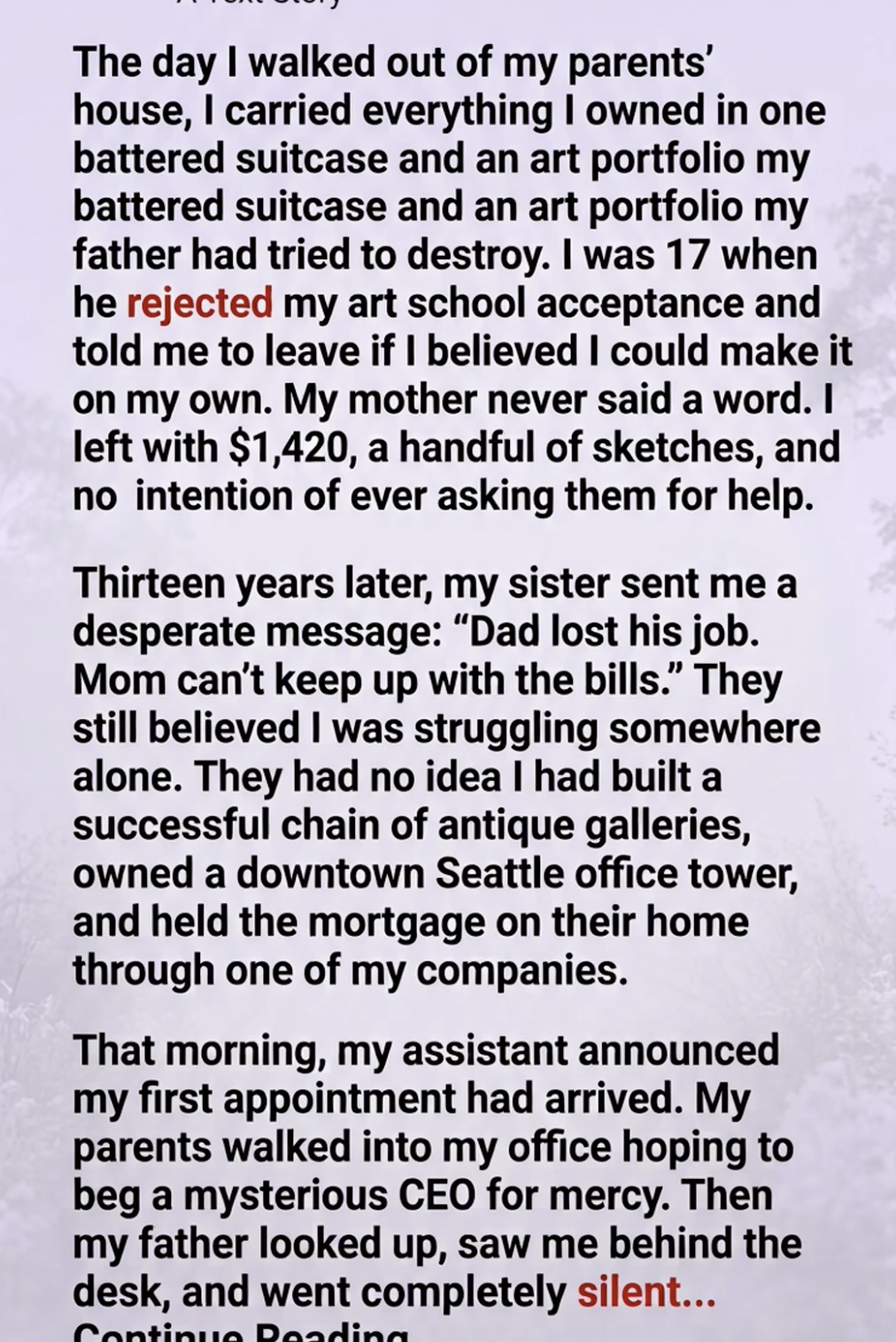
The day I walked out of my parents’ house, I carried everything I owned in one battered suitcase and an art portfolio my father had tried to destroy.
I was seventeen.
My art school acceptance letter was folded inside my coat pocket.
My father had found it that morning.
He read it twice.
Then he looked at me as if I’d announced I was dropping out of life.
“You are not going.”
“I got accepted.”
“I don’t care.”
“It’s a scholarship.”
“I said no.”
I remember standing in the kitchen holding the acceptance letter while my mother washed a plate at the sink.
I looked at her.
“Mom?”
She didn’t turn around.
My father pointed toward the front door.
“If you think you’re old enough to make your own decisions, you’re old enough to pay for them.”
I stared at him.
“What are you saying?”
He opened the door.
“If art is more important than this family, then go make a life with it.”
My mother finally looked at me.
Her eyes were wet.
But she said nothing.
So I went upstairs.
I packed everything I owned into one suitcase.
Clothes.
A few books.
My sketch pencils.
My portfolio.
And the $1,420 I’d saved from babysitting, working weekends, and selling drawings to people around town.
Before I left, I went into my father’s workshop.
My portfolio was sitting beside the trash.
Several pages had been torn.
One of my charcoal drawings had been ripped straight down the middle.
I stood there staring at it.
Then I carefully gathered the pieces.
I put them in my suitcase.
And I walked out.
I didn’t slam the door.
I didn’t scream.
I didn’t tell my parents they’d regret it.
I simply said,
“Goodbye.”
My father didn’t answer.
My mother didn’t follow me.
I walked three blocks to the bus stop.
I sat down.
And cried for exactly one bus ride.
Then I stopped.
Because I had somewhere to go.
And something to prove.
Thirteen years later, my sister sent me a message.
I hadn’t spoken to her much over the years.
Not because I hated her.
Because every conversation eventually turned into my parents.
How angry Dad still was.
How Mom missed me.
How I should call.
How family was family.
I always changed the subject.
But that morning, her message was different.
Dad lost his job.
Then another.
Mom can’t keep up with the bills.
Then:
They’re behind on the mortgage.
I stared at the screen.
I almost put my phone down.
Then she sent:
I don’t know who else to ask.
I looked around my office.
The office occupied the twenty-third floor of a downtown Seattle building.
My building.
Below me, traffic moved through the city.
Across the street was one of my antique galleries.
Another was three blocks away.
We had locations in Portland.
San Francisco.
Chicago.
New York.
Thirteen years earlier, I had left home with $1,420.
Now my company was worth considerably more than I’d ever imagined.
But I hadn’t built it overnight.
I had worked.
I studied at night.
Worked during the day.
Sold my sketches.
Restored old furniture.
Bought damaged antiques from estate sales.
Learned how to identify pieces everyone else overlooked.
At twenty-one, I opened my first tiny gallery.
It barely survived the first year.
At twenty-four, I bought the building next door.
At twenty-seven, I bought my first commercial property.
At thirty, I acquired the mortgage company that held several local properties.
One of those properties was my parents’ house.
I hadn’t planned it.
I didn’t even know it was theirs when my company purchased the loan portfolio.
I discovered it only afterward.
I could have sold the mortgage.
I could have called it a coincidence.
Instead, I left it where it was.
I never contacted them.
They never knew.
They thought I was still struggling somewhere.
My sister occasionally told them I was “doing okay.”
She didn’t know the truth either.
I hadn’t told anyone in my family.
Until that morning.
My assistant knocked on the door.
“Your first appointment is here.”
I looked at my calendar.
“The homeowners?”
“Yes.”
“Send them in.”
A few minutes later, the door opened.
My parents walked into my office.
My mother looked older than I remembered.
Her hair was almost completely gray.
My father had lost weight.
He carried a folder.
He looked exhausted.
They didn’t recognize me.
Why would they?
The seventeen-year-old girl they’d thrown out had been all elbows and messy hair.
The woman sitting behind the desk wore a dark suit.
My hair was shorter.
I wore glasses.
And I had learned how to sit in rooms where people underestimated me.
My father sat down.
My mother followed.
He opened the folder.
“Thank you for seeing us.”
I nodded.
“Tell me what happened.”
He sighed.
“I lost my position six months ago.”
“I see.”
“I’ve been applying everywhere.”
He swallowed.
“Nothing has worked.”
My mother spoke softly.
“And we’re behind on the mortgage.”
I looked at the file.
I already knew.
“How far behind?”
“Five months.”
I turned a page.
“Your lender has started foreclosure proceedings.”
My father nodded.
“That’s why we’re here.”
“Why me?”
He looked uncomfortable.
“We were told you might be able to restructure the loan.”
I almost smiled.
Of all the things he could have asked me for…
he had asked me to save the house.
The same house where he’d told me to leave.
The same house where he’d destroyed my drawings.
The same house I’d never entered again.
I folded my hands.
“What would you like me to do?”
My father looked at me.
“Give us more time.”
My mother added,
“We’re not asking for the debt to disappear.”
My father nodded.
“We just need a chance.”
I stared at them.
Then I asked,
“Why didn’t you ask your daughter?”
My mother looked confused.
“Which daughter?”
I didn’t answer.
My father looked at the file.
“My younger daughter can’t help us.”
“Why?”
“She’s struggling.”
I finally looked up.
He didn’t recognize me.
Not even then.
“How do you know she’s struggling?”
He sighed.
“Because she left.”
My mother looked down.
“She hasn’t spoken to us in years.”
I asked quietly,
“Have you ever looked for her?”
My father’s face tightened.
“She made her choice.”
I felt something crack inside me.
Thirteen years.
And he still believed that.
I leaned back.
“Did she ever send you anything?”
My mother shook her head.
“No.”
“Letters?”
“No.”
“Money?”
My father looked almost offended.
“She wouldn’t.”
I stared at him.
He had no idea.
Not even a little.
I opened the financial file.
“Your mortgage is held by Evergreen Capital.”
My father nodded.
“Yes.”
“Do you know who owns Evergreen Capital?”
He shook his head.
“No.”
I turned the folder around.
My company logo was on the top.
My father stared at it.
Then at me.
Then back at the logo.
His eyes narrowed.
Something changed in his expression.
He looked at the name beneath the logo.
Evergreen Capital Group — Rachel Morgan, CEO.
He stopped breathing.
My mother looked at the page.
Then at me.
Her face went completely white.
My father slowly raised his eyes.
“Rachel?”
I nodded.
“Hello, Dad.”
My mother covered her mouth.
My father stood so quickly that his chair nearly fell backward.
“No.”
I didn’t move.
“No.”
He shook his head.
“That’s not possible.”
“It’s possible.”
My mother started crying.
“Rachel?”
I nodded.
She whispered,
“Oh my God.”
My father stared at me.
“You?”
“Yes.”
“You own this company?”
“Yes.”
“The galleries?”
“Yes.”
“The building?”
“Yes.”
He looked like someone had knocked the air out of him.
Then his eyes fell to the mortgage documents.
His voice became barely audible.
“You own our house.”
I nodded.
“Through one of my companies.”
He sat back down.
Neither of them spoke.
For the first time in my life, my father looked at me without having an answer.
My mother finally whispered,
“Why didn’t you tell us?”
I laughed softly.
Not cruelly.
Just sadly.
“You never asked.”
Her eyes filled with tears.
“We thought you were struggling.”
“I was.”
“Then how?”
“Because I didn’t quit.”
My father stared at the desk.
“I thought you would come home.”
“I almost did.”
He looked up.
“When?”
“Three years after I left.”
His face changed.
“What happened?”
“I stood outside the house.”
My mother began crying.
“I could see your car.”
I swallowed.
“I waited twenty minutes.”
“Why didn’t you knock?”
“Because I remembered what you said.”
My father closed his eyes.
I continued.
“You told me if I thought I could make it on my own, I should go make a life.”
Silence.
“So I did.”
My father whispered,
“I didn’t mean—”
“You did.”
He stopped.
“You meant it.”
I looked at him.
“And I believed you.”
My mother reached across the desk.
I didn’t take her hand.
Not yet.
“I’m sorry.”
I nodded.
“I know.”
“No,” she said. “I should have said something that day.”
I looked at her.
“Why didn’t you?”
She cried.
“Because I was afraid of your father.”
That sentence stunned me.
My mother had always seemed like the quiet one.
The peaceful one.
The one who never chose sides.
But suddenly I realized something.
Silence was still a choice.
“I thought staying quiet would keep the peace,” she said.
“It didn’t.”
“I know.”
She looked at me.
“I’ve regretted it every day.”
I didn’t know whether to believe her.
But I believed the tears.
Sometimes those are different things.
My father finally spoke.
“Why did you keep our mortgage?”
I looked at him.
“Because when I discovered it belonged to you, I couldn’t decide what I wanted to do.”
“What did you decide?”
“Nothing.”
“Why?”
“Because I didn’t want revenge.”
He looked confused.
“I thought about selling it.”
“Why didn’t you?”
“Because then I’d be making a decision because of you.”
He stared at me.
“And I didn’t want my life to be about what you did to me.”
My father lowered his head.
That was the first time I’d ever seen him cry.
Not angry tears.
Not frustrated tears.
Quiet tears.
The kind that come when someone realizes there is no version of the past where they were the hero.
I opened the mortgage file.
“I can restructure the loan.”
My father looked up.
“Really?”
“Yes.”
My mother started crying again.
“But there’s a condition.”
My father nodded.
“Anything.”
“You don’t get the house for free.”
“I understand.”
“The payments will be reduced for twelve months.”
He nodded.
“After that, the original terms resume.”
“I can do that.”
“If you can’t, we’ll sell it.”
He nodded again.
Then I added,
“And you don’t owe me anything beyond the loan.”
My father stared at me.
“Why?”
“Because I don’t want your gratitude.”
He looked confused.
“What do you want?”
I thought about it.
“The truth.”
He swallowed.
“Ask me.”
I looked directly at him.
“Do you regret telling me to leave?”
His eyes filled with tears.
“Every day.”
“Do you regret destroying my portfolio?”
His face crumpled.
“Yes.”
“Do you regret not following me?”
He couldn’t answer.
My mother reached for his hand.
Finally he whispered,
“That is the thing I regret most.”
Before they left, my father stopped at the door.
He turned around.
“I don’t know if I deserve to be your father anymore.”
I looked at him.
“You’re my father.”
He nodded.
“But that doesn’t mean you get to pretend nothing happened.”
“I won’t.”
“Good.”
He stood there for a moment.
Then he said,
“I’m proud of you.”
Those words should have meant everything.
Instead, they hurt.
Because I had spent thirteen years wishing he’d said them when I was seventeen.
I looked at him.
“I know.”
He nodded.
Then he walked out.
My mother stayed behind.
She came around the desk.
She didn’t hug me.
She simply asked,
“Can I?”
I nodded.
She hugged me.
And I cried.
Not because everything was fixed.
It wasn’t.
But because sometimes healing begins with something as small as finally allowing someone to touch the wound without pretending it isn’t there.
Six months later, I received a package.
It came from my father.
Inside was my old art portfolio.
The torn drawings had been carefully restored.
Every ripped page had been repaired.
There was a note.
“I spent thirteen years thinking I destroyed your dream.
I didn’t understand that I only destroyed the version of your life where I got to watch it happen.
I’m sorry.
Dad.”
Underneath the note was something else.
My original acceptance letter.
He had kept it.
For thirteen years.
I stared at it for a long time.
Then I framed it.
Not because I wanted to remember what he had done.
Because I wanted to remember the girl who left that house with $1,420 and a broken portfolio.
She had no idea where she was going.
She only knew she couldn’t stay.
Today, my galleries hang her artwork.
My office sits above the city she once dreamed of escaping to.
And the house she left behind still stands.
Not because she needed it.
Because she finally understood something her father never did.
Home isn’t the place that refuses to let you leave.
Home is the place where you are allowed to become who you were meant to be.
My parents came to my office believing they were begging a stranger for mercy.
Instead, they discovered that the daughter they thought had failed without them had built a life far beyond anything they imagined.
But I didn’t take pleasure in watching them realize it.
I didn’t need revenge.
I’d already won the only victory that mattered.
I became the person that seventeen-year-old girl believed she could become.
And when I looked at the framed acceptance letter on my wall, I finally understood:
My father had told me to leave if I believed I could make it on my own.
So I did.
And thirteen years later…
he walked into the life I built without him and finally saw what I had known all along.
I didn’t leave home because I failed.
I left because I refused to let someone else decide how small my life was allowed to be.