She had never missed a Sunday.
Not once.
Not during holidays.
Not when she had the flu.
Not even during the year she broke her ankle.
Sunday dinner was sacred in our family.
My brother Jason and I would show up at six.
Mom would have enough food to feed fifteen people, even though there were only three of us.
And at the end of dinner, she’d always point at the leftovers and say,
“Take some home. I’m not eating all this.”
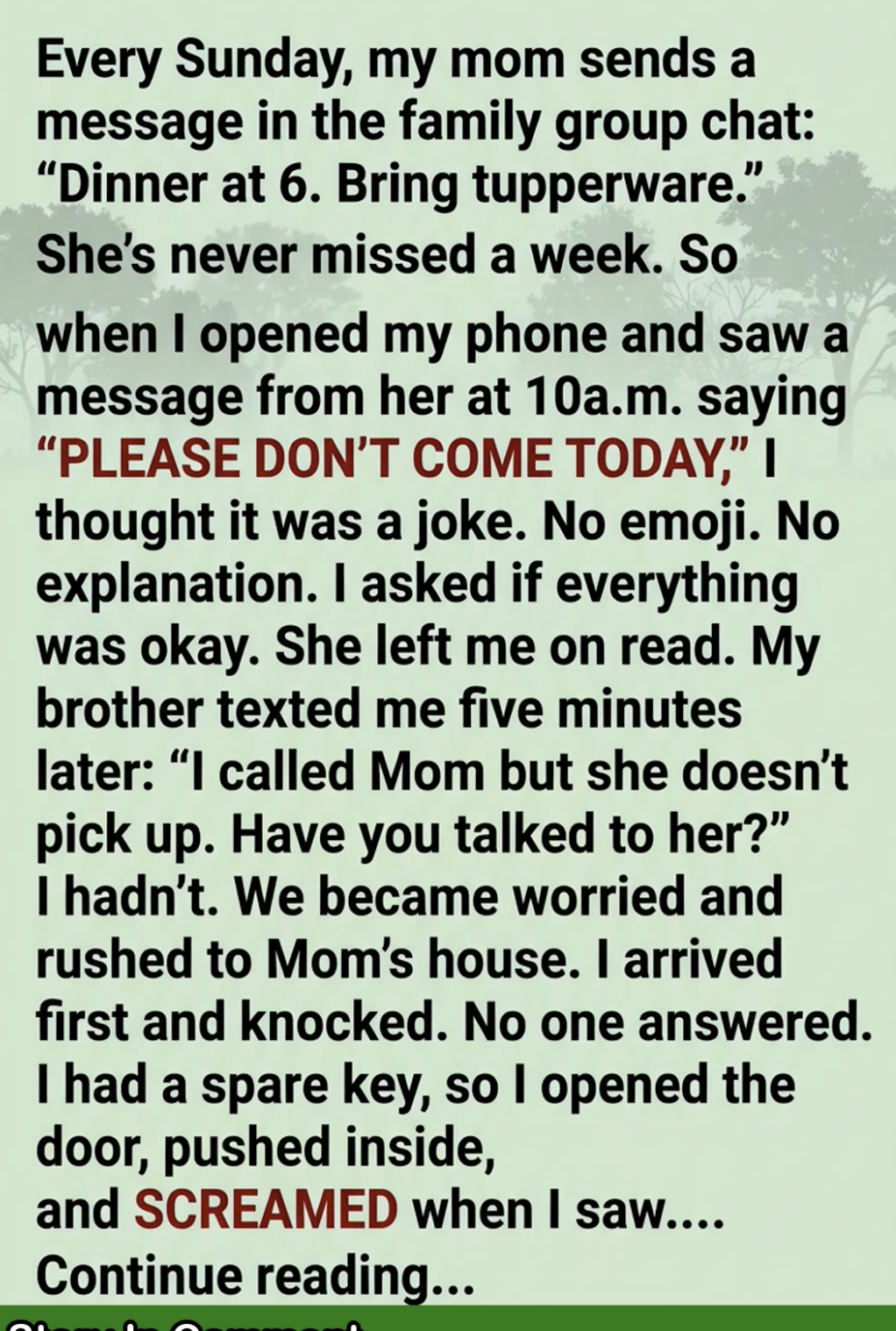
That’s why the message I received that Sunday morning scared me.
It said:
“PLEASE DON’T COME TODAY.”
No emoji.
No explanation.
Just those four words.
I stared at my phone.
I assumed she had accidentally sent it.
I replied:
“Mom? Everything okay?”
Read.
No response.
Five minutes later, Jason texted me.
“I called Mom. She doesn’t pick up. Have you talked to her?”
“No.”
“I’ll drive over.”
“I’m already going.”
I grabbed my keys.
Mom lived about fifteen minutes away.
I arrived first.
Her car was in the driveway.
The front door was locked.
I knocked.
“Mom?”
Nothing.
I knocked harder.
“Mom, it’s me!”
Silence.
I called her.
Her phone rang inside the house.
That was when my stomach dropped.
I had a spare key.
I unlocked the door.
“Mom?”
I stepped inside.
The house was completely silent.
Then I saw the kitchen.
A chair was knocked over.
A glass lay shattered on the floor.
And beside the kitchen table was my mother.
She was lying motionless.
I screamed.
“Mom!”
I ran to her.
She was breathing.
Barely.
Her eyes were closed.
I called 911.
The dispatcher told me to check her breathing and follow their instructions.
I stayed beside her until the paramedics arrived.
Jason arrived seconds later.
He ran through the door.
“What happened?”
“I don’t know!”
The paramedics rushed in.
They stabilized Mom and carried her out.
I followed the ambulance to the hospital.
Jason drove behind me.
Neither of us spoke.
At the hospital, doctors took her immediately.
We sat in the waiting room for what felt like hours.
Finally, a doctor came out.
“She had a severe reaction to a medication,” he said.
I felt relief.
“So she’s going to be okay?”
“She should recover.”
I closed my eyes.
Then I remembered the message.
PLEASE DON’T COME TODAY.
I showed it to Jason.
He frowned.
“Why would she send that?”
“I don’t know.”
Then the doctor returned.
“There is something else.”
He looked at us.
“We found evidence that she had been taking much more of the medication than prescribed.”
Jason looked confused.
“Mom wouldn’t do that.”
The doctor nodded.
“That’s what concerns us.”
He told us that Mom’s symptoms weren’t consistent with a simple accidental mistake.
Someone had apparently been altering her medication.
We immediately thought of one person.
My mother’s home-health aide.
Her name was Karen.
Karen had started working with Mom six months earlier.
She helped with groceries, cleaning, and medications.
Mom always said Karen was wonderful.
But suddenly, things started making sense.
Over the past few months, Mom had complained that she was tired.
She’d forgotten appointments.
She’d seemed confused.
We thought it was stress.
Karen had always been there.
Too helpful.
Too involved.
Jason called the police.
Officers went to Mom’s house.
They found something hidden behind a stack of cleaning supplies.
A small bag.
Inside were several medication bottles.
Some belonged to Mom.
Some had been prescribed to other people.
And one bottle had been altered.
The detective called us.
“We need to ask you something.”
“What?”
“Has your mother ever mentioned changing her will?”
I looked at Jason.
“No.”
The detective paused.
“Karen has been making inquiries about your mother’s financial accounts.”
My stomach turned.
“What kind of inquiries?”
“She’s been trying to find out whether your mother has life insurance.”
I suddenly remembered something Mom had said two weeks earlier.
“Karen asked me who would get the house if something happened to you.”
At the time, Mom had laughed.
I thought nothing of it.
Now I felt sick.
The police searched Karen’s apartment.
They found copies of Mom’s bank statements.
Insurance documents.
Property records.
And something else.
A notebook.
It contained dates.
Medication doses.
Notes about Mom’s condition.
And beside several dates, one phrase appeared repeatedly:
“Sunday dinner.”
I couldn’t understand.
Why Sunday?
Then the detective explained.
Karen had been planning to make Mom appear confused and incapable of managing her own affairs.
She intended to convince a lawyer that Mom needed someone else to control her finances.
And she’d been slowly manipulating Mom’s medication to make the confusion worse.
But that Sunday, something went wrong.
Mom realized what was happening.
She confronted Karen.
Karen panicked.
She gave Mom another dose of the medication.
Mom collapsed.
Then Karen left.
But she hadn’t expected Mom to regain consciousness long enough to send one message.
PLEASE DON’T COME TODAY.
We initially thought Mom was telling us to stay away.
She wasn’t.
She was trying to warn us.
She knew something was wrong.
And because she couldn’t safely explain it over text, those four words were the only warning she could send.
The police arrested Karen later that week.
But there was another twist.
She hadn’t been working alone.
Someone had been giving her information about Mom’s finances.
We assumed it was someone outside the family.
It wasn’t.
It was my brother’s wife, Melissa.
Jason was devastated.
Melissa had been struggling with debt.
She knew Mom owned the house outright.
She had convinced herself that Mom would eventually leave the property to Jason.
When Karen approached her, Melissa gave her information about Mom’s accounts.
She never expected things to go this far.
She insisted she didn’t know Karen was manipulating Mom’s medication.
But the messages between them told a different story.
One message from Melissa said:
“Just make sure she doesn’t change anything before we know what she’s doing.”
Another said:
“She trusts you. Use that.”
Jason sat in the police station afterward with his head in his hands.
“My wife did this?”
I didn’t know what to say.
His marriage ended.
His relationship with Mom changed forever.
And our family was never the same.
But Mom survived.
After several weeks of recovery, she came home.
The first Sunday she was back, she insisted on cooking.
We tried to stop her.
She refused.
At exactly six o’clock, my phone buzzed.
I looked at the family group chat.
Mom had sent a message.
“Dinner at 6. Bring Tupperware.”
I started laughing.
Then crying.
Jason replied:
“We’re coming.”
Mom sent another message.
“And don’t be late.”
When we arrived, she was standing in the kitchen.
She looked thinner.
A little weaker.
But she was smiling.
There were three pots on the stove.
Too much food.
Exactly like before.
We sat around the table.
Nobody mentioned the hospital.
Nobody mentioned Karen.
Nobody mentioned Melissa.
For a while, we simply ate.
Then Mom put down her fork.
“I want you two to understand something.”
We looked at her.
“I knew something was wrong before that Sunday.”
My brother stared at her.
“Why didn’t you tell us?”
“Because I wasn’t sure.”
She looked at me.
“And because I didn’t want my children to start fighting over me.”
My eyes filled with tears.
“You should have called me.”
“I know.”
She smiled.
“But I did something better.”
“What?”
“I sent you that message.”
We laughed.
Then she reached across the table.
“I thought it might be my last chance to protect you.”
I squeezed her hand.
“It wasn’t.”
She smiled.
“No.”
“You came back.”
Mom looked around the table.
“I’ve learned something.”
“What?”
“People who want something from you will often tell you what you want to hear.”
She looked at Jason.
“And people who love you sometimes need you to tell them when something is wrong.”
Jason nodded.
Mom smiled.
“That’s why we’re having dinner.”
“Every Sunday?”
“Every Sunday.”
I laughed.
“Even if you don’t feel like cooking?”
She looked offended.
“Who said I was cooking?”
We laughed.
And just like that, our Sunday tradition returned.
But it was different.
We didn’t take Mom’s presence for granted anymore.
We listened when she said she didn’t feel right.
We checked her medications.
We visited more often.
And we stopped assuming that because someone was older, their concerns were simply confusion.
That Sunday changed everything.
I had walked into Mom’s house expecting to find an ordinary family dinner.
Instead, I found my mother fighting for her life.
And the message I’d almost dismissed as strange turned out to be the most important message she had ever sent.
She wasn’t telling us not to come because she didn’t want us there.
She was trying to protect us from walking into something dangerous.
And somehow, even while barely conscious, she was still doing what she’d always done.
Taking care of her children.
Years later, she still sends the same message every Sunday.
“Dinner at 6. Bring Tupperware.”
And every single time my phone lights up with those words, I smile.
Because I know what they really mean.
Come home.
You’re safe here.
And there’s always enough for one more plate.
Sometimes the most ordinary family traditions are the ones we don’t realize we’re lucky to have.
And sometimes, a message that looks like a simple warning is actually a desperate cry for help.
So when someone you love suddenly says, “Don’t come,” don’t always assume they want distance.
Sometimes they’re trying to tell you something they don’t know how to say.