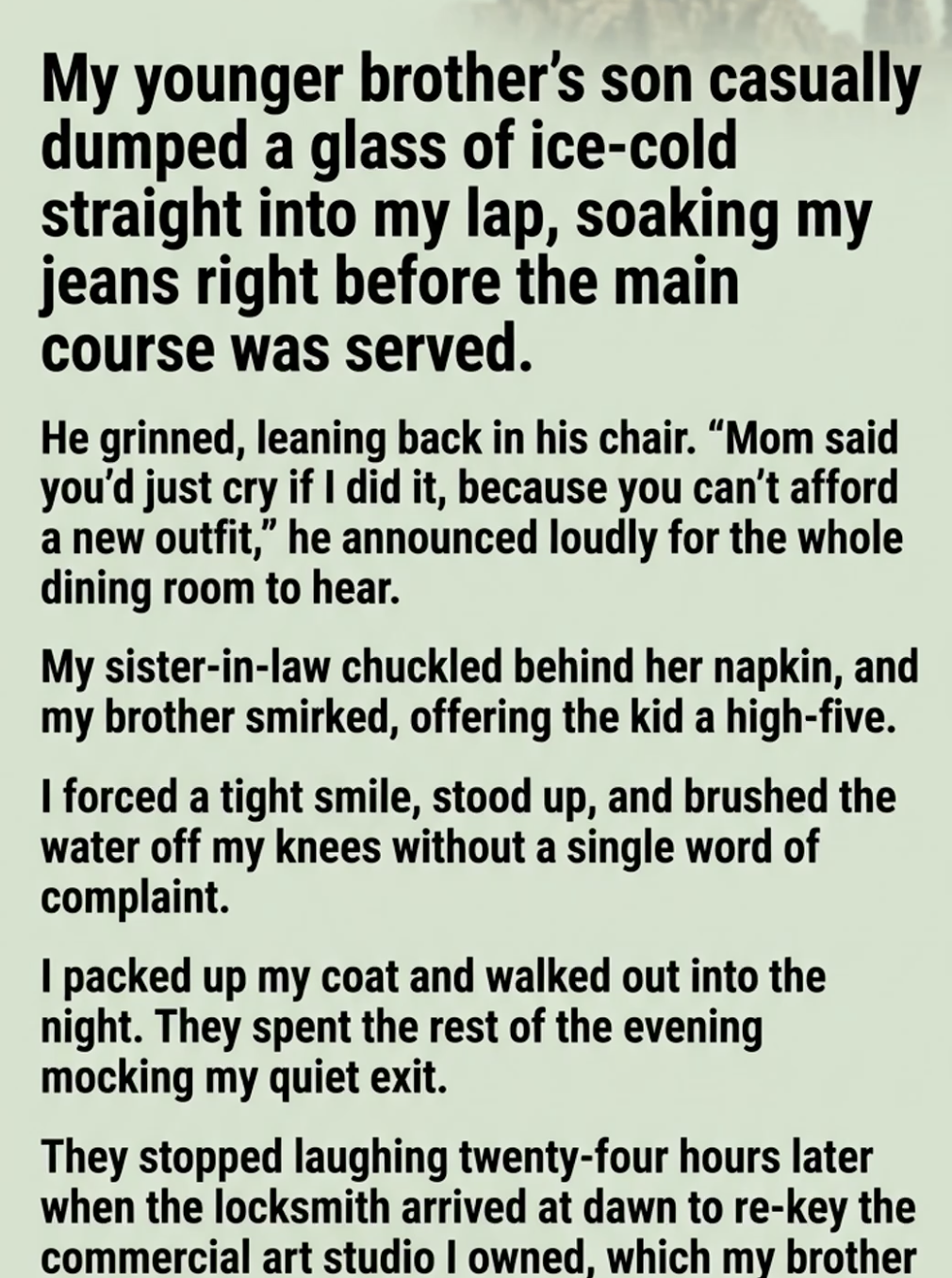
My younger brother’s son dumped a glass of ice-cold water straight into my lap right before the main course was served.
The water soaked through my jeans.
For a second, nobody moved.
Then my nephew grinned.
“Mom said you’d just cry if I did it,” he announced loudly.
He pointed at my clothes.
“Because you can’t afford a new outfit.”
My sister-in-law covered her mouth with her napkin.
She was laughing.
My brother leaned back in his chair and smirked.
Then he offered his son a high-five.
The boy slapped his father’s hand.
Everyone at the table laughed.
Everyone except me.
I looked down at my soaked jeans.
Then I looked at my nephew.
He was eleven.
Old enough to know what humiliation was.
Young enough to believe adults would always protect him from consequences.
I forced a smile.
“Excuse me.”
That’s all I said.
I stood up.
I picked up my coat.
I didn’t yell.
I didn’t insult anyone.
I didn’t demand an apology.
I simply walked out.
Behind me, I heard my sister-in-law say,
“Look at her.”
Then my brother laughed.
“She always makes everything dramatic.”
The restaurant door closed behind me.
And the laughter continued.
They thought I’d been defeated.
They were wrong.
Because what they didn’t know was that the restaurant wasn’t the first place my family had disrespected me.
It was simply the last.
For five years, my brother and his freelance design team had been using my commercial art studio.
Rent-free.
When my brother first asked, it sounded temporary.
He had just started building his design business.
He needed somewhere inexpensive to work.
“Six months,” he promised.
“Maybe eight.”
I agreed.
The studio had been sitting mostly unused after my own art business moved into a larger space.
I told him he could use it.
No rent.
No utilities.
Just keep the place clean.
He hugged me.
“You’re saving us.”
I smiled.
“That’s what family does.”
Six months became a year.
Then two.
Then three.
By the fourth year, his entire freelance team was working there.
They had desks.
Computers.
Printers.
Meeting rooms.
A coffee machine.
They even put their company logo on the front door.
I mentioned rent once.
My brother laughed.
“Come on. You’re family.”
I reminded him that the original agreement had been temporary.
He became offended.
“You’re really going to charge your own brother?”
I backed down.
I shouldn’t have.
The following year, I asked again.
This time my sister-in-law became involved.
“You have plenty of money,” she said.
“You own multiple properties.”
“Why would you take money from us?”
I didn’t argue.
I simply said,
“Because it’s a business property.”
She rolled her eyes.
And my brother told me,
“You’re becoming selfish.”
So I stayed quiet.
Meanwhile, they became increasingly comfortable.
They hosted client meetings there.
They stored equipment there.
They used my electricity.
They used my internet.
They used the loading dock.
They even complained when I came by without warning.
Once, my brother actually said,
“You should let us know before you come to your own building.”
I remember staring at him.
“My building?”
He corrected himself.
“I mean, the studio.”
But the meaning was obvious.
They had stopped seeing it as mine.
They had started seeing it as theirs.
And I had allowed it.
Until dinner.
That night, after walking out of the restaurant, I drove home.
I changed out of my wet clothes.
Then I sat at my desk.
I opened the studio’s ownership documents.
The property was entirely mine.
The business license was mine.
The insurance was mine.
The utilities were in my name.
There was no lease.
No rental agreement.
No legal transfer of possession.
Just five years of my generosity.
I called my attorney.
“Can we end their permission to use the property?”
He reviewed the documents.
“Yes.”
“What do I need to do?”
He explained the proper legal notice and procedures.
I followed them.
No threats.
No shouting.
No revenge.
Just paperwork.
The next morning, before sunrise, a locksmith arrived at the studio.
The old locks came off.
New ones went on.
Every access code was changed.
Every key was canceled.
And a legal notice was posted according to my attorney’s instructions.
At 8:17 a.m., my brother called.
I didn’t answer.
He called again.
Then again.
Finally, I picked up.
“What did you do?”
I knew exactly what he meant.
“I ended the arrangement.”
“You locked us out!”
“I reclaimed my property.”
“You can’t do this!”
“I can.”
“We have equipment in there!”
“Your equipment can be collected through the process my attorney outlined.”
“You’re destroying my business!”
I paused.
“No.”
“You are.”
“No,” I said quietly.
“I gave your business five years of free space.”
“You built your business on my generosity.”
Then he said the sentence that told me everything.
“But we’re family!”
I closed my eyes.
“Family doesn’t mean one person gets to take advantage of another.”
He hung up.
Ten minutes later, my sister-in-law called.
She didn’t scream.
She cried.
She told me the entire team was outside the studio.
Clients were waiting.
They had nowhere to work.
I told her,
“You should have thought about that before your son humiliated me in front of an entire restaurant.”
She went silent.
Then she said,
“That was just a joke.”
“No.”
My voice remained calm.
“It was a message.”
“What message?”
“That you believed I was powerless.”
She had nothing to say.
Later that afternoon, my nephew called.
My brother had apparently made him apologize.
His voice was small.
“I’m sorry.”
I didn’t immediately answer.
“Why did you do it?”
Silence.
“Dad said you wouldn’t do anything.”
That sentence hurt more than the water had.
Not because my nephew was cruel.
Because he’d been taught that kindness meant weakness.
I said,
“You should never hurt someone just because you think they can’t stop you.”
He whispered,
“I know.”
“I hope you do.”
I didn’t punish him.
I didn’t humiliate him.
I simply told him that what happened wasn’t funny.
And that consequences were part of growing up.
A week later, my brother came to my office.
He looked exhausted.
The design team had found temporary space.
It cost them money.
He sat across from me.
“I messed up.”
I didn’t respond.
“I thought because you were my sister, you’d always help.”
“I wanted to help.”
“I know.”
“But you stopped seeing help as something I gave you.”
He looked down.
“You started expecting it.”
He nodded.
“I did.”
I slid a document across the desk.
It was a proposal.
Not for free rent.
A proper commercial lease.
Market-rate rent.
Clear rules.
Insurance requirements.
Maintenance responsibilities.
Everything documented.
He stared at it.
“You’d still rent it to me?”
“If you can afford it.”
He looked surprised.
“After everything?”
I nodded.
“I’m not trying to destroy your business.”
“Then why?”
“Because I don’t want our relationship to depend on whether I let you use my property for free.”
He sat quietly.
Finally, he signed.
Not immediately.
He took the document home.
He reviewed it with his attorney.
Then he returned two days later.
He signed the lease.
He paid the deposit.
And for the first time in five years, my brother became my tenant instead of my dependent.
The relationship changed.
Not overnight.
But gradually.
My sister-in-law stopped making comments about my money.
My nephew became more respectful.
And my brother began asking before assuming.
A few months later, he invited me to his company’s anniversary dinner.
When I arrived, he stood up.
“I want to say something.”
Everyone became quiet.
He looked at me.
“Five years ago, my sister gave us a place to work when we were struggling.”
He swallowed.
“And instead of being grateful, we became entitled.”
I didn’t expect him to say that.
He continued.
“We forgot that generosity is a gift, not an obligation.”
Then he looked at his son.
“And we taught our kids the wrong lesson.”
My nephew stood up.
He walked over to me.
“I’m really sorry.”
This time, I hugged him.
“Thank you.”
Then he whispered,
“I don’t think you’re poor.”
I laughed.
“No?”
He shook his head.
“Dad says you own the building.”
I smiled.
“I do.”
He grinned.
“That’s why you changed the locks?”
“Exactly.”
He laughed.
And for the first time, the memory of that dinner didn’t hurt.
It taught me something.
I had spent years thinking that being generous meant never saying no.
It doesn’t.
Generosity without boundaries eventually becomes expectation.
And expectation without gratitude becomes entitlement.
I didn’t change the locks because I wanted revenge.
I changed them because I finally understood that my kindness had been mistaken for permission.
That night at the restaurant, they laughed when I walked away.
They thought my silence meant I had lost.
They didn’t understand that sometimes silence isn’t surrender.
Sometimes it’s the sound of someone making a decision.
Twenty-four hours later, the locks changed.
The boundaries changed.
And eventually, my relationship with my brother changed too.
Not because I stopped loving him.
Because I finally learned that loving family doesn’t mean allowing family to disrespect you.
You can be generous without being used.
You can forgive without forgetting.
And you can say “enough” without becoming cruel.
That glass of water cost my nephew nothing.
But it taught me the value of something much more expensive:
knowing when your kindness has crossed the line into being taken for granted.