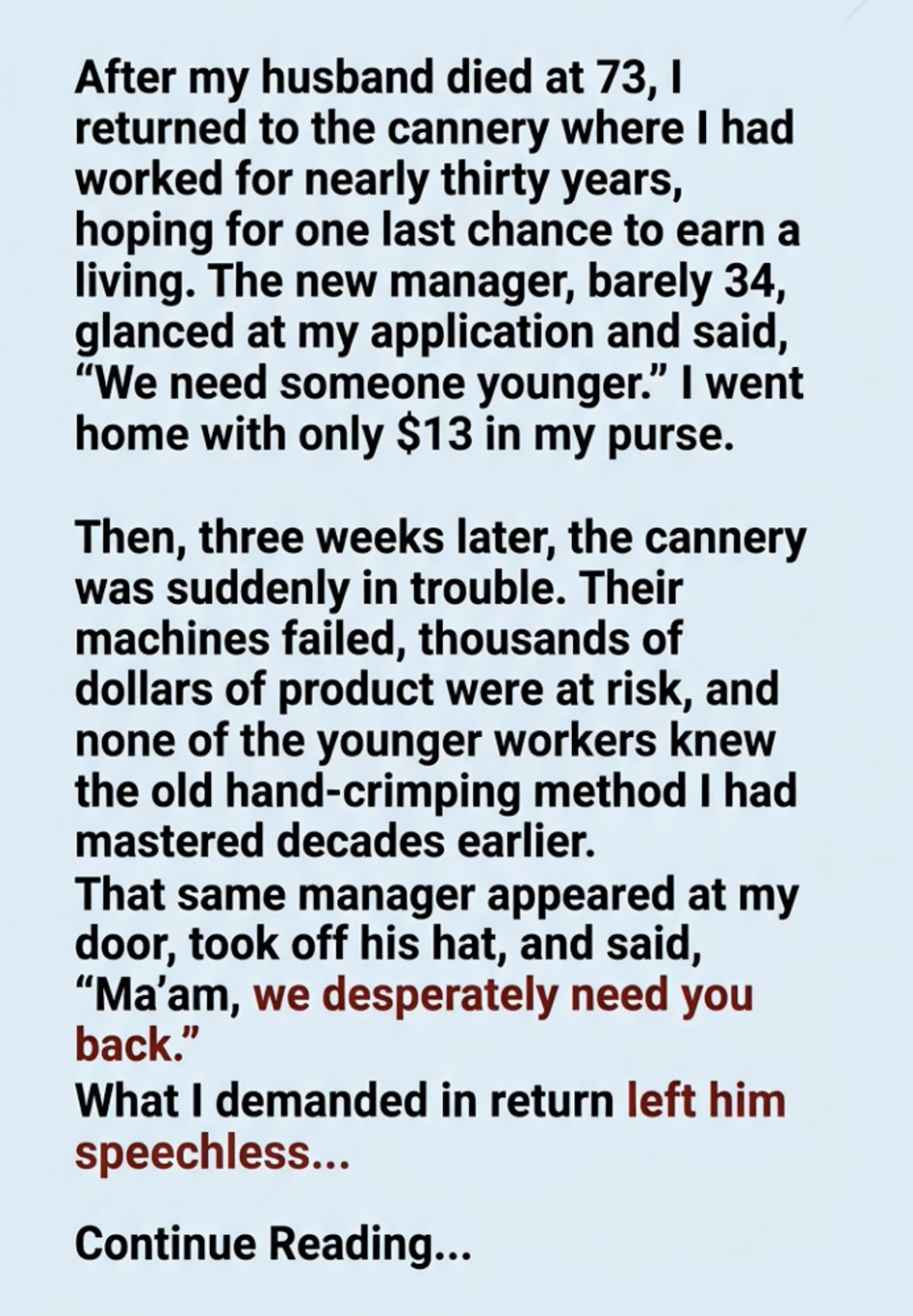
After my husband died at seventy-three, I discovered how quickly a lifetime of security could disappear.
His pension stopped.
The medical bills arrived.
The electricity bill didn’t care that I was grieving.
Neither did the mortgage.
For thirty years, I had worked at the Riverside Cannery.
I started there when I was twenty-nine.
I learned every machine on the floor.
I knew which conveyor belt squeaked before it jammed.
I knew which packing machine needed a gentle adjustment and which one needed a wrench.
Most importantly, I knew how to hand-crimp the old metal tins.
It was a method almost nobody used anymore.
The younger workers had been trained on automated equipment.
But when the old machines misbehaved, people used to call me.
“Ask Margaret.”
That had been my reputation.
Not because I was special.
Because I had spent thirty years paying attention.
After my husband died, I sat at our kitchen table with thirteen dollars in my purse.
That was all the cash I had.
I needed work.
So I pulled an old blouse from my closet, ironed it, printed my résumé, and went back to the cannery.
The building looked smaller than I remembered.
The same brick walls.
The same loading docks.
The same smell of tomatoes, metal, oil, and salt.
I stood outside for a moment before walking in.
The receptionist recognized me.
“Margaret?”
I smiled.
“It’s been a while.”
She hugged me.
Then she looked embarrassed.
“You’re applying?”
“Yes.”
“For production?”
“If you’ll have me.”
She lowered her voice.
“You should talk to Mr. Carter.”
The new manager was thirty-four.
His name was Jason Carter.
He had been brought in after the previous manager retired.
I sat across from him in his office.
He glanced at my résumé.
Then at me.
Then back at the résumé.
“You worked here for almost thirty years?”
“Yes.”
“When did you retire?”
“I didn’t.”
He looked confused.
“I left when my husband became sick.”
“I see.”
He tapped the résumé.
“So you’re looking to come back?”
“Yes.”
He leaned back.
“Mrs. Miller, we’re trying to modernize.”
“I understand.”
“We need people who can keep up with the new production environment.”
“I can.”
He smiled politely.
“I don’t doubt your work ethic.”
Then he said the sentence I would never forget.
“We need someone younger.”
I stared at him.
He quickly added,
“It’s nothing personal.”
I stood.
“Of course.”
He offered his hand.
I shook it.
“Thank you for applying.”
I walked out.
Nobody stopped me.
Nobody asked if I was all right.
Outside, the wind was cold.
I reached into my purse.
Thirteen dollars.
That was everything.
I walked home.
That night, I ate soup from a can and calculated how long my savings would last.
Not long.
I stared at the photograph of my husband on the mantel.
“You’d tell me not to worry,” I whispered.
Then I laughed sadly.
“You’d also tell me to find another job.”
So I did.
I applied everywhere.
A grocery store.
A bakery.
A laundry.
A hotel.
A packaging company.
A warehouse.
I was rejected again and again.
Sometimes politely.
Sometimes not.
One interviewer looked at my age on the application and immediately said,
“We’re looking for someone who intends to stay long-term.”
I almost asked him how he knew I wouldn’t.
I didn’t.
Three weeks passed.
Then, at 5:42 on a Tuesday morning, someone knocked on my door.
I opened it.
Jason Carter was standing there.
The same manager who had told me they needed someone younger.
His hat was in his hand.
His hair was wet from the rain.
And he looked terrified.
“Mrs. Miller.”
I stared at him.
“Mr. Carter.”
He swallowed.
“Can I come in?”
I stepped aside.
He entered the kitchen.
He looked around.
Then he took a deep breath.
“We have a serious problem.”
“I heard the cannery was having trouble.”
His eyes widened.
“How?”
“People talk.”
He nodded.
“Our main crimping machine failed yesterday.”
I said nothing.
“Three production lines are affected.”
“How much product?”
He hesitated.
“About $280,000 worth.”
I sat down.
“That’s a lot.”
“It is.”
He looked at me.
“We’ve had technicians working all night.”
“And?”
“Nothing.”
I already knew what he was going to say.
“We need you.”
I looked at him.
“You need someone older?”
His face reddened.
“Mrs. Miller, I was wrong.”
“You were.”
He nodded.
“I was wrong.”
He took another breath.
“We have younger workers who are excellent with the automated systems. But none of them know the old hand-crimping process.”
I smiled faintly.
“You threw out the old manuals.”
His face fell.
“You know about that?”
“Of course.”
I had worked there for thirty years.
I knew exactly what had been thrown away.
He stepped closer.
“Ma’am, we desperately need you back.”
I looked at him.
“And what makes you think I’ll come?”
He didn’t answer.
I stood.
“Three weeks ago, I walked into your office with a résumé.”
“Yes.”
“You didn’t ask what I could do.”
“I know.”
“You looked at my age.”
“Yes.”
“And decided I wasn’t worth hiring.”
He lowered his head.
“I made a mistake.”
“You did.”
He waited.
Then he said,
“Please.”
That word mattered.
Not because I wanted him to beg.
Because it meant he finally understood that experience had value.
I crossed my arms.
“What exactly are you offering?”
He began to speak.
“Your previous hourly wage.”
I laughed.
“No.”
He blinked.
“No?”
“I don’t want my old wage.”
He looked nervous.
“What do you want?”
I thought about it.
Then I said,
“First, I want a written contract.”
He nodded.
“Of course.”
“Second, I want the same health benefits available to full-time employees.”
“Done.”
“Third, I want you to put two younger workers under my supervision.”
He looked surprised.
“Why?”
“Because if I teach them the hand-crimping method, it won’t disappear when I do.”
He nodded slowly.
“That makes sense.”
“Fourth, I want the cannery to preserve the old methods in a proper training manual.”
He smiled.
“Absolutely.”
I wasn’t finished.
“And fifth…”
He waited.
“I want you to publicly acknowledge that you made a mistake.”
His expression changed.
“You mean an announcement?”
“Yes.”
“In front of the staff?”
“Yes.”
He stared at me.
I continued.
“Not because I need an apology.”
“Then why?”
“Because there are other workers in that building who are going to grow old someday.”
He looked down.
“I want them to know that becoming older doesn’t make them useless.”
Jason was silent for a long time.
Then he nodded.
“Agreed.”
“And one more thing.”
He looked up.
“What?”
“I want overtime pay for the emergency work.”
He almost smiled.
“Fair.”
I smiled back.
“Now we’re negotiating.”
He laughed for the first time.
Then he held out his hand.
“Do we have a deal?”
I shook it.
“We have a deal.”
I returned to the cannery that afternoon.
When I walked through the doors, people stared.
Some of the older workers hugged me.
The younger workers looked nervous.
Jason gathered everyone around the production floor.
He cleared his throat.
“Three weeks ago, Mrs. Miller applied to work here.”
Everyone became quiet.
“I told her we needed someone younger.”
He paused.
“That was a mistake.”
He looked at me.
“Experience isn’t something you become too old to have.”
Nobody spoke.
Then one of the workers started clapping.
Another joined.
Soon the entire floor was applauding.
I felt tears in my eyes.
Not because of the applause.
Because for the first time since my husband died, I felt useful again.
We started with the failed machine.
I examined it.
Then the damaged tins.
Then the sealing mechanism.
The newer workers stood around me.
One young man named Tyler asked,
“How did you learn this?”
I smiled.
“By breaking things.”
He laughed.
“Seriously?”
“Of course.”
I pointed toward the machine.
“Every machine tells you something.”
He frowned.
“What?”
“You have to listen.”
For the next six hours, I worked beside them.
We couldn’t restore the machine immediately.
So I taught them the old hand-crimping technique.
Slowly.
Carefully.
One tin at a time.
By midnight, the production line was moving again.
Not quickly.
But safely.
By morning, hundreds of cases had been saved.
The cannery avoided a catastrophic loss.
Jason came to me afterward.
“You saved us.”
I shook my head.
“No.”
He looked confused.
“You did.”
“The workers saved you.”
He smiled.
“You taught them.”
I shrugged.
“That’s what experience is supposed to do.”
Over the next several months, something changed at Riverside Cannery.
The old methods weren’t thrown away anymore.
They were documented.
The younger workers learned them.
The older workers were invited to teach.
Jason created a mentorship program.
And the hand-crimping technique that everyone had considered obsolete became part of the cannery’s emergency training.
Then something happened that I never expected.
Jason came to me one afternoon carrying a folder.
“We have an offer for you.”
I raised an eyebrow.
“I already have a contract.”
“This is different.”
He opened the folder.
They wanted me to become a paid production trainer.
Part-time.
Flexible hours.
Better pay.
I stared at him.
“You’re serious?”
“Yes.”
I smiled.
“I suppose I can handle being old and useful.”
He laughed.
“You’re not old.”
I gave him a look.
He corrected himself.
“You’re experienced.”
“Better.”
Years passed.
I didn’t work every day.
I didn’t need to.
I worked when I wanted.
I trained people.
I consulted when machines failed.
I became something I never imagined I would be at seventy-three.
A teacher.
One afternoon, Tyler came into my office.
He was carrying a small metal tin.
“Mrs. Miller?”
“Yes?”
“I fixed it.”
He held up the tin.
It had been hand-crimped perfectly.
I smiled.
“Who taught you?”
“You did.”
I shook my head.
“No.”
He smiled.
“You did.”
I corrected him.
“I showed you.”
He looked at the tin.
“You gave me a skill nobody else knew.”
I thought about that.
Then I said,
“That’s why skills matter.”
He nodded.
“You think they’ll still use this twenty years from now?”
I smiled.
“If someone remembers how to teach it.”
That evening, I drove home.
The sun was setting over the water.
I parked in the driveway and sat in the car for a few minutes.
My husband had been gone for nearly a year.
There were still moments when I expected to hear his key in the door.
Still mornings when I reached across the bed before remembering.
But I was learning how to build a life around the empty space.
I walked inside.
On the refrigerator was a photograph someone at the cannery had given me.
It showed me standing beside six younger workers.
Underneath, someone had written:
“Experience doesn’t expire.”
I smiled.
Three weeks earlier, I had gone home with thirteen dollars in my purse and the feeling that the world had decided I was no longer useful.
Three weeks later, the same man who had rejected me stood on my porch asking me to save the place where I had spent thirty years of my life.
But the best part wasn’t making him regret his decision.
It wasn’t proving him wrong.
It wasn’t even the money.
It was what happened afterward.
The younger workers learned that knowledge doesn’t automatically become worthless because it comes from someone with gray hair.
The older workers learned that they still had something valuable to give.
And I learned something too.
After my husband died, I thought getting a job was about earning enough money to survive.
But it became something much bigger.
It gave me purpose.
It gave me people.
It gave me a reason to get dressed in the morning.
And most importantly, it reminded me that my age was never the measure of my worth.
The day Jason first came to my door, he took off his hat before asking for my help.
I never forgot that.
Not because I needed him to humble himself.
But because sometimes people only recognize the value of experience after they’ve almost lost it.
As for the thirteen dollars I had in my purse that first day?
I kept it.
I put it inside a small frame beside my kitchen table.
Not because thirteen dollars was a fortune.
It wasn’t.
It was a reminder.
A reminder of the morning I thought my working life was over.
And the day I discovered it was only beginning again.