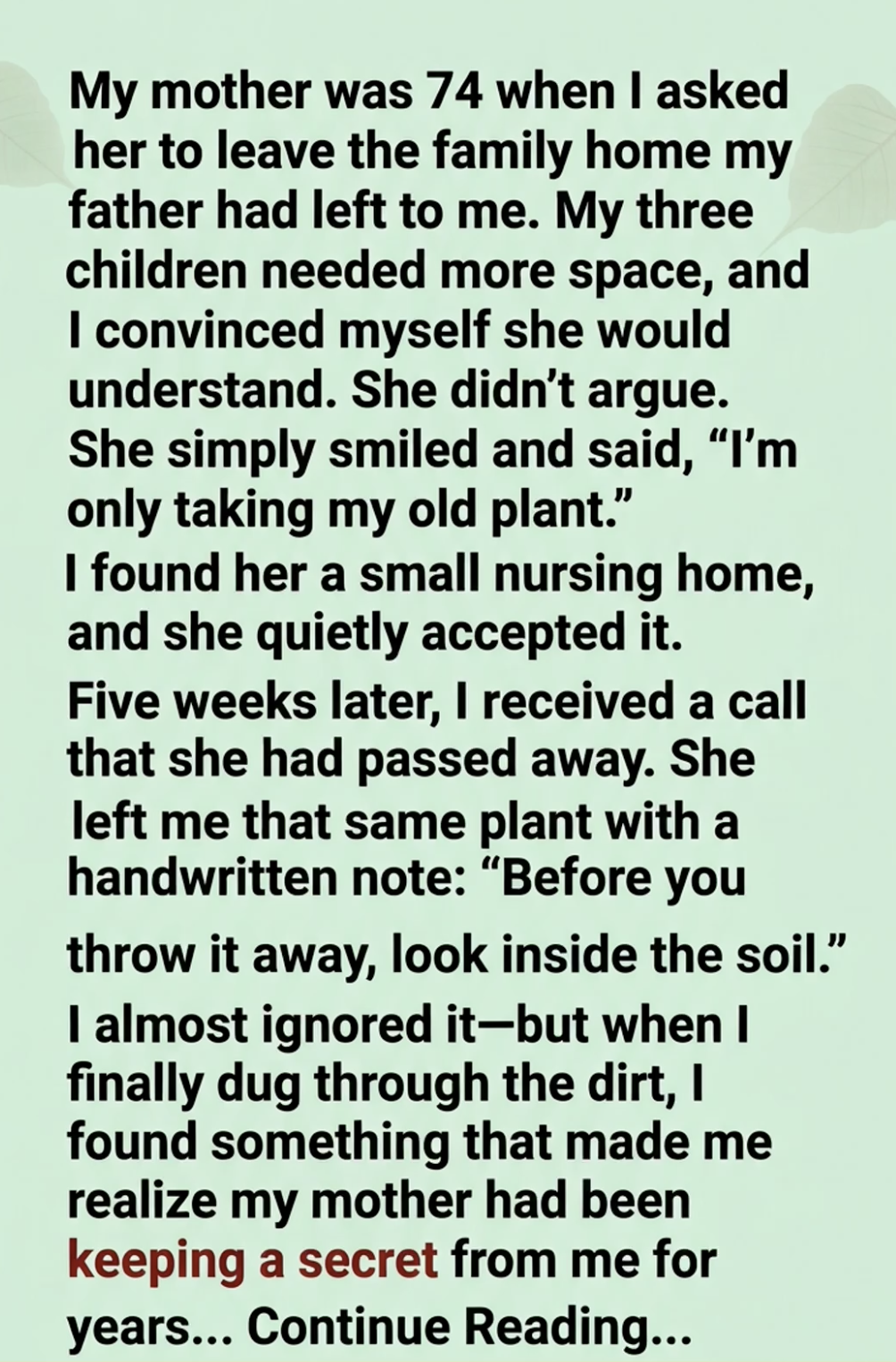
My mother was seventy-four when I asked her to leave the family home.
The house had belonged to my father.
After he died, he left it to me.
At first, I didn’t think anything would change.
My mother continued living there.
I continued raising my three children.
We shared the kitchen.
We watched television together.
We had breakfast on Sundays.
It was crowded, but it was family.
Then my youngest started school.
My oldest needed a quieter place to study.
My middle child had begun sharing a bedroom with his younger sister.
One night, I sat at the kitchen table looking at bills, school schedules, and the mortgage statement.
I convinced myself we needed more space.
I convinced myself that my mother would understand.
So I told her.
“Mom, I think you need to find somewhere else to live.”
She looked at me.
She didn’t argue.
She didn’t ask why.
She simply nodded.
“I understand.”
Those two words should have stopped me.
They didn’t.
I found a small nursing home about twenty minutes away.
It wasn’t terrible.
The rooms were clean.
The staff seemed kind.
There was a garden.
My mother signed the paperwork without complaining.
On moving day, she packed very little.
A few dresses.
Some photographs.
Her medications.
A small box of letters.
And one old plant.
It had been sitting beside the living-room window for as long as I could remember.
I pointed at it.
“Are you taking that?”
She smiled.
“I’m only taking my old plant.”
I laughed.
“Of course.”
She carried it herself.
I helped her into the car.
Before we left, she stood in the doorway of the house.
She looked back for a long time.
Then she said,
“Take care of the children.”
I nodded.
“I will.”
She smiled.
“And take care of yourself too.”
I didn’t understand why those words made me uncomfortable.
I drove away.
For the first few days, I felt relieved.
The house was quieter.
The children had more space.
There was finally room for a desk in the hallway.
I told myself I had made the right decision.
My mother called occasionally.
She never complained.
“How are the children?”
“Fine.”
“Are you eating?”
“Yes.”
“Good.”
She never said she missed the house.
She never asked to come back.
Then, five weeks later, my phone rang at 6:18 in the morning.
It was the nursing home.
My mother had died during the night.
I sat down on the floor.
The person on the phone kept talking.
I heard words like peaceful and family and arrangements.
But I couldn’t process any of them.
My mother was gone.
And the last thing I had done was put her in a nursing home because I wanted more room.
I drove there immediately.
Her room looked exactly as she had left it.
Her clothes were folded.
Her photographs were on the table.
And beside the window sat the old plant.
The staff told me my mother had left it to me.
There was a small handwritten note attached to the pot.
I recognized her handwriting immediately.
It said:
“Before you throw it away, look inside the soil.”
I stared at it.
For a moment, I almost laughed.
Then I almost threw the note away.
It was an old plant.
The leaves were dusty.
The pot was cracked.
I couldn’t imagine why she would leave instructions about dirt.
But something stopped me.
I took the plant home.
That evening, I placed it on the kitchen table.
The children were asleep.
The house was quiet.
I found a spoon and carefully dug into the soil.
Nothing.
I dug deeper.
Still nothing.
Then my spoon hit something hard.
I stopped.
I brushed away the soil.
A small metal container appeared.
My heart began beating faster.
I pulled it out.
It was sealed with a rubber band.
Inside were several documents.
A key.
A bank receipt.
And an envelope with my name on it.
I opened the envelope.
The first line said:
“My darling, if you are reading this, then I am no longer there to explain why I left so quietly.”
My hands started shaking.
She continued.
“Please don’t feel guilty about the house.”
I stopped reading.
Tears blurred the page.
Then I continued.
“Your father left the house to you because he believed you needed it. I agreed with him.”
I looked at the documents.
There was a copy of my father’s will.
I had seen it before.
But there was something I had never known.
A second document.
A trust agreement.
My father had established it shortly before his death.
The trust contained investments and life-insurance proceeds.
My mother had been the beneficiary during her lifetime.
After her death, the remaining assets were to pass to me and my children.
I stared at the number on the statement.
More than $620,000.
I couldn’t breathe.
My father hadn’t simply left me the house.
He had also left money specifically intended to protect the family.
My mother had never spent it.
She had never told me about it.
I kept reading.
“Your father wanted you to have a secure home. He also wanted you to have something for the children when they were older.”
I wiped my eyes.
Then came the part that made me feel ashamed.
“I never told you about the trust because you were already carrying too much.”
She explained that after my father’s death, she had used her own pension and savings to cover household expenses whenever she could.
She had paid for groceries.
School supplies.
Medical bills.
Small repairs.
She had quietly contributed thousands of dollars over the years.
She didn’t want me to know because she knew I was proud.
She knew I would insist on paying her back.
The money in the trust had been left untouched.
She wanted it to remain available for emergencies.
Then I found another document.
A nursing-home payment statement.
My mother had paid the first year’s expenses in advance.
My hands went numb.
She had known she might eventually need long-term care.
She had prepared for it.
She had made sure I wouldn’t have to choose between caring for her and caring for my children.
But there was more.
The key.
I stared at it for several seconds.
Attached to it was another note.
“This opens your father’s old desk.”
I still had the desk.
It had been in the basement for years.
I had never opened the locked drawer because I didn’t have the key.
I went downstairs.
The key fit.
The drawer opened.
Inside was a small leather notebook.
My father’s handwriting filled the first page.
He had written it two years before he died.
The first sentence was:
“If our daughter ever believes her mother was a burden, she needs to know the truth.”
I sat down.
My father had written about my mother.
He knew she would eventually become dependent on me.
He knew I might someday feel overwhelmed.
And he had written something that made me cry harder than anything else.
“Your mother will probably tell you she doesn’t need anything. Believe her when she says it, but don’t mistake that for not needing love.”
I closed the notebook.
I couldn’t continue.
For years, I had thought my mother stayed in the house because she had nowhere else to go.
I had thought she was taking up space.
I had thought I was doing her a favor by finding her a place where professionals could care for her.
I had never asked what she wanted.
I had never asked what she was afraid of.
And when she left, she had taken one thing.
Her plant.
The plant I had always considered ordinary.
It had been with her for forty-six years.
My father had bought it for her when they first moved into the house.
She had kept it alive through every hardship.
The plant wasn’t valuable.
The secret inside it was.
I called the nursing home the next morning.
I asked whether my mother had ever complained about being sent there.
The nurse paused.
“No.”
“Are you sure?”
“She was very calm.”
“Did she seem sad?”
Another pause.
“She missed you.”
My heart broke.
“Did she say anything?”
The nurse smiled sadly.
“She said you had three children and needed the space.”
I closed my eyes.
“She said you were a good mother.”
I couldn’t speak.
The nurse continued.
“She said she didn’t want you to feel guilty.”
I started crying.
“She was protecting me even then.”
“Yes.”
After the call, I sat beside the plant.
I touched one of its leaves.
Then I noticed something else.
There was another folded paper underneath the metal container.
I opened it.
My mother’s final letter.
“I know you think I gave you the house by leaving it empty. But the truth is, I gave you much more than that.”
She wrote that she had stayed in the house because it was the last place where my father had lived.
She had watched me grow there.
She had watched my children take their first steps there.
She had wanted to remain there as long as she could.
But when I asked her to leave, she realized something.
I needed the house more than she did.
So she chose not to fight.
She chose to leave quietly.
Then she wrote:
“Please don’t confuse my silence with not being hurt.”
That sentence broke me.
I had assumed that because she didn’t argue, she wasn’t suffering.
But sometimes people stay quiet because they love you too much to make you feel worse.
The letter continued.
“You told yourself that I would understand. I did. I understood that you were trying to give your children what you thought they needed.”
Then:
“But one day, when you have more space, I hope you understand that a home is not measured by how many people fit inside it.”
I pressed the letter against my chest.
“It is measured by how many people feel they belong there.”
I cried for a long time.
The next morning, I called my children into the living room.
I told them about their grandmother.
My oldest asked,
“Is that why she left?”
I nodded.
My daughter started crying.
“We should have visited more.”
“We all should have.”
My youngest looked at the plant.
“Is that Grandma’s plant?”
“Yes.”
“Can we keep it?”
I smiled.
“Forever.”
We placed it beside the window where my mother had kept it.
Then something unexpected happened.
The children started remembering things I had forgotten.
Grandma teaching them card games.
Grandma sneaking them cookies.
Grandma sitting on the porch when they came home from school.
Grandma telling them stories about their grandfather.
I realized she hadn’t simply been living in our house.
She had been part of the house.
And I had mistaken her presence for clutter.
Months later, I used part of the trust money to renovate the house.
Not to make it bigger.
To make it warmer.
I created a small room for my mother.
I kept her chair.
Her photographs.
Her books.
And the plant.
On the wall, I hung one photograph of her and my father standing in front of the house when they were young.
Underneath it, I placed a small plaque.
It read:
“This home belongs to everyone who was loved here.”
I never moved the plant again.
Years later, when my children were grown, they still asked about it.
“Is Grandma’s plant okay?”
I would smile.
“Yes.”
“It keeps growing.”
Just like she had.
Quietly.
Patiently.
Even after I had convinced myself that I had no room for her.
I eventually understood the greatest secret my mother had been keeping.
It wasn’t the money.
It wasn’t the trust.
It wasn’t the documents.
It was how much she had been protecting me without letting me know.
She had hidden the financial security because she didn’t want me to worry.
She had paid what she could because she didn’t want to burden me.
She accepted the nursing home because she didn’t want to interfere with my children’s lives.
And when she knew she was dying, she left me the plant because she knew I might finally be ready to listen.
I had asked my mother to leave because I thought she was taking up too much space.
She left me a fortune.
But more importantly, she left me a lesson.
The house my father left me wasn’t really the inheritance.
The inheritance was my mother’s sacrifice.
Her patience.
Her forgiveness.
Her love.
And that old plant sitting by the window.
Every time I water it, I think about the sentence she wrote.
“Before you throw it away, look inside the soil.”
I almost didn’t.
And if I hadn’t, I might have spent the rest of my life believing I had simply lost my mother.
Instead, I discovered something much harder to accept.
She had been protecting me until the very end.
Even when I failed to protect her.
And now, whenever my children complain that our house feels crowded, I smile and tell them,
“There’s always room for one more person you love.”
Because my mother taught me too late that space is not what makes a home.
Love does.