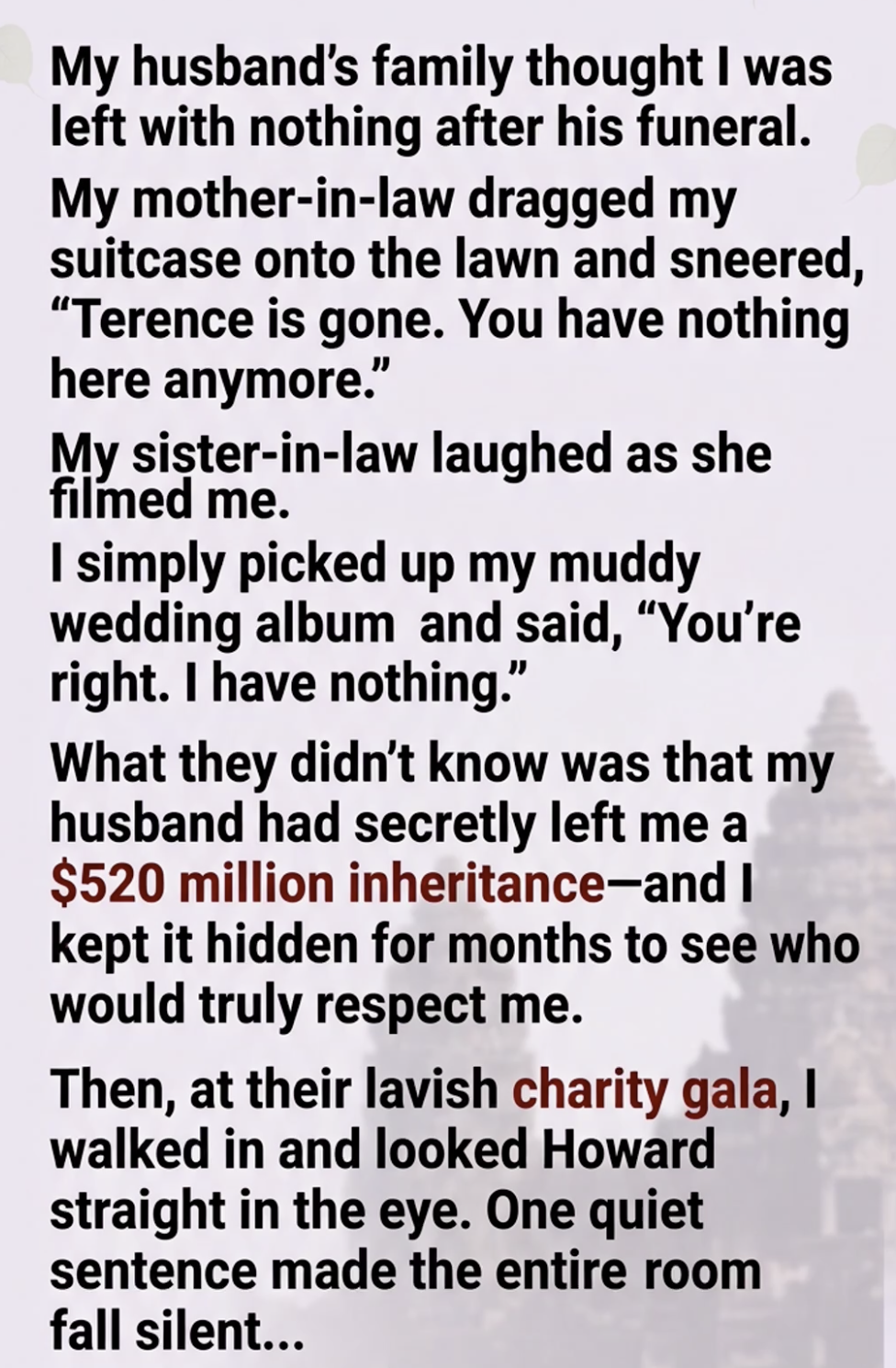
My mother-in-law dragged my suitcase across the front lawn as if she were throwing away garbage.
It landed in the mud beside the rose bushes.
My wedding album was still inside.
Howard stood on the porch with his arms folded.
My sister-in-law, Denise, was filming everything on her phone.
My mother-in-law looked me up and down.
“Terence is gone,” she said coldly. “You have nothing here anymore.”
I stared at her.
Then I bent down and picked up my wedding album.
The cover was smeared with mud.
I wiped it with my sleeve.
“You’re right,” I said quietly.
“I have nothing.”
Denise laughed.
“Oh, she finally understands.”
My mother-in-law smiled.
“Take your things and go.”
So I did.
I carried one suitcase to my car.
I didn’t argue.
I didn’t scream.
I didn’t tell them what was sitting inside a secure vault less than three miles away.
I didn’t tell them that six weeks before Terence died, he had quietly transferred control of a family investment structure into a trust bearing my name.
I didn’t tell them the trust was worth approximately $520 million.
And I certainly didn’t tell them that Terence had specifically instructed his attorneys not to reveal it immediately.
He had left behind one final request.
“Let them believe she has nothing.”
At the time, I didn’t understand why.
Now I did.
Terence and I had been married for twenty-two years.
His family had never treated me as an equal.
To them, I was always the woman who married into the family.
Howard, Terence’s older brother, controlled most of the family’s public affairs.
He ran their foundation.
He appeared at charity dinners.
He gave speeches about generosity.
He loved telling reporters that his family believed wealth meant responsibility.
But behind closed doors, Howard treated people according to what they could give him.
Terence had noticed.
I hadn’t.
Or maybe I had simply refused to believe it.
Terence died unexpectedly after a short illness.
His funeral was enormous.
Hundreds of people came.
Politicians.
Business partners.
Celebrities.
Charity directors.
People who had barely spoken to Terence in years suddenly cried beside his coffin.
Howard gave the eulogy.
He talked about his brother’s generosity.
His integrity.
His devotion to family.
I sat in the front row.
I said nothing.
Three days later, Howard knocked on my bedroom door.
“We need to discuss the house.”
I looked at him.
“What about it?”
“This is a family property.”
I frowned.
“Terence and I lived here for twenty-two years.”
“Exactly.”
He paused.
“Terence is gone.”
That sentence still hurts when I remember it.
Not because it was cruel.
Because he said it like Terence’s death had erased everything we had built together.
“What are you asking me to do?”
“Leave.”
I stared at him.
“Now?”
“You’ll have enough time to pack.”
I looked toward the hallway.
“My clothes are here.”
“Pack them.”
“My photographs.”
“Fine.”
“My wedding album.”
Howard shrugged.
“Take whatever personal things you want.”
I asked him the question I should have asked years earlier.
“What happens to Terence’s things?”
His expression changed.
“That’s family business.”
I knew then.
They weren’t grieving.
They were dividing.
And apparently, I wasn’t considered part of the family anymore.
The next morning, my mother-in-law arrived.
She didn’t bring flowers.
She brought suitcases.
“Start packing.”
I looked at her.
“Howard said I could have some time.”
“You’ve had twenty-two years.”
She opened my closet.
Then Denise arrived with her phone already recording.
She pointed the camera toward me.
“Say goodbye to the house.”
I didn’t.
She laughed.
My mother-in-law pulled my suitcase outside.
That was when she said it.
“Terence is gone. You have nothing here anymore.”
I picked up my muddy wedding album.
“You’re right.”
I had nothing.
At least that’s what they thought.
That night, I stayed in a hotel.
I sat on the edge of the bed and opened the wedding album.
The first photograph was Terence smiling at me.
He looked nervous.
Young.
Happy.
I touched the photograph.
“You knew,” I whispered.
Because two months before his death, Terence had asked me something strange.
“If you lost everything tomorrow, who would still stand beside you?”
I laughed at the time.
“I’d have you.”
He had looked at me for a long moment.
Then he kissed my forehead.
“That’s not what I asked.”
I didn’t understand.
Now I did.
The next morning, I met with Terence’s attorney.
His name was Samuel Reed.
He placed a thick folder on the table.
“Your husband anticipated what happened.”
I stared at him.
“What happened?”
“Your husband’s family.”
He slid the first document toward me.
“Terence established a private family trust.”
I opened it.
My hands began shaking.
The assets included investment holdings.
Real estate.
Private equity interests.
Technology companies.
International funds.
Art.
And controlling interests in several corporations I had never heard of.
I looked at Samuel.
“How much?”
He hesitated.
“Approximately five hundred and twenty million dollars based on the most recent valuation.”
I stared at him.
“That’s impossible.”
“No.”
He turned another page.
“It belongs to you.”
I couldn’t speak.
“Why didn’t he tell me?”
“Because he wanted you to see something.”
“What?”
Samuel leaned forward.
“He wanted to know whether the people around you loved you—or the life they believed you could provide them.”
I thought about the lawn.
The suitcase.
The camera.
Howard’s cold expression.
And suddenly, everything made sense.
Terence had left instructions.
The trust would remain confidential for several months.
I was not to announce the inheritance.
I was not to retaliate against his family.
I was simply to observe.
Samuel gave me another letter.
It was from Terence.
I opened it.
My love,
If you’re reading this, I’m gone. I’m sorry.
I had to stop.
I wiped my eyes.
Then continued.
You always believed people were better than they sometimes showed themselves to be. I loved that about you. But I’ve watched my family change when money enters the room.
If they believe you have nothing, you’ll finally see who they are when they think you can’t benefit them.
Don’t punish them. Don’t expose yourself too early. Just watch.
And when you finally understand them, use what I left you to build something that has nothing to do with them.
At the bottom was one final sentence.
You were my family long before you became my heir.
I cried for an hour.
Not because of the money.
Because Terence had known me well enough to understand exactly what I would need after he was gone.
Time.
Distance.
And the truth.
So I disappeared.
For four months.
I lived quietly.
I rented a small house.
I drove an ordinary car.
I wore the same clothes.
I told almost nobody about the inheritance.
And I watched.
Howard never called to ask if I was okay.
My mother-in-law didn’t ask where I was living.
Denise posted videos online about “starting over after loss.”
She never mentioned me except once.
She called me “Terence’s unfortunate widow.”
I saw it.
I said nothing.
Then something unexpected happened.
Howard announced the family’s annual charity gala.
It was their biggest event of the year.
They were raising money for children’s hospitals.
The guest list included hundreds of wealthy donors.
And Howard had apparently decided that Terence’s death should become part of his public image.
The invitation said:
An evening celebrating the legacy of Terence Whitmore.
I stared at the words.
Then I called Samuel.
“I want to attend.”
He was silent.
“Are you sure?”
“Yes.”
“What are you going to do?”
“Nothing.”
“Nothing?”
I smiled.
“I’m going to listen.”
The night of the gala, I arrived twenty minutes late.
The ballroom was spectacular.
Crystal chandeliers.
White roses.
A massive photograph of Terence stood behind the stage.
Howard was giving a speech.
“Terence believed family was everything,” he said.
I almost laughed.
Then I walked through the doors.
The room gradually noticed me.
Whispers began.
Someone dropped a glass.
Howard stopped speaking.
Denise stared at me.
My mother-in-law looked horrified.
I walked toward them.
I wasn’t wearing anything extravagant.
No diamonds.
No designer dress.
Just a simple black gown and Terence’s wedding ring.
Howard approached me.
“What are you doing here?”
I smiled.
“I was invited.”
“By whom?”
“The charity.”
He looked uncomfortable.
“You should leave.”
I looked at the photograph of Terence.
“No.”
His jaw tightened.
“This isn’t appropriate.”
I looked around the room.
All those people had come to celebrate generosity.
So I asked the question I had been waiting four months to ask.
“Howard, how much did you donate tonight?”
He blinked.
“What?”
“To the charity.”
He cleared his throat.
“That isn’t the point.”
“Isn’t it?”
People around us started listening.
Howard lowered his voice.
“You have no business causing a scene.”
“I haven’t caused one.”
I looked at the stage.
“You did.”
Then I noticed something on the large screen behind him.
A video montage.
Terence’s photograph appeared.
Howard had prepared a speech about his brother’s legacy.
But the video included a statement:
The Whitmore family will continue Terence’s tradition of generosity.
I smiled.
“That’s interesting.”
Howard’s face became pale.
“What?”
I looked directly at him.
Then I said the one sentence that made the entire room fall silent.
“If Terence were here tonight, he’d ask you why you’re raising money in his name when you stole from his widow.”
Nobody moved.
Howard’s face went white.
“What are you talking about?”
I reached into my handbag.
I didn’t pull out the trust documents.
I pulled out a single sheet.
“The charity received a transfer today.”
Howard stared at me.
“How much?”
“Twenty million dollars.”
Gasps moved through the room.
Denise whispered, “What?”
I continued.
“It’s from the Whitmore Family Trust.”
Howard looked confused.
“What trust?”
I smiled.
“The one Terence left me.”
The room exploded into whispers.
Howard stared at me.
“You’re lying.”
“No.”
He stepped closer.
“You don’t have twenty million dollars.”
I looked at him.
“You told me I had nothing.”
His face changed.
Then Samuel entered the ballroom.
He was carrying a leather folder.
Behind him were two financial trustees and an independent auditor.
Howard stepped backward.
Samuel approached the microphone.
“Ladies and gentlemen, I believe it’s time to clarify several matters regarding Mr. Terence Whitmore’s estate.”
Howard tried to interrupt.
“This is a private family issue.”
Samuel looked at him.
“No.”
He opened the folder.
“It became a legal matter when assets belonging to the trust were improperly transferred.”
The room went silent again.
Samuel explained that shortly before Terence’s death, Howard had attempted to move several assets out of companies controlled by Terence.
He believed the assets would eventually be divided among the family.
But Terence had already transferred ownership into the trust.
Howard had signed documents he wasn’t authorized to sign.
He had also withdrawn money from a foundation account for personal expenses.
The audit had uncovered everything.
Howard turned toward me.
“You knew.”
“Yes.”
“For months?”
“Yes.”
“And you let me think you were broke?”
I looked at him.
“You let yourself think that.”
My mother-in-law began crying.
“We didn’t know.”
I looked at her.
“You didn’t ask.”
Denise lowered her phone.
“You really have all that money?”
I nodded.
She looked ashamed.
Then she whispered:
“Why didn’t you tell us?”
I smiled sadly.
“Because I wanted to know whether you’d treat me differently if I had it.”
Nobody spoke.
I turned toward the photograph of Terence.
“I already know the answer.”
The charity gala ended early.
Howard resigned from the foundation three weeks later.
The financial investigation continued.
My mother-in-law eventually sent me a letter.
She apologized.
I never moved back into the house.
I didn’t want it.
Terence had left me enough to build something better.
So I created the Whitmore Legacy Fund.
Its first focus was widows and children who suddenly lost financial security after a spouse or parent died.
I funded scholarships.
Emergency housing.
Legal assistance.
Education trusts.
And small grants for families who had no one else to help them.
I never named a building after myself.
I never gave interviews about the inheritance.
And I never told people how much money I had unless they needed to know.
A year after the gala, I returned to the old house.
Not to reclaim it.
To collect one thing.
My wedding album.
The cover had been repaired.
I stood in the doorway holding it.
Howard wasn’t there.
Denise wasn’t there.
My mother-in-law wasn’t there.
The house was quiet.
I opened the album.
There was that first photograph again.
Terence and me.
Young.
Hopeful.
Completely unaware of what life would eventually ask of us.
I touched his face in the photograph.
“You were right,” I whispered.
Then I closed the album.
They thought they had thrown a woman away because her husband had died.
They thought grief had made me powerless.
They thought an empty suitcase meant an empty life.
They were wrong.
The greatest inheritance Terence left me wasn’t the $520 million.
It was the knowledge that I didn’t need to beg anyone to recognize my worth.
Money revealed what people already carried inside them.
It didn’t make my family cruel.
It simply removed their reason to hide it.
And when they thought I had nothing, they showed me everything.
So I kept my inheritance quiet.
I watched.
I learned.
And when the time came, I didn’t use Terence’s fortune to destroy the people who had hurt me.
I used it to make sure other families would never have to wonder where they would sleep after losing the person they loved.
Because Terence had taught me something before he died.
Sometimes the most powerful response to being told you have nothing is to quietly build a life so meaningful that their opinion no longer matters.