My husband left me after twelve years of marriage because he believed I wasn’t successful enough for him.
He stood in our bedroom doorway, holding a suitcase, and said something I would never forget.
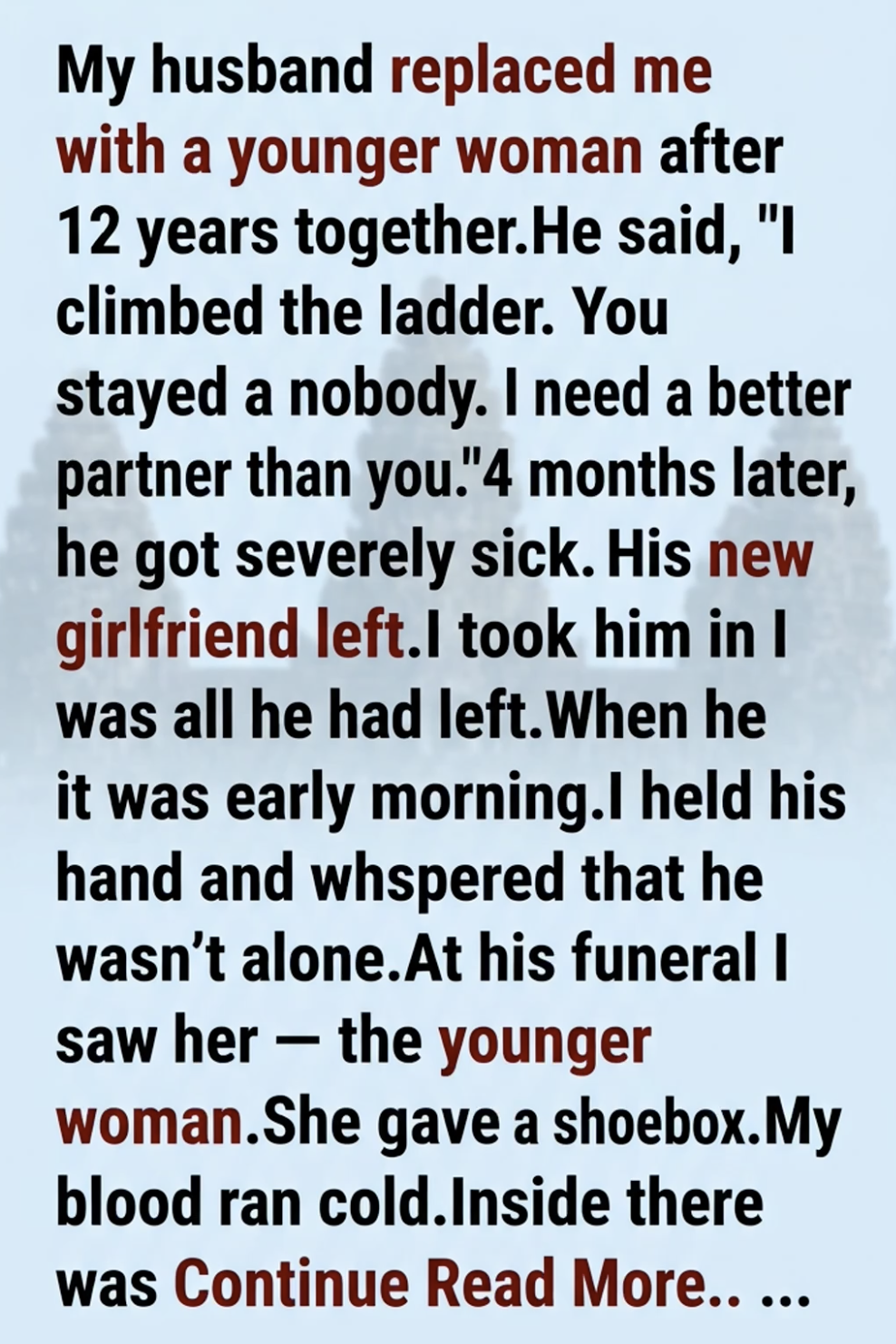
“I climbed the ladder. You stayed a nobody. I need a better partner than you.”
I remember staring at him.
Not because I didn’t understand.
Because I couldn’t believe the man I had loved for twelve years could reduce our entire marriage to a comparison between his career and mine.
I had supported him through everything.
The late nights.
The failed business idea.
The years when his salary barely covered our bills.
The promotions he celebrated.
The conferences I attended alone.
The weekends I spent waiting for him to come home.
But apparently, none of that counted.
His new partner was twenty-nine.
Her name was Lauren.
She worked in the same industry.
She dressed beautifully.
She knew how to talk about investments, networking, and “moving forward.”
According to my husband, she was everything I wasn’t.
“She understands where I’m going,” he told me.
I nodded.
“Then go.”
He looked surprised.
“You’re not going to fight for me?”
I shook my head.
“No.”
That was the last night we slept under the same roof.
Four months later, everything changed.
My husband called me at 2:17 in the morning.
His voice was barely recognizable.
“I can’t breathe.”
I sat up in bed.
“Where are you?”
“At home.”
“Where’s Lauren?”
Silence.
Then he whispered:
“She left.”
He had been diagnosed with an aggressive illness.
The doctors told him treatment would be difficult.
Lauren lasted eleven days.
Then she packed her bags.
She sent me one message.
I can’t do this.
I stared at it for a long time.
I didn’t hate her.
I almost wished I could.
Hatred would have been easier.
Instead, I felt something else.
Pity.
My husband had spent twelve years building a life he thought was impressive.
Then the moment he became vulnerable, the person he had chosen over me disappeared.
He had nobody.
So I went.
I told myself it would only be for a few days.
It became seven months.
I moved his medication into labeled containers.
I cooked.
I drove him to appointments.
I sat beside him during treatments.
I washed his clothes.
I learned which foods made him nauseous.
I kept track of his prescriptions.
Sometimes he apologized.
Sometimes he didn’t.
One afternoon, he looked at me from his hospital bed.
“Why are you doing this?”
I shrugged.
“Because you’re sick.”
“You don’t owe me anything.”
“I know.”
He looked away.
“I treated you badly.”
“Yes.”
He swallowed.
“I thought I was becoming someone important.”
“You were.”
He looked at me.
“I wasn’t?”
“You became successful.”
I paused.
“But you forgot that success isn’t the same thing as being valuable.”
His eyes filled with tears.
“I don’t know how I became that man.”
I didn’t answer.
Because I knew.
He had spent years climbing a ladder.
He simply never looked down to see who had been holding it.
His condition worsened.
Eventually, he could barely walk.
The man who had once told me I was a nobody needed help getting out of bed.
And I never reminded him.
Not once.
One morning, just before sunrise, I found him awake.
He looked peaceful.
“Are you there?” he whispered.
“Yes.”
He reached for my hand.
I took it.
His fingers were cold.
“I was wrong,” he said.
“I know.”
He smiled faintly.
“Still honest.”
“Always.”
He closed his eyes.
A few minutes later, his breathing slowed.
Then stopped.
I held his hand.
And whispered:
“You aren’t alone.”
He died at 5:41 in the morning.
I arranged the funeral.
I called relatives.
I chose flowers.
I contacted the funeral home.
And somehow, I managed to keep moving.
The funeral was held six days later.
I stood near the front.
People spoke about his career.
His achievements.
His ambition.
His determination.
Everyone described the man he had become.
Very few knew the man he had been at home.
Then I saw her.
Lauren.
She stood at the back of the church.
She looked nervous.
She waited until most people had left.
Then she approached me.
“I need to give you something.”
I stared at her.
“What?”
She held out a shoebox.
It was old.
Brown.
The edges were worn.
My stomach tightened.
“What is it?”
“I think he wanted you to have it.”
“Why didn’t you give it to him?”
Her eyes filled with tears.
“Because I wasn’t supposed to.”
I took the box.
My hands were shaking.
“What does that mean?”
She looked toward the coffin.
“He told me once that if something happened to him, I should give this to you.”
“When?”
“Before I left.”
I stared at the box.
“Why?”
“I don’t know.”
She took a breath.
“Open it.”
I carried it home.
I put it on the kitchen table.
For nearly an hour, I couldn’t bring myself to lift the lid.
Finally, I opened it.
My blood ran cold.
Inside were twelve envelopes.
One for every year we had been married.
Each envelope had a date written on it.
I opened the first.
Inside was a photograph.
It showed me sitting at a hospital beside my husband after his first surgery.
On the back, he had written:
She stayed.
I opened the second.
Another photograph.
Me sitting at the kitchen table at midnight, helping him prepare for an interview.
She believed in me when I didn’t believe in myself.
The third contained a photograph from the day he received his first major promotion.
I remembered that day.
He had come home with champagne.
He had hugged me.
We had danced in the kitchen.
On the back:
She celebrated like it was her victory too.
I opened the fourth.
Then the fifth.
Then the sixth.
Every envelope contained something.
Photographs.
Receipts.
Old cards.
Notes.
Little memories I had completely forgotten.
Our first apartment.
Our first vacation.
The night we bought our first car.
The dinner we had after he lost his job.
A photograph of me asleep on the couch while waiting for him to come home.
And beneath it, his handwriting:
She waited again.
I started crying.
The seventh envelope contained a letter.
I unfolded it.
I spent years thinking love was supposed to make me look successful.
I thought the right partner would make other people admire me.
I confused being impressive with being happy.
I had to stop reading.
Then I continued.
You never made me look successful.
You made me feel safe.
I was too arrogant to understand the difference.
My hands trembled.
The eighth envelope contained something I didn’t expect.
A bank receipt.
Then another.
Then another.
I called the bank the next morning.
The representative told me there was a joint investment account I hadn’t known about.
It had been opened years earlier.
My husband had deposited a portion of his bonuses into it.
The account was worth nearly $280,000.
I stared at the paperwork.
“Why didn’t he ever tell me?”
The banker couldn’t answer.
But the ninth envelope could.
Inside was another letter.
I knew you would never ask for anything. That’s one of the things I loved about you and one of the things I took advantage of.
So I put money aside for you. Not because you needed rescuing. Because you deserved security after everything you gave me.
The tenth envelope contained a copy of his updated will.
I was the primary beneficiary.
Not Lauren.
Not his colleagues.
Not his parents.
Me.
The woman he had once called a nobody.
I opened the eleventh envelope.
There was a photograph of Lauren.
I stared at it.
For a moment, I felt angry.
Then I read the note beneath it.
Don’t blame her for becoming part of my mistake. I chose her because I wanted the version of myself I imagined she represented.
She didn’t destroy our marriage. I did.
I sat back.
The final envelope was the thickest.
Inside was a handwritten letter.
I recognized his handwriting immediately.
My love,
If you’re reading this, I’m gone.
I’m sorry that the last chapter of our marriage became the ugliest one.
You deserved better than the way I left.
I wanted you to know something I was too ashamed to tell you while I was alive.
I never stopped loving you.
I closed my eyes.
Tears rolled down my cheeks.
Then I read the next line.
I stopped respecting what I had.
That sentence hurt more than anything.
Because it was true.
He hadn’t stopped loving me.
He had simply decided love wasn’t enough.
He wanted status.
Recognition.
A partner who made him feel important.
And only after losing everything did he understand what he had thrown away.
The letter continued.
When I was sick, you came back.
You didn’t ask whether I deserved it.
You didn’t ask what you would receive.
You simply came.
That is who you have always been.
Please don’t spend the rest of your life proving that I was wrong about you.
You don’t need to become rich.
You don’t need to become famous.
You don’t need to climb any ladder.
Build a life you actually want.
And never let anyone call you a nobody again.
I held the letter against my chest.
For the first time since his death, I allowed myself to grieve the entire marriage.
Not just the man.
Not just the good memories.
Everything.
The love.
The betrayal.
The forgiveness.
The years.
The version of him I had married.
And the version of myself I had lost while trying to support him.
A few weeks later, Lauren came to my house.
She stood at the door holding a small envelope.
“I wanted to apologize.”
“You don’t have to.”
“I do.”
She looked down.
“He told me you were holding him back.”
I didn’t respond.
“I believed him.”
“I know.”
“He told me you didn’t understand ambition.”
I smiled sadly.
“I understood it.”
She looked at me.
“I just didn’t think it was more important than people.”
Her eyes filled with tears.
“He talked about you constantly after he got sick.”
I looked away.
“What did he say?”
“That you were the only person he trusted.”
I swallowed.
“That’s ironic.”
“He knew that.”
She handed me the envelope.
“What is it?”
“Something he gave me before I left.”
I opened it.
Inside was one sentence in his handwriting.
Tell her I finally understood.
I closed my eyes.
For years, I had thought the end of a marriage meant someone had won and someone had lost.
It doesn’t.
Sometimes both people lose.
Sometimes one person leaves because they believe something better is waiting.
And sometimes they discover too late that what they were searching for had been sitting beside them all along.
I never remarried.
Not because I was afraid of love.
Because I learned to love myself without needing someone else to confirm my worth.
I used the money my husband left me to pay off my home, establish a small scholarship fund for women returning to school, and finally take the photography classes I had postponed for years.
I traveled.
I made friends.
I laughed again.
And every year on the anniversary of his death, I visited his grave.
I never brought expensive flowers.
Just a single white rose.
I would sit quietly for a while.
Then I’d tell him about my life.
The photographs I had taken.
The places I’d visited.
The people I’d helped.
And once, years later, I said something that made me laugh.
“You know, Terence, I finally climbed a ladder.”
The cemetery was quiet.
I smiled.
“But this time, I chose where it was going.”
Then I stood up and walked away.
Because my husband had been right about one thing.
I didn’t need to become somebody.
I already was.
I simply needed to stop believing the person who told me otherwise.