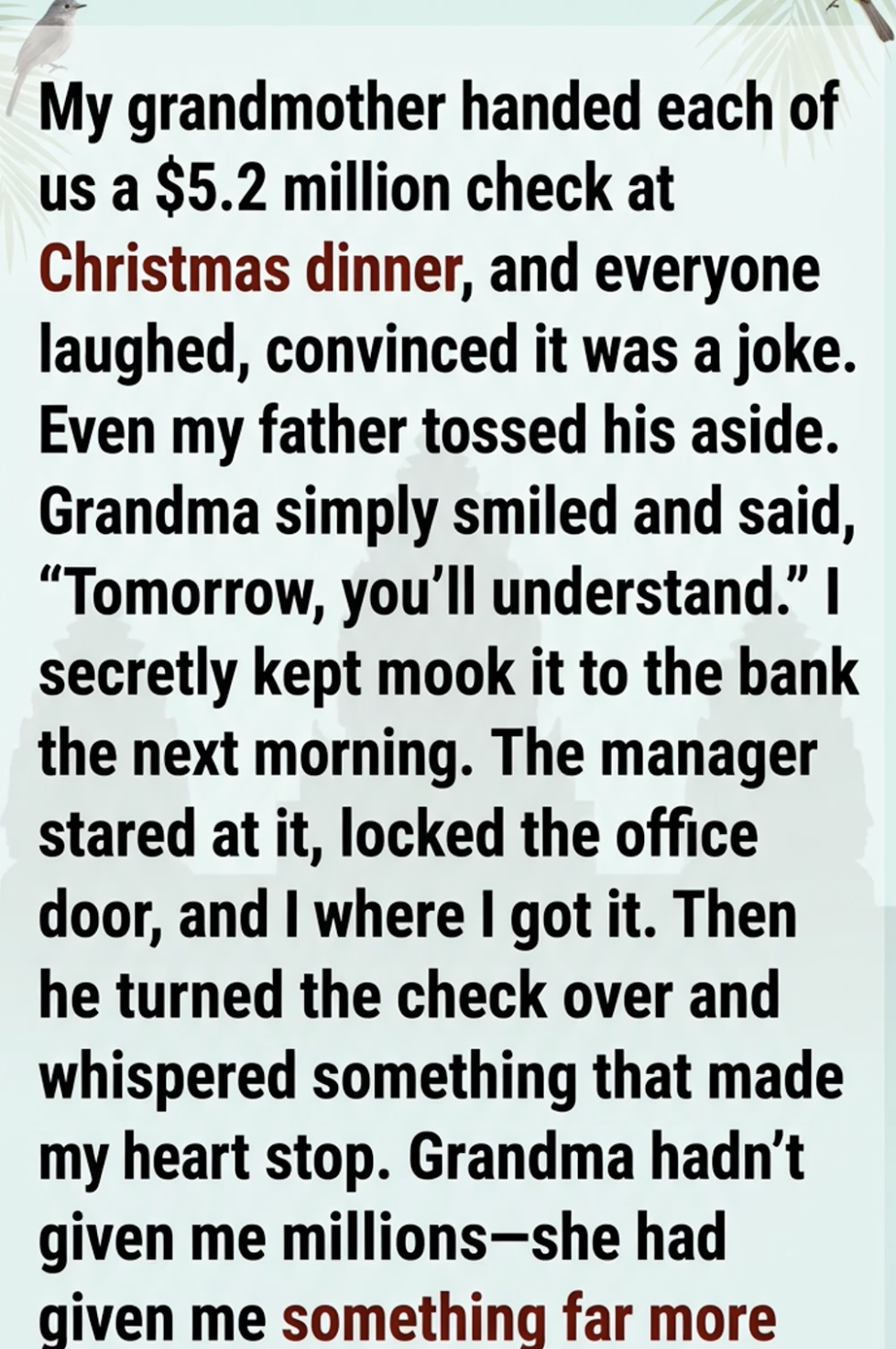
My grandmother handed each of us a check for $5.2 million at Christmas dinner.
Nobody believed her.
My father laughed first.
Then my uncle.
Then my cousins.
Within seconds, the entire table was laughing.
Grandma just sat there, smiling.
She had placed six white envelopes beside her plate.
One for my father.
One for my uncle.
One for each of my three cousins.
And one for me.
“Merry Christmas,” she said.
My father opened his envelope.
He pulled out the check.
Then he stared at it.
“Five point two million dollars?”
Grandma nodded.
He laughed so hard he nearly dropped it.
“Mom, seriously?”
“Very seriously.”
My uncle looked at his own check.
“This isn’t real.”
“It is.”
My cousin held hers up to the chandelier.
“Grandma, where did you even get these?”
She smiled.
“Tomorrow, you’ll understand.”
My father tossed his check onto the table.
“This is ridiculous.”
Everyone laughed again.
I didn’t.
Something about Grandma’s expression bothered me.
She wasn’t joking.
I quietly folded my check and put it inside my purse.
My father noticed.
“You’re keeping yours?”
“I don’t know.”
“It’s obviously fake.”
“Maybe.”
Grandma looked at me.
“Keep it.”
I nodded.
The dinner continued.
Nobody talked about the checks again.
Except Grandma.
When dessert arrived, she looked around the table and said,
“Whatever happens tomorrow, don’t blame each other.”
My father frowned.
“What does that mean?”
She simply smiled.
“You’ll see.”
The next morning, I woke before sunrise.
I couldn’t stop thinking about the check.
I looked at it again.
It appeared completely legitimate.
My grandmother’s name was printed on the account.
The bank was one of the largest banks in the state.
The amount was exactly $5,200,000.
There was a signature.
There was even a handwritten note on the back.
I had initially assumed it was Grandma’s handwriting.
But I wasn’t sure.
At 9:05 a.m., I went to the bank.
I handed the check to the manager.
He looked at it casually.
Then he looked again.
His expression changed.
“Where did you get this?”
“My grandmother gave it to me.”
“Yesterday?”
“Yes.”
He stared at the check.
Then he looked at me.
“Please come into my office.”
I followed him.
He closed the door.
Then he locked it.
My heart started pounding.
“Is something wrong?”
He didn’t answer.
Instead, he turned the check over.
His finger stopped on the back.
There was a handwritten sentence.
I hadn’t noticed it before.
The manager read it silently.
Then he whispered,
“Your grandmother told you to bring this here, didn’t she?”
“Yes.”
He looked at me.
“She knew exactly what would happen.”
“What?”
He turned the check toward me.
And I finally read the words.
The check is worthless. The person holding it is not.
I stared at him.
“What does that mean?”
The manager sat down.
“Your grandmother doesn’t want you to deposit this.”
“Then why give it to me?”
“Because this isn’t a check.”
I looked at the paper.
“It looks like one.”
“It is a legal instrument.”
“But there are no funds behind it?”
He shook his head.
“Not in the way you think.”
He opened a secure banking system.
Then he typed in my grandmother’s name.
Several records appeared.
He clicked one.
A trust account.
Then another.
A holding company.
Then another.
A charitable foundation.
I stared at the screen.
“What is all this?”
The manager looked at me.
“Your grandmother has spent the last thirty-eight years preparing something.”
“For whom?”
“You.”
I shook my head.
“That’s impossible. She gave everyone the same check.”
“No.”
He leaned forward.
“She gave everyone the same opportunity.”
I didn’t understand.
He explained.
The $5.2 million figure wasn’t the amount of money each person was receiving.
It was the estimated value of the assets each person would have access to if they completed the conditions attached to their inheritance.
The checks were symbolic.
The real inheritance was controlled by a family trust.
And the trust had rules.
Very specific rules.
I asked,
“What rules?”
The manager opened a document.
“Your grandmother wanted to know what each of you would do when you believed you had already been given everything.”
I stared at him.
“What does that mean?”
“She has been testing your family for years.”
I almost laughed.
“My grandmother?”
“Yes.”
The manager explained.
For years, Grandma had quietly watched how everyone behaved when money was involved.
Who borrowed and didn’t repay.
Who expected gifts.
Who treated employees badly.
Who helped strangers when nobody was watching.
Who visited her only when they needed something.
And who showed up simply because they loved her.
The $5.2 million checks were the final test.
Everyone had laughed.
Everyone except me.
I had kept mine.
That mattered.
But it wasn’t enough.
The manager pulled another document from the file.
“This is addressed to you.”
I opened it.
Grandma’s handwriting filled the page.
Dear Anna,
If you’re reading this, you probably came here because you wondered whether the check was real.
It isn’t.
I smiled despite myself.
Not because I lied to you.
Because money was never what I wanted to give you.
I wanted to know whether you would protect something simply because it might be valuable.
You kept the check.
Your father threw his away.
Your uncle laughed.
Your cousins took photographs of theirs before leaving them on the dining table.
But none of them asked why.
I stopped reading.
My eyes filled with tears.
The manager quietly looked away.
I continued.
You always ask why.
That is why you’re the person I trust.
I wiped my eyes.
Then I reached the final page.
The money isn’t yours yet.
The responsibility is.
My heart started racing.
There was an attachment.
A legal document.
The manager explained it carefully.
Grandma had created a foundation years earlier.
It funded scholarships, small-business grants, emergency housing, and education programs for people in our county.
The foundation owned several commercial properties.
It had investment accounts.
It had farmland.
It had shares in companies.
The total value was far greater than the checks suggested.
But Grandma hadn’t wanted to leave it all to one person.
Instead, she had divided the responsibility.
My father was supposed to oversee one division.
My uncle another.
My cousins would manage several programs.
And I had been chosen to become chair of the foundation.
I stared at the document.
“But why me?”
The manager smiled.
“Because your grandmother believed you understood something the rest of your family didn’t.”
“What?”
“That money is a tool.”
He paused.
“Not an identity.”
I left the bank with the check.
I didn’t cash it.
I didn’t need to.
That afternoon, Grandma called me.
“Did you go to the bank?”
“Yes.”
“Did they lock the door?”
I laughed.
“Yes.”
“Good.”
“Grandma, what are you doing?”
“Giving you a job.”
“A job?”
“A very important one.”
I sat down.
“Why didn’t you tell me?”
“Because if I told you, you’d have spent the entire year trying to prove yourself.”
She laughed.
“I wanted to see who you were when nobody was watching.”
I looked at the check.
“Were you really going to give us $5.2 million?”
“No.”
“Then why that amount?”
“Because $5.2 million is enough money to reveal someone’s character very quickly.”
I laughed.
“You’re terrible.”
“I know.”
Then her voice became serious.
“Anna, there’s something else.”
“What?”
“I won’t be here much longer.”
My smile disappeared.
“Grandma…”
“Don’t interrupt an old woman.”
I stayed quiet.
“I’ve been sick for some time.”
She had known.
She hadn’t wanted to tell us because she didn’t want the final months of her life to become a family argument over an inheritance.
“I wanted one last Christmas where everyone sat around the same table,” she said.
I closed my eyes.
“And now?”
“Now you have work to do.”
She was right.
Within weeks, the family discovered the truth.
My father was furious.
“You mean I don’t get five million dollars?”
Grandma smiled.
“You never had five million dollars.”
He looked at me.
“So what did you get?”
I answered,
“Responsibilities.”
He laughed bitterly.
“That sounds like something people say when they don’t get the money.”
I didn’t argue.
Neither did Grandma.
She simply handed him a folder.
Inside was his appointment to oversee a community housing program.
He had to complete financial-management training and serve for two years before receiving any compensation.
My uncle had similar conditions.
My cousins were given educational and business responsibilities.
Some accepted them.
Some complained.
One cousin walked away entirely.
He said,
“I didn’t sign up to become a charity worker.”
Grandma nodded.
“That’s exactly why I didn’t leave you the money directly.”
My father eventually changed.
Not immediately.
But after six months overseeing the housing program, he called me.
“I understand now.”
“What?”
“Grandma wasn’t punishing us.”
“No.”
“She was trying to teach us.”
“Yes.”
He was quiet.
Then he said,
“I threw the check away.”
“I know.”
“I wish I hadn’t.”
I smiled.
“You would’ve learned the lesson eventually.”
He laughed.
“Probably.”
Grandma died the following spring.
Her funeral was small.
No lavish speeches.
No discussion of money.
Just family.
And hundreds of people from the community whose lives she had touched.
A woman I’d never met stood beside me after the service.
She was holding a photograph of Grandma.
“She paid my rent when I was twenty-three,” the woman said.
Another man told me Grandma had helped him start a repair shop.
A former teacher told me she had paid for his graduate degree.
A mother told me Grandma had quietly covered the deposit on her first apartment.
I stood there listening.
And suddenly I understood.
The inheritance wasn’t $5.2 million.
It was thousands of lives changed quietly.
The check had been a piece of paper.
The real gift was the responsibility to continue what Grandma had built.
Years later, the foundation was still operating.
We expanded the scholarship program.
We added emergency housing.
We created grants for small businesses.
And every Christmas, I received one envelope from the foundation.
Inside was a copy of the original check Grandma had given me.
I kept it framed above my desk.
Not because it was worth $5.2 million.
It wasn’t.
It was worth something much more.
It reminded me of the lesson Grandma had spent her entire life teaching us:
Wealth isn’t measured only by what you can keep.
Sometimes the greatest inheritance is being trusted with something that belongs to people you’ve never even met.
My grandmother didn’t give me millions.
She gave me a purpose.
And somehow, that turned out to be worth far more.