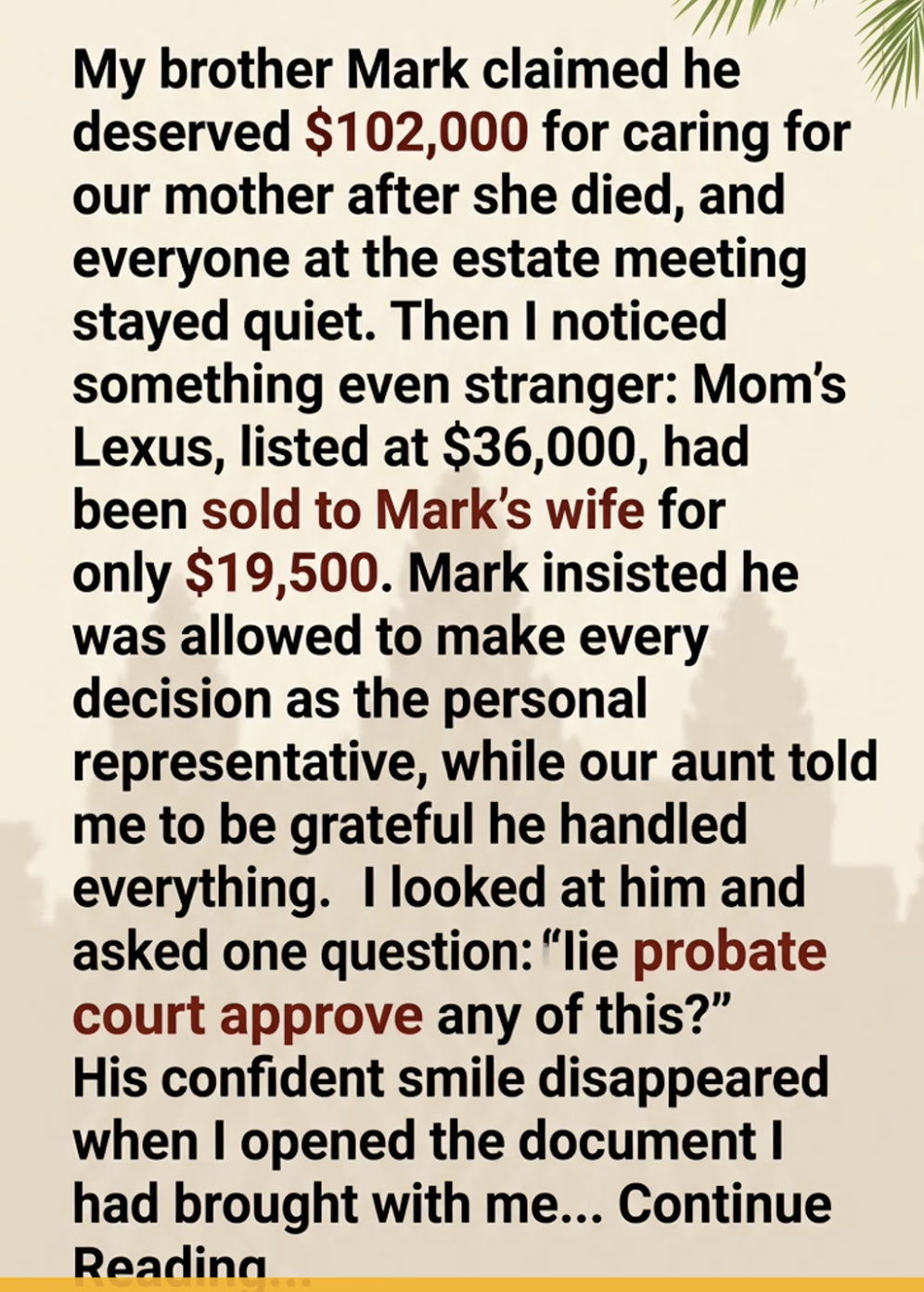
My brother Mark claimed he deserved $102,000 for caring for our mother after she died.
Nobody at the estate meeting said a word.
Not our aunt.
Not our cousins.
Not even the attorney sitting across the table.
Mark sat at the head of the conference table with a thick folder in front of him, looking completely comfortable.
He had been appointed personal representative of Mom’s estate.
According to him, that meant he could make almost every decision himself.
“I handled everything,” he said.
“The hospital bills. The funeral. The house. The accounts. The paperwork. I was the one who was there.”
I looked at him.
“I was there too.”
He smiled.
“Not like I was.”
That sentence bothered me.
Not because I wanted credit.
Because Mom had been my mother too.
After she died, I had spent weeks helping sort her belongings, calling insurance companies, notifying utilities, and going through boxes of photographs.
Mark had lived closest to her, so he’d handled more of the day-to-day care during her final months.
I had never denied that.
But $102,000?
That was different.
Then Mark slid another document across the table.
“And there’s the Lexus.”
I looked down.
Mom’s Lexus had been valued at $36,000.
Mark had sold it.
For $19,500.
To his wife.
I stared at the number.
“Your wife bought Mom’s car?”
“Yes.”
“For nineteen-five?”
“She got a family discount.”
I looked around the table.
Our aunt Margaret shrugged.
“She needed a vehicle.”
I looked back at Mark.
“Why wasn’t it sold at market value?”
“Because I handled the estate.”
“And that gives you the right to sell an estate asset to your own wife for nearly half its value?”
Mark leaned back.
“I’m the personal representative.”
He said it like it ended the conversation.
Our aunt nodded.
“Just be grateful Mark handled everything.”
I looked at her.
“I’m grateful he helped Mom.”
Then I looked at Mark.
“But I have a question.”
He smiled.
“Go ahead.”
“Did the probate court approve any of this?”
His smile disappeared.
For the first time that afternoon, he looked nervous.
I opened the folder I’d brought with me.
I had spent the previous week reviewing the probate file.
I wasn’t an attorney.
I wasn’t trying to become one.
I simply wanted to understand what Mark was claiming he had authority to do.
And I’d found something.
A court order.
I placed it on the table.
“Because according to this, you were required to obtain court approval before making certain transactions involving estate assets.”
Mark stared at the document.
“That’s not what it says.”
I turned it around.
“It is.”
He picked it up.
His hands were suddenly unsteady.
Our aunt leaned over.
“What does it say?”
Mark didn’t answer.
I did.
“It says the personal representative has a duty to act in the estate’s best interest and disclose transactions involving potential conflicts of interest.”
I pointed toward the Lexus paperwork.
“Your wife bought an estate asset for $19,500.”
Mark shook his head.
“That doesn’t prove anything.”
“No.”
I opened another page.
“But this does.”
It was the vehicle valuation.
The Lexus had been professionally valued at $36,000.
The sale price was $19,500.
Then I placed a third document on the table.
A copy of the title transfer.
The buyer was Mark’s wife.
The seller was Mark, acting as personal representative.
The room went silent.
Our aunt looked at Mark.
“Why didn’t you tell us?”
Mark rubbed his forehead.
“Because it wasn’t important.”
I looked at him.
“It was $16,500 below the valuation.”
“It needed repairs.”
“Then why did the valuation report say it was in good condition?”
He had no answer.
But the Lexus wasn’t the only problem.
I opened another folder.
“Let’s talk about the $102,000.”
Mark’s expression hardened.
“I earned that.”
“How?”
“I cared for Mom.”
“For how many hours?”
“I don’t know.”
“How many hours did you bill the estate?”
He looked away.
“That’s not the point.”
“It is exactly the point.”
I placed his invoice on the table.
He had billed the estate $85 an hour.
Eight hours a day.
Seven days a week.
For more than two years.
I stared at him.
“Mark, Mom was in assisted living for eleven months before she died.”
“I still handled her affairs.”
“You billed the estate for twenty-four-hour care during months when professional caregivers were already being paid.”
He became defensive.
“I visited her.”
“I know.”
“And I drove her to appointments.”
“I know.”
“I bought groceries.”
“I know.”
“Then I deserve to be compensated.”
“Possibly.”
I paused.
“But not for services you didn’t provide.”
The attorney finally spoke.
“Let’s slow down.”
Everyone looked at him.
He had been silent throughout most of the meeting.
He picked up Mark’s invoice.
“Mr. Mark, did you maintain contemporaneous records of the services you claim to have provided?”
Mark hesitated.
“No.”
“Time sheets?”
“No.”
“Receipts?”
“Some.”
“Care logs?”
“No.”
The attorney nodded.
“That presents a problem.”
Mark looked at me.
“You’ve been digging around behind my back.”
“No.”
I shook my head.
“I’ve been reading the documents you were supposed to provide.”
That silenced him.
Then the attorney asked,
“Was the $102,000 payment made?”
Mark didn’t answer.
I did.
“Not yet.”
The attorney looked relieved.
“Good.”
Our aunt looked confused.
“Why?”
“Because the estate should not distribute disputed compensation without proper review.”
Mark stood up.
“This is ridiculous.”
“No,” I said quietly.
“This is probate.”
He stared at me.
“You think I’m stealing from Mom?”
“I think the court should decide what you’re entitled to.”
That distinction mattered.
I wasn’t interested in accusing my brother of a crime.
I wanted the estate handled correctly.
Mom had left a will.
She had named both of us beneficiaries.
She had not named Mark as owner of everything.
She had appointed him to administer the estate.
Those were two very different things.
Mark had apparently forgotten that.
Or perhaps he had decided everyone else would forget.
The attorney requested a full accounting.
Bank statements.
Invoices.
Vehicle records.
Property records.
Receipts.
Emails.
Every transaction Mark had made on behalf of the estate.
Within three weeks, the numbers told a much larger story.
Mark had made several payments to companies connected to his wife.
Some were legitimate.
Some were questionable.
The Lexus sale was only the most obvious.
There was also $8,700 for “property maintenance.”
The company receiving the money belonged to Mark’s brother-in-law.
Another $4,200 was labeled “estate consulting.”
The consultant was Mark’s wife.
Then there was a $6,900 landscaping bill.
The landscaper was a friend of Mark’s.
Some services had actually been performed.
But several charges were significantly above comparable local estimates.
None had been properly disclosed as related-party transactions.
The attorney requested explanations.
Mark provided them.
Some made sense.
Others didn’t.
The $102,000 caregiving claim was eventually reduced dramatically after review.
He received reimbursement for documented expenses and a reasonable amount for certain services he could substantiate.
But the original $102,000 claim was rejected.
The Lexus transaction was worse.
The court required the vehicle transaction to be reconsidered.
Mark’s wife ultimately returned the Lexus to the estate.
It was sold through an independent process.
It brought significantly more than the original $19,500.
The difference went back into the estate.
Mark was removed as personal representative.
A neutral professional was appointed to complete the administration.
For months, our family barely spoke.
Mark blamed me.
Our aunt blamed me.
Even some cousins said I should have handled everything privately.
But I kept thinking about Mom.
She had spent her final years worrying about whether her children would stay close after she was gone.
She had once held my hand and said,
“Promise me you won’t let money turn you against each other.”
I had promised.
That’s why I didn’t fight Mark.
I fought the process.
There was a difference.
Eventually, the estate was settled.
Mom’s house was sold.
Her remaining accounts were distributed according to her will.
The final accounting showed exactly where every dollar went.
Mark received a legitimate share.
So did I.
Neither of us received everything.
That was the point.
Months later, Mark came to my house.
He stood on my porch holding a paper bag.
“I brought something.”
“What?”
He handed me a small wooden box.
I opened it.
Inside was one of Mom’s old photographs.
The three of us were children.
Mark was maybe eight.
I was six.
Our mother was sitting between us.
We were both missing front teeth.
I smiled.
“I thought you kept this.”
“I did.”
He looked down.
“Until I realized I was keeping the wrong things.”
I didn’t know what to say.
Then he sighed.
“I was angry.”
“At me?”
“At everything.”
He sat down.
“Mom was dying. I was there every day. I thought that meant I deserved more.”
I listened.
“And when she died, I was terrified.”
“Of what?”
“Of being left with nothing after spending years taking care of everything.”
I nodded slowly.
“That doesn’t make what you did okay.”
“I know.”
He looked at me.
“I know now.”
We didn’t hug.
Not immediately.
There were still wounds.
But we talked for two hours.
For the first time since Mom died, we talked about her instead of her estate.
We remembered her terrible cooking.
Her habit of hiding birthday presents so well that she sometimes forgot where she put them.
The way she sang while vacuuming.
The way she called both of us by the wrong name when she was angry.
We laughed.
And for a few hours, we were just her children again.
Before Mark left, he said,
“I should have asked you for help.”
I nodded.
“Yes.”
“And you should have asked me how I was doing.”
I looked at him.
“Yes.”
We both knew there were things we had done wrong.
But neither of us could change them.
What we could change was what happened next.
I kept the photograph.
Mark kept the memories.
And the estate was finally settled without anyone quietly taking more than they were entitled to.
Looking back, I realize the most important document I brought to that meeting wasn’t the court order.
It was the willingness to ask one simple question:
Who actually has the authority to make this decision?
Because grief can make families vulnerable.
Money can make them suspicious.
And authority can be misunderstood.
But when someone is managing another person’s estate, trust isn’t a substitute for accountability.
Mom deserved better than a family argument over her belongings.
She deserved for us to honor the rules she left behind.
And in the end, that’s what we did.
Not perfectly.
Not without damage.
But honestly.
Sometimes protecting an inheritance isn’t about getting more.
Sometimes it’s about making sure nobody takes what was never theirs to take.