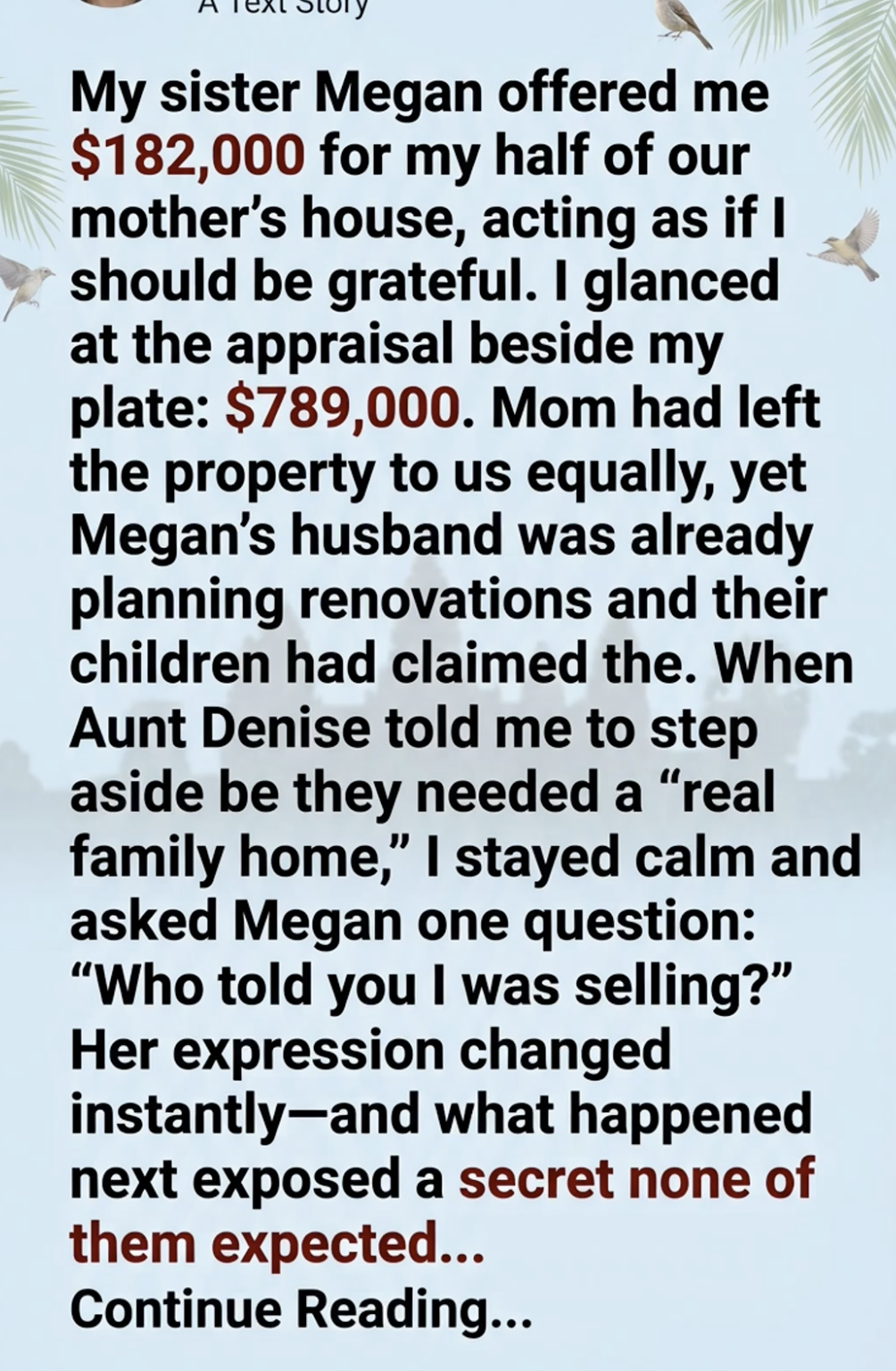
My sister Megan offered me $182,000 for my half of our mother’s house.
She said it as casually as if she were doing me a favor.
“You should take it.”
I looked across the dining table.
“What?”
“$182,000. For your half.”
She pushed a folder toward me.
“It’s a fair offer.”
I opened it.
Inside was a single-page agreement.
I barely looked at it.
Then my eyes moved to the appraisal sitting beside my plate.
$789,000.
I looked back at Megan.
“Fair?”
She shrugged.
“You don’t live here anymore.”
“That doesn’t change what it’s worth.”
Her husband, Colin, leaned back in his chair.
“We’re not trying to cheat you.”
“I didn’t say you were.”
“You need to be realistic.”
I looked around the room.
My mother’s dining room.
Her curtains.
Her china cabinet.
The clock she’d owned for forty years.
Even the scratches on the hardwood floor were familiar.
Mom had left the house to Megan and me equally.
Fifty percent each.
There was no ambiguity.
No special condition.
No clause giving Megan first choice.
Just two daughters inheriting the same property.
But apparently, Megan had already made plans.
Colin had hired a contractor.
Their children had already chosen bedrooms.
One of them had even taped a piece of paper to the upstairs door.
MIA’S ROOM.
I looked at it for several seconds.
Then Aunt Denise spoke.
“You have to understand, sweetheart. They need stability.”
I turned toward her.
“Who does?”
“Megan’s family.”
I almost laughed.
“I’m family too.”
“Of course you are.”
She smiled.
“But you have your own place.”
“So?”
“Megan has children.”
“I know.”
“They need a real family home.”
I looked at the appraisal again.
$789,000.
My mother had spent her entire life paying for that house.
She had raised both of us there.
She had cooked Thanksgiving dinners in that kitchen.
She had sat at the upstairs window waiting for us to come home.
And now my sister’s family had apparently decided that her house belonged to them.
I closed the folder.
“No.”
Megan blinked.
“No?”
“No.”
“You haven’t even considered it.”
“I have.”
“For five seconds.”
“That’s enough.”
Colin leaned forward.
“You’re making a mistake.”
“Maybe.”
“You could take the money and walk away.”
“I could.”
“So why won’t you?”
I looked directly at Megan.
“Because nobody asked me if I wanted to sell.”
Her expression changed.
Just slightly.
But I saw it.
She knew something.
I leaned back.
Then I asked the question that stopped the entire table.
“Who told you I was selling?”
Megan went completely still.
Colin looked at her.
Aunt Denise frowned.
“What does that mean?”
Megan finally said,
“Nobody.”
“Then why did you prepare a purchase agreement?”
She didn’t answer.
“Why did Colin hire a contractor?”
Silence.
“And why are your children already choosing bedrooms?”
Colin sighed.
“We assumed.”
“No.”
I shook my head.
“You didn’t assume.”
I opened my purse.
“I think you knew something I didn’t.”
I placed a document on the table.
Megan looked at it.
Then her face went pale.
It was a copy of Mom’s original estate plan.
Not the will everyone had seen.
A separate document.
A letter Mom had left with her attorney.
I had received a copy that morning.
The letter began:
I know my daughters may disagree about what happens to this house after I’m gone.
I looked at Megan.
“She knew.”
Megan swallowed.
“She knew we’d fight?”
“She knew you might try to take control.”
Colin reached for the document.
I pulled it away.
“Don’t.”
He stopped.
Mom’s letter continued.
If one daughter wants to buy the other out, the price must be based on an independent appraisal. Neither daughter may pressure the other into accepting less.
I looked at the $182,000 offer.
Then at Megan.
“You weren’t offering me half.”
“You were offering me less than half.”
Megan shook her head.
“That wasn’t intentional.”
“The appraisal is $789,000.”
“Yes.”
“My half is $394,500.”
She said nothing.
“You offered me $182,000.”
“I thought you’d accept.”
“Why?”
She looked down.
Then Colin answered.
“Because we knew you didn’t want the house.”
I frowned.
“How?”
Megan finally spoke.
“Because Mom told me.”
“What did she tell you?”
“That you wanted to sell.”
I stared at her.
“Mom never told me that.”
“She said you were tired of the house.”
“I was tired of seeing her suffer.”
“That isn’t the same thing.”
Megan’s eyes filled with tears.
“She told me you didn’t want to deal with it.”
“When?”
“Three months before she died.”
I sat back.
Something didn’t make sense.
Mom had been sick.
But she had been mentally sharp.
She had never once told me she wanted me to sell.
Then I remembered something.
Two weeks before she died, Mom had asked me to meet her alone.
She had held my hand.
“Promise me something.”
“What?”
“Don’t let anyone rush you after I’m gone.”
At the time, I thought she was talking about grief.
Now I understood.
She had known exactly what might happen.
I pulled another document from my purse.
“This came from the attorney too.”
Megan looked at it.
It was a handwritten note.
Mom’s handwriting.
The date was three weeks before she died.
If Megan tells you I wanted her to have the house, don’t believe her.
Megan’s face went white.
Aunt Denise whispered,
“What?”
I continued reading.
I love both my daughters equally. But I know Megan is already making plans for this property.
She has asked me twice to sign documents I refused to sign.
She says it is for convenience.
It is not.
Colin suddenly stood.
“That doesn’t prove anything.”
I looked at him.
“You’re right.”
Then I placed the final document on the table.
“It proves something else.”
It was a copy of an email.
Megan had sent it to Mom’s attorney two months before Mom died.
The subject line was:
House Transfer
In the email, Megan asked whether Mom could transfer the property to her before death so that it would “remain in the immediate family.”
The attorney had responded:
No. Your mother has stated clearly that she intends to divide the property equally between you and your sister.
The room went silent.
I looked at Megan.
“You knew Mom was leaving it to both of us.”
She began crying.
“I knew.”
“You knew the appraisal.”
“Yes.”
“You knew I had equal ownership.”
“Yes.”
“And you still offered me $182,000.”
“I was desperate.”
“For what?”
She covered her face.
Colin answered.
“We were about to lose our house.”
I stared at him.
“What?”
They had taken out multiple loans.
Their mortgage was behind.
Colin’s construction business had collapsed.
They had significant credit-card debt.
And they had already planned to move into Mom’s house.
They weren’t just trying to buy my share cheaply.
They needed the property.
If they controlled the house, they could sell it, refinance it, or use it as collateral.
Suddenly the renovations made sense.
The bedrooms made sense.
The pressure made sense.
The fake “family home” argument made sense.
It wasn’t about giving the children stability.
It was about solving their financial crisis with an asset that wasn’t theirs.
I looked at Aunt Denise.
“You knew about this?”
She shook her head.
“I knew they were struggling.”
“Did you know about the offer?”
“Yes.”
“Did you know the appraisal was $789,000?”
She looked down.
“Yes.”
“And you still told me to step aside.”
Aunt Denise began crying.
“I thought you would be okay.”
I nodded slowly.
“That was the problem.”
Everyone kept deciding what I would be okay with.
Nobody asked.
Megan finally looked at me.
“I made a terrible mistake.”
“Yes.”
“I was scared.”
“I know.”
“I thought if I got the house, I could save my family.”
I believed her.
That didn’t make it acceptable.
“You should have asked me for help.”
“I was ashamed.”
“You should have told me the truth.”
“I was afraid you’d say no.”
I looked at her.
“I might have.”
She nodded.
“I know.”
That was the saddest part.
She knew I might have helped.
She simply didn’t trust me enough to ask.
The probate attorney became involved immediately.
The proposed sale was rejected.
The court required the estate to be handled according to Mom’s will and the applicable probate rules.
The house remained jointly owned.
Megan couldn’t sell my share.
She couldn’t mortgage my interest.
She couldn’t renovate the property without my agreement.
And she couldn’t simply move her family into a house she didn’t solely own.
We eventually agreed to have another independent appraisal.
It came back at $801,000.
Megan couldn’t afford to buy my half.
I couldn’t afford to buy hers.
So we sold the house.
It was painful.
More painful than I expected.
The day we emptied it, I found myself standing in Mom’s bedroom.
Her perfume bottle was still on the dresser.
A sweater hung behind the door.
I picked it up.
For a moment, I could almost imagine her walking back into the room.
Megan stood in the doorway.
“I don’t want to sell it.”
“Neither do I.”
She wiped her eyes.
“But we can’t keep fighting over it.”
“No.”
She nodded.
“I wish I had handled everything differently.”
I looked at her.
“So do I.”
The house sold for $812,000.
After expenses and closing costs, the proceeds were divided according to our ownership interests.
Megan received her half.
I received mine.
It wasn’t a fortune after everything was settled.
But it was fair.
And more importantly, it was Mom’s decision.
Megan used her share to resolve part of her family’s debt.
She and Colin downsized.
It wasn’t easy.
But eventually they stabilized.
A few months later, Megan came to my apartment.
She brought a small box.
Inside was Mom’s old recipe book.
“I found this in the attic.”
I smiled.
“I thought you had it.”
“I did.”
She handed it to me.
“Then I realized Mom probably meant for us to share things.”
I laughed.
“That would have been nice to remember before the house.”
She smiled sadly.
“I deserved that.”
We sat together.
For the first time in months, we didn’t talk about property.
We talked about Mom.
About her recipes.
Her garden.
The way she always bought too many Christmas presents.
The way she would pretend not to hear us arguing when we were children.
Eventually, Megan said,
“Do you know what Mom told me the last time I saw her?”
“What?”
“She said, ‘A house isn’t a family.’”
I looked at her.
“She told me the same thing.”
Megan’s eyes filled with tears.
“Then she said, ‘If my daughters have to fight over my walls, I’ve left them nothing worth keeping.’”
I looked down at the recipe book.
For months, I had thought the battle was about money.
It wasn’t.
It was about trust.
My sister had believed she could decide my future for me because she thought I would eventually give in.
I had believed my sister knew that I loved her enough to help if she simply asked.
We were both wrong.
But Mom had been right.
A house isn’t a family.
A deed isn’t love.
And an inheritance isn’t permission to take more than someone left you.
I never got the house.
Neither did Megan.
But I got something I value more.
I got my mother’s recipe book.
I got the truth.
And, eventually, I got my sister back.
Not the sister who assumed I’d surrender.
Not the sister who thought family meant entitlement.
Just my sister.
The woman who finally learned to ask instead of take.
And I learned something too.
When someone tells you to “be grateful” for an offer on something you already own, don’t let their confidence make you question the facts.
Look at the documents.
Look at the numbers.
And ask the simplest question of all:
“Who told you I agreed?”
Because sometimes the most important boundary you can set isn’t saying no.
It’s refusing to let someone else decide that you’ve already said yes.