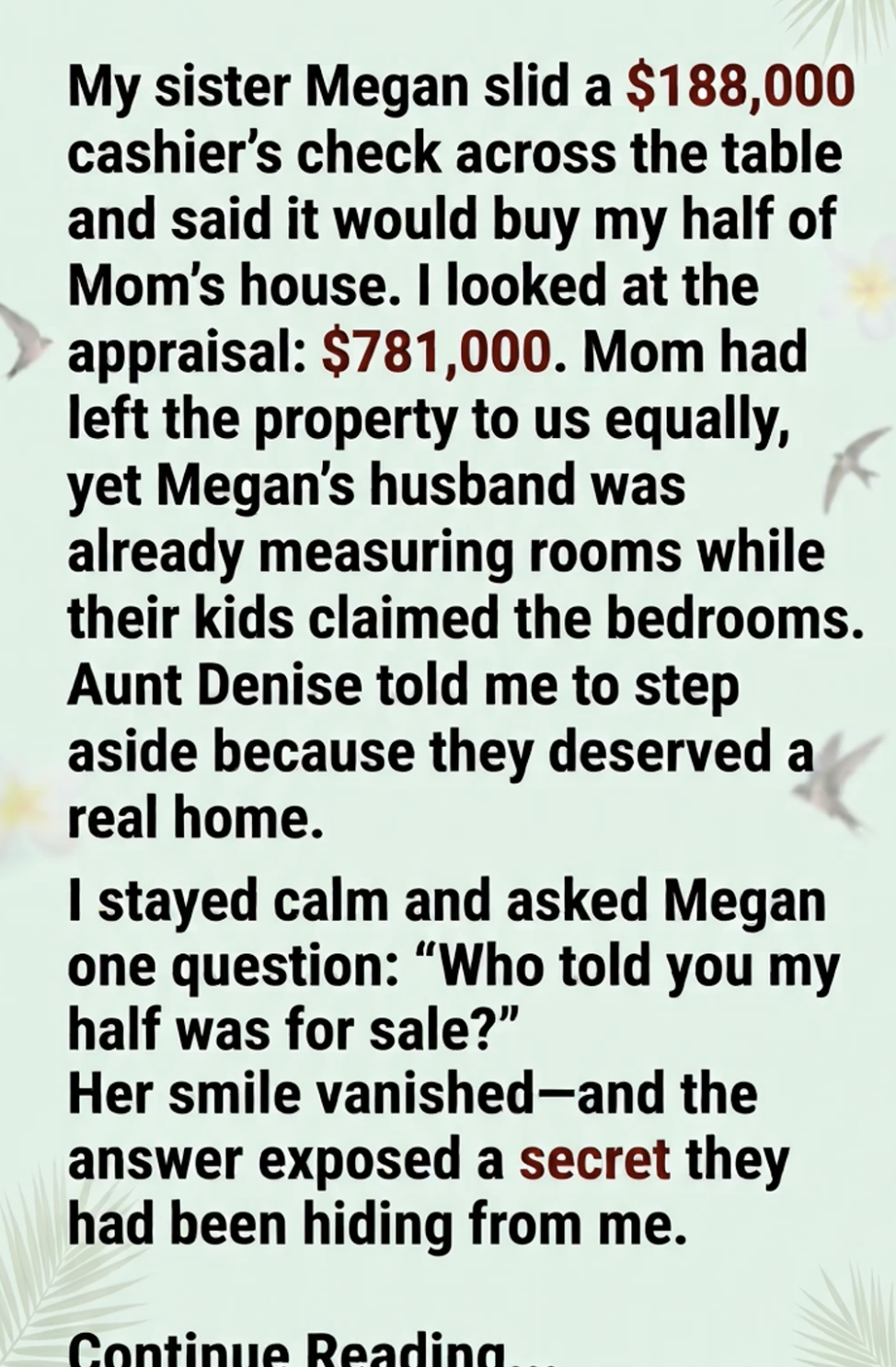
My sister Megan slid the cashier’s check across the kitchen table as if she were handing me a restaurant bill.
“$188,000,” she said. “That should be more than fair for your half.”
I looked down at the check.
Then I looked at her.
Then at the appraisal sitting beside my coffee.
$781,000.
I picked up the appraisal and tapped the number with my finger.
“Megan, this house is worth $781,000.”
She shrugged.
“We’re offering you $188,000 for your half.”
“Your math is wrong.”
“No, it isn’t.”
“It absolutely is.”
She leaned back.
“You’re forgetting everything that comes with the house.”
“What comes with it?”
“Taxes. Repairs. Insurance. The mortgage.”
I stared at her.
“Mom didn’t have a mortgage.”
Megan’s husband, Trevor, suddenly stopped measuring the wall behind her.
That was when I noticed what was happening.
He had a tape measure in his hand.
There were cardboard boxes stacked along the hallway.
Their children’s shoes were beside the front door.
Someone had already put a pink name tag on the smallest bedroom.
“Megan,” I said slowly, “why are your things in Mom’s house?”
She smiled.
“Because we’re moving in.”
I almost laughed.
“You’re moving in?”
“Eventually.”
“You can’t just move in.”
She sighed as though I were being difficult.
“It’s our family home.”
“No.”
“It belongs to both of us.”
“Yes.”
“And we’re willing to buy your half.”
I looked again at the check.
“Who calculated $188,000?”
“Our lawyer.”
“What lawyer?”
She hesitated.
“Trevor’s.”
I looked at Trevor.
He suddenly became very interested in the tape measure.
My mother had died four months earlier.
Her will was simple.
The house went equally to Megan and me.
Fifty percent to her.
Fifty percent to me.
No special conditions.
No right of first refusal.
No provision saying Megan could purchase my share at whatever price she chose.
Nothing.
We had both signed the estate documents.
We had both received copies.
And yet somehow, four months later, Megan was standing in Mom’s kitchen offering me less than half the property’s appraised value while her husband measured rooms.
Aunt Denise was sitting at the table too.
She had come with Megan.
She gave me a disappointed look.
“Your sister has children.”
I said nothing.
“She needs stability.”
I nodded.
“That’s wonderful.”
Denise frowned.
“You don’t understand.”
“I understand perfectly.”
“You live alone.”
“That doesn’t make my inheritance less valuable.”
Megan interrupted.
“We’re not trying to steal anything.”
I looked at the check.
“Then why does this feel like you’re trying to buy something before I realize what it’s worth?”
Nobody answered.
I picked up the check.
Then placed it back on the table.
“No.”
Megan’s face hardened.
“You’re seriously going to make us fight over Mom’s house?”
“No.”
“Then what?”
“I want the property sold at fair market value.”
Her husband finally spoke.
“That would be ridiculous.”
I looked at him.
“Why?”
“Because we have plans.”
“For my property?”
“Our property.”
“Half of it is mine.”
He said nothing.
Aunt Denise sighed.
“Sometimes family means giving up something.”
I looked at her.
“Giving up what?”
She didn’t answer.
“My half of a $781,000 house?”
“You don’t need the house.”
“That isn’t the point.”
“Then what is?”
I looked at Megan.
“The point is that nobody asked me whether I wanted to sell.”
Megan crossed her arms.
“We assumed you’d understand.”
“Understand what?”
“That this is what Mom wanted.”
That stopped me.
“What did Mom want?”
Megan looked away.
“She wanted the kids to have a home.”
I stared at her.
“My mother never told me that.”
“She told me.”
“When?”
“Before she died.”
“Exactly what did she say?”
Megan’s eyes flickered.
“She said she wanted me to keep the house.”
“Keep the house?”
“Yes.”
“But she left it to both of us.”
“She changed her mind later.”
“Then where is the updated will?”
Silence.
I looked from Megan to Trevor.
Then to Aunt Denise.
Nobody spoke.
I felt something cold settle in my stomach.
“Show me the new will.”
Megan swallowed.
“There isn’t a new will.”
“Then Mom didn’t change her mind.”
“You don’t know that.”
“I know what the legal documents say.”
Trevor stepped forward.
“You’re making this unnecessarily complicated.”
I turned toward him.
“Why are you measuring the rooms?”
He lowered the tape measure.
“Because we’re trying to figure out how to make the house work for our family.”
“You mean after you buy my half for $188,000?”
He didn’t answer.
I stood.
“I’m leaving.”
Megan looked furious.
“You can’t just walk away.”
“Watch me.”
I grabbed my purse.
As I reached the front door, Aunt Denise called after me.
“Your mother would be ashamed of you.”
I stopped.
Then turned around.
“My mother spent her last year telling me to protect myself.”
Aunt Denise blinked.
“What?”
I walked out.
The next morning, I called an estate attorney.
Her name was Laura Bennett.
I brought her the will, the appraisal, the cashier’s check, and every email Megan had sent me.
Laura read everything carefully.
Then she looked up.
“Has your sister provided you with any documentation showing she has a right to purchase your interest at this amount?”
“No.”
“Has she filed anything with the probate court?”
“Not that I know of.”
“Has she claimed you agreed to sell?”
“No.”
Laura leaned back.
“Then don’t sign anything.”
“I wasn’t planning to.”
“Good.”
She paused.
“There’s something else.”
“What?”
“The $188,000 amount is strangely specific.”
“I thought so too.”
Laura pulled out her calculator.
“Half of the appraisal would be $390,500.”
“I know.”
“So $188,000 isn’t simply an arbitrary lowball.”
“What do you mean?”
“It may correspond to another valuation.”
“Another valuation?”
She nodded.
“Possibly a previous appraisal, an estate tax value, an insurance value, or a valuation based on an alleged debt.”
I stared at her.
“Mom didn’t owe anyone that kind of money.”
Laura looked at the documents.
“Then we need to find out where this number came from.”
Two days later, Laura contacted the estate attorney who had handled my mother’s probate.
His response surprised us.
He had never authorized a $188,000 valuation.
He had never advised Megan to buy my share.
And there was no document showing Mom had promised the house to Megan.
Then Laura discovered something else.
Three weeks before Mom died, someone had submitted a request for a property valuation to a local lender.
The applicant was Trevor.
The estimated property value on the application?
$376,000.
Exactly half of $752,000.
But that still didn’t explain everything.
So Laura dug deeper.
The lender had rejected Trevor’s application.
Why?
Because the property was owned by my mother and wasn’t collateral he could legally pledge without her consent.
That should have been the end of it.
Except Trevor had apparently tried again after Mom’s death.
This time, he claimed that Megan had the authority to negotiate the entire property.
She didn’t.
And somehow, the $188,000 offer to me matched a figure derived from a debt arrangement involving Trevor’s failing construction company.
He wasn’t trying to give me half the home’s value.
He was trying to use the house to solve his company’s financial problems.
I felt sick.
I called Megan.
“Did Trevor use Mom’s house as part of a business loan?”
Silence.
“Megan?”
She finally said:
“It wasn’t like that.”
“What was it like?”
“We were trying to refinance.”
“With a house you don’t own?”
“Mom said she’d help.”
“Mom was dying.”
“She wanted to help us.”
“Then why didn’t she leave the house to you?”
Megan began crying.
“I don’t know.”
I closed my eyes.
“Does Trevor owe money?”
She didn’t answer.
That was answer enough.
Laura later discovered that Trevor’s company had accumulated significant debt.
He had been trying to secure financing by presenting the family property as though Megan’s future ownership gave him control over it.
When Mom died, he realized the house could potentially solve the problem.
But there was one obstacle.
Me.
My half.
So they had created a story.
Megan needed the house.
The children needed stability.
I didn’t need it.
$188,000 was “fair.”
And if I accepted quickly, the problem disappeared.
Except it didn’t.
Because I refused.
The next week, we went back to the house with the estate attorney.
Megan was there.
Trevor was there.
Aunt Denise was there too.
Laura placed a folder on the table.
“I want everyone to understand something,” she said.
“The property is owned equally by Megan and my client. Neither party can unilaterally sell, mortgage, transfer, or encumber the other’s interest.”
Trevor shifted in his chair.
Laura continued.
“The $188,000 offer does not represent fair market value. It appears to be based on figures connected to Mr. Carter’s financing attempts.”
Megan looked at her husband.
“What did you do?”
Trevor stood.
“This is ridiculous.”
“No,” Laura said calmly. “What’s ridiculous is presenting a personal debt problem as a family inheritance issue.”
Aunt Denise looked horrified.
“You used the house?”
Trevor didn’t answer.
Megan started crying.
“You told me it was worth $376,000.”
“I was trying to help us.”
“You told me Mom wanted us to have it.”
“I said we’d keep the family together.”
Megan turned toward me.
“I didn’t know.”
I believed her.
At least partly.
She had allowed herself to believe what she wanted to believe because it benefited her family.
But she had still tried to pressure me into surrendering hundreds of thousands of dollars.
I couldn’t ignore that.
Laura gave us two options.
Sell the house and divide the proceeds according to ownership.
Or one sister could buy the other’s share at a properly supported fair-market valuation.
Megan couldn’t afford to buy me out.
And Trevor’s company couldn’t use the property as collateral without a completely separate legal agreement.
Eventually, the house was sold.
The final sale price was $768,000.
After legitimate closing costs and estate expenses, the proceeds were divided according to our ownership interests.
My share was several times larger than the check Megan had offered me.
Megan and her family rented a house nearby.
Trevor’s business went through restructuring.
Aunt Denise stopped speaking about what my mother “would have wanted.”
Because now she knew exactly what Mom had wanted.
She had wanted her daughters treated equally.
That was what the will said.
Months later, Megan came to my apartment.
She looked exhausted.
“I owe you an apology.”
I let her sit.
“I believed Trevor,” she said.
“I know.”
“I thought you would just take the money because you didn’t want conflict.”
“That was the plan.”
She nodded.
“Yes.”
She looked down.
“I became so focused on giving my children a stable home that I stopped seeing you as my sister.”
I didn’t know what to say.
Finally, I said:
“You weren’t asking me to help your children. You were asking me to surrender my inheritance.”
“I know.”
“And those aren’t the same thing.”
She nodded.
“I know that now.”
We didn’t hug.
Not immediately.
Some things don’t disappear because someone says sorry.
But we started talking again.
Slowly.
Carefully.
And a year later, we were sitting together at a café when Megan smiled and said:
“Do you remember the question you asked me?”
“Which one?”
“Who told you your half was for sale?”
I smiled.
“Yes.”
She laughed softly.
“Trevor told me you’d never ask.”
I raised an eyebrow.
“Ask what?”
She looked at me.
“Ask who gave us permission.”
That sentence stayed with me.
Because sometimes the most important thing you can do when someone hands you a deal that seems unfair isn’t to argue about the number.
It’s to ask one simple question.
Who told you I agreed?
My mother left me half of her house.
Not because she wanted me to fight my sister.
Not because she wanted me to become wealthy.
She left it to me because she believed I had the right to decide what happened to my share.
And the day Megan slid that $188,000 check across the table, she thought she was offering me a way out.
She didn’t realize I wasn’t trapped.
I was simply the only person at the table who hadn’t agreed to the deal.