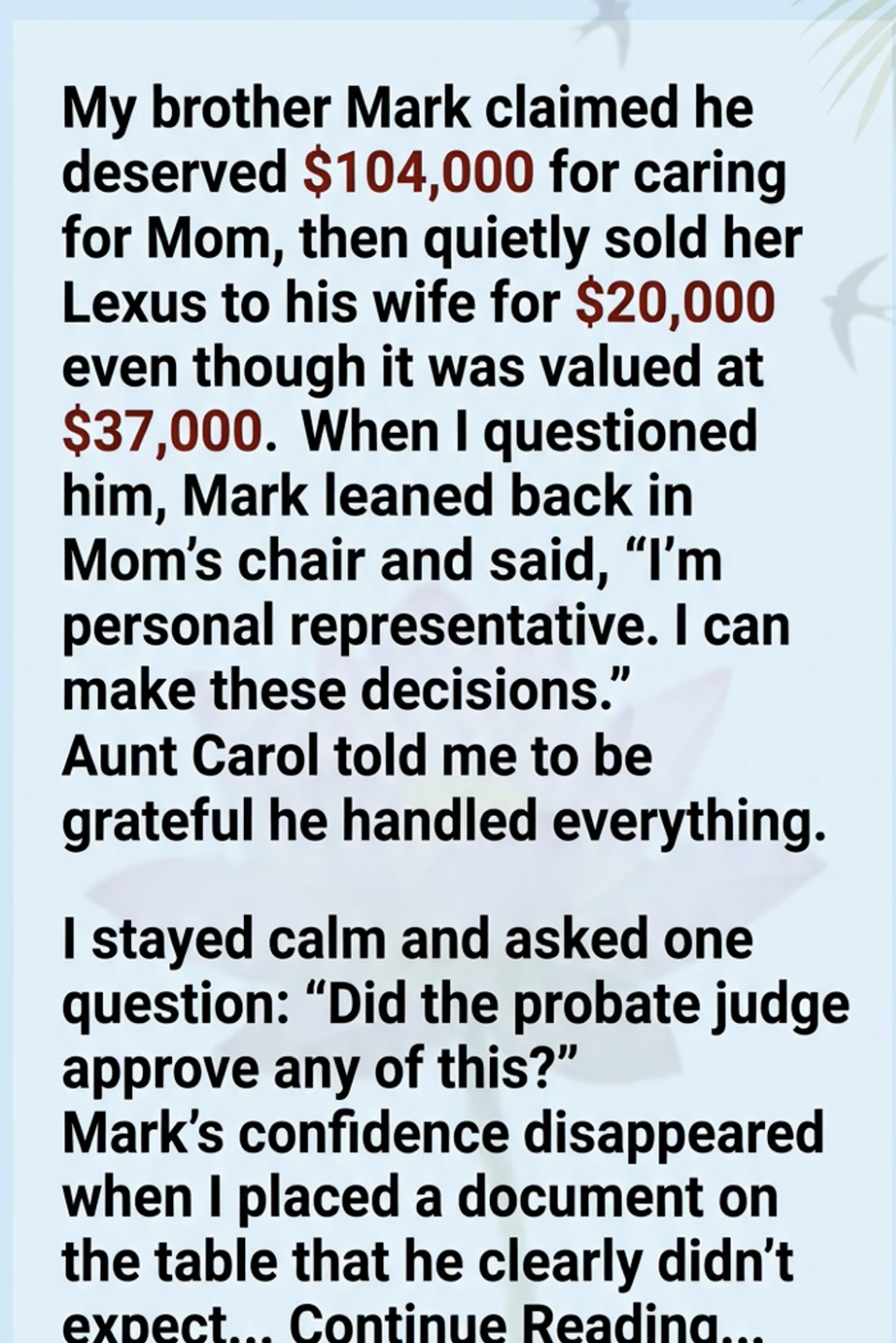
My brother Mark claimed he deserved $104,000 for taking care of our mother during the last two years of her life.
He said it like the number was obvious.
Like everyone should simply nod and thank him.
“She needed someone there,” he told us at the first family meeting after the funeral. “I was the one who did it.”
I didn’t argue.
I knew Mom had needed help.
I also knew Mark had been the one living closest to her.
But something about the number bothered me.
Not because I thought he hadn’t worked hard.
Because nobody could explain how he had calculated it.
Then I found out about the Lexus.
Mom’s 2019 Lexus was worth approximately $37,000.
Mark had sold it to his wife, Jenna, for $20,000.
The sale had happened less than three weeks after Mom died.
When I asked him about it, he leaned back in Mom’s favorite chair.
“I’m the personal representative,” he said. “I can make these decisions.”
Aunt Carol nodded beside him.
“You should be grateful, honestly. Mark handled everything.”
I looked at my brother.
Then at the empty place where Mom used to sit.
And I asked one question.
“Did the probate judge approve any of this?”
Mark stopped smiling.
“What?”
“The $104,000.”
Silence.
“The Lexus.”
More silence.
“Did the probate court approve either transaction?”
Mark sat forward.
“I don’t need permission for every little thing.”
“Maybe not.”
I reached into my folder.
“But I brought something.”
I placed the document on the table.
Mark stared at it.
His face went completely pale.
It was a copy of the probate court’s order.
And it said something he clearly hadn’t expected me to know.
Mom’s estate was still under court supervision.
And Mark had never received authorization to pay himself $104,000.
Nor had he received authorization to sell the Lexus to his own wife for $20,000.
Aunt Carol leaned closer.
“What does that mean?”
I looked at Mark.
“It means being the personal representative doesn’t mean you own Mom’s estate.”
Mark’s jaw tightened.
“You went behind my back.”
“No.”
“I told everyone I was handling this.”
“You were supposed to handle it for the estate.”
“I did.”
“Then the records should prove it.”
He stood.
“This is family.”
I looked at him.
“That’s exactly why I wanted everything documented.”
Mom had always hated fighting.
She used to say that money could turn siblings into strangers faster than almost anything.
She was right.
The first warning sign came six months before she died.
Mom’s health had declined, and Mark moved into her house.
At first, I was relieved.
I lived several hours away and couldn’t be there every day.
Mark told me:
“Don’t worry. I’ve got her.”
And he did help.
He drove her to appointments.
He picked up prescriptions.
He cooked meals.
He handled repairs.
I never denied that.
But after Mom died, Mark began talking about compensation.
“I basically gave up my life for her.”
I asked:
“What does that mean?”
“I couldn’t work full-time.”
“How much did you lose?”
He wouldn’t give me a number.
Instead, he announced that the estate owed him $104,000.
When I asked for records, he became defensive.
“You weren’t here.”
“I know.”
“So you don’t get to question what I did.”
“I get to question the estate’s expenses.”
He didn’t like that answer.
Then there was the Lexus.
Mom had loved that car.
She bought it after retiring.
She kept the service records in a little blue folder.
When I asked Mark why Jenna had bought it for $20,000, he said:
“That’s what it was worth.”
I had a professional appraisal showing approximately $37,000.
He laughed.
“Appraisals don’t mean anything if you don’t have a buyer.”
“Did you advertise it?”
“No.”
“Get multiple offers?”
“No.”
“Have an independent dealer evaluate it?”
“No.”
“Then how did you decide $20,000?”
He shrugged.
“I knew what it was worth.”
I didn’t argue.
I started researching.
The probate file was public.
That’s how I found the court order.
The judge had required Mark to provide a complete inventory of Mom’s assets and obtain authorization before certain related-party transactions.
The Lexus sale was a related-party transaction because it was sold to his wife.
And Mark had never disclosed the sale properly.
The $104,000 claim was even worse.
There were no signed caregiving agreements.
No timesheets.
No invoices.
No contemporaneous records showing Mom had agreed to pay him.
There were bank withdrawals.
Receipts.
Grocery purchases.
Some legitimate household expenses.
But there was nothing supporting a $104,000 personal claim.
So I hired an estate attorney.
Her name was Rachel Morgan.
She reviewed everything quietly.
Then she said:
“Don’t accuse him of theft.”
“I’m not.”
“Good. Let the documents speak.”
“What happens now?”
“We ask the probate court to review the transactions.”
I nodded.
“And if Mark objects?”
“He’ll have an opportunity to explain them.”
That was exactly what happened.
A hearing was scheduled.
Mark arrived with Jenna.
Aunt Carol came too.
She sat behind him.
I sat beside my attorney.
The judge asked Mark about the caregiving claim.
Mark explained how much time he’d spent with Mom.
The judge listened.
Then asked:
“Do you have an agreement showing your mother agreed to compensate you at this rate?”
Mark shuffled through his papers.
“No written agreement.”
“Any contemporaneous accounting?”
“No.”
“Tax records reflecting compensation?”
“No.”
“Then how did you arrive at $104,000?”
Mark looked toward me.
“She knows what I did.”
The judge looked at me.
I said:
“I don’t dispute that he cared for Mom. I’m asking whether the estate can be charged $104,000 without documentation or court approval.”
The judge nodded.
Then turned back to Mark.
“What about the vehicle?”
Mark’s attorney tried to explain that the Lexus was sold at a reasonable price.
The judge asked for the valuation.
Mark produced a document.
It showed the vehicle had been valued at approximately $37,000.
The judge looked at him.
“And you sold it to your wife for $20,000?”
“Yes.”
“Was the vehicle offered publicly?”
“No.”
“Were independent offers obtained?”
“No.”
“Was the court notified before the transaction?”
Mark hesitated.
“No.”
The judge leaned back.
That was the moment I saw Mark’s confidence disappear completely.
The court ordered an independent review of the estate.
The Lexus transaction was scrutinized.
An independent dealer later valued the car at $36,500.
The court determined that the estate had not received fair value from the related-party sale.
Jenna ultimately had to return the vehicle to the estate, or pay the estate the difference required under the court’s order.
As for Mark’s $104,000 claim, the court rejected the unsupported amount.
However, it did recognize certain documented expenses Mark had personally paid on Mom’s behalf.
He received reimbursement for legitimate, documented costs.
Not $104,000.
Not even close.
The difference was enormous.
But the most important thing wasn’t the money.
It was the principle.
Mark had mistaken authority for ownership.
Being a personal representative meant he had responsibilities.
It didn’t mean Mom’s estate belonged to him.
After the hearing, Aunt Carol approached me.
“I owe you an apology.”
I looked at her.
“For what?”
“I told you to be grateful.”
“You didn’t know what was happening.”
“No.”
She sighed.
“I believed Mark because he was the one here.”
I understood.
Because that was exactly what made the situation difficult.
Being present doesn’t automatically make someone dishonest.
And being absent doesn’t automatically make someone uncaring.
But neither one eliminates the need for accountability.
Mark eventually stepped down as personal representative.
A neutral professional was appointed to finish the estate.
When everything was finally settled, my brother asked if we could talk.
We sat outside Mom’s house.
He looked older than he had a few months earlier.
“I really did take care of her,” he said.
“I know.”
“I thought that should count for something.”
“It should.”
He looked at me.
“Then why did you fight me?”
“I didn’t fight you.”
He frowned.
“I fought the number.”
He looked down.
“I was angry.”
“At me?”
“At everything.”
He rubbed his hands together.
“I lost time with Mom. I lost work. I was exhausted. And after she died, I felt like nobody understood what I’d sacrificed.”
I nodded.
“I believe you.”
“Then why didn’t you just give me the money?”
“Because Mom’s money wasn’t ours to divide based on feelings.”
He didn’t answer.
After a while, he said:
“I should have asked for help.”
“Yes.”
“I shouldn’t have sold the Lexus to Jenna.”
“No.”
“I thought because I was handling everything, I could make the decisions.”
I looked at him.
“That was the problem.”
He nodded.
“I know.”
We didn’t suddenly become close again.
But we started speaking.
Slowly.
Carefully.
The family stopped treating Mom’s estate like something that could be settled around a kitchen table.
Everything was documented.
Every expense.
Every reimbursement.
Every transfer.
Every decision.
And eventually, the house was sold according to Mom’s instructions.
On the last day, I walked through the rooms one more time.
Mom’s chair was gone.
The kitchen table was empty.
The blue folder containing the Lexus records was in my hands.
I remembered her warning about money turning siblings into strangers.
But I also remembered something else she used to say.
“Trust isn’t about believing someone will never make a mistake. It’s about believing they’ll tell the truth when they do.”
I don’t know whether Mark ever fully understood how close he came to destroying our relationship forever.
Maybe he did.
Maybe he didn’t.
But I learned something that day.
When someone says, “I’m in charge,” don’t automatically assume they mean, “I have authority to do whatever I want.”
Ask what the documents say.
Ask who approved it.
Ask where the money went.
And sometimes, the most powerful question in the room is only seven words:
“Did the probate judge approve any of this?”
When I asked it, Mark thought I was challenging him.
I wasn’t.
I was protecting Mom’s final wishes.
And once the document was on the table, nobody could argue with what it said.