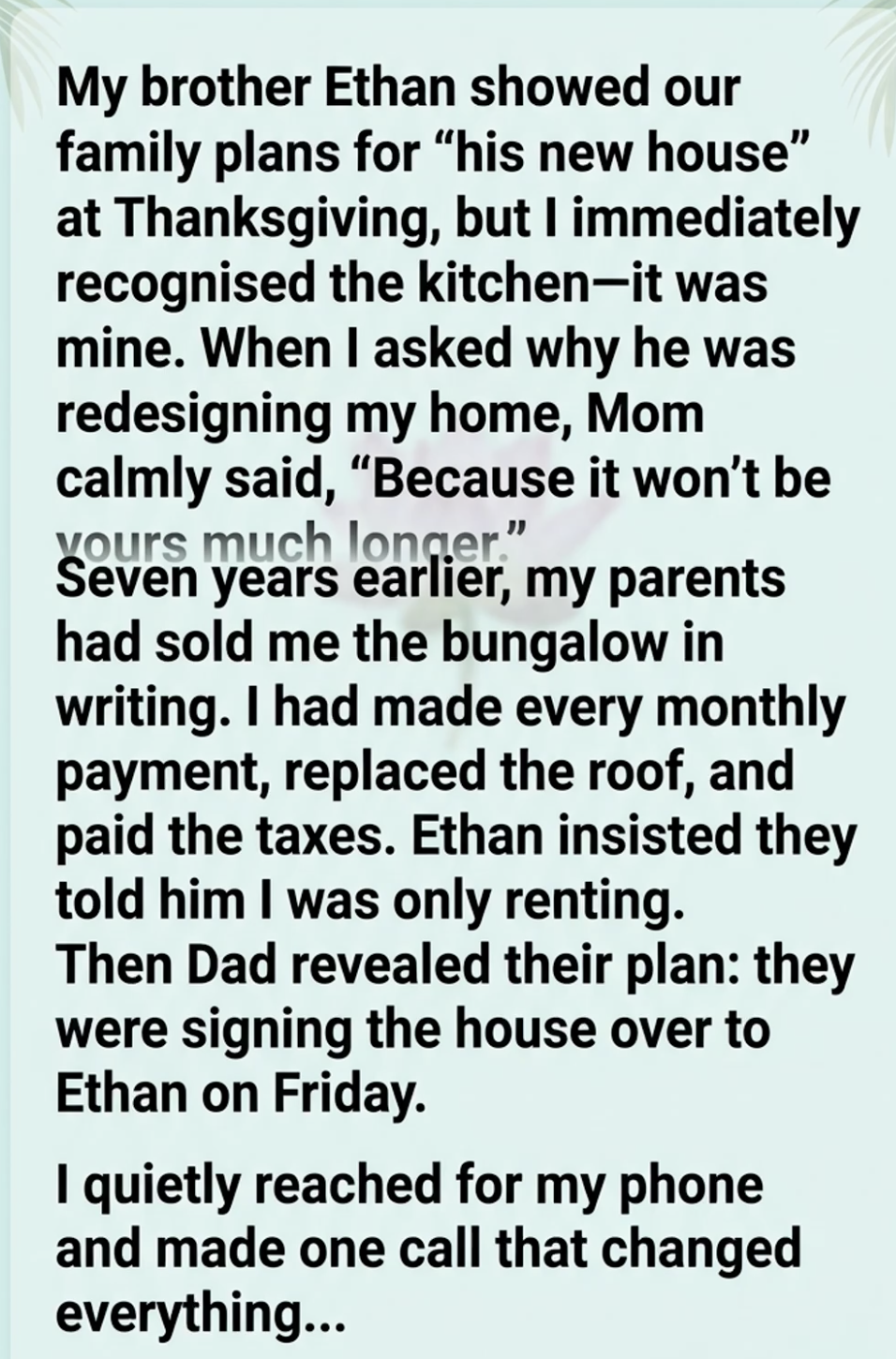
My brother Ethan unfolded a stack of glossy floor plans across the Thanksgiving table.
He was smiling like a man who had just won the lottery.
“I’m thinking of opening this wall,” he said. “Then we’ll put the kitchen island here.”
I glanced down.
Then I froze.
I knew that kitchen.
I knew the exact position of the window.
The little pantry in the corner.
Even the strange angle where the countertop met the wall.
It was my house.
“My kitchen?” I asked.
Ethan laughed.
“Yeah.”
I looked at Mom.
She calmly took a sip of wine.
“Because it won’t be yours much longer.”
For a few seconds, I honestly thought she was joking.
Then Dad put his fork down.
“Your mother and I have made a decision.”
I looked at him.
“What decision?”
“We’re transferring the bungalow to Ethan.”
I stared at him.
The bungalow.
My home.
The house I had bought from them seven years earlier.
The house I had paid for every single month.
The house where I had replaced the roof.
The house where I had paid the property taxes.
The house where I’d spent thousands renovating the bathroom and repairing the foundation.
“You can’t transfer my house.”
Ethan looked confused.
“Your house?”
“Yes.”
Mom shook her head.
“You’ve been renting it.”
I laughed.
It wasn’t a happy laugh.
“Renting?”
Dad nodded.
“That was always the arrangement.”
“No.”
I reached into my bag.
“I have the purchase agreement.”
Dad’s expression changed.
I pulled out a folder.
Seven years earlier, my parents had offered to sell me the bungalow.
They wanted to downsize.
I wanted a home.
We signed a written agreement.
The purchase price was $285,000.
I paid the agreed amount every month.
I had bank records for every payment.
I had receipts for the roof.
Property tax statements.
Insurance documents.
Utility bills.
Contractor invoices.
Everything.
Ethan stared at the folder.
Mom waved her hand.
“That doesn’t prove what you think it proves.”
“What does it prove?”
“That you were helping us.”
“Helping you buy your own house?”
Dad looked uncomfortable.
Ethan leaned forward.
“Mom and Dad told me you were renting.”
I looked at him.
“Did they?”
“Yes.”
“Did they tell you I paid for the roof?”
He shrugged.
“I don’t know.”
“Did they tell you I paid the property taxes?”
“No.”
“Did they tell you they gave me a signed purchase agreement?”
He looked at my parents.
They said nothing.
I slowly closed the folder.
Dad cleared his throat.
“We’re transferring the property Friday.”
I stared at him.
“Why Friday?”
“Because that’s when the paperwork is scheduled.”
“With whom?”
“An attorney.”
I nodded.
“Okay.”
Mom looked relieved.
“You understand?”
“Yes.”
Ethan smiled.
“Great. Then there’s no reason to fight.”
I reached for my phone.
Dad frowned.
“What are you doing?”
“Making a phone call.”
“To whom?”
I looked at him.
“To the person who has the answer.”
I stepped away from the table.
Then called my attorney.
Her name was Laura.
She answered on the second ring.
“Hi. What’s going on?”
“My parents are trying to transfer my house to my brother.”
There was silence.
“Your house?”
“Yes.”
“Do you have the purchase agreement?”
“Yes.”
“Do you have proof of payment?”
“Yes.”
“Property records?”
“Yes.”
“Tax records?”
“Yes.”
“Then don’t panic.”
“I wasn’t planning to.”
“Good. Send me everything.”
I walked into the hallway and started photographing the documents.
Within fifteen minutes, Laura had everything.
She called back.
“I’ve reviewed the agreement.”
“And?”
“You’re the owner.”
I closed my eyes.
“I know.”
“No. I mean legally, the paperwork is very clear.”
“Can they transfer it anyway?”
“Not lawfully.”
“What should I do?”
“First, don’t sign anything. Second, don’t give anyone the original documents. Third, I’m going to verify the title and place the appropriate notice with the relevant property records if necessary.”
I nodded.
“Okay.”
“Did your parents tell you why they’re doing this?”
“They say Ethan deserves a house.”
Laura sighed.
“That isn’t a legal basis for taking yours.”
I returned to the dining room.
Everyone was waiting.
Dad asked:
“Well?”
I put my phone down.
“My attorney says the house is mine.”
Mom shook her head.
“She doesn’t understand our agreement.”
“She reviewed it.”
Dad stood.
“You’re trying to turn this into a legal battle against your own parents.”
“No.”
I looked at him.
“You’re trying to turn my property into a gift for Ethan.”
Ethan stood too.
“This is unbelievable.”
I looked at him.
“You believed I was renting.”
“That’s what they told me.”
“Then ask them why.”
He turned toward our parents.
“Why did you tell me that?”
Mom looked away.
Dad sat back down.
Finally, he said:
“Because we knew you wouldn’t give up the house willingly.”
The room went silent.
I felt something crack inside me.
Not because I was surprised.
Because he’d finally said the truth out loud.
Ethan stared at him.
“You knew it wasn’t yours?”
Dad nodded.
“We knew.”
“And you were going to give it to me anyway?”
“We thought she would understand.”
Ethan looked at me.
“I didn’t know.”
“I believe you.”
Mom suddenly became angry.
“You have everything.”
I stared at her.
“What?”
“You have a good job. You’re independent. You don’t have children.”
“And?”
“Ethan needs a home.”
I looked at Ethan.
“Does he?”
Ethan’s face reddened.
“I can afford a home.”
Mom interrupted.
“Not one like this.”
I looked around the table.
This wasn’t about need.
It was about entitlement.
And apparently, the family had decided that my independence meant I could be sacrificed without consequence.
I picked up my bag.
“I’ll see you in court if you try to transfer it.”
Mom gasped.
“You’d take your parents to court?”
I stopped.
“I wouldn’t be taking my parents to court.”
I looked directly at Dad.
“I’d be defending my property.”
I left.
The next morning, Laura called.
“There’s another issue.”
“What?”
“Your parents apparently contacted the title company.”
I felt my stomach tighten.
“They did?”
“Yes. They’re trying to complete the transfer Friday.”
“Can they?”
“No. Not if the records are what you’ve shown me.”
“What should I do?”
“I’m filing the necessary notice today.”
By Thursday afternoon, the title company had been formally notified of the dispute.
The scheduled transfer was placed on hold.
Friday morning, my father called.
“You’ve embarrassed us.”
“I didn’t.”
“You stopped the transfer.”
“I stopped you from transferring property you don’t own.”
“It’s a technicality.”
“No.”
He became quiet.
Then said:
“You’re really going to do this?”
“Yes.”
“You’ll destroy the family.”
I answered softly.
“Dad, the family isn’t being destroyed by me protecting my home.”
He hung up.
Two weeks later, we were sitting in an attorney’s office.
My parents had brought their own lawyer.
Ethan came too.
The original agreement was on the table.
So were seven years of bank statements.
Seven years of tax records.
The roof invoice.
The insurance records.
The property maintenance records.
And the title documents.
My attorney looked at everyone.
“There is very little ambiguity here.”
My father’s attorney agreed.
The purchase agreement clearly transferred the property.
My parents had received the agreed payments.
The title records supported my ownership.
The planned transfer to Ethan could not legally proceed.
Ethan sat quietly.
Finally, he asked:
“So the house was never theirs?”
His attorney answered.
“Not after the sale was completed and recorded as documented.”
Ethan looked at Mom.
“Why didn’t you tell me?”
Mom started crying.
“We thought your sister would help.”
Ethan shook his head.
“You didn’t ask her.”
“We knew she would say no.”
That sentence destroyed whatever argument remained.
Ethan stood.
“I don’t want the house.”
Dad looked at him.
“You need somewhere to live.”
“I’ll buy my own.”
Then he looked at me.
“I’m sorry.”
I nodded.
“Thank you.”
He left the room.
My parents stayed.
Dad looked exhausted.
“I thought because we were your parents, you’d let us make this right.”
I looked at him.
“You made your choice seven years ago.”
He frowned.
“When?”
“When you sold me the house.”
“You were our daughter.”
“And your daughter paid you.”
He looked down.
“You’re right.”
Mom whispered:
“We were trying to help Ethan.”
“I know.”
“He’s struggling.”
“Then help him.”
She looked at me.
“How?”
“Without taking something that belongs to someone else.”
She started crying.
I didn’t feel victorious.
I felt tired.
A few months later, Ethan bought a smaller house across town.
He called me before closing.
“I wanted you to know something.”
“What?”
“Mom and Dad offered to help with the down payment.”
I smiled.
“Did you accept?”
“No.”
“Why?”
He laughed softly.
“Because I finally realized what happens when family starts confusing help with entitlement.”
That was the first time I truly forgave him.
Not because he had done anything wrong.
Because he had finally understood.
My parents and I eventually rebuilt some kind of relationship.
It took time.
There were boundaries.
A lot of them.
They were welcome in my home.
But they couldn’t make decisions about it.
They couldn’t borrow against it.
They couldn’t promise it to anyone.
And they couldn’t rewrite history.
The bungalow remained mine.
I kept the original purchase agreement in a safe.
Not because I expected another fight.
Because it reminded me of something important.
A signature matters.
A payment matters.
A promise matters.
And family love doesn’t erase ownership.
Years later, I renovated the kitchen.
I kept the strange angle where the countertop met the wall.
I kept the little pantry.
And I added the island Ethan had drawn on his Thanksgiving floor plan.
Not because he had claimed it.
Because I actually liked the idea.
When he visited after the renovation, he stood in the kitchen and laughed.
“You actually used my design.”
I smiled.
“Some of it.”
He shook his head.
“Fair enough.”
We stood there together.
Two siblings in a kitchen that had almost destroyed our relationship.
Then Ethan said:
“I’m glad you made that phone call.”
“So am I.”
Because that phone call didn’t just stop my parents from giving away my house.
It stopped me from spending years wondering whether protecting myself made me a bad daughter.
It didn’t.
I could love my parents and still say no.
I could love my brother and still keep my home.
And I could forgive my family without handing them the keys.
Sometimes the most important thing you can protect isn’t a house.
It’s the boundary that tells everyone where your life ends and theirs begins.