My son Patrick’s text arrived at 8:12 on a Tuesday morning.
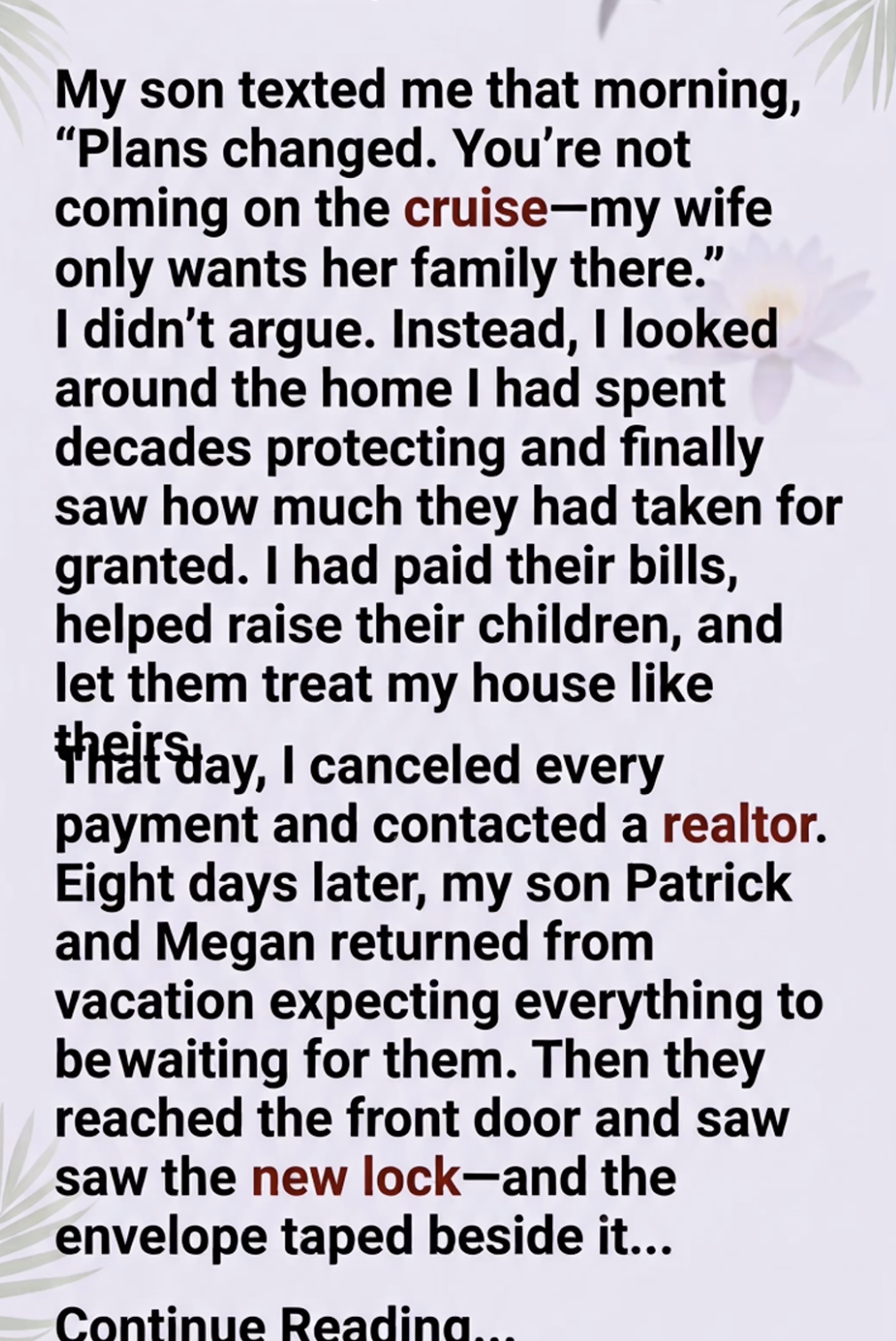
“Plans changed. You’re not coming on the cruise—Megan only wants her family there.”
I read it twice.
Then I put my phone down.
I didn’t ask why.
I didn’t argue.
I didn’t send a long message about everything I’d done for them.
I simply looked around my house.
And for the first time in years, I actually saw it.
Not as my son’s home.
Not as my grandchildren’s home.
Not as the place everyone could come whenever they needed something.
Mine.
I had bought the house thirty-one years earlier.
I had worked two jobs for almost a decade to pay it off.
Every repair had come out of my pocket.
The roof.
The furnace.
The plumbing.
The new windows.
I had even converted the basement into a bedroom when Patrick and Megan said they needed somewhere to stay after their second child was born.
They said it would only be for six months.
That was nine years ago.
They never really left.
They moved into their own place eventually, but my house remained their second home.
Their children had rooms here.
Their mail came here.
They stored bicycles in my garage.
Megan kept boxes of decorations in my attic.
Patrick had a key.
Then another key.
Then his wife had one.
Then the kids had one.
Somehow, without anyone asking, my house had become a place everyone considered theirs.
And I had allowed it.
Because I loved them.
Because I thought family meant making room.
Because whenever Patrick needed help, I helped.
When his business slowed down, I covered two months of his car payments.
When Megan went back to school, I paid the childcare bill.
When the children needed braces, I contributed.
When their furnace broke, I paid for the repair.
When they went through a difficult year, I quietly covered groceries.
Over the previous five years, I had spent tens of thousands of dollars helping them.
I didn’t regret helping my grandchildren.
But suddenly, as I stood in my kitchen reading that text, I realized something.
They didn’t think of it as help anymore.
They thought of it as what I was supposed to do.
My phone buzzed.
Patrick again.
“Don’t make this a big thing, Mom.”
I stared at the words.
Then I typed:
“Have a good trip.”
I sent it.
And that was the last message I sent him.
That morning, I opened my bank account.
I had automatic payments set up for several things connected to Patrick and Megan.
Their children’s extracurricular fees.
A monthly transfer for groceries.
An insurance payment I’d been covering.
A credit card I’d co-signed years earlier.
I canceled every payment that was legally and practically mine to stop.
Then I opened my email.
I contacted a realtor.
Her name was Susan.
I wrote:
“I’d like to discuss selling my house.”
She called within an hour.
“Are you sure?”
“Yes.”
“Is this because of your son?”
I paused.
“No.”
Then corrected myself.
“Not exactly.”
She came over that afternoon.
We walked through the house.
She pointed out things I had stopped noticing.
The hardwood floors.
The renovated kitchen.
The large backyard.
The finished basement.
“You’ve maintained this place beautifully,” she said.
“I had help.”
She smiled.
“From your family?”
“Mostly from my wallet.”
She laughed.
I didn’t.
By Thursday, we had a plan.
The house would go on the market after the necessary preparations.
I didn’t tell Patrick.
I didn’t tell Megan.
I didn’t tell my grandchildren.
I simply began packing.
Not everything.
Just my things.
The things that had been pushed into closets because someone else needed the space.
My father’s photographs.
My mother’s china.
The quilt I’d made when I was thirty.
My books.
My jewelry.
The documents I’d kept in the basement safe.
I found things I hadn’t seen in years.
One afternoon, I opened the closet under the stairs.
Inside were three boxes labeled:
“Patrick.”
“Megan.”
“Kids.”
I moved them to the garage.
Then I changed the garage code.
It felt strange.
Almost cruel.
But I reminded myself:
I wasn’t throwing anyone out.
I was reclaiming my own house.
The realtor listed the property.
Within four days, we had multiple interested buyers.
I accepted an offer.
The closing date was set for the following week.
Patrick and Megan were still on their cruise.
Apparently, they were having a wonderful time.
Megan posted photographs.
Cocktails.
Sunsets.
Dinner.
The children beside the pool.
Patrick wrote:
“Best family vacation ever.”
I saw the post.
Then closed the app.
Eight days after Patrick’s text, they came home.
I knew because Patrick called.
“Mom?”
I was sitting in my new apartment.
“Yes?”
“We’re back.”
“I hope you had a good trip.”
“We did.”
There was a pause.
“Can you open the house?”
I smiled.
“No.”
“What?”
“The house isn’t mine anymore.”
Silence.
“What do you mean?”
“I sold it.”
“You what?”
“I sold the house.”
“Mom, you’re joking.”
“No.”
“Why would you do that?”
“Because it’s my house.”
He became angry.
“You couldn’t wait until we got back?”
“I gave you exactly what you gave me.”
“What does that mean?”
“You told me I wasn’t part of your vacation because your wife wanted only her family there.”
“That’s not the same thing.”
“It felt the same.”
“Mom, that’s ridiculous.”
I didn’t argue.
He hung up.
Twenty minutes later, another call came.
Megan.
“You can’t do this.”
“I already did.”
“Where are we supposed to go?”
“I don’t know.”
“You know the kids have their things there.”
“Your things are packed.”
“Where?”
“I’ll have them delivered.”
She began crying.
“Please.”
I closed my eyes.
“I love the children.”
“Then don’t do this.”
“I’ve spent years making sure you had somewhere to go.”
“You’re their grandmother.”
“Yes.”
“And this is how you treat family?”
I took a breath.
“Megan, family doesn’t mean one person gets to provide everything while everyone else decides when she belongs.”
She said nothing.
Then she asked:
“Where are you?”
“Somewhere safe.”
She hung up.
I thought that was the end.
It wasn’t.
That evening, Patrick and Megan drove to the old house.
They had expected the spare key to work.
It didn’t.
Patrick tried again.
Nothing.
He checked the garage.
The code had been changed.
He walked around to the back door.
Locked.
Then he saw the envelope.
It was taped beside the front door.
His name was written across it.
Patrick opened it.
Inside was a letter.
It said:
“Patrick,
This house was never yours.
You were welcome here because I loved you.
Your wife and children were welcome because I loved them.
But being welcomed is not the same as owning something.
For years, I paid expenses you could have paid yourselves. I let you use rooms, storage, keys, and resources because I wanted my grandchildren to feel at home here.
Then you told me I wasn’t family enough to come on your vacation.
That sentence made something very clear.
You had become comfortable receiving from me without remembering that I was giving.
So I stopped.
The house has been sold.
Your belongings are safely stored and will be delivered.
I am not asking you to apologize.
I am not asking you to beg.
I am asking you to learn how to stand on your own.
I love you.
But I will no longer fund a life in which my presence is optional while my money is essential.
Mom.”
Patrick called me immediately.
I didn’t answer.
He called again.
Then Megan.
Then Patrick again.
Finally, he left a voicemail.
His voice sounded different.
Not angry.
Scared.
“Mom, please call me.”
I waited until the next morning.
Then I called.
“What do you need?”
“Can we talk?”
“We’re talking.”
“No. In person.”
I agreed.
We met at a coffee shop.
Patrick looked exhausted.
Megan sat beside him.
Neither of them spoke at first.
Finally, Patrick said:
“I didn’t mean to hurt you.”
“I know.”
“Megan’s parents were coming.”
“I know.”
“We thought you wouldn’t mind.”
“I did mind.”
He nodded.
“I know that now.”
Megan looked at me.
“I was wrong.”
I said nothing.
“I thought because you were always helping us, you didn’t mind.”
“That was the problem.”
She began crying.
“I didn’t realize.”
“I know.”
Patrick looked at me.
“Did you really sell the house?”
“Yes.”
“Why didn’t you tell us?”
“Because you weren’t entitled to a vote.”
That answer hurt him.
But it was true.
The sale closed two weeks later.
I used the proceeds to buy a smaller house.
One that was completely mine.
No extra bedrooms for visiting adults.
No basement full of someone else’s boxes.
No spare keys distributed without asking.
Just a quiet little place with a garden.
I kept one bedroom for my grandchildren.
That part mattered to me.
A few weeks later, they came to visit.
My granddaughter ran through the front door and hugged me.
“Grandma, I missed you.”
“I missed you too.”
She looked around.
“Where’s Dad’s room?”
I laughed.
“He doesn’t have one.”
She looked shocked.
“Why?”
“Because Dad has his own house now.”
She thought about that.
Then smiled.
“Can I still sleep here?”
“Of course.”
She hugged me again.
And I realized something.
Setting boundaries hadn’t made me less of a grandmother.
It had simply made me stop being everyone’s safety net.
Patrick eventually found a rental.
He and Megan began paying their own bills.
They sold a few things.
Cut back on expenses.
And, for the first time, they started living within their means.
It wasn’t easy.
But they managed.
Six months later, Patrick came to my house carrying flowers.
“I owe you an apology.”
I took them.
“Thank you.”
He looked around.
“I like this place.”
“So do I.”
He smiled.
“It’s smaller.”
“Yes.”
“Quieter.”
“Yes.”
He hesitated.
“Do you miss the old house?”
I thought about it.
“Sometimes.”
“I’m sorry we made you feel like you didn’t belong there.”
I looked at him.
“You didn’t make me not belong.”
“What then?”
“I forgot that it was mine.”
He nodded.
“I understand.”
Before he left, he handed me a small envelope.
Inside was a check.
Not for everything I had ever spent.
Not even close.
It was the first repayment toward the money I’d loaned them years earlier.
I looked at him.
“You don’t have to pay everything at once.”
“I know.”
“But I’m going to.”
I smiled.
“Okay.”
He hugged me.
For the first time in years, it felt like my son was hugging me because he loved me.
Not because he needed something.
That mattered more than the money.
The cruise had been the moment that changed everything.
Patrick thought excluding me from a vacation was a small decision.
Maybe it was.
But it forced me to look at the larger picture.
I had spent years making sure my family had everything they needed.
And somewhere along the way, they had stopped seeing it as generosity.
They saw it as the natural order of things.
I was the mother.
The grandmother.
The helper.
The one who paid.
The one who opened the door.
The one who said yes.
Until one day, they told me I wasn’t invited.
So I stopped opening the door.
Not because I stopped loving them.
Because I finally understood that love doesn’t require unlimited access.
My son thought the hardest part would be seeing the new lock.
He was wrong.
The hardest part was realizing how long I had lived without one.
And the best part?
When I finally put that lock on the door, I wasn’t locking my family out.
I was finally letting myself in.