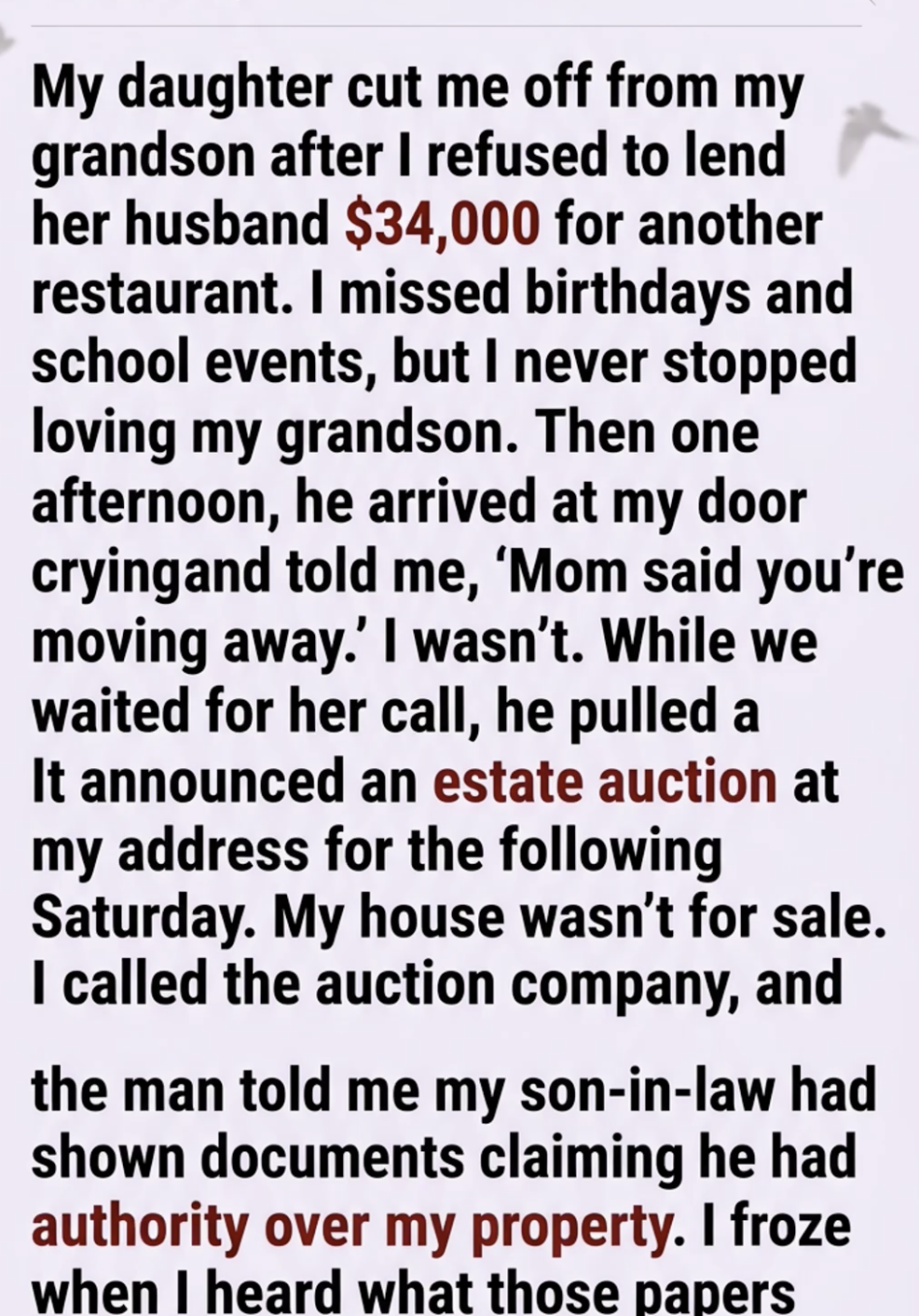
My daughter stopped letting me see my grandson after I refused to lend her husband $34,000.
He wanted the money for another restaurant.
“It’s a guaranteed investment,” Daniel told me.
He had said the same thing about the first restaurant.
And the second.
The first one closed after eleven months.
The second lasted less than a year.
Now he wanted another $34,000.
I said no.
My daughter, Rachel, didn’t take it well.
“You don’t trust my husband.”
“I don’t trust the business plan.”
“He’s trying to build something for our family.”
“I hope he succeeds.”
“You could help.”
“I’ve already helped.”
She stared at me.
Then she said:
“Fine. Don’t expect to be part of our lives anymore.”
I thought she was angry.
I didn’t realize she meant it.
Within two weeks, my calls went unanswered.
My messages were ignored.
Then came the birthdays I wasn’t invited to.
My grandson’s school play.
His soccer games.
His science fair.
Christmas.
I missed all of them.
His name was Oliver.
He was nine years old.
And I loved that boy more than I could explain.
I kept buying birthday presents anyway.
I kept them in a closet.
Every few months, I’d take one out, wrap it, write his name on it, and put it back.
I told myself that someday he’d understand.
Then one afternoon, someone knocked on my door.
I opened it.
Oliver stood there.
Alone.
His backpack was hanging from one shoulder.
His face was wet with tears.
“Grandma?”
I froze.
“Oliver?”
He threw his arms around me.
I held him tightly.
“What happened?”
He sniffled.
“Mom said you’re moving away.”
I pulled back.
“I’m not moving.”
He looked confused.
“She said you were selling the house.”
“No.”
“She said I wouldn’t see you anymore.”
I knelt in front of him.
“Who brought you here?”
He looked toward the street.
“Dad dropped me off.”
My stomach tightened.
“Did he say anything?”
“No.”
“Why are you crying?”
“Because Mom said you were leaving.”
I hugged him again.
“You’re not losing me.”
He pulled away and wiped his face.
Then he reached into his backpack.
“I brought this.”
He handed me a folded flyer.
I opened it.
At the top, in large letters, were the words:
ESTATE AUCTION
Then I saw the address.
My address.
My house.
The date was the following Saturday.
I stared at the page.
“This isn’t real.”
Oliver looked frightened.
“Are they selling your house?”
“No.”
I immediately called the number printed on the flyer.
A man answered.
“Good afternoon. Harper Estate Auctions.”
I gave him the address.
“Yes,” he said. “That’s one of our scheduled properties.”
My voice tightened.
“Who authorized this auction?”
He paused.
“Mr. Daniel Carter.”
“My son-in-law?”
“Yes.”
“He doesn’t own this property.”
Another pause.
“Ma’am, I’m only handling the auction.”
“Then tell me what documents he provided.”
“I shouldn’t discuss that with you.”
“I am the property owner.”
He hesitated.
Then said:
“According to the documents we received, Mr. Carter claims he has authority to dispose of the property.”
I felt cold.
“What documents?”
“A power of attorney and a property authorization.”
“I never gave him power of attorney.”
“I understand.”
“And my daughter doesn’t own this house either.”
“I can’t verify ownership.”
“What else did he give you?”
The man sighed.
“There was also a notarized document stating that you had authorized him to manage the property.”
My hands began shaking.
“That signature isn’t mine.”
He went quiet.
“Ma’am?”
“I never signed anything.”
He lowered his voice.
“Then you need to contact an attorney immediately.”
I hung up.
Oliver was watching me.
“Grandma?”
I forced myself to breathe.
“It’s okay.”
“Is my dad selling your house?”
“I don’t know yet.”
I called my attorney.
She answered immediately.
“What’s wrong?”
I told her everything.
“Send me a photograph of the flyer.”
I did.
Then I photographed the deed from my records.
She called back within minutes.
“Your ownership is clear.”
“What about the auction?”
“I need to see what they’re claiming.”
“I was told they have a power of attorney.”
“Did you sign one?”
“No.”
“Then we’re dealing with a potentially serious document issue.”
She asked me to send her every property record I had.
I did.
Then she said:
“Don’t confront Daniel.”
“Why?”
“Because if he’s already using documents he shouldn’t have, I want the evidence preserved.”
That night, I barely slept.
Oliver stayed with me.
I made him dinner.
We watched a movie.
He eventually fell asleep on my couch.
I sat beside him and stared at the flyer.
My house wasn’t just a building.
It was where I had raised Rachel.
Where Oliver had spent his first Christmas.
Where my husband had planted the apple tree in our backyard.
Where my parents had lived before me.
I had paid it off twelve years earlier.
There was no mortgage.
No lien.
No reason anyone should have been able to schedule an auction.
The next morning, my attorney called.
“We found something.”
“What?”
“A power of attorney was recorded with the county two months ago.”
My heart stopped.
“Two months ago?”
“Yes.”
“Who signed it?”
“You supposedly did.”
“I didn’t.”
“I know.”
She continued.
“It gives Daniel broad authority over the property.”
“What about the signature?”
“We’re having the document examined.”
I closed my eyes.
Then another thought occurred to me.
“Two months ago…”
“What?”
“That was around the time Rachel stopped letting me see Oliver.”
My attorney went silent.
“Are you saying the timing may be connected?”
“I don’t know.”
“Don’t assume anything yet.”
That afternoon, I requested copies of the recorded documents.
When I received them, I immediately recognized the notary’s name.
It was a man I’d never met.
But the signature looked frighteningly similar to mine.
There was only one problem.
The document stated that I had signed it in person at a law office on a Tuesday afternoon.
I had been at the hospital that day.
My medical records showed it.
So did my credit card receipt from the hospital cafeteria.
I sent everything to my attorney.
She said:
“This is enough to challenge the document.”
But then she found something worse.
Daniel had also submitted a second document.
A “property management agreement” claiming I had transferred control of the house to a company he owned.
The agreement stated that I had authorized him to refinance or sell the property if necessary to satisfy “family business obligations.”
I had never heard of the company.
My attorney searched the corporate records.
It belonged to Daniel.
And it had significant debt.
That was when everything clicked.
The restaurants weren’t simply failing.
Daniel was in serious financial trouble.
He had been borrowing money from different sources.
Credit cards.
Private lenders.
Business partners.
And apparently, he had started looking at my house as an asset he could use.
My daughter had known.
Maybe not everything.
But enough.
That’s why they had stopped me from seeing Oliver.
It wasn’t only punishment for refusing the $34,000.
It had also kept me from asking questions.
And if I had been told I was moving away, perhaps they expected me to leave the property voluntarily.
Maybe the auction was supposed to look legitimate.
Maybe Daniel hoped someone would buy the house before I discovered what had happened.
I didn’t know his exact plan.
But I knew enough.
My attorney filed an emergency request to stop the auction.
The auction company received notice.
The county received notice.
The supposed power of attorney was formally challenged.
And the auction was canceled.
But Daniel didn’t stop.
He called me.
“You’ve made a huge mistake.”
I said nothing.
“You’re destroying my business.”
“I never authorized you to use my house.”
“You know what you signed.”
“I signed nothing.”
“You’re lying.”
“No.”
He became angry.
“Your daughter is going to lose everything because of you.”
I looked across the room at Oliver.
“No.”
“You don’t understand.”
“I understand that you tried to sell my house.”
“You think I’m doing this for myself?”
“Yes.”
“I did it for my family.”
“You don’t get to steal from someone and call it family.”
He hung up.
The next day, Rachel came to my house.
She looked exhausted.
I opened the door.
She stood there crying.
“Mom.”
I stepped aside.
She walked in.
Oliver ran toward her.
She hugged him.
Then looked at me.
“I didn’t know about the auction.”
“Did you know about the power of attorney?”
She hesitated.
“Yes.”
My heart sank.
“When?”
“Daniel told me you had given him permission.”
“Did you see the document?”
“Yes.”
“Did you ask me?”
“No.”
“Why?”
She started crying.
“Because I believed him.”
I nodded.
“What about the $34,000?”
“I knew he wanted it.”
“Did you know he was planning to use my house?”
“No.”
She sat down.
“Mom, he told me the restaurants were going to recover.”
“Were they?”
“No.”
She looked down.
“He owes people money.”
“How much?”
“I don’t know.”
“My attorney found records suggesting substantial debt.”
Rachel covered her face.
“I was scared.”
“You should have called me.”
“I was embarrassed.”
“So you kept my grandson from me.”
“I thought you hated Daniel.”
“I don’t hate him.”
“You refused to help him.”
“Yes.”
“Why?”
“Because I had already given him money before.”
“How much?”
I told her.
Her face changed.
“You never told me.”
“I didn’t want to make you choose between your husband and your mother.”
She started sobbing.
“I thought you didn’t believe in us.”
“I believed in you. I didn’t believe in another restaurant.”
She looked at Oliver.
Then back at me.
“I was wrong.”
“Yes.”
She nodded.
“I know.”
The investigation continued.
The notary whose name appeared on the power of attorney denied meeting me.
That became important.
The document had been notarized without a legitimate signing meeting.
The attorney who supposedly witnessed the property agreement also denied preparing it.
Daniel had apparently assembled documents using information he already possessed.
His financial records were subpoenaed.
Several transactions were examined.
The case became much bigger than my house.
There were questions about business debts, representations made to lenders, and documents submitted to third parties.
I never tried to decide his criminal liability myself.
I let the investigators and courts determine that.
My priority was my property.
And my grandson.
Months later, the legal proceedings were still ongoing.
Daniel’s businesses were shut down.
The fraudulent property documents were invalidated.
My house remained mine.
Rachel eventually left Daniel.
Not because I told her to.
Because she finally saw the financial records for herself.
She and Oliver moved into an apartment.
She found work.
It wasn’t easy.
But she stopped asking me for money.
One afternoon, Oliver and I were sitting in my backyard.
He was doing homework at the patio table.
He looked up.
“Grandma?”
“Yes?”
“Are you really not moving?”
I smiled.
“No.”
“Good.”
“Why?”
“Because I like your house.”
I laughed.
“So that’s why you wanted me to stay?”
“No.”
He grinned.
“Because you make pancakes.”
I shook my head.
“That’s more believable.”
He returned to his homework.
After a moment, he said:
“Mom said something else.”
“What?”
“She said she was sorry.”
I looked at him.
“For what?”
“For keeping me away from you.”
I nodded.
“She made a mistake.”
“Are you mad?”
“I was.”
“Are you still?”
I thought about it.
“Not anymore.”
He smiled.
“Good.”
Then he went back to his homework.
A year after the auction was canceled, Rachel came over with a box.
She placed it on my kitchen table.
“What is this?”
“Everything I could find from Daniel’s files.”
I looked at her.
“Why?”
“Because I don’t want secrets between us anymore.”
Inside were copies of emails, business records, and messages.
At the bottom was a photograph of the original document Daniel had used.
Rachel had written across the top:
I should have asked Mom first.
I looked at her.
“You’re doing the right thing.”
She nodded.
“I know.”
We hugged.
Not because everything was fixed.
But because we had finally stopped pretending it wasn’t broken.
The following Christmas, Oliver slept in the guest room.
He woke me before sunrise.
“Grandma!”
“What?”
“Come see!”
I followed him downstairs.
He had placed a small handmade sign beside the Christmas tree.
It said:
GRANDMA’S HOUSE — NO AUCTIONS ALLOWED
I laughed so hard I nearly cried.
Oliver grinned.
“Dad can’t sell it anymore, right?”
I knelt beside him.
“No.”
“Because it’s yours?”
“Yes.”
He smiled.
“Good.”
I hugged him.
The house had almost become the center of a family disaster.
But it ended up becoming something else.
A place where my grandson could come without fear.
A place where my daughter could rebuild her life.
A place where I finally understood that saying no to someone doesn’t mean you stop loving them.
When Daniel asked me for $34,000, he thought money was the only thing I was refusing to give him.
He was wrong.
I was refusing to give him control.
And when he tried to take my house instead, he thought the documents would be enough.
They weren’t.
Because a piece of paper can claim almost anything.
What matters is whether the truth behind it can survive scrutiny.
In the end, the auction never happened.
My house stayed mine.
My grandson came home.
And my daughter finally learned that love doesn’t mean believing someone without asking questions.
Sometimes, protecting your family means being the person willing to say:
“Show me the document.”
And sometimes, that one question is enough to stop someone from taking everything you built.