The note fell out of my fifteen-year-old son’s backpack while he was taking out his homework.
I almost didn’t notice it.
It was a small sheet of lined paper, folded twice.
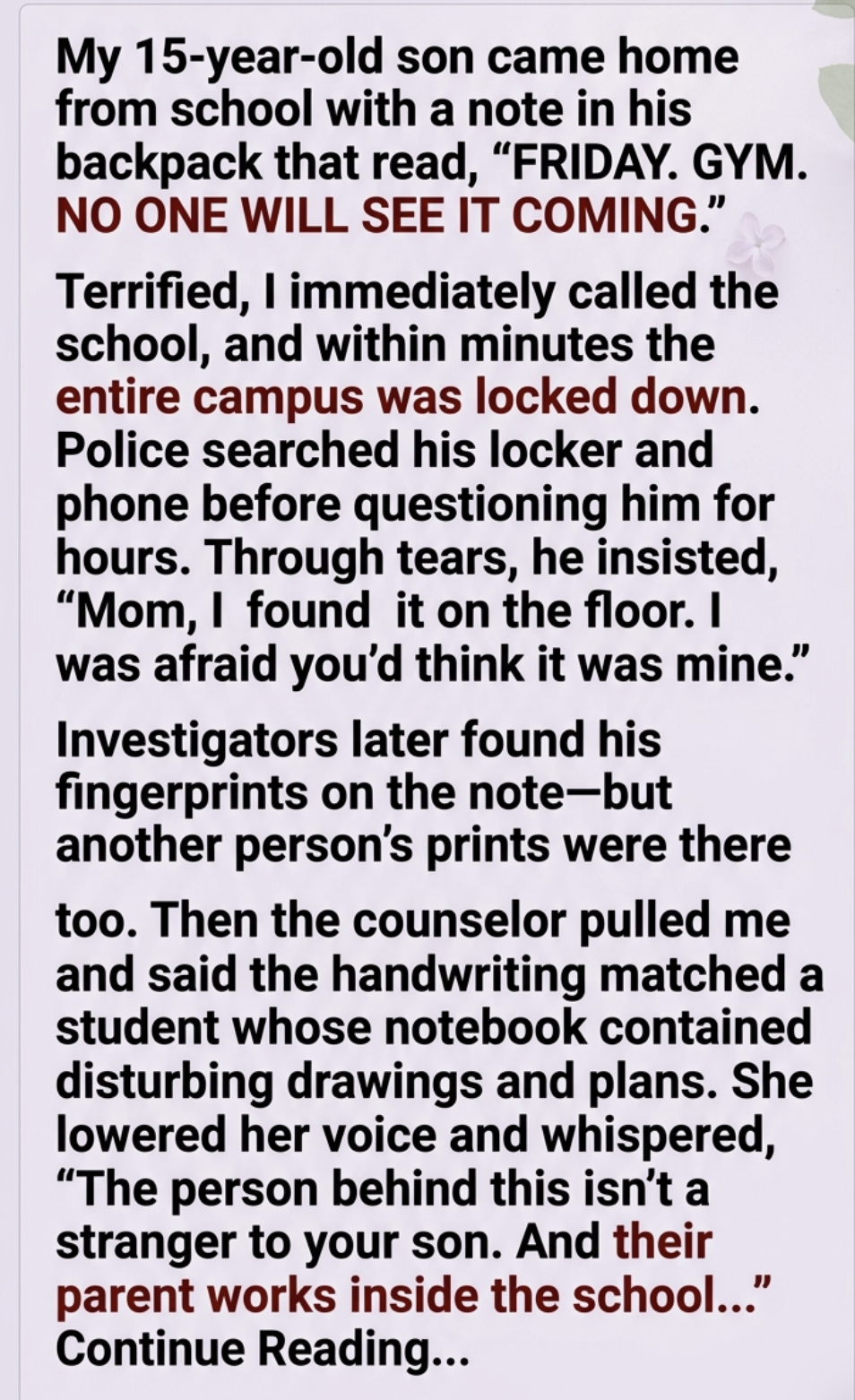
Then I saw the words written across the front.
FRIDAY. GYM. NO ONE WILL SEE IT COMING.
My heart stopped.
“Ethan?”
My son looked over.
“What?”
I held up the paper.
“What is this?”
His face went white.
“I don’t know.”
“Where did you get it?”
“I found it.”
“Where?”
“At school.”
His voice started shaking.
“Mom, I swear I found it on the floor.”
I grabbed my phone.
“I’m calling the school.”
“Mom—”
“I’m not taking any chances.”
Within minutes, the school went into lockdown.
Police cars filled the parking lot.
Parents began receiving emergency notifications.
Students were kept in classrooms while officers searched the building.
And my son was taken to a separate room for questioning.
For nearly three hours, I sat in the administrative office waiting.
Every minute felt like an hour.
When an officer finally came out, he looked serious.
“Your son says he found the note.”
“He did.”
“We searched his locker and backpack.”
“And?”
“We found nothing else.”
I swallowed.
“His phone?”
“We’re reviewing it.”
“Does he still have his phone?”
“No.”
I nodded.
“Can I see him?”
“Not yet.”
My hands were shaking.
Then another officer walked in carrying a clear evidence bag.
Inside was the note.
“There are fingerprints,” he said.
My heart sank.
“His?”
“One set appears consistent with your son’s.”
I stared at him.
“But he told you he found it.”
“We’re aware.”
“Then why are you treating him like he wrote it?”
“We aren’t.”
The officer paused.
“We found another partial print.”
“Whose?”
“We don’t know yet.”
That was the first thing that gave me hope.
There was another person.
Someone else had touched the paper.
Later that afternoon, the school counselor asked to speak with me privately.
Her name was Mrs. Harper.
She closed the office door.
“I need to tell you something.”
“What?”
“We have another student we’re concerned about.”
“Who?”
“His name is Nolan.”
I knew the name.
Nolan had been in Ethan’s class since middle school.
“They’re friends?”
“Not exactly.”
“Then why are you telling me?”
Mrs. Harper lowered her voice.
“Because the handwriting on the note appears to match writing we’ve seen in Nolan’s notebook.”
My stomach tightened.
“What kind of writing?”
She hesitated.
“Disturbing drawings.”
“Drawings of what?”
“Violence.”
I stared at her.
“Does Nolan have anything to do with this?”
“We don’t know yet.”
Then she leaned closer.
“But there’s something else.”
“What?”
“The person behind this isn’t a stranger to your son.”
My heart sank.
“What do you mean?”
“Nolan has been following Ethan around for weeks.”
“Following him?”
“Watching him. Sitting near him at lunch. Asking him questions about where he goes after school.”
I felt sick.
“Why didn’t anyone tell me?”
“We were trying to understand what was happening.”
“That’s not an answer.”
She looked toward the hallway.
Then whispered,
“Nolan’s father works here.”
I froze.
“Who?”
“Mr. Keller.”
The assistant principal.
I knew him.
Everyone did.
He was one of the people who had been handling the lockdown.
I stared at Mrs. Harper.
“Are you telling me the assistant principal’s son may have written a threat, and his father is involved in the investigation?”
“I’m telling you that there is a potential conflict of interest.”
“Does the police know?”
“Yes.”
“Does Mr. Keller know about Nolan?”
“Yes.”
“Then why is he still involved?”
Mrs. Harper looked uncomfortable.
“He was removed from the direct investigation.”
I exhaled.
For the first time all day, I felt like someone was actually listening.
Then she said,
“There’s another reason I called you.”
“What?”
“Ethan has been keeping something from you.”
My stomach dropped.
“What?”
“He received messages from Nolan.”
“What kind?”
“Messages telling him to meet at the gym Friday.”
I closed my eyes.
“Why didn’t Ethan tell me?”
“He was scared.”
“Of Nolan?”
“Yes.”
Mrs. Harper pulled up a message on her computer.
It read:
Don’t tell anyone. If you do, they’ll blame you.
Another said:
You found it. So now it’s yours.
I felt tears come to my eyes.
My son hadn’t been hiding something because he was guilty.
He’d been hiding it because he was afraid.
When I finally saw Ethan, he looked exhausted.
I hugged him.
He started crying immediately.
“I didn’t write it.”
“I know.”
“I swear, Mom.”
“I know.”
“I found it by the gym doors.”
“Why didn’t you tell someone?”
He wiped his face.
“Because Nolan told me not to.”
My heart pounded.
“What exactly did he say?”
Ethan hesitated.
“He said if I gave it to a teacher, they’d think I wrote it.”
“And you believed him?”
“I didn’t know what to do.”
Then Ethan told me something I’d never forget.
“Nolan said his dad would make sure nobody believed me.”
I stared at him.
“Did he say that?”
“Yes.”
The police took another statement.
They searched Nolan’s locker.
Then his backpack.
Then his notebook.
The handwriting matched.
But that still wasn’t enough.
Because the question remained:
Why would Nolan write the threat and make sure Ethan found it?
The answer came the next morning.
A detective called me.
“We found security footage.”
My heart raced.
“Of what?”
“The hallway outside the gym.”
“What does it show?”
“Your son entering the hallway.”
I swallowed.
“And Nolan?”
“He appears about three minutes later.”
“What happened?”
“He picks something up.”
My hands went cold.
“The note?”
“Yes.”
“And then?”
“He places it inside Ethan’s backpack while Ethan is distracted.”
I closed my eyes.
The fingerprints suddenly made sense.
Ethan had touched the note because it was inside his own backpack.
Nolan’s print was there too.
But there was more.
The detective said they had found deleted messages on Nolan’s phone.
One message from Nolan to another student said:
He’ll get blamed for it.
Another said:
Dad says the school can’t afford another incident.
I frowned.
“What does that mean?”
The detective didn’t answer immediately.
Then he said,
“We’re investigating.”
That afternoon, Mr. Keller was placed on administrative leave.
Nolan was taken into protective custody while investigators continued the case.
The school finally admitted there had been warning signs.
Nolan had been drawing disturbing scenes.
He had been writing about causing panic.
He had been asking students about emergency procedures.
And several students had reported that he was obsessed with the school’s reputation.
But the most disturbing discovery came from his father’s office.
Investigators found emails between Mr. Keller and a district administrator.
Months earlier, there had been concerns about security failures at the school.
A previous incident had exposed serious problems.
Mr. Keller had been under pressure.
He was terrified that another security failure would cost him his position.
According to investigators, Nolan had overheard his father talking about the consequences.
He became obsessed with the idea that he could create a crisis and then make the school look heroic for preventing it.
But there was no evidence that Mr. Keller had instructed his son to write the threat.
Instead, the investigation found something more complicated.
Nolan had created the threat himself.
Then, when he realized investigators would take it seriously, he tried to shift suspicion toward Ethan.
His father’s position gave him confidence that people would believe the wrong child first.
The assistant principal hadn’t planned the threat.
But he had made a terrible mistake afterward.
When he discovered that his son might be involved, he tried to protect him from immediate suspicion.
He pressured staff to avoid discussing Nolan until more evidence was available.
That delay allowed Nolan’s story to spread.
It was an unforgivable conflict of interest.
And it nearly destroyed my son.
The school eventually held a meeting with parents.
The superintendent stood at the front of the auditorium.
“We failed to communicate appropriately,” she said.
Parents were angry.
Some demanded resignations.
Others demanded new security procedures.
I sat quietly.
Ethan sat beside me.
He held my hand.
After the meeting, Mrs. Harper approached us.
“I owe you an apology.”
I looked at her.
“For what?”
“For not telling you sooner that Ethan was being targeted.”
She paused.
“We were trying to avoid panic.”
I nodded.
“I understand.”
“But your son should never have had to carry that fear alone.”
“No,” I said.
“He shouldn’t have.”
Ethan looked at her.
“Am I in trouble?”
She shook her head.
“No.”
“Even though my fingerprints were on the note?”
She smiled sadly.
“Finding something doesn’t make you responsible for it.”
That sentence stayed with him.
Months later, Ethan returned to school.
He still felt nervous around the gym.
He still checked his backpack twice before leaving class.
He talked with a counselor regularly.
And slowly, he became himself again.
Nolan’s case went through the juvenile justice system.
Because he was a minor, many details remained confidential.
Mr. Keller was eventually dismissed after the district’s investigation found that he had improperly interfered with the handling of evidence involving his son.
The school also changed its reporting procedures.
No administrator could oversee an investigation involving their own child.
Students were given clearer ways to report threats anonymously.
And counselors were required to notify parents when a student was being specifically targeted.
Months after everything happened, Ethan and I were sitting in the car.
He looked out the window.
“Mom?”
“Yes?”
“Do you think I did the right thing?”
“You mean telling me?”
He nodded.
I smiled.
“You absolutely did.”
“What if they had thought it was mine?”
“They might have.”
He looked frightened.
“But you told the truth anyway.”
He was quiet.
Then he said,
“I almost didn’t.”
I reached over and squeezed his hand.
“Being brave doesn’t mean you aren’t scared.”
He smiled.
“I know.”
Then he looked at me.
“It means you tell the truth even when you’re scared.”
I smiled.
“Exactly.”
That frightening piece of paper had entered our house as a mystery.
For one terrible day, I thought my son might be in danger of being blamed for something he didn’t do.
But the truth eventually came from the smallest details.
A second fingerprint.
A security camera.
Deleted messages.
A counselor who listened.
And a boy who finally found the courage to say,
“Mom, I found it. I was afraid you’d think it was mine.”
I had believed him.
And I’m grateful every day that I did.
Because sometimes protecting your child isn’t about knowing every answer.
Sometimes it’s simply about believing them enough to keep asking questions until the truth comes out.