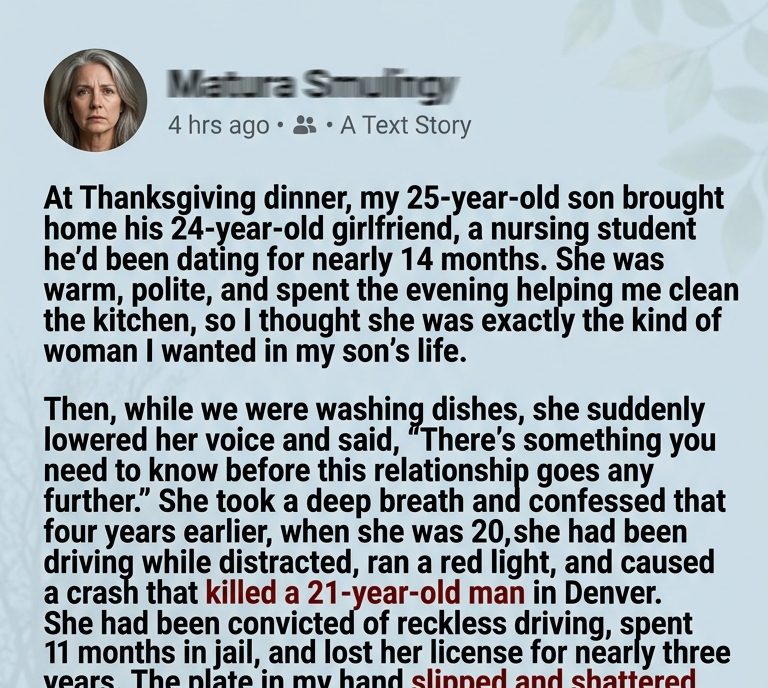
The plate slipped from my hands and shattered against the kitchen floor.
For a moment, neither of us moved.
I stared at the young woman standing across from me, my fingers trembling, my heart pounding so violently that I could barely hear the sounds of Thanksgiving dinner continuing in the next room.
Aaron Mitchell.
My oldest son’s name had come from her lips like a sentence I had been waiting four years to hear, though I had never imagined hearing it from the girlfriend of my younger son.
“I’m sorry,” she whispered. “I’m so sorry.”
Her name was Lauren. She was twenty-four, a nursing student, and she had been dating my twenty-five-year-old son, Daniel, for nearly fourteen months. She had brought a pumpkin pie to dinner, complimented my cooking, and spent the evening helping me prepare the meal. She had laughed at Daniel’s terrible jokes and listened attentively when my husband told stories about his childhood.
I had liked her.
I had even caught myself wondering whether she might eventually become part of our family.
Now I couldn’t look at her without remembering the phone call that had destroyed our lives four years earlier.
Aaron had been twenty-one when he died in Denver. He was driving home after meeting a friend when another vehicle ran a red light and struck his car. The crash was devastating. By the time the paramedics arrived, there was nothing they could do.
The driver was a twenty-year-old woman named Lauren.
She had been distracted behind the wheel. She ran the red light, caused the collision, and was later convicted of reckless driving. She spent eleven months in jail and lost her driver’s license for nearly three years.
I had followed the court proceedings. I had read the reports. I had sat through the hearing and listened to lawyers discuss my son’s final moments in language so clinical that I wanted to scream.
Afterward, I tried to rebuild my life around the empty space Aaron had left behind.
And now the woman responsible for his death was standing in my kitchen, wearing a cream-colored sweater, with tears streaming down her face.
“Daniel doesn’t know,” she said. “I swear he doesn’t know.”
I gripped the edge of the counter.
“How long have you known who I am?”
“Two weeks.”
“Two weeks?”
She nodded.
“I came here with Daniel the first time, and I saw the photograph in the hallway. The graduation picture. Aaron was standing next to Daniel, and I recognized his face from the news coverage. Then I noticed your last name.”
I remembered that visit. Daniel had brought Lauren over for coffee on a Sunday afternoon. She had stood in the hallway studying the framed photograph longer than I thought necessary.
At the time, I had assumed she was simply looking at our family pictures.
“I searched online that night,” she continued. “I found the articles about the accident. I read the court records. I knew it was him.”
“And you kept dating my son?”
Her face crumpled.
“I didn’t know what to do.”
“You had two weeks.”
“I know.”
“You sat at my table. You ate the food I prepared. You smiled at me while knowing that you had taken my son away.”
“I never wanted to hurt you.”
The words made something inside me snap.
“Then you should have told us the truth!”
My voice carried into the dining room.
I heard Daniel call out, “Mom? Everything okay in there?”
Lauren flinched.
I looked toward the doorway, unable to answer.
My younger son was sitting only a few steps away, completely unaware that his girlfriend had been responsible for his brother’s death.
“Please,” Lauren whispered. “Don’t tell him before you see what I brought.”
She reached into her handbag and pulled out a thick manila envelope.
My first instinct was to throw it back at her.
“What is that?”
“Something I should have given your family years ago.”
She placed it on the counter.
Inside were photocopies of police reports, photographs, and several pages of handwritten notes. At the bottom was a small, sealed evidence envelope containing a damaged silver keychain.
I recognized it immediately.
Aaron had carried that keychain since he was sixteen. It had been a gift from Daniel after they saved enough money together to buy their father a birthday present. The two boys had bought matching keychains, one for each of them, and Aaron had kept his on his car keys for years.
My throat tightened.
“Where did you get this?”
“The police returned some of my personal belongings after the investigation,” Lauren said. “This was among the things I found in my car after the crash. I kept it because I knew it belonged to him.”
“You kept my son’s property?”
“I tried to give it to the investigator. I was told it had been documented, but I couldn’t bear to throw it away. I should have turned it over again. I know that.”
I stared at the keychain.
It was scratched and bent, but I could still recognize the tiny mountain design engraved on its surface.
Then I noticed a folded sheet of paper beneath the photographs.
It was a printed copy of an emergency call transcript.
“What is this?”
Lauren took a shaky breath.
“The police report said I was distracted and ran the red light. That part is true. I was looking away from the road. I made a terrible decision, and Aaron died because of it. I have never denied that.”
“Then why bring me this?”
“Because there’s something in the report that was never fully explained to your family.”
She pointed to a section near the bottom of the page.
I began reading.
The document contained a summary of a witness’s emergency call. A driver traveling behind Aaron had reported seeing a third vehicle near the intersection moments before the collision. The witness described a dark pickup truck moving erratically and entering the intersection just before the impact.
The information had appeared in the original investigative notes, but the witness had not been able to provide a complete license plate number. The truck had never been identified conclusively.
I looked up.
“What are you saying?”
“I’m not saying I didn’t cause the crash,” Lauren replied quickly. “I did. I was distracted, and I entered the intersection against the light. I was responsible for that.”
“Then what does this mean?”
She swallowed.
“It means I don’t think I was the only person who made a dangerous decision that night.”
I felt my anger collide with something else: confusion.
For four years, I had believed I understood exactly what had happened. Lauren had been distracted, she had run the red light, and Aaron had died in the collision.
The courts had established her responsibility.
But the document suggested there might have been another vehicle involved in the events leading up to the crash.
“Why didn’t you tell us this earlier?”
“I tried to raise it during the investigation. My attorney told me not to speculate, and the police said they couldn’t establish that the other vehicle caused the collision. I was convicted based on what could be proven.”
She looked at the floor.
“I was afraid that if I contacted your family, you would think I was trying to escape responsibility. And I didn’t want to make your grief worse.”
I wanted to reject everything she was saying.
It would have been easier if she had arrived with nothing but excuses. I could have told her to leave, informed Daniel, and never allowed her into my home again.
But the documents were there, and I couldn’t pretend I hadn’t seen them.
“What else is in the envelope?” I asked.
Lauren hesitated before removing a second document.
It was a letter addressed to the district attorney’s office, dated several months after the crash. The letter requested that investigators review the possibility of an unidentified vehicle contributing to the collision.
The request had been acknowledged, but the response stated that the available evidence was insufficient to reopen the investigation.
I read the letter twice.
“You knew about this, and you never told us.”
“I should have. I was ashamed, and I thought nothing could change what happened.”
“Nothing can change the fact that Aaron died.”
“I know.”
“Nothing can give him back to us.”
“I know.”
Her voice broke.
“But if there was another vehicle involved, I thought your family deserved to know. Not because it makes me innocent. It doesn’t. I was looking away from the road, and I should have been paying attention. I will live with that for the rest of my life.”
For the first time, she wasn’t asking me to forgive her.
She was simply telling me what she believed I had a right to know.
From the dining room, Daniel called again.
“Mom? Lauren? What’s going on?”
I closed my eyes.
I had two choices. I could send Lauren away and try to process the information alone, or I could tell my younger son that the woman he loved had been involved in his brother’s death.
Neither choice felt survivable.
I looked at Lauren.
“Did you come here planning to tell Daniel?”
“Yes.”
“Then why haven’t you?”
“Because every time I look at him, I remember that he lost Aaron too. I know I don’t deserve to ask him for anything. But I love him, and I can’t keep lying to him.”
I took a slow breath.
“You don’t get to decide how much truth he can handle.”
“I know.”
“And you don’t get to decide whether he forgives you.”
“I know.”
I picked up the envelope.
“Then we’re going to tell him together.”
Daniel appeared in the kitchen doorway a moment later, carrying two empty glasses.
He looked from my face to Lauren’s and immediately frowned.
“What’s going on?”
I couldn’t speak at first.
Lauren stepped forward.
“Daniel, there’s something about my past that I should have told you before we started dating.”
He gave her a puzzled smile.
“Okay?”
She began to cry.
“Four years ago, I was involved in a car crash in Denver. I was distracted while driving, and I ran a red light. Another car was struck, and the driver died.”
Daniel’s smile disappeared.
“Who was the driver?”
Lauren looked at him through her tears.
“Aaron.”
The glasses slipped from Daniel’s hands and landed on the carpet. One rolled beneath the table.
He stared at her as if she had begun speaking another language.
“No.”
“Daniel—”
“No. Don’t say his name.”
“I am so sorry.”
He stepped backward.
“You knew who he was when you met me?”
“No. I only realized two weeks ago, when I saw the photograph in your hallway.”
“And you kept it from me?”
“I was afraid.”
Daniel laughed once, a short, disbelieving sound.
“You were afraid?”
He turned toward me.
“Mom, is this true?”
I nodded, tears streaming down my face.
He looked back at Lauren.
“You’ve been sitting next to me on the couch. You’ve met my friends. You’ve listened to me talk about Aaron. And you knew?”
“I didn’t know at first,” she said. “I swear. I should have told you the moment I found out.”
He shook his head.
“I can’t look at you.”
He walked out of the kitchen and disappeared upstairs.
Lauren started to follow, but I held up my hand.
“Give him space.”
She stopped.
The Thanksgiving dinner we had spent all day preparing sat untouched on the dining room table. My husband, who had been talking with relatives in the living room, came into the kitchen and saw the broken glass.
“What happened?”
I told him.
He listened without interrupting. When I finished, he looked at Lauren with an expression I had never seen on his face before.
“You need to leave,” he said quietly.
She nodded.
“I understand.”
Before she walked out, she placed the envelope on the counter.
“Please have someone independent review these records,” she said. “I am not asking you to believe me. I just don’t want the possibility to disappear because no one wants to hear it from me.”
Then she left.
That night, nobody ate much. Our relatives departed early, and Daniel stayed upstairs with his bedroom door locked. My husband and I sat at the kitchen table long after midnight, examining the documents.
I didn’t know what to believe.
Lauren had caused the crash. She had been convicted. Her punishment had been decided through the legal process, and nothing in the envelope erased her responsibility.
But if another vehicle had been present, we needed to know whether that information had been properly investigated.
The following morning, I contacted an attorney who had experience reviewing accident records. I asked for an independent assessment and provided copies of the documents. We also contacted the appropriate authorities to ask whether the original case file contained additional evidence concerning the unidentified pickup truck.
I made it clear that I wasn’t asking anyone to clear Lauren’s name. I wanted an accurate account of what had happened to Aaron.
The review took several weeks.
Investigators examined the original scene photographs, the emergency call records, the witness statement, and the physical evidence from the vehicles. They also reviewed an archived traffic-camera record that had not been available when the original investigation was completed.
The footage was grainy, but it showed a dark pickup truck approaching the intersection shortly before the collision. The truck appeared to change lanes abruptly, then continued through the intersection without stopping.
It did not prove that the truck had caused the crash. It did, however, support the witness’s recollection that another vehicle had been present.
The authorities reopened a limited review of the evidence.
Eventually, they identified the pickup’s registered owner, who had since moved out of state. After further inquiries, investigators located the driver who had been using the vehicle that night.
He was interviewed.
His account was inconsistent with the available records, and he initially denied having been near the intersection. Investigators found additional evidence suggesting that he had been driving aggressively before the crash, but they could not establish that his actions alone had caused Aaron’s death.
The final review did not overturn Lauren’s conviction. She had been distracted, and her decision to run the red light had been a proven and significant cause of the collision.
But it established something our family had never known: another driver had been present, and his dangerous conduct had contributed to the sequence of events that ended with Aaron’s death.
The discovery didn’t make the tragedy easier to accept.
It made it more complicated.
I felt anger toward the unidentified driver, sadness for the young woman Lauren had been at twenty, and a renewed wave of grief for Aaron. I also felt frustrated that the information had not been fully explained to us at the time.
But the greatest surprise was what happened next.
Daniel asked to speak with Lauren.
He did not invite her over. He met her in a public park near the university where she studied nursing. He told me afterward that he had spent days deciding whether he wanted to hear her out.
When he finally sat across from her, he asked only one question.
“Did you ever think about Aaron after the crash?”
Lauren began crying before she answered.
“Every day.”
She told him about the years she had spent living with what she had done. She explained that she had completed her sentence, attended counseling, and worked to understand the consequences of distracted driving. She had chosen nursing partly because she wanted to spend her life helping people, though she knew no amount of good work could undo the harm she had caused.
“I don’t expect you to forgive me,” she told him. “I don’t expect you to stay with me. I just wanted you to know the truth.”
Daniel listened without speaking.
When she finished, he said, “I don’t know if I can be in a relationship with you right now.”
She nodded.
“I understand.”
“But I don’t want to pretend I never knew you, either. You were honest about what happened eventually, even though you should have told me sooner. And you brought my family information that deserved to be examined.”
He paused.
“I need time.”
Lauren agreed.
For several months, they did not date. Daniel focused on his work and spent more time with his father and me. He visited Aaron’s grave, something he had struggled to do since the funeral, and talked openly about the anger and grief he had kept inside.
I also had to confront my own feelings.
Part of me wanted Lauren to disappear from our lives forever. I had lost one son, and the thought of accepting the woman responsible for his death into our family felt unbearable.
But I eventually understood that forgiveness was not an obligation, and neither was hatred.
I could hold Lauren accountable without pretending she was nothing more than the worst thing she had ever done. I could acknowledge the harm she had caused without ignoring the truth she had brought to us.
Most importantly, I could allow Daniel to make his own decisions.
Nearly a year after Thanksgiving, Daniel told us that he and Lauren had begun speaking again. They were taking things slowly, and he had made it clear that he might never feel the same way about their relationship.
I didn’t tell him whether he should stay with her.
Instead, I told him what I wished I had understood sooner.
“You don’t have to choose between loving your brother and deciding what kind of future you want. Aaron will always be part of your life. Nothing changes that.”
Daniel nodded, his eyes filling with tears.
We still visit Aaron’s grave on his birthday. We still tell stories about his terrible singing, his love of mountain roads, and the way he always called me when he needed advice he pretended he didn’t want.
The unidentified driver’s role in the crash did not erase Lauren’s responsibility. And the documents she brought to our kitchen did not give our family a happy ending.
They gave us a fuller understanding of a tragedy we had spent years trying to comprehend.
That Thanksgiving, I had believed the woman standing beside me was about to confess something unforgivable and ask us to carry the burden of her guilt.
Instead, she brought evidence that forced us to reconsider part of the story we had been told.
She should have spoken sooner. She should never have allowed Daniel to build a relationship with her without knowing the truth.
But when the moment finally came, she did not ask us to forget Aaron or pretend his death had been an accident without consequences.
She gave us the documents and let us decide what to do with them.
I still miss my oldest son every day. No new evidence can change the fact that he should have come home that night.
But I have learned that truth and forgiveness are separate things. We can seek one without promising the other. We can hold people responsible while still allowing facts to speak for themselves.
And sometimes, the first step toward understanding a painful past is not deciding whom to hate.
It is being willing to look at the whole story, even when the truth is harder than the version we have carried for years.