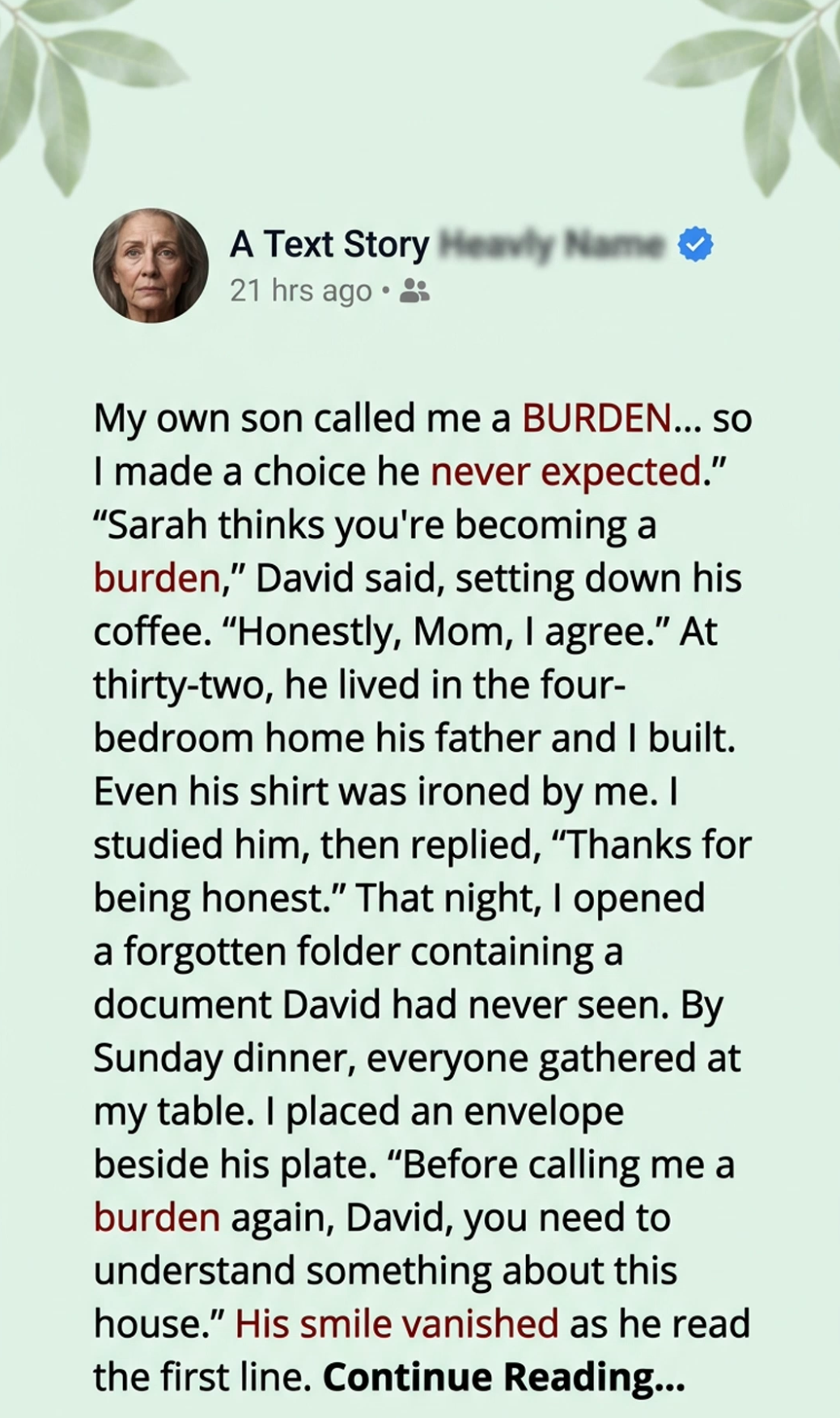
My name is Margaret Ellis, and I was sixty-seven years old when my only son told me I had become a burden.
I had imagined many painful moments in my old age. I had imagined losing friends, struggling with my husband’s absence, and waking up in a house that seemed too quiet after decades of family life.
But I had never imagined that the boy I once carried through fevers, sleepless nights, and schoolyard disappointments would sit across from me at the breakfast table and explain that my presence had become an inconvenience.
The worst part was not the word itself.
It was how calmly he said it.
David was thirty-two, handsome in the polished way of a man who had never needed to worry about whether his shirt was ironed or his dinner would be ready when he came home. He lived in the four-bedroom house his father and I had bought when David was six. His wife, Sarah, lived there too, along with their seven-year-old daughter, Lily.
I had welcomed them into my home three years earlier when David told me they needed time to recover financially after their apartment rent increased and Sarah’s workplace reduced her hours.
“Just six months, Mom,” he had promised. “We’ll save money, get back on our feet, and find a place of our own.”
Six months had become three years.
I had never charged them rent.
I cooked most of the meals, bought groceries whenever I went shopping, cleaned the downstairs rooms, and made sure Lily had breakfast before school. I ironed David’s shirts because he complained that the laundry service was expensive. I watched Lily when school closed unexpectedly and stayed up when Sarah worked late.
I did all of it because I loved them.
And because, after my husband, Robert, died, having my family under one roof made the silence less painful.
Robert had been gone for four years. He died after a short battle with pancreatic cancer, leaving me with a house full of memories and a savings account that was comfortable but not limitless.
He had always been careful with money. We bought our house in 1997, paid off the mortgage years before his death, and kept our financial affairs organized in a filing cabinet in his study.
Robert used to say that a home was more than walls and a roof.
“It is the place where people should feel safe,” he told me once. “But never forget, Maggie, that a house can become a prison if you let other people decide what you’re allowed to do inside it.”
At the time, I thought he was talking about the outside world.
I never imagined he might have been preparing me for my own family.
The morning David called me a burden began like any other Tuesday.
I had risen at six, put a load of laundry into the washing machine, prepared scrambled eggs, and made coffee. David came downstairs wearing the pale blue shirt I had ironed the previous evening.
He checked his phone while I placed a plate in front of him.
“Sarah wants to talk to you,” he said.
I sat across from him.
“About what?”
“She thinks you’re becoming a burden.”
The words were so unexpected that I thought I had misunderstood.
“What did you say?”
David sighed, as though I were making a simple conversation unnecessarily difficult.
“She says you do too much around the house and then expect everyone to be grateful. She feels like we have to organize our lives around you.”
I stared at him.
“I have never asked either of you to organize your lives around me.”
“Mom, please don’t start.”
“Start what?”
“This. Making everything emotional.”
I placed my coffee cup on the table.
“David, I make your breakfast. I do your laundry. I look after your daughter. I pay the household bills from my own account, and I have never charged you rent. How exactly am I making your life difficult?”
He leaned back in his chair.
“That’s the problem. You do all these things, and then you act as if we owe you something.”
I felt a tightness in my chest.
“Do you believe I expect payment for loving my family?”
He rubbed his forehead.
“That’s not what I said.”
“It is what you implied.”
He glanced toward the stairs, where Sarah was still getting ready for work.
Then he lowered his voice.
“Honestly, Mom, I agree with Sarah. We need more independence. You need to understand that we’re adults now. We can’t spend the rest of our lives feeling responsible for you.”
For a moment, I heard nothing except the refrigerator humming in the kitchen.
I looked at the man sitting across from me.
I remembered him at eight years old, crying because the other children had made fun of his homemade Halloween costume. I remembered him at seventeen, standing in the rain beside his broken-down car while Robert drove forty minutes to rescue him. I remembered him at twenty-six, calling me after midnight because he had lost a job and did not know how he would pay his bills.
I had never asked him to repay those moments.
I had simply been his mother.
Now he was telling me that my existence had become a responsibility he resented.
I could have reminded him of every sacrifice I had made.
I could have cried.
I could have demanded an apology.
Instead, I looked him in the eyes and said, “Thank you for being honest.”
He seemed surprised.
Perhaps he had expected an argument. Perhaps he had prepared a list of reasons I was too sensitive.
When I did not provide the reaction he wanted, he picked up his coffee and stood.
“I’m glad you understand.”
He walked out of the kitchen.
I remained at the table long after his car had left the driveway.
Then I cleared his plate, washed his cup, and folded the dish towel over the sink.
My hands were steady.
That frightened me more than tears would have.
For years, I had measured my worth by how useful I was to the people I loved. If someone needed a meal, I cooked. If someone needed money, I helped. If someone was upset, I listened.
I had mistaken being needed for being valued.
That morning, my son had finally shown me the difference.
I spent the rest of the day doing what I always did, but something inside me had changed.
I did not iron David’s next shirt.
I did not prepare the elaborate dinner Sarah had mentioned wanting earlier in the week.
I made soup for myself, ate it at the kitchen table, and went upstairs to Robert’s study.
The room had barely changed since his death. His desk remained beside the window. His reading glasses sat in a wooden tray. The filing cabinet stood against the wall beneath a framed photograph of us on our twenty-fifth wedding anniversary.
I had avoided the room because everything in it reminded me of what I had lost.
That evening, I entered it for a different reason.
I wanted to understand what Robert had meant when he told me never to let other people decide what I was allowed to do inside my own home.
I opened the filing cabinet and began sorting through the folders.
There were tax returns, insurance policies, old bank statements, receipts from home repairs, and the paperwork from Robert’s estate.
Near the bottom, behind a folder marked PROPERTY, I found a thick manila envelope.
My name was written across the front in Robert’s handwriting.
I sat down before opening it.
Inside were several documents, including a certified copy of our property deed, a will, and a letter dated six months before Robert died.
I unfolded the letter.
Maggie,
If you are reading this because life has become difficult, I hope you remember that you are not obligated to sacrifice your peace to keep everyone else comfortable.
I know you. You will give and give until you have nothing left, then apologize for needing a little kindness in return.
Our house is yours. We bought it together, paid for it together, and built our life here together. Do not let anyone convince you that being a mother means surrendering your right to make decisions about your own home.
If David ever needs help, help him because you choose to—not because you are afraid he will stop loving you.
You have always been stronger than you realize. Please use that strength for yourself sometimes.
All my love,
Robert
I read the letter twice.
Then I pressed it against my chest and cried.
Robert had known me better than anyone.
He had understood that my greatest weakness was not generosity. It was the belief that I had to earn the right to be loved.
But it was the property documents that made me sit up straight.
I had always known the house was mine. Robert and I had purchased it jointly, and after his death, ownership had passed to me under the estate arrangements.
What I had forgotten was the separate document Robert had prepared after we paid off the mortgage.
It was a declaration of ownership and a set of estate-planning instructions that made the position unmistakably clear.
The house was not David’s.
It was not Sarah’s.
It was not a family asset that could be claimed by whoever happened to live in it.
It was mine.
I was the sole legal owner.
And there was nothing in any document that gave David the right to decide when I should leave.
I placed the papers neatly on the desk.
For the first time since Robert died, I felt something other than grief in that room.
I felt prepared.
The following morning, I called an attorney named Helen Brooks, whom Robert and I had consulted years earlier about our estate.
Helen was retired from active practice, but she referred me to a colleague, Mr. Thomas Bennett, who specialized in property and elder-law matters.
I explained the situation without exaggeration.
I told him my son and his family had been living in my home without paying rent. I told him that my son had begun describing me as a burden and that I wanted to understand my rights before deciding what to do.
He listened carefully.
“First,” he said, “do not assume that a difficult family conversation automatically gives you grounds to remove someone immediately. The law can treat long-term occupants differently depending on the jurisdiction and the circumstances.”
I appreciated his honesty.
He reviewed my deed and estate documents, then explained that I remained the owner and that David had no ownership interest in the property.
He also explained that if I decided the living arrangement should end, I would need to follow the applicable local procedures, including any required written notice.
“Your goal should be to protect your rights without creating unnecessary legal complications,” he said.
“What if my son says he has a right to stay because he’s my child?”
“Being your child does not automatically make him the owner of your home. But we should handle any change in occupancy correctly.”
I asked him to prepare a written summary of my options.
Before we ended the meeting, I asked one more question.
“Can I change how much I do for them without making it a legal issue?”
He paused.
“Of course. You are allowed to stop providing unpaid domestic services. You can decide what you cook, what you clean, and how you spend your time. You do not need a lawyer’s permission to establish ordinary personal boundaries.”
I thanked him.
When I hung up, I felt as if a window had opened in a room that had been closed for years.
I did not have to throw anyone out that afternoon.
I did not have to make a dramatic announcement.
I simply had to stop behaving as though I were a guest in my own home.
On Thursday, I changed my routine.
I made breakfast for myself and left the remaining ingredients on the counter.
When David came downstairs, he opened the refrigerator and looked around.
“Is there anything to eat?”
“Eggs, bread, and fruit,” I replied.
“Didn’t you make breakfast?”
“I made mine.”
He stared at me.
“Are you feeling okay?”
“I’m fine.”
He looked as though he wanted to say more, but he eventually made toast.
That afternoon, I did my laundry and left his clothes in the basket where he had placed them.
When he came home and discovered his shirts had not been ironed, he appeared in the kitchen holding one.
“Mom, I need this for tomorrow.”
“You’ll have to iron it yourself.”
He laughed as though I had made a joke.
I did not laugh with him.
“I’m serious, David.”
His expression changed.
“What’s going on with you?”
“Nothing is going on with me. I’m simply taking care of my own responsibilities instead of automatically taking care of yours.”
He shook his head and walked away.
That evening, Sarah found me reading in the living room.
“David says you’re upset about something.”
I closed my book.
“Your husband told me I was becoming a burden.”
She looked uncomfortable.
“He probably shouldn’t have used that word.”
“Do you disagree with what he said?”
Sarah crossed her arms.
“I think we all need more privacy. It’s difficult having another adult in the house.”
I nodded slowly.
“I understand that. It can be difficult for me, too.”
She seemed surprised.
“I don’t think you realize how much we do for you,” she said.
I looked at her.
“What do you believe you do for me?”
She hesitated.
“We keep you company. We make sure you’re not alone.”
The words hurt more than I expected.
I had not asked them to move in because I was incapable of living alone. I had welcomed them because they said they needed help.
But over time, the story had changed. My generosity had become their sacrifice. My home had become their accommodation. My presence had become a burden they were nobly tolerating.
“I appreciate having family around,” I said. “But I am perfectly capable of living independently. I don’t need you to manage my life.”
Sarah’s face tightened.
“That’s not what I meant.”
“Then perhaps you and David should think carefully about what you do mean.”
She left the room.
I returned to my book, although I had to reread the same paragraph several times before I could concentrate.
For the first time, I was not trying to repair the discomfort I had caused by speaking honestly.
I was allowing it to exist.
On Saturday morning, David approached me while I watered the plants on the back patio.
“Mom, we need to talk.”
I set down the watering can.
“I’m listening.”
He rubbed the back of his neck.
“Sarah thinks things are getting tense. We don’t want Lily caught in the middle.”
“Neither do I.”
“Maybe you should spend more time with your friends. Take a trip. Get out of the house a little.”
I studied him.
“Are you suggesting I leave?”
“No. I’m saying you need a life of your own.”
“I have a life of my own, David.”
He sighed.
“You know what I mean.”
“Yes,” I replied. “I think I do.”
He looked toward the garden.
“It’s just that we can’t live like this forever.”
I nodded.
“Then we should discuss a plan for your family to find a place of its own.”
His head snapped toward me.
“What?”
“You said you need independence. I agree. You and Sarah should begin looking for a home you can afford.”
His face flushed.
“Mom, we can’t afford to move right now.”
“You told me three years ago that you needed six months.”
“We’ve had expenses.”
“So have I.”
He stared at me as if I had betrayed him.
I felt a brief, familiar urge to soften my position.
Then I remembered his words at the breakfast table.
We can’t spend the rest of our lives feeling responsible for you.
I took a breath.
“I’m not asking you to move tomorrow. I’m asking you to begin making a realistic plan. I’ll discuss the timeline with you after I’ve received legal advice.”
“You’re making this sound like we’re strangers.”
“No, David. I’m treating you like an adult.”
He walked away without answering.
That evening, I made a decision.
I would invite everyone to Sunday dinner.
Not to humiliate my son.
Not to threaten him.
Not to reveal the property documents as some kind of theatrical revenge.
I would do it because the arrangement could not continue under the same unspoken assumptions. Everyone needed to understand the facts, and I needed to stop pretending that avoiding conflict was the same as preserving peace.
I called David and Sarah into the dining room and told them I wanted us to sit down after dinner the following evening.
David looked annoyed.
“Is this about the house again?”
“Yes,” I replied. “It’s about our living arrangement and what happens next.”
He exchanged a glance with Sarah.
“Fine.”
Sunday arrived with a cold wind and gray clouds.
I spent the morning doing something I had not done in years.
I went for a long walk.
I visited the little bakery Robert and I used to frequent on Saturday mornings, ordered a cup of tea, and sat by the window watching people pass.
I thought about my husband.
I thought about the life we had built.
I thought about the son we had raised and the woman I had become while trying to keep him happy.
When I returned home, I felt calmer.
I prepared a simple dinner of roast chicken, potatoes, and green beans. I did not spend hours making multiple desserts. I did not rush around checking whether everyone had enough food.
I set the table for four and placed an envelope beside David’s plate.
Inside were copies of the deed, the relevant estate documents, and a short letter from my attorney confirming the basic ownership facts and explaining that any future change to the living arrangement would be handled according to the law.
I had asked the attorney to review the letter before I brought it home. It contained no threats, no invented deadlines, and no claims that David had already lost any rights he might have as an occupant.
It simply stated what was true.
The house belonged to me.
At six, David and Sarah came downstairs with Lily.
Lily ran over and hugged me.
“Grandma, are we having apple pie?”
“Not tonight, sweetheart. But we can make one together next weekend.”
She smiled and went to wash her hands.
David sat at the table, noticed the envelope, and frowned.
“What’s that?”
“Something we need to discuss after dinner.”
He pushed it away.
“Can we just eat first?”
“Of course.”
For half an hour, we talked about ordinary things. Lily told us about a class project. Sarah described a problem at work. David complained about traffic.
I listened, but I no longer felt responsible for making every silence comfortable.
When we finished eating, I cleared the plates and brought out tea.
Then I sat down across from my son.
“David, last Tuesday morning, you told me that Sarah thought I was becoming a burden and that you agreed.”
He shifted in his chair.
“Mom, I already told you we need more independence.”
“You did. And I listened.”
I placed my hands on the table.
“I have thought carefully about what you said. I agree that your family needs independence. I also need to make decisions about my own life.”
He frowned.
“What does that mean?”
“It means we need to change our living arrangement.”
Sarah immediately spoke.
“We knew this was coming. You’re upset, and now you’re punishing us.”
“No,” I said. “I’m responding to what David told me. You both want a more independent life. That is reasonable. But I cannot continue to provide a home, meals, laundry, childcare, and household expenses while being told that my presence is an inconvenience.”
David leaned forward.
“We never said you had to do all that.”
“You didn’t have to. I chose to do it. And now I am choosing to stop.”
He shook his head.
“This is unbelievable.”
I pushed the envelope toward him.
“Please read this before you decide what is unbelievable.”
He opened it impatiently.
The first page was a copy of the property deed.
His eyes moved across the document.
Then he stopped.
He read the first line again.
His face changed.
“What’s this?”
“The deed to the house.”
“I know what a deed is.”
“Then you know whose name is on it.”
He looked up at me.
“Your name.”
“Yes.”
He flipped to the next page.
“This says you are the sole owner.”
“That is correct.”
He turned another page and found the estate document.
“Dad left you the house?”
“The house was ours. After he died, ownership passed to me under the arrangements we made.”
David looked genuinely stunned.
“Why didn’t you ever tell me?”
I held his gaze.
“You never asked.”
He opened his mouth, then closed it.
Sarah leaned across the table to read the papers.
“So what are you saying? That we have no rights?”
“I am saying the house belongs to me. Your right to occupy it, and any steps needed to change the arrangement, will be handled properly. I have consulted an attorney so that no one acts on assumptions.”
David pushed the papers away.
“Are you threatening to throw us out?”
“No. I’m telling you that the current arrangement cannot continue indefinitely.”
His voice rose.
“We have a child! Where are we supposed to go?”
I felt a deep ache at the mention of Lily.
I loved my granddaughter more than I could explain. I would never want her to feel unsafe or unwanted.
But loving Lily did not mean surrendering my home to her parents forever.
“You have time to make a plan,” I said. “I’m not asking you to leave tonight. We will discuss a reasonable transition with my attorney’s guidance. But I will no longer be treated as though I owe you my home simply because you live here.”
Sarah’s eyes filled with tears.
“We thought this was our family home.”
“It is the home where our family has lived,” I replied. “That doesn’t make it yours.”
David stood so abruptly that his chair scraped the floor.
“Dad would never have wanted this.”
The words struck me hard.
For a moment, I felt Robert’s absence as sharply as I had the day he died.
Then I remembered his letter.
Do not let anyone convince you that being a mother means surrendering your right to make decisions about your own home.
“Your father wanted you to become independent,” I said. “He wanted you to build a life of your own. He did not work for decades so that I could be made to feel unwelcome in the house we built together.”
David looked away.
“You’re making me sound like a terrible son.”
“I am not calling you anything. I am telling you how your words affected me and what I intend to do about the living arrangement.”
He picked up the envelope and stared at the documents.
Then, quietly, he asked, “So what happens now?”
It was the first reasonable question he had asked all evening.
“Now, you and Sarah begin planning for a home of your own. We will agree on a fair timeline after reviewing the legal requirements. Until then, we will establish clear expectations about expenses, chores, privacy, and childcare.”
Sarah wiped her eyes.
“And if we can’t afford anything?”
“Then we will discuss your budget and look at realistic options. I am willing to help you plan. I am not willing to be treated as a burden while providing everything for you.”
David sat down slowly.
For several minutes, nobody spoke.
Lily had been quiet throughout the conversation. She sat beside Sarah, looking from one adult to another.
Finally, she asked, “Grandma, are we going to have to leave you?”
My heart broke a little.
I moved to the chair beside her.
“No, sweetheart. You are always welcome to visit me. Your parents and I are working out where everyone will live. This is an adult problem, and you don’t have to solve it.”
She reached for my hand.
“Will you still make pancakes when I come over?”
I smiled.
“Absolutely.”
David looked at us, and something in his expression softened.
For the first time that evening, he seemed to understand that the conversation was not about abandoning his family.
It was about ending an arrangement that had allowed everyone to avoid responsibility except me.
The weeks that followed were difficult.
David was angry at first. He accused me of changing the rules and said I was making Sarah feel unwelcome. My mother called after he told her what had happened and asked why I was being so harsh.
I explained that I was not throwing my son into the street. I was asking a grown man and his wife to make a plan for their future.
My mother sighed.
“Family should help each other.”
“I agree,” I said. “But help should not require one person to surrender all her choices.”
She had no answer to that.
David and Sarah met with a financial counselor and began reviewing their expenses. They discovered that moving would be difficult, but not impossible. They had been spending more than they realized on dining out, subscriptions, and shopping because they had not been paying rent.
They began saving.
I also stopped providing automatic services.
Everyone was responsible for their own laundry. David and Sarah bought groceries for their meals and contributed to household expenses while they remained in the house. We created a schedule for shared spaces and agreed that I would help with Lily only when I was available, not whenever they assumed I would be.
The changes were uncomfortable.
They were also necessary.
At first, David treated every new boundary as a personal rejection. If I went out with friends instead of watching Lily, he looked disappointed. If I declined to cook dinner, Sarah complained that the evening became difficult.
I reminded them that I had my own plans.
Gradually, they adjusted.
I began attending a weekly book club at the library. I joined a gardening group and took a short painting class, something I had wanted to do since I was young.
I started having lunch with two old friends I had not seen regularly since Robert became ill.
For the first time in years, I had entire afternoons that belonged only to me.
I discovered that I enjoyed my own company.
I also discovered that the house felt different when I stopped trying to manage every person’s mood.
The kitchen became quieter. The laundry room no longer overflowed with David’s clothes. I no longer woke at dawn to prepare breakfast for people who considered my effort an obligation.
I was still a mother.
I was still a grandmother.
But I was no longer the household’s unpaid staff.
Three months after our Sunday dinner, David knocked on the door of Robert’s old study.
I was sorting photographs.
“Can I come in?”
“Of course.”
He sat in the chair opposite me.
For a while, he said nothing.
Then he looked at the framed photograph of his father.
“I found Dad’s old toolbox in the garage.”
I smiled faintly.
“He kept everything.”
“He taught me how to repair the back fence with that toolbox. I remember him saying that if you wanted something to last, you had to take care of it.”
He rubbed his hands together.
“I’ve been thinking about what I said to you.”
I waited.
“I shouldn’t have called you a burden.”
The apology was quiet and awkward.
But it was an apology.
“No,” I said. “You shouldn’t have.”
He nodded.
“I was frustrated. Sarah and I have been arguing about money, and I took it out on you.”
“I’m sorry you’re having a difficult time. But your frustration doesn’t make it acceptable to speak to me that way.”
“I know.”
He looked down.
“I think I got used to everything you did. I stopped noticing it.”
I felt tears gathering behind my eyes, but I did not rush to reassure him.
“That is what hurt the most,” I said. “Not that you needed help. Not that you wanted independence. It was that you could receive so much from me and still see me as the problem.”
He swallowed.
“I don’t want you to feel that way.”
“Then your actions need to change.”
He nodded again.
“I want to change them.”
I studied my son.
I could see the little boy he had been, but I could also see the adult he needed to become.
“I’m glad you’re saying that,” I replied. “And I hope you mean it.”
He stood and walked toward the door.
Before leaving, he turned back.
“Can you show me where Dad kept the instructions for the lawn mower?”
I smiled.
“They’re probably in the garage, in the top drawer of the workbench.”
He laughed softly.
“Of course they are.”
For the first time in months, we shared a moment that did not revolve around conflict.
It did not solve everything.
But it was real.
By the sixth month, David and Sarah had saved enough for a deposit on a modest rental house about fifteen minutes away. It was smaller than my home, but it had three bedrooms, a little garden, and a kitchen where Sarah could cook without feeling watched.
They planned their move carefully.
I helped Lily pack her books and favorite toys. I gave her a small framed photograph of Robert holding her as a baby.
“You can keep this in your new room,” I told her.
She hugged it against her chest.
“Grandpa would like our new house, wouldn’t he?”
“I think he would like that you’re growing up in a place where you can make your own memories.”
She smiled.
On moving day, David carried boxes down the stairs while Sarah organized the car. I stood in the doorway and watched them move the last of their belongings.
My son came back inside after the final box had been loaded.
He looked around the living room.
“I never realized how much stuff we had.”
I laughed.
“You had three years to collect it.”
He smiled, then became serious.
“Thank you for letting us stay while we got ourselves together.”
I nodded.
“You were welcome here. I just needed the arrangement to have an ending.”
He looked toward the dining room.
“I’m sorry it took me so long to understand.”
I wanted to say that he should have understood sooner.
Instead, I said, “I hope we can do better from now on.”
He hugged me.
It was not the desperate embrace of a frightened child. It was the slightly awkward hug of a grown man who was learning how to stand on his own feet.
When he stepped away, I could see that he was holding back tears.
“I love you, Mom.”
“I love you too.”
Then he left.
I stood in the doorway until his car disappeared down the street.
For a few moments, the house felt painfully empty.
I walked through the rooms, noticing the places where their belongings had been. The corner where Lily’s toys had gathered. The spare bedroom where David kept boxes he never unpacked. The kitchen counter where Sarah left her handbag every evening.
I expected to feel abandoned.
Instead, I felt something I had not felt in years.
Space.
Not just physical space, but room to breathe, room to think, and room to decide what I wanted the next chapter of my life to look like.
I cleaned the house slowly over the following week. I moved a reading chair into the sunny corner of the living room and turned the spare bedroom into a small art studio.
I bought fresh flowers for the dining table.
I began cooking meals I enjoyed, even when they were too simple or unusual for anyone else.
On Saturday mornings, I walked to the bakery with a book in my bag and ordered tea without checking whether anyone needed anything from me.
I still saw David and his family regularly.
They came over for Sunday lunch twice a month, and sometimes I visited their house. David began ironing his own shirts. Sarah took responsibility for her family’s meals and laundry. They paid their bills, managed Lily’s schedule, and learned to ask for help instead of assuming it would appear.
Our relationship improved because it became more honest.
David no longer treated my time as something that belonged to him.
I no longer treated every request as an obligation.
And when I helped, I did so because I wanted to—not because I was afraid of disappointing him.
A year after the breakfast conversation, David invited me to dinner at his house.
When I arrived, the kitchen was a little chaotic. A pot of pasta boiled on the stove, Lily was setting out plates, and Sarah was trying to find a serving spoon.
David stood over a pan of sauce with a dish towel over his shoulder.
“Don’t laugh,” he said. “I’m trying to make your tomato sauce.”
I tasted a spoonful.
“It needs more basil.”
He grinned.
“I knew you’d say that.”
We ate together at their small dining table. The chairs were mismatched, and the meal was not perfect. Lily spilled water, David burned the garlic bread, and Sarah forgot to put the salad dressing on the table.
But nobody seemed ashamed.
Nobody expected me to repair everything.
After dinner, David helped Lily with her homework while Sarah and I washed the dishes together.
Later, he walked me to my car.
“Mom, can I tell you something?”
“Of course.”
“When you gave me that envelope, I thought you were trying to punish me.”
I waited.
“Now I realize you were showing me that I had confused being comfortable with being entitled.”
I looked at him.
“That’s a hard thing to recognize.”
“I know. I also realized that when I called you a burden, I was describing the responsibility I didn’t want to take for my own life.”
His voice faltered.
“I made you responsible for too much, and then blamed you for being there.”
For a moment, I could not speak.
I had not expected him to understand it so clearly.
“Thank you for saying that,” I replied.
He hugged me.
This time, I held him a little longer.
When I drove home, I thought about Robert’s letter.
Help him because you choose to—not because you are afraid he will stop loving you.
I finally understood that love did not require me to be endlessly available.
It did not require me to sacrifice my independence, silence my hurt, or accept disrespect in exchange for a place in my son’s life.
Love could include boundaries.
It could include difficult conversations.
It could even include saying no.
And sometimes, the most loving thing a mother could do was allow her child to discover what it meant to be responsible for his own life.
I still kept the envelope in Robert’s study.
Not because I needed to remind David who owned the house.
Not because I planned to use it against him.
I kept it because it marked the day I stopped asking permission to belong in my own life.
My son had called me a burden.
I could have spent the rest of my days trying to prove that I was useful enough to deserve his respect.
Instead, I made a choice he never expected.
I chose myself—not instead of my family, but alongside the love I had for them.
I chose to protect my peace.
I chose to make decisions without apologizing for being an adult with needs and dreams of my own.
And I chose to leave the door open to a healthier relationship, one built on mutual respect rather than guilt.
Today, my house is quieter than it used to be.
Sometimes I miss the sound of Lily running down the stairs. Sometimes I make too much soup and find myself wishing there were more people around the table.
But I no longer confuse an empty chair with being unwanted.
I fill my days with friends, books, gardening, painting, and visits with the people I love. I travel when I can. I spend money on things that bring me joy without feeling guilty that I might someday need it to rescue someone else.
And when David calls, I answer because I want to hear his voice—not because I fear what will happen if I don’t.
My son once believed that my value depended on how much I could do for him.
Now he is learning that a mother’s love is not an unlimited service, and that gratitude should never be a condition she has to beg for.
As for me, I have learned something even more important.
You can love your children without handing them the keys to your peace.
You can help your family without making yourself responsible for every problem they face.
And you can grow older without surrendering your right to choose how you live.
The house Robert and I built is still standing. Its walls hold the memories of our marriage, our son’s childhood, and the years we worked to create a secure future.
But it is no longer the place where I quietly prove my worth by doing everything for everyone else.
It is my home.
And after years of putting myself last, I have finally learned that I belong there just as much as anyone I love.
The envelope changed the way my son saw the house.
The choice I made changed the way I saw myself.