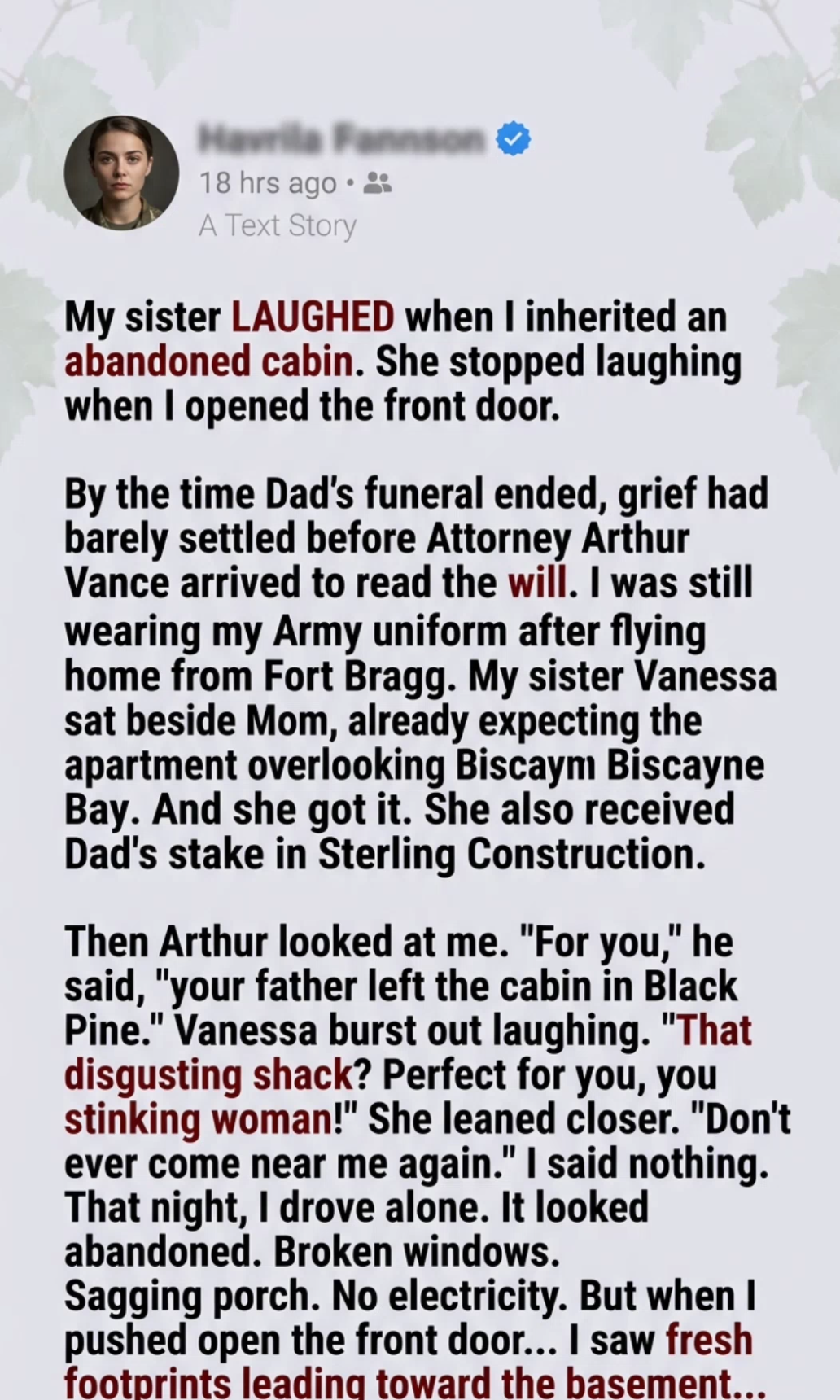
By the time Dad’s funeral ended, grief had barely settled before Attorney Arthur Vance arrived to read the will. I was still wearing my Army uniform after flying home from Fort Bragg. My sister Vanessa sat beside Mom, already expecting the Miami apartment overlooking Biscayne Bay.
And she got it. She also received Dad’s stake in Sterling Construction.
Then Arthur looked at me.
“For you,” he said, “your father left the cabin in Black Pine.”
Vanessa burst out laughing.
“That disgusting shack? Perfect for you, you stinking woman!”
She leaned closer.
“Don’t ever come near me again.”
I said nothing.
That night, I drove alone through the mountains. The cabin looked abandoned. Broken windows. Sagging porch. No electricity. The front door hung crookedly on its hinges.
But when I pushed it open, I saw fresh footprints leading toward the basement.
And someone had been down there recently.
I stood in the doorway for nearly a minute, listening.
The wind moved through the pine trees. Somewhere inside the cabin, a floorboard creaked.
I reached for the flashlight in my truck, then returned and stepped inside.
The smell hit me first: damp wood, cold ashes, and something faintly familiar.
Dad’s tobacco.
He had quit smoking twenty years earlier, but the scent seemed to have settled into the old timber itself.
I followed the footprints across the dusty floor. They were not random. Someone had walked from the front door toward a narrow staircase at the back of the cabin.
The basement door was closed.
I turned the handle.
It was locked.
Then I heard a voice from the other side.
“Who’s there?”
I froze.
“Identify yourself,” I called.
A long silence followed.
Then a man answered.
“Is that you, Claire?”
My heart stopped.
Only one person had ever called me that way, with the same rough, familiar voice.
“Mr. Bennett?”
The lock clicked.
The door opened slowly.
Standing at the top of the basement stairs was a man I had not seen in almost twelve years.
Samuel Bennett.
Dad’s former construction foreman.
He was older now, his beard mostly white, his shoulders bent beneath a heavy wool sweater. A small cut crossed his forehead, and one hand rested against the railing.
“Your father said you might come,” he whispered.
I stared at him.
“Dad said what?”
Samuel stepped aside.
“Come down. There’s something you need to see.”
I descended carefully.
The basement was not what I expected.
It was warm.
A wood-burning stove glowed in one corner. A generator hummed quietly behind a partition. Shelves held canned food, blankets, medical supplies, and neatly labeled boxes.
There was a workbench beneath a bright lamp. On the wall hung a map of the surrounding mountains, marked with colored pins and handwritten notes.
And at the far end of the room stood three narrow beds.
Two were empty.
The third was occupied by a young man with a bandaged leg.
He looked no older than twenty.
“Who is he?” I asked.
Samuel glanced toward the bed.
“His name is Caleb. He got caught in a storm two nights ago. Your father would have brought him here.”
I looked around again.
“What is this place?”
Samuel lowered himself into a chair.
“Your father called it the Black Pine Shelter.”
I almost laughed.
Dad had never mentioned anything about a shelter.
He had spent most of his life working for Sterling Construction, managing crews, inspecting sites, and repairing whatever other people had built badly.
He was not the kind of man who talked about grand plans.
He was the kind of man who quietly fixed a broken fence before anyone noticed it was broken.
“Why is it here?” I asked.
Samuel took a deep breath.
“Because people get lost up here. Hikers. Hunters. Sometimes families who think they can drive through the mountains before the weather turns.”
He pointed toward the shelves.
“Your father started bringing supplies after a couple nearly froze on the old road. Then he installed the generator. Built the beds. Put in the radio equipment.”
I looked at the map.
There were dozens of markings.
“Did he do all this himself?”
“Mostly. I helped when I could.”
I turned toward him.
“Why didn’t he tell me?”
Samuel’s eyes softened.
“He wanted to.”
He reached beneath the workbench and pulled out a sealed envelope.
My name was written across it in Dad’s handwriting.
Claire.
I recognized the slanted letters immediately.
My fingers began to shake.
“Where did you get this?”
“He left it with me. Told me to give it to you if you came here.”
I opened the envelope.
Inside was a letter, a small brass key, and a photograph.
The photograph showed Dad standing outside the cabin.
He was younger, perhaps forty, with dark hair and a broad smile. Beside him stood a little girl wearing an oversized winter coat.
Me.
I had been six years old.
I barely remembered that day.
But I remembered the cabin.
I remembered Dad carrying me through the snow while I complained that my feet were cold. I remembered him telling me that a house was not made of walls.
It was made of people who knew they could come inside.
I unfolded the letter.
Claire,
If you are reading this, then I am gone, and I am sorry I did not tell you everything while I was still here.
I know your sister will laugh when she hears about the cabin. She always thought things were valuable only when someone could put a price on them.
I hope you will understand why I left it to you.
You were the one who always noticed when someone was missing.
I stopped reading.
The memory came back so suddenly that I had to sit down.
When I was twelve, a neighbor’s son had disappeared during a winter storm. Everyone thought he had gone to a friend’s house.
I was the one who noticed his bicycle was still beside the barn.
I had told Dad.
He found the boy in an abandoned shed, frightened and freezing.
Dad never forgot that.
I continued reading.
The cabin is not much to look at from the road. I know that.
But I have spent the last fifteen years making sure that anyone who needs help in these mountains has somewhere to go.
The county knows about the shelter. The volunteer rescue team knows about it. Samuel has the emergency contact list.
The cabin is not a fortune, Claire.
It is a promise.
My eyes filled with tears.
The letter continued.
I wanted to leave it to someone who would understand that a door is worth more when it opens than when it locks.
You have spent your life helping people who were afraid, injured, or alone.
I am proud of you.
Love,
Dad.
I lowered the letter.
For the first time since the funeral, I cried.
Not quietly.
Not politely.
I cried until Samuel moved a chair beside me and sat without saying a word.
When I finally looked up, Caleb was awake.
He watched me with embarrassed eyes.
“Sorry,” he murmured. “I didn’t mean to be here when you came.”
I shook my head.
“You don’t have to apologize.”
He looked toward the stove.
“Your dad saved me.”
I turned to him.
“What happened?”
Caleb explained that he had been driving home from a seasonal job when his truck slid off the mountain road. He had managed to climb out, but his leg was injured.
He tried calling for help.
His phone had no signal.
He had followed a trail until he saw a light through the trees.
Dad had been there.
Even though he was sick, even though his heart had been failing, he had driven up the mountain that evening to check the shelter.
He found Caleb lying near the road.
He carried him inside.
Then he called Samuel.
I looked at the empty beds.
“How many people have stayed here?”
Samuel thought for a moment.
“Thirty-seven in the last three years.”
“Thirty-seven?”
“Some overnight. Some longer. A couple of families during the wildfire evacuation. A woman whose car broke down with her two children. Two hikers who got separated from their group.”
He paused.
“And one young soldier who came home from overseas and didn’t know where to go.”
I looked down at my uniform.
I knew exactly what he meant.
After my first deployment, I had spent three nights sleeping in my car because I could not bear to walk into my apartment and pretend I was fine.
I had never told Dad.
But somehow, he had understood.
I looked around the basement again.
This was not a neglected cabin.
It was a place Dad had built for people who needed somewhere to breathe.
The brass key in my hand suddenly felt heavier.
“What does this open?” I asked.
Samuel nodded toward a metal cabinet beside the stove.
“Your father said you would know.”
I walked over.
The cabinet had a small lock.
I inserted the key.
It turned smoothly.
Inside were folders, notebooks, emergency records, and a thick binder marked:
BLACK PINE COMMUNITY RESCUE PROJECT.
I opened it.
The first pages contained contact information for volunteer firefighters, mountain rescue teams, local doctors, and county emergency services.
There were maintenance schedules, supply inventories, and maps of trails that were dangerous during winter.
Then I found a document that made me stop.
A signed agreement between Dad and the county.
The cabin had been registered as a volunteer emergency shelter.
Dad had donated the building and the surrounding land to a small nonprofit organization he had established years earlier.
The organization had one purpose: to maintain the shelter and provide emergency assistance to people stranded in the mountains.
The cabin was not simply an inheritance.
It was the headquarters of a service that had been operating quietly for years.
I turned another page.
There was a list of donations.
Dad had used his own money to pay for the generator, radio equipment, medical supplies, and repairs.
He had never asked Sterling Construction for help.
He had never asked us.
He had simply done it.
At the bottom of the binder was a handwritten note.
The cabin belongs to the people who need it.
The land belongs to the shelter.
The responsibility belongs to whoever is willing to carry it.
I closed the binder.
Then I understood why Dad had left it to me.
He had not chosen the daughter who could make the most money from it.
He had chosen the daughter who would keep it open.
The next morning, I called Arthur Vance.
He answered on the second ring.
“Claire? Have you visited the cabin?”
“Yes.”
“And?”
“I found the shelter.”
There was a pause.
“Your father asked me to explain the legal arrangements if you decided to accept the responsibility.”
I sat on the porch, looking at the mountains.
“Why didn’t you tell me at the will reading?”
“Because the shelter agreement was included in the documents, but your father wanted you to see the place before making a decision.”
I looked toward the basement window.
“Is the cabin worth anything?”
Arthur gave a small sigh.
“Financially? Not much. The property is remote, the building needs repairs, and the land is restricted by the shelter agreement.”
I almost smiled.
“Vanessa was right about one thing.”
“What do you mean?”
“It’s not a fortune.”
Arthur was quiet.
Then he said, “Your father never intended it to be.”
I thanked him and ended the call.
For the next two weeks, I stayed in Black Pine.
I repaired the porch railing. Replaced the broken windows. Cleaned the rooms. Checked the generator and tested the radio equipment.
Samuel taught me how Dad had organized the shelter.
Every supply had a place.
Every emergency contact had a backup.
Every person who stayed there was recorded, not because Dad wanted to keep track of them, but because he wanted to make sure no one disappeared without someone noticing.
I found his old work gloves beside the woodpile.
The fingers were worn through.
I held them for a long time.
Then I put them back where they belonged.
Three weeks after the funeral, Vanessa called.
“What are you doing up there?”
“Fixing the cabin.”
She laughed.
“Claire, be serious. You’re wasting your time.”
I looked through the window.
A volunteer truck had just pulled into the driveway.
Two rescue workers stepped out carrying boxes of supplies.
“No,” I said. “I’m not.”
She sighed.
“Mom says you’re living like a hermit.”
“Mom can call me.”
“You could sell the place and get something decent.”
I glanced at the cabin.
The new windows reflected the morning sun. The porch was sturdy again. Smoke rose from the chimney.
“It isn’t for sale.”
Vanessa’s voice sharpened.
“Dad left me the apartment and the company. You got a broken cabin. You don’t have to pretend it means something.”
I took a breath.
“You’re right. It means something different.”
“What does that mean?”
“It means people can come here when they have nowhere else to go.”
She laughed again.
Then she hung up.
I thought that would be the end of it.
But two months later, Vanessa arrived.
I was outside splitting firewood when her black SUV stopped beside the porch.
She stepped out wearing expensive boots that sank immediately into the mud.
“Claire!”
I set down the axe.
“What are you doing here?”
She looked at the cabin.
“I wanted to see it.”
I almost laughed.
“You came all this way to see a disgusting shack?”
Her face tightened.
“Don’t start.”
She walked toward the porch.
The door was open.
Inside, a family sat around the table.
A mother with two small children.
Their car had broken down on the mountain road that morning. They were waiting for a mechanic and a ride to town.
The youngest child was drawing pictures on a piece of paper.
Vanessa stopped.
She looked at the warm room, the clean blankets, the stocked shelves, and the small sign beside the door.
BLACK PINE EMERGENCY SHELTER.
Then she looked at me.
“Who are they?”
“People who needed help.”
The mother stood.
“Thank you for letting us stay,” she said.
Vanessa nodded awkwardly.
The little boy held up his drawing.
It showed a house with a yellow door and a mountain behind it.
“This is the place that saved us,” he said.
Vanessa stared at the picture.
For a moment, she seemed unable to speak.
Then she stepped outside.
I followed her onto the porch.
She looked toward the basement window.
“Is that where you found the footprints?”
“Yes.”
“Dad used to come here alone?”
“Almost every week.”
She folded her arms.
“I never knew.”
I looked at her.
“You never asked.”
Her eyes flashed.
“That’s not fair.”
“No,” I said. “It isn’t.”
We stood in silence.
Finally, Vanessa looked down at her boots.
“I thought he left you nothing.”
I shook my head.
“He left me something I can’t put a price on.”
She swallowed.
“Do you think he would have wanted me to help?”
I did not answer immediately.
I remembered the letter.
I remembered Dad’s words about doors.
Then I said, “I think he would have wanted you to come inside.”
Vanessa looked at the open doorway.
The family was still there.
The little boy had added a second yellow door to his drawing.
Vanessa took a step toward the entrance.
Then another.
She stopped beside me.
“Can I help?”
I looked at her.
For years, I had imagined what I would say if she ever apologized.
I had imagined shouting.
I had imagined walking away.
But standing there, with the cabin warm behind us and the mountains quiet around us, I realized I did not need to punish her for laughing.
The cabin had never been built for punishment.
It had been built for people who needed a place to begin again.
I handed her a pair of work gloves.
“Start with the woodpile.”
She looked at the gloves.
Then at me.
For the first time in my life, Vanessa did not complain about the work.
She put them on.
That afternoon, we repaired the porch together.
She carried boards.
I held the hammer.
When the sun began to set, she stood beside the door and looked at the cabin again.
“I’m sorry,” she said.
I nodded.
“I know.”
She wiped her eyes.
“I really thought you got nothing.”
I looked through the open doorway.
The family was preparing to leave. The mother hugged the children close while Samuel helped them load their bags into the rescue truck.
The little boy turned and waved.
I waved back.
Then I looked at my sister.
“Dad knew what he was leaving me.”
Vanessa nodded.
And this time, she did not laugh.
The following spring, we held a small gathering at Black Pine.
Volunteers came from the county. Rescue workers brought supplies. A local carpenter donated lumber. The family who had stayed during the winter returned with a framed copy of the little boy’s drawing.
We hung it beside the front door.
Underneath it, I placed a small wooden plaque.
It read:
Black Pine Shelter
A place for anyone who needs a light in the dark.
Vanessa stood beside me as I finished fastening it to the wall.
She had become one of the shelter’s regular volunteers.
She helped organize donations, arrange repairs, and prepare emergency supplies.
She never asked whether the cabin had increased in value.
She never asked how much Dad had spent.
She only asked what needed to be done.
One evening, after the last volunteer had gone home, I walked downstairs to the basement.
The stove was warm.
The beds were made.
The map still covered the wall.
And beside the metal cabinet, I noticed a small envelope I had never seen before.
My name was written on it.
I opened it.
Inside was a final note from Dad.
Claire,
If the cabin is still standing, then you did what I hoped you would do.
Remember, a person can inherit a house, a company, or a bank account.
But the greatest inheritance is the chance to make someone else feel they are not alone.
Keep the light on.
Love, Dad.
I folded the letter carefully.
Then I walked upstairs and opened the front door.
Outside, the mountains were dark.
A single pair of headlights appeared on the road below.
Someone was coming.
I stepped onto the porch and raised my hand.
The truck slowed.
The driver rolled down the window.
“Is this Black Pine Shelter?”
I smiled.
“Yes.”
The driver looked exhausted.
“Can we come in?”
I opened the door wider.
“Of course.”
And behind me, the cabin glowed warmly against the night.
The End