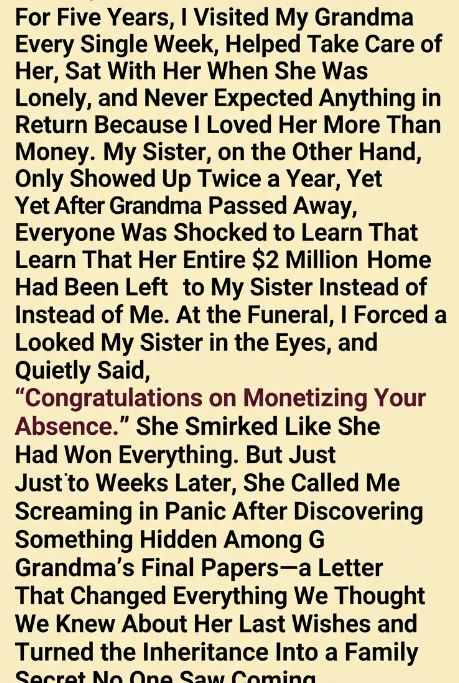
For the last five years of my grandmother’s life, every Saturday belonged to her.
I’d arrive around nine in the morning with groceries, fresh flowers, and whatever mystery novel she wanted me to borrow from the library.
We’d drink tea.
I’d mow the lawn.
Replace light bulbs.
Drive her to doctor’s appointments.
Sometimes we’d simply sit on the porch for hours while she told me stories about growing up during harder times.
She always apologized for “being a burden.”
She never was.
She was my favorite person in the world.
My younger sister, Nicole, had a different relationship with Grandma.
She visited twice a year.
Christmas.
And Grandma’s birthday.
Every visit lasted just long enough for a few photographs that inevitably appeared on social media with captions about “cherishing family.”
Grandma never complained.
If I mentioned it, she’d simply smile.
“People love differently.”
I wasn’t so sure.
Still, I never expected anything in return.
Not money.
Not property.
Not even recognition.
Helping Grandma wasn’t an investment.
It was love.
When she passed away peacefully at ninety-one, I thought the hardest part would be saying goodbye.
I was wrong.
A week after the funeral, the attorney gathered the family to read the will.
Most of the estate was straightforward.
A few charities.
Some jewelry.
Personal keepsakes.
Then came the house.
The family home.
A beautiful Victorian property that had recently been appraised at just over $2 million.
The attorney adjusted his glasses.
“I leave my residence to my granddaughter, Nicole.”
The room fell silent.
My sister gasped.
Then burst into tears.
Mom hugged her.
Dad smiled proudly.
I simply stared at the floor.
The attorney continued reading, but I barely heard another word.
Afterward, relatives surrounded Nicole with congratulations.
Someone whispered,
“Grandma always knew who deserved it.”
That hurt more than I expected.
As everyone prepared to leave, Nicole walked over wearing the smile of someone who believed she’d won.
“You okay?”
I forced one of my own.
“Of course.”
Then I quietly said,
“Congratulations on monetizing your absence.”
Her smile faltered.
“What does that mean?”
“You’ll figure it out.”
I walked away.
That night, I cried.
Not because I wanted the house.
Because I wondered if I’d misunderstood everything.
Had all those Saturdays meant so little?
Had Grandma secretly loved Nicole more?
Two weeks later, my phone rang.
Nicole.
She was hysterical.
“You have to come over.”
“I’m busy.”
“Please.”
“There are lawyers here.”
“They’re asking questions.”
I drove to Grandma’s house.
Nicole met me at the door, pale and shaking.
“The attic.”
“What about it?”
“Come see.”
Inside, several boxes sat open on the dining room table.
While cleaning the attic, Nicole had found an old cedar chest tucked behind insulation.
Inside were family photo albums, journals, and one large envelope marked:
To be opened only after my house belongs to Nicole.
The attorney carefully unfolded the letter.
Grandma’s handwriting was unmistakable.
My dear family,
If you’re reading this, then my plan worked exactly as I intended.
Nicole, I left you this house because I knew you valued it.
Your sister never did.
She valued me.
Everyone looked at me.
The attorney continued reading.
During the past five years, your sister never once asked me about my estate.
She never hinted about inheritance.
She simply showed up.
Every week.
She gave me something money can never buy.
Time.
Nicole lowered her head.
The next paragraph stunned everyone.
The house is yours only if you choose to keep it.
But before making that decision, there is something you should know.
Twenty years ago, I placed nearly all my financial investments into a family trust.
The trust is not mentioned in this will because it transfers outside probate.
Its primary beneficiary is…
the granddaughter who cared for me without expecting reward.
The attorney looked directly at me.
Then opened another sealed envelope.
Inside was the trust documentation.
Grandma hadn’t left me the house.
She had left me the trust.
Its value exceeded $6.4 million.
The room became completely silent.
Nicole looked at me with tears streaming down her face.
“I didn’t know.”
“I believe you.”
The letter wasn’t finished.
Nicole,
Houses can be sold.
Money can disappear.
But I wanted you to spend at least two weeks believing you had received everything.
Long enough to ask yourself one important question:
Why wasn’t visiting me enough when I was alive?
Nicole began sobbing.
For the first time, she truly understood what Grandma had been trying to teach.
A month later, she asked if we could have coffee.
“I’ve been angry at myself.”
“I know.”
“I kept thinking there would always be more time.”
“There usually isn’t.”
She nodded.
“I’m sorry.”
“I wasn’t there.”
“No,” I answered gently.
“You weren’t.”
“But you are now.”
Over the next year, Nicole surprised everyone.
She sold the house.
Not because she had to.
Because she wanted to.
She donated a portion of the proceeds to a senior companionship program that matched volunteers with elderly people who had no nearby family.
She said she never wanted another grandmother to spend years waiting for visits that never came.
As for my inheritance, I used part of the trust to establish a foundation in Grandma’s name that provided free transportation and home support for older adults who wished to remain independent.
Every Saturday, I still visit someone.
Not because I have to.
Because Grandma taught me that showing up is one of the purest forms of love.
People often think an inheritance is measured in dollars.
Mine wasn’t.
The greatest thing my grandmother ever left me wasn’t a trust worth millions.
It was the certainty that the time we give the people we love is never wasted.
And sometimes…
The most valuable legacy isn’t hidden in a house.
It’s hidden in the life someone quietly watched you live.