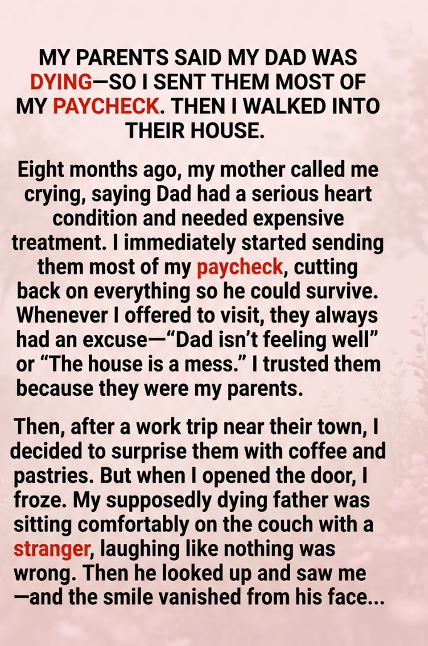
Eight months ago, my mother called me crying.
Not just crying.
She was sobbing so hard that I could barely understand her.
“Mom?”
“It’s your father.”
My heart dropped.
“What happened?”
“He’s sick.”
“How sick?”
She was silent for several seconds.
Then she whispered,
“The doctors found something wrong with his heart.”
I stood up from my desk at work.
“What do you mean?”
“He needs treatment.”
“What kind?”
“Expensive treatment.”
I asked how much.
She gave me a number that made my stomach turn.
They needed thousands of dollars immediately.
My parents had never asked me for money before.
They lived modestly.
They weren’t wealthy.
But they had always managed.
So I didn’t hesitate.
“Tell me where to send it.”
My mother started crying harder.
“Are you sure?”
“Of course.”
“He’s your father.”
“I know.”
That was how it started.
The first month, I sent almost half my paycheck.
The second month, even more.
By the third month, I was barely paying my own bills.
I stopped eating lunch at work.
I canceled a weekend trip.
I delayed replacing my broken laptop.
I even borrowed money from my savings account.
Whenever my mother called, I asked about Dad.
“How is he?”
“Not good.”
“Is he seeing the specialist?”
“Yes.”
“Does he need anything else?”
“We’ll let you know.”
I kept sending money.
Month after month.
My coworkers noticed.
One asked me,
“Are you okay?”
I smiled.
“My dad is sick.”
They immediately stopped asking questions.
Because everyone understands that family comes first.
At least, that’s what I believed.
Whenever I offered to visit, my mother found a reason not to let me.
“Dad isn’t feeling well.”
“Maybe next month.”
“The house is a mess.”
“He’s sleeping.”
“Don’t come yet.”
I thought they were protecting me from seeing my father sick.
So I accepted it.
I trusted them.
They were my parents.
Eight months passed.
Then my company sent me on a work trip.
The client was only forty minutes from my parents’ town.
I finished the meeting early.
I looked at the clock.
It was 10:30 a.m.
I smiled.
I decided to surprise them.
I stopped at a bakery.
I bought coffee.
I bought my father’s favorite cinnamon pastries.
For the first time in months, I felt excited.
I parked outside their house.
The curtains were open.
I smiled.
I picked up the coffee.
Walked to the front door.
And knocked.
No answer.
I knocked again.
Still nothing.
I tried the handle.
It opened.
“Mom?”
Nothing.
I stepped inside.
Then I heard laughter.
Male laughter.
My father’s laughter.
I froze.
It wasn’t the weak voice I’d heard on the phone.
It wasn’t someone struggling to breathe.
It was loud.
Healthy.
Happy.
I walked toward the living room.
And there he was.
My supposedly dying father was sitting comfortably on the couch.
He was wearing jeans and a sweater.
He looked completely healthy.
Beside him sat a man I’d never seen before.
They were laughing.
My father looked up.
The smile vanished from his face.
The stranger stood.
My mother came rushing into the room.
“Why are you here?”
I stared at her.
“I wanted to surprise you.”
She went pale.
I looked at my father.
“Dad?”
He said nothing.
I held up the coffee.
“I brought you cinnamon pastries.”
No one moved.
I put the bag down.
“What is going on?”
My father looked at the stranger.
The stranger looked at my mother.
Then my father finally spoke.
“You shouldn’t have come.”
Those words hurt more than anything.
I laughed because I couldn’t believe what I was hearing.
“I shouldn’t have come?”
My voice shook.
“I’ve been sending you most of my paycheck for eight months.”
My mother started crying.
“I know.”
“For what?”
My father looked down.
“Treatment.”
“What treatment?”
Silence.
I stepped closer.
“Show me your medical records.”
My mother whispered,
“Please.”
“No.”
I looked at my father.
“You told me you were dying.”
“I said I had a heart condition.”
“You told me you needed thousands of dollars.”
“I did.”
“For what?”
He didn’t answer.
I turned to the stranger.
“Who are you?”
The man swallowed.
“My name is Robert.”
“What are you doing here?”
He looked uncomfortable.
“I think you deserve to know.”
My mother snapped,
“Robert, don’t.”
I stared at her.
“Don’t what?”
Robert looked at my father.
Then he said,
“Your father isn’t sick.”
My stomach dropped.
I looked at my father.
He closed his eyes.
The room went silent.
I whispered,
“How much did you send me?”
My mother started crying.
“How much?”
She finally said,
“Almost forty-six thousand dollars.”
I felt like the floor disappeared.
Forty-six thousand.
That was almost everything I’d saved.
I stared at my father.
“Where is it?”
He didn’t answer.
“Where is my money?”
My father whispered,
“It’s gone.”
I felt numb.
“Gone where?”
Robert stepped forward.
“Your father gave most of it to me.”
I turned toward him.
“Why?”
Robert looked at the floor.
“Because I was blackmailing him.”
My breath caught.
“What?”
My father stood.
“Robert, stop.”
“No.”
Robert looked at me.
“You’ve been lied to for eight months.”
He pulled out a folder.
“I think you need to know why.”
Inside were photographs.
Bank statements.
Emails.
Legal documents.
And something else.
A marriage certificate.
I stared at the name.
Robert Hale.
My father’s name.
They weren’t business partners.
They weren’t friends.
They were brothers.
Half-brothers.
I looked at my father.
“You have a brother?”
He nodded.
“I never knew.”
“I know.”
“Why?”
He didn’t answer.
Robert did.
“Because your grandfather didn’t want him known.”
I sat down.
Robert explained that my grandfather had a second family.
My father’s mother had been his first wife.
Robert’s mother was another woman.
When the affair became public, my grandfather abandoned Robert and his mother.
My father grew up believing Robert was the reason his family had fallen apart.
He hated him.
But years later, Robert came back.
Not for revenge.
At least not initially.
He came back because his mother was dying.
She had evidence that their father had stolen money from her.
She wanted Robert to expose him.
But their father had already died.
The documents eventually ended up with Robert.
And those documents revealed something shocking.
My father had inherited more than he admitted.
A secret account.
A property.
And shares in a company.
My father had hidden the assets from everyone.
Including me.
Robert discovered them.
Then he confronted my father.
“Give me what my mother was owed.”
My father refused.
Robert threatened to expose him.
That’s when things got ugly.
My father began taking money from the secret account.
But eventually, he ran out.
So he invented the heart condition.
He called me.
He told me he was dying.
And he asked for money.
I stared at him.
“Did you ever even go to a hospital?”
He shook his head.
“No.”
“Did you take medication?”
“No.”
“Did you have a heart condition at all?”
He looked at me.
“Yes.”
“What?”
He placed his hand on his chest.
“I have high blood pressure.”
I almost laughed.
“You turned high blood pressure into a terminal illness?”
My mother cried.
“We didn’t know what else to do.”
“You didn’t know what else to do?”
I stood.
“You could have asked me for help.”
“We were ashamed.”
“No.”
I shook my head.
“You were greedy.”
My father looked away.
Then Robert said something that stopped me.
“There’s another reason you need to see the documents.”
He opened the folder.
Inside was a copy of a life-insurance policy.
My name was listed as the beneficiary.
My stomach turned.
“Why is my name on this?”
My father stared at me.
“I took out a policy years ago.”
“For how much?”
“$500,000.”
I looked at the date.
It had been taken out shortly after I graduated college.
“Why?”
He didn’t answer.
Robert said,
“Your father planned to disappear.”
I looked at him.
“What?”
“He was going to move away.”
“Where?”
“Another state.”
“Why?”
“Because he was drowning in debt.”
My father’s face collapsed.
He had accumulated gambling debts.
Credit-card debt.
Private loans.
And unpaid business obligations.
The $46,000 I’d sent wasn’t paying for medical treatment.
It was paying creditors.
My father had been using my money to keep himself from financial collapse.
But the worst discovery came next.
Robert handed me another document.
It was a legal agreement.
My father had attempted to transfer ownership of my childhood home to himself.
I stared at it.
“That house belongs to Mom.”
My mother shook her head.
“He tried.”
“Why?”
“Because he owed people money.”
I looked at her.
“And you helped him?”
She began crying.
“I was afraid.”
“Of him?”
She nodded.
That was the moment everything changed.
My mother hadn’t invented the lie.
But she had helped maintain it.
She had watched me sacrifice my life.
She had watched me skip meals.
She had watched me empty my savings.
And she had said nothing.
I felt betrayed by both of them.
I stood.
“I want my money back.”
My father looked at me.
“I can’t.”
“Then sell the house.”
He went silent.
I turned toward my mother.
“You’re going to need to decide whether you’re staying with him.”
She looked at me.
“I don’t know anymore.”
I left.
I didn’t speak to them for three weeks.
Then I received a letter.
It was from my mother.
She had finally told me everything.
My father had been hiding debt for years.
She had discovered it six months before the first phone call.
He told her that if the debts weren’t paid, they would lose the house.
Then he came up with the story about the heart condition.
She agreed because she was terrified.
But as the months passed, she became trapped in the lie.
Every time she wanted to tell me, my father threatened to leave.
So she kept quiet.
I didn’t forgive her immediately.
I don’t think I could.
But I eventually understood something.
Fear can make people participate in things they never would have chosen freely.
That doesn’t excuse it.
It explains it.
My father eventually sold the house.
The proceeds covered most of what he owed.
He also sold the car.
He surrendered the insurance policy.
The remaining assets were divided through legal proceedings.
I recovered almost all of the money I’d sent.
Not because my father suddenly became generous.
Because the documents forced him to repay it.
Robert also gave up his claim to the old inheritance.
He said he didn’t want money from a family that had spent decades fighting over it.
“I just wanted the truth,” he told me.
I believed him.
Months later, I met my mother for coffee.
She looked older.
Much older.
“I miss you,” she said.
“I miss you too.”
“I know you may never forgive me.”
“I don’t know.”
She nodded.
“I understand.”
I reached across the table.
“But I don’t want to hate you.”
Tears filled her eyes.
“I don’t want to lose you.”
“I don’t want to lose you either.”
We sat quietly.
Then she said,
“Your father wasn’t the only thing I lied about.”
I looked up.
“What else?”
She reached into her purse.
She pulled out a photograph.
It was old.
A picture of me as a child.
My father was holding me.
My mother stood beside him.
But there was someone else in the background.
Robert.
I stared.
“When was this?”
“The year you were five.”
“Why was he there?”
My mother smiled sadly.
“He came to meet you.”
I looked at her.
“I don’t remember.”
“You were too young.”
“Did Dad know?”
“Yes.”
“Then why did he say I had no uncle?”
“Because he was ashamed.”
I looked at the photograph again.
For years, I had believed my family was simple.
Two parents.
One child.
A normal childhood.
But beneath that ordinary life were secrets, debts, fear, and resentment.
And somehow, after everything, I had one person I never expected to have.
An uncle.
Robert.
We stayed in contact.
He told me stories about my grandfather.
Some were ugly.
Some were funny.
Some made me angry.
But they were part of my history.
And I realized that knowing the truth—even an ugly truth—is better than living inside a beautiful lie.
My father and I never returned to the relationship we had before.
I visited him once.
He looked smaller.
Older.
He apologized.
Not for the money.
Not even for the lie.
For teaching me that love meant sacrificing myself for people who wouldn’t sacrifice anything for me.
I told him,
“I hope you get better.”
He nodded.
“Thank you.”
I stood to leave.
Then he said,
“I’m sorry.”
I paused.
For the first time, I believed he meant it.
I didn’t hug him.
I wasn’t ready.
But I didn’t slam the door either.
Sometimes forgiveness isn’t a dramatic moment.
Sometimes it’s simply deciding not to carry the anger everywhere you go.
A year after the incident, I visited my mother again.
She had moved into a small apartment.
She was working part-time.
My father was living elsewhere.
She had finally separated from him.
We sat together on the balcony.
She looked at me.
“Do you remember the coffee and pastries?”
I laughed.
“How could I forget?”
She smiled.
“I thought that was the day everything would end.”
I looked at her.
“It was.”
She frowned.
“What?”
“The family we thought we were.”
I took her hand.
“But maybe that wasn’t the end.”
She squeezed it.
“No.”
“It was the beginning of something honest.”
And that was the strange thing about betrayal.
It doesn’t always destroy everything.
Sometimes it destroys the lie that was holding everything together.
My parents told me my father was dying.
I believed them.
I gave them most of my paycheck.
I sacrificed my savings.
I gave up things I wanted.
I did it because I thought I was saving my father.
But when I opened that door and saw him laughing on the couch, I realized something I’d never forget:
I wasn’t saving my father.
I was financing a lie.
And the stranger sitting beside him that day wasn’t just a stranger.
He was the brother my father had hidden.
The man who knew the truth.
The man who finally gave me the evidence.
The man who helped me understand what my parents had spent eight months trying to hide.
I thought that day would be the day I lost my family.
Instead, it became the day I finally discovered the truth about it.
And sometimes, painful as it is, the truth is the first place real healing can begin.