Mrs. Eleanor Hayes had been teaching physics for twenty-three years.
She had seen every kind of student.
The brilliant ones.
The lazy ones.
The ones who asked questions.
The ones who slept through class.
And the ones who convinced themselves they were incapable before they had even tried.
One of those students was seventeen-year-old Lucas Bennett.
Lucas was failing physics.
Badly.
His grades were usually somewhere between 35 and 45 percent.
He rarely completed homework.
He almost never studied.
And whenever Eleanor asked him why, he shrugged.
“Physics isn’t my thing.”
She had heard that excuse hundreds of times.
But something about Lucas bothered her.
He wasn’t disruptive.
He wasn’t disrespectful.
He simply seemed absent.
His body was in the classroom.
His mind was somewhere else.
One Thursday evening, Eleanor stayed late to finish grading exams.
The school was almost completely empty.
Rain tapped against the classroom windows.
She picked up Lucas’s paper.
His score was terrible.
Thirty-eight percent.
She sighed.
“Come on, Lucas.”
She turned to the final page.
There was a blank space beneath the last question.
And in that blank space, written in hurried handwriting, were seven words:
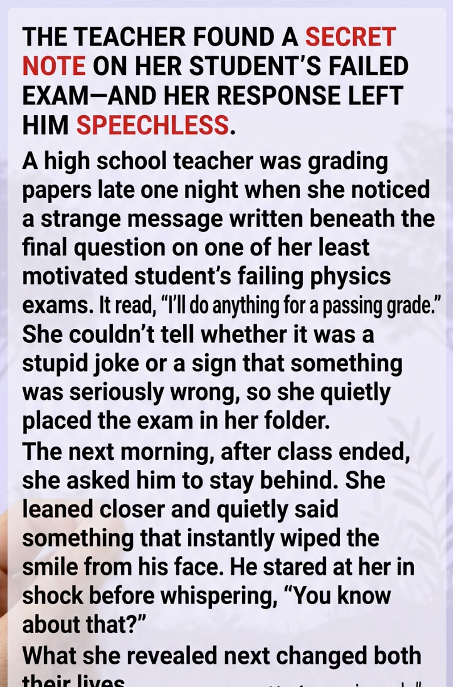
“I’ll do anything for a passing grade.”
Eleanor stared at it.
At first, she thought it was a joke.
Maybe an immature attempt at flirting.
Maybe a desperate student’s attempt at humor.
But she looked at the rest of Lucas’s exam.
His answers were unusually careless.
Some questions he’d clearly understood.
Others he had left blank.
That wasn’t normal for him.
He usually knew at least some of the material.
She picked up a red pen.
Then stopped.
She didn’t write anything.
Instead, she placed the exam inside her folder.
The next morning, after class, she said,
“Lucas, stay behind.”
He looked nervous.
“Am I in trouble?”
“Not yet.”
The other students left.
Lucas packed his backpack slowly.
Finally, he looked up.
“What?”
Eleanor closed the classroom door.
She placed his exam on the desk.
He saw the note.
His face changed.
“I can explain.”
“I hope you will.”
He looked down.
“I was joking.”
“Were you?”
“Yes.”
She waited.
Lucas shifted uncomfortably.
Then Eleanor said quietly,
“Your father didn’t come home last night, did he?”
The smile disappeared from his face.
He stared at her.
“You know about that?”
Eleanor nodded.
Lucas’s face went pale.
“How?”
She didn’t answer immediately.
Instead, she said,
“I’ve seen you checking your phone every few minutes during class.”
Lucas looked away.
“And I’ve noticed you’ve been wearing the same clothes for several days.”
His eyes filled with tears.
“I’ve been worried about you.”
Lucas sat down.
For several seconds, he said nothing.
Then he whispered,
“My dad left.”
“Left where?”
“I don’t know.”
“When?”
“Two weeks ago.”
Eleanor sat beside him.
“Why didn’t you tell someone?”
Lucas laughed bitterly.
“Who?”
“Your mother?”
“She died.”
Eleanor’s expression softened.
“I’m sorry.”
Lucas nodded.
“My dad lost his job.”
“What happened?”
“He started drinking.”
Lucas stared at the floor.
“He got angry all the time.”
“Did he hurt you?”
Lucas shook his head.
“Not really.”
Eleanor looked at him carefully.
“What does ‘not really’ mean?”
He didn’t answer.
That was enough.
She contacted the school counselor.
They arranged for Lucas to speak privately with a social worker.
But the story became more complicated.
Lucas wasn’t living with his father anymore.
He had been sleeping in the back room of an abandoned auto shop.
He had been eating whatever food he could find.
And he’d been hiding it because he was terrified that social services would separate him from his father.
Eleanor felt sick.
“You should never have had to handle this alone.”
Lucas shrugged.
“I didn’t know what else to do.”
Then he said something that broke her heart.
“I thought if I passed physics, maybe I could get a scholarship.”
“A scholarship?”
“My mom wanted me to go to college.”
“What did she want you to study?”
“Engineering.”
Eleanor looked at him.
“You still can.”
Lucas laughed.
“I’m failing physics.”
“That can change.”
“How?”
“By starting with one problem.”
She pointed to his exam.
“This one.”
Lucas looked at her.
“What?”
“You don’t need to fix your whole life today.”
She slid the paper toward him.
“You need to solve one problem.”
He stared at the equation.
Then he smiled faintly.
“I don’t understand it.”
“Good.”
“Good?”
“Now we know where to start.”
That became their routine.
Every morning before class, Lucas came to her room.
They worked through physics problems.
Then chemistry.
Then mathematics.
Eleanor also made sure he ate breakfast.
The school counselor helped him obtain temporary housing.
A local family agreed to become his foster placement.
Lucas slowly stabilized.
His grades improved.
Thirty-eight became fifty-two.
Fifty-two became sixty-four.
Then seventy.
By the end of the semester, he passed physics.
But Eleanor still wondered about the note.
One afternoon, she asked him.
“Why did you write that?”
Lucas smiled.
“I was desperate.”
“You thought I’d give you a passing grade?”
“I didn’t know.”
“What were you hoping I’d do?”
He looked down.
“Anything.”
“Why?”
“Because I thought failing meant my life was over.”
Eleanor shook her head.
“Grades don’t determine whether your life is worth living.”
He nodded.
“I know that now.”
But the story didn’t end there.
Three months later, Lucas’s father was found.
He was living in another town.
He was alive.
But he was deeply ill.
Lucas wanted to visit him.
Eleanor encouraged him to do so with a counselor present.
During the visit, Lucas learned something he had never known.
His father hadn’t abandoned him because he didn’t care.
He had been ashamed.
He’d lost his job.
Then he’d lost his home.
He believed Lucas would be better off without him.
That didn’t excuse leaving.
But it explained it.
Lucas eventually forgave him.
Not immediately.
But slowly.
His father entered treatment.
Lucas continued school.
Then came graduation.
Eleanor sat in the audience.
When Lucas’s name was called, he walked across the stage.
He had graduated near the top of his class.
He had received a scholarship to study mechanical engineering.
After the ceremony, he approached Eleanor.
“I have something for you.”
He handed her a small framed piece of paper.
It was the same physics exam.
The final question was still there.
But beneath it, Lucas had written something new.
“I don’t need a passing grade anymore.”
Underneath that:
“I just needed someone to believe I could pass.”
Eleanor’s eyes filled with tears.
“You did this.”
Lucas smiled.
“You showed me how.”
Years later, Lucas returned to the school.
Eleanor was still teaching.
He walked into her classroom wearing an engineer’s badge.
She recognized him immediately.
“Lucas?”
He smiled.
“Hi, Mrs. Hayes.”
She hugged him.
“I heard you were doing well.”
“I am.”
“What are you working on?”
He opened his laptop.
“A low-cost cooling system for temporary shelters.”
Eleanor smiled.
“Why?”
“Because people shouldn’t have to sleep in abandoned buildings just because life went wrong.”
She stared at him.
“You remembered.”
“Remembered what?”
“Your own story.”
Lucas nodded.
“That’s why I built it.”
He looked around the classroom.
“I used to think physics was the reason I was failing.”
“And now?”
“Now I think physics is the reason I survived.”
She laughed.
“That doesn’t make any sense.”
“It does to me.”
He pointed to the whiteboard.
“You taught me something.”
“What?”
“When everything feels impossible, break it into smaller problems.”
Eleanor smiled.
“That sounds like physics.”
“No.”
Lucas shook his head.
“That’s life.”
Then he reached into his pocket.
He pulled out the original note.
The one he’d written years earlier.
He had kept it.
Eleanor looked at the words.
I’ll do anything for a passing grade.
Lucas smiled.
“I thought this was the most embarrassing thing I’d ever written.”
“It was.”
He laughed.
“But I’m glad you found it.”
“Why?”
“Because you didn’t punish me.”
Eleanor shook her head.
“You were never asking for a grade.”
He looked at her.
“You were asking for help.”
Lucas nodded.
“And you heard me.”
They stood there quietly.
Then he said,
“You know what I tell engineering students now?”
“What?”
“Never assume a failed test means a failed person.”
Eleanor smiled.
“That’s a good lesson.”
Lucas looked at the old classroom.
“It saved my life.”
And that was why Eleanor never forgot the strange note on the bottom of a failing exam.
It wasn’t a bribe.
It wasn’t a joke.
It wasn’t even really about physics.
It was a seventeen-year-old boy quietly saying:
“I don’t know how to ask for help.”
And sometimes, the most important thing a teacher can teach isn’t found in a textbook.
Sometimes it’s simply recognizing when a student isn’t failing a subject.
They’re struggling to survive.
And instead of asking,
“Why aren’t you doing better?”
someone finally asks,
“What happened to you?”
That one question can change everything.