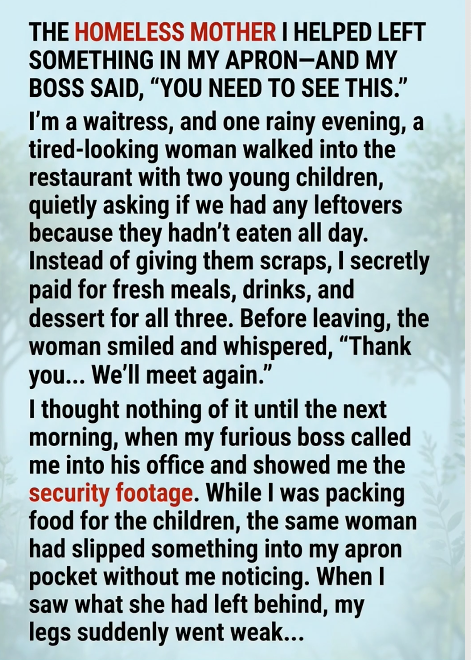
I was working the late shift when she walked into the restaurant.
It was raining so hard that the windows were fogged.
The streets outside were almost empty.
I was wiping down a table when I noticed a woman standing near the entrance.
She looked exhausted.
Her clothes were soaked.
Her hair was dripping.
And she had two young children holding onto her coat.
One boy was maybe seven.
The girl couldn’t have been more than five.
They looked cold.
Hungry.
Terrified.
The woman approached me slowly.
“Excuse me.”
I smiled.
“Can I help you?”
She looked toward the kitchen.
“Do you have any leftovers?”
I knew exactly what she meant.
“Food that’s going to be thrown away?”
She nodded.
“My children haven’t eaten all day.”
I looked at the kids.
The little girl was staring at the bread basket on another table.
My heart broke.
“Wait here.”
I walked to the kitchen.
The chef was preparing closing orders.
I took out my wallet.
“Can I get three meals?”
The chef looked at me.
“For them?”
I nodded.
“Fresh meals.”
I ordered chicken, rice, vegetables, drinks, and dessert.
I paid myself.
When I brought the food out, the children stared at the plates.
The boy whispered,
“Is this really for us?”
“Yes.”
The little girl smiled.
The mother covered her mouth.
“You don’t have to do this.”
“I know.”
“Thank you.”
“Please eat.”
They did.
The children ate quickly at first.
Then slowly.
Then the little girl began smiling.
She ate her dessert with a tiny plastic spoon.
The mother barely touched her own food.
She kept watching her children.
I pushed my plate toward her.
“Eat.”
She shook her head.
“I can’t.”
“You can.”
She finally took a bite.
After they finished, she stood.
“I don’t know how to repay you.”
“You don’t have to.”
She smiled.
Then she whispered,
“Thank you.”
She took her children’s hands.
Before leaving, she looked directly into my eyes.
“We’ll meet again.”
I smiled.
“Take care.”
She disappeared into the rain.
I thought that was the end.
It wasn’t.
The next morning, my boss called me into his office.
His name was Mr. Harris.
He was furious.
“Sit down.”
I sat.
He closed the door.
“You remember the woman from last night?”
“Yes.”
He turned his computer around.
“I want you to watch this.”
It was security footage.
I watched myself helping the woman.
I watched myself carry food.
I watched the children eat.
Then something happened.
While I was packing a container of food, the woman stepped behind me.
She reached toward my apron.
I didn’t notice.
She slipped something into my pocket.
Then she walked away.
I stared at the screen.
“What did she put in my apron?”
Mr. Harris looked at me.
“That’s what I want to know.”
I reached into my apron pocket.
My fingers touched something hard.
I pulled it out.
It was a small envelope.
My name was written on it.
Emily.
I froze.
My boss stared at me.
“Open it.”
My hands were shaking.
I opened the envelope.
Inside was a photograph.
I looked at it.
And my legs suddenly went weak.
It was a photograph of me.
As a little girl.
Maybe five years old.
I was sitting on a woman’s lap.
The woman was smiling.
I recognized her.
My mother.
But the photograph wasn’t the shocking part.
Behind us stood another woman.
The homeless mother from the restaurant.
Only she wasn’t homeless in the picture.
She was young.
Well-dressed.
And smiling.
I stared.
“What is this?”
Mr. Harris leaned closer.
“I don’t know.”
There was a note behind the photograph.
I unfolded it.
It said:
“You don’t remember me, but your mother saved my life.”
I read it again.
My heart began racing.
The woman had known my mother.
I called my mother immediately.
She answered.
“Emily?”
“Mom, I need to ask you something.”
“What happened?”
“Do you know a woman named Sarah?”
Silence.
My mother’s voice changed.
“Where did you hear that name?”
My stomach tightened.
“Who is she?”
My mother didn’t answer.
“Mom?”
Finally, she whispered,
“Where are you?”
“At work.”
“Is she there?”
“No.”
Another silence.
Then:
“You need to come home.”
I drove home immediately.
My mother was sitting at the kitchen table.
She looked frightened.
I placed the photograph in front of her.
She stared at it.
Then she began crying.
“You found her.”
I sat down.
“Who is she?”
My mother took a deep breath.
“Her name is Sarah Bennett.”
“What happened?”
My mother looked at the photograph.
“Twenty-six years ago, before you were born, I worked at a hospital.”
She explained that she had been a nurse.
One night, a young woman named Sarah was brought into the emergency room.
She was severely injured after an accident.
She had no identification.
No family nearby.
And no money.
My mother stayed with her.
She helped arrange treatment.
She contacted social services.
She even paid for Sarah’s medication.
Sarah eventually recovered.
But she disappeared shortly afterward.
“She never contacted you?”
“She tried.”
“What happened?”
My mother shook her head.
“Your father told me not to get involved.”
I frowned.
“Why?”
“He said Sarah was dangerous.”
“Was she?”
“No.”
My mother looked ashamed.
“She had witnessed something.”
“What?”
“Your father’s business partner had been stealing money from their company.”
My stomach tightened.
My father had died twelve years earlier.
I’d always believed he had been a successful businessman.
My mother continued.
“Sarah knew the truth.”
“She was a witness?”
“Yes.”
“And Dad?”
“He was involved.”
I stared at her.
“What do you mean?”
My mother began crying.
“Your father didn’t steal the money.”
She paused.
“He was trying to expose it.”
My heart raced.
“But someone threatened him.”
“Who?”
“His business partner.”
My mother told me that Sarah had been the only person who had seen the partner destroying financial records.
She had been threatened.
Then she disappeared.
My mother thought she had died.
But she hadn’t.
She had spent years moving from place to place.
Eventually, she lost everything.
And somehow, she ended up outside my restaurant.
I stared at the photograph.
“Why did she come to me?”
My mother shook her head.
“She must have recognized you.”
“How?”
“She knew you were my daughter.”
I remembered the woman’s words.
We’ll meet again.
My skin prickled.
“Mom…”
“What?”
“There’s something else.”
I showed her the note.
My mother read it.
Then she turned pale.
“What?”
“She says you saved her life.”
My mother nodded.
“I did.”
“But why would she leave me something?”
“I don’t know.”
I looked at the photograph again.
There was something written on the back.
I turned it over.
Three words.
“Your father knew.”
I stared.
My father knew Sarah survived.
My mother didn’t.
But why had he kept it secret?
The answer came the next day.
Sarah returned.
Not to the restaurant.
To my mother’s house.
I was there.
When she walked through the door, I barely recognized her.
She looked tired.
But her eyes were the same.
She smiled.
“You look exactly like her.”
“Like my mother?”
She nodded.
Then she handed me another envelope.
“This belonged to your father.”
I opened it.
Inside were bank records.
Photographs.
And a handwritten letter.
My father’s handwriting.
The letter was addressed to Sarah.
I know what they did.
I know you were threatened.
I know you had to disappear.
But if you ever find my daughter, tell her the truth.
I read the next line.
I didn’t betray you.
My hands shook.
Sarah whispered,
“Your father tried to protect me.”
“What happened?”
“He gave me evidence.”
“Evidence of what?”
“Your father’s business partner had been stealing millions.”
I stared at her.
“Did my father expose him?”
“He tried.”
Sarah shook her head.
“He was killed before he could.”
I felt numb.
My father had supposedly died of a heart attack.
But Sarah said something else.
“Your father didn’t die naturally.”
I looked at my mother.
She was crying.
“What are you saying?”
Sarah looked at me.
“I was there the night before he died.”
I couldn’t breathe.
“He gave me the evidence.”
“Then what happened?”
“I ran.”
“Why?”
“Because I knew they were coming for me too.”
My mother covered her face.
She had believed her husband died naturally.
For twelve years.
Now she was learning that his death might have been connected to the same conspiracy.
Sarah gave the evidence to a lawyer.
The investigation was reopened.
Financial records were uncovered.
Several former executives were questioned.
The business partner had already died, but investigators discovered that he’d been involved in fraud.
And the evidence my father had hidden helped expose the entire scheme.
But there was one more thing.
The lawyer found a trust.
My father had created it secretly.
For me.
He had put money aside for my future.
And there was a letter attached.
I opened it.
Emily,
If you are reading this, I probably never got the chance to explain.
I hope you grew up believing I loved you.
I did.
Everything I did was to keep you and your mother safe.
Sarah may someday find you.
If she does, don’t blame her.
She survived.
That is enough.
I cried.
My mother cried too.
Sarah stood quietly beside us.
Then I understood why she had come to the restaurant.
She hadn’t come for charity.
She had come because she had finally found the daughter of the woman who once saved her.
She had wanted to see me.
But she didn’t know how.
So she came as a stranger.
She watched me.
She waited.
And when I fed her children without asking questions, she knew I was the person her friend had raised me to be.
She slipped the photograph into my apron because she wanted me to discover the truth.
I looked at her.
“You could have just told me.”
She smiled sadly.
“I was afraid.”
“Of me?”
“No.”
“Then what?”
“That you’d look at me and see a homeless woman.”
I shook my head.
“I saw a mother who was hungry.”
Her eyes filled with tears.
“And that is exactly what your mother would have done.”
Years later, Sarah was no longer homeless.
The legal case helped her recover compensation from a settlement tied to the old fraud.
But she didn’t become wealthy.
She didn’t care.
She bought a small house.
She found work.
And she stayed in our lives.
My mother visited her every Sunday.
Sometimes I joined them.
The two women would sit in the garden and talk about the years they’d lost.
One afternoon, Sarah gave me the photograph again.
I looked at the younger version of her standing behind my mother.
Then I looked at myself.
“I still can’t believe you were the woman in the restaurant.”
She laughed.
“I can’t believe you gave me dessert.”
“You had children.”
“I know.”
She smiled.
“My daughter always had a soft heart.”
I laughed.
“I’m not your daughter.”
She looked at me.
“No.”
She touched the photograph.
“But your mother saved my life.”
Then she smiled.
“And you reminded me why.”
I still keep that photograph.
And sometimes I think about that rainy night.
A tired woman walked into a restaurant with two hungry children.
She asked for leftovers.
Instead, I gave her a fresh meal.
I thought I was simply being kind.
I had no idea she was carrying a photograph that connected our families.
I had no idea she knew my mother.
I had no idea my father had left behind a secret.
And I certainly had no idea that the woman everyone might have dismissed as homeless was carrying the final piece of a story my family had been hiding for decades.
My boss thought the object in my apron might be evidence of a crime.
Instead, it became evidence of something else.
That kindness has a way of finding its way back to you.
Sometimes not as money.
Not as recognition.
Not even as gratitude.
Sometimes it comes back as a person.
A person who walks through your door on a rainy night and quietly reminds you that the world is connected in ways you could never imagine.
And that night, when Sarah whispered,
“We’ll meet again,”
she wasn’t making a promise.
She was telling me the truth.
We weren’t strangers.
We had never really been strangers.
We were two pieces of the same family story.
And all it took to bring the missing piece home…
was one meal, one photograph, and a little kindness.